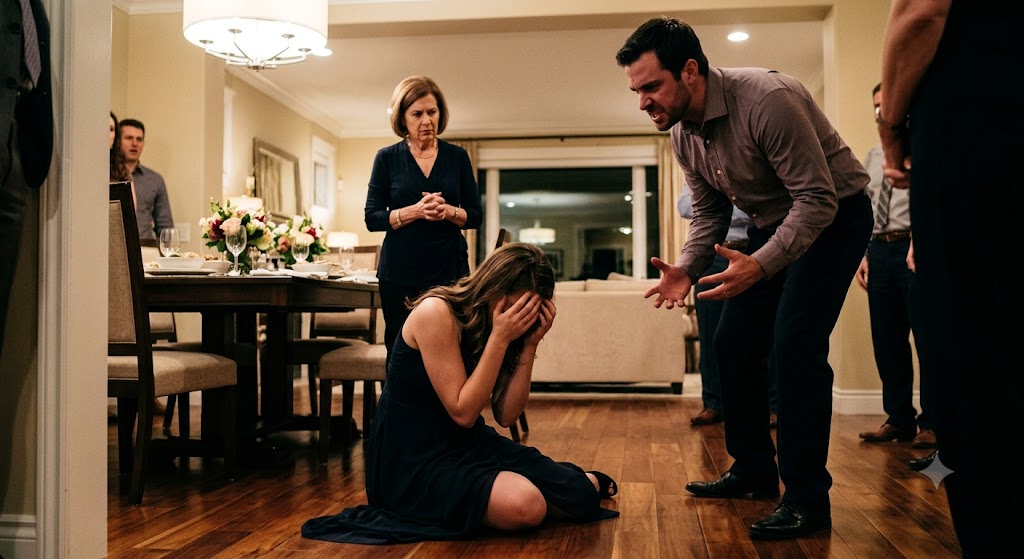
My mother-in-law raised her champagne glass, smiled at more than 600 guests, and said, “Let’s all appreciate Olivia’s courage. Not every bride is confident enough to wear white at her size. ”
The ballroom erupted in uncomfortable laughter. I felt every single eye in that room land on me at once.

I looked at my husband. He stood up. He removed his microphone. He walked toward the stage.
What he said next ended the reception before dinner was even served. My name is Olivia Bennett. I’m 30 years old, and I work as a pediatric nurse at a children’s hospital. It’s a job I’ve loved since day one, one that taught me how to stay calm under pressure and keep a warm expression on my face even when everything underneath it feels like it’s breaking apart.
That skill, it turns out, prepared me for far more in my personal life than I ever expected. To understand why that toast mattered so much, you have to understand how Daniel and I found each other in the first place. Daniel is 33, a civil engineer, quiet by nature in a way some people mistake for coldness until they get to know him. He isn’t someone who fills every silence with conversation.
He watches carefully, absorbs details other people miss, and speaks only when he has something worth saying. We met four years ago volunteering on the same weekend shift at the children’s hospital where I worked. He was helping build and repair play equipment in the pediatric recovery wing through a community outreach program his engineering firm sponsored. I noticed him before he ever noticed me, the careful, patient way he worked with the children, kneeling down to their eye level, never rushing, never treating the volunteer work as an obligation to check off a list.
Our relationship grew slowly, the way good things sometimes do when neither person is in a hurry to force something before it’s ready. We dated for almost two years before he proposed. Throughout that entire time, Daniel was consistently thoughtful, consistently loyal, exactly the kind of steady presence I had always hoped to build a life with. There was, however, one persistent shadow hanging over our relationship almost from the very beginning.
That shadow was Daniel’s mother, Margaret. Margaret is 61, elegant in the deliberate, curated way that takes considerable effort to maintain, deeply status conscious, someone who has spent decades carefully cultivating a specific image of her family within their social circle. She comes from a background considerably more affluent than my own. Daniel’s father built a successful architecture firm that placed the family firmly within a particular social tier in our city, one built around country club memberships, charity gala committees, and a network of relationships Margaret guarded with the same precision she applied to everything else.
I come from a much more modest background. My parents worked steady, unglamorous jobs, my father as an electrician, my mother managing a small local bakery. I grew up understanding the value of hard work without ever having access to the kind of social polish Margaret seemed to consider essential. From the very first time Daniel introduced us, I sensed, underneath her polite smile and carefully chosen words, a kind of quiet disapproval that had nothing to do with who I actually was as a person, and everything to do with where I had come from.
Margaret never openly attacked me directly. She was far too sophisticated, far too aware of appearances, to ever say something bluntly cruel in a way that might make her look bad to the people watching. Instead, she delivered what I eventually came to recognize as a very particular kind of insult, polite on its surface, sharp underneath, always delivered with a smile, and always framed in a way that made objecting to it feel unreasonable, even petty. “Oh, you’re brave wearing white,” she said once early in our engagement while helping select dress options.
Her tone light and conversational, as though she had simply offered an observation rather than an insult. Another time, during a family dinner where I had gone back for a second small helping of dessert, she remarked, smiling warmly at the other guests at the table, “You have such a healthy appetite. ” Her tone somehow managing to sound complimentary and cutting simultaneously. When I once expressed confidence about a work presentation I was proud of, she offered, almost as an aside, “I suppose confidence really is beautiful at any size.
” A comment that drew a few awkward, uncertain laughs from everyone else at the table. Laughter that existed in that strange, uncomfortable space between recognizing something was cruel and not wanting to be the one to call it out directly. Every single time the room would laugh, that particular nervous, uncertain laughter when people sense something is wrong but don’t feel equipped or entitled to challenge a respected, elegant, older woman in her own setting. Every single time I would smile along, too, swallowing whatever hurt those comments caused, telling myself it wasn’t worth the conflict, that Margaret was simply old-fashioned, that she would eventually warm up to me once she got to know me better.
Daniel, for his part, always defended me privately, immediately, in whatever way he could manage in the moment, usually a gentle correction or a change of subject, occasionally a firmer private word to his mother after we left a family gathering, but he rarely confronted her directly, openly, in front of others. Looking back now, I understand that this pattern, more than any single comment Margaret ever made, was the real source of harm accumulating quietly underneath our relationship for years. I want to be fair to Daniel here, because I think it matters, and because the eventual moment when he finally did speak up carries far more weight when you understand the years of silence that preceded it. He genuinely loved his mother, complicated as that love clearly was, and he genuinely struggled with the impossible position of feeling caught between two people he cared deeply about.
He told me more than once during those early years that confronting Margaret directly would only make things worse, that she would become defensive and dig in further, that the best strategy was simply to let her comments pass without giving them the satisfaction of a visible reaction. I believed him, mostly because I wanted to believe there was some strategic logic to enduring what I was enduring, some reason beyond simple avoidance that made staying quiet the right choice. Over the two years of our engagement, the pattern of subtle undermining continued, and if anything, gradually intensified as our wedding approached. Margaret accidentally ordered a dress for a bridal shower fitting in a size noticeably too small for me, insisting afterward that the boutique must have made an error with the measurements, an explanation that felt increasingly implausible given how many times similar accidents seemed to occur.
She excluded me more than once from carefully composed extended family photographs at gatherings, always with some reasonable-sounding explanation ready. The lighting wasn’t right. We needed to get just the family first, an oversight that would be corrected later, but somehow never quite was. She complimented Daniel’s college girlfriend whenever her name happened to come up in conversation with noticeably more warmth and enthusiasm than she ever extended towards me, mentioning her figure, her poise, her natural elegance, comparisons that felt anything but accidental given how consistently they occurred whenever I happened to be within earshot.
Whenever I gathered the courage to mention any of this to Daniel, he would gently ask me to try to ignore it, reminding me that his mother’s approval, however grudging, mattered for the sake of family peace, especially with the wedding approaching and so many logistics still requiring her considerable social connections and generous financial contribution to coordinate successfully. I agreed every single time because I loved him, because I told myself this was simply the price of joining a family with a complicated matriarch, and because, if I’m being completely honest, I had spent most of my life avoiding conflict whenever possible, a pattern that long predated Daniel or Margaret, and one I had never fully examined until everything came to a head in that ballroom. Our wedding day arrived after nearly two years of planning, an event that given Margaret’s social standing and considerable financial contribution towards the celebration grew far larger and more elaborate than either Daniel or I had originally envisioned for ourselves. Nearly 600 guests filled that grand ballroom downtown, extended family from both sides, close friends we’d known for years, but also a significant number of Margaret’s business associates, her charity committee colleagues, community leaders she had cultivated relationships with over decades, and several of Daniel’s father’s most important architectural clients.
It was, by any conventional measure, an impressive, beautiful event, the kind of wedding people would talk about for months afterward, though not ultimately for the reasons anyone initially expected. I remember standing at the entrance of that ballroom before the reception began, genuinely happy, genuinely excited. My nervousness about Margaret’s presence temporarily overshadowed by the simple joy of having just married the person I loved most in the world. Daniel looked at me throughout the ceremony with an expression I’ll never forget, steady and certain.
The kind of look that made every uncomfortable moment with his mother over the preceding two years feel in that instant like it had all been worth enduring for exactly this outcome. The reception unfolded beautifully at first. Dinner service was about to begin, and as tradition dictated for a family of Margaret’s social standing, she had specifically requested the opportunity to give a formal toast before the meal. An honor she had emphasized repeatedly throughout the planning process, insisting it mattered deeply to her to properly welcome me into the family in front of everyone who mattered most to them socially.
I remember feeling genuinely touched by that request in the weeks leading up to the wedding, allowing myself to hope, despite everything that had come before, that this moment might represent some kind of genuine turning point in our relationship. Margaret stood, elegant as always, in a deep emerald gown that perfectly matched the room’s decor, champagne glass raised gracefully, commanding the attention of the entire room with the practiced ease of someone accustomed to public speaking at countless charity galas over the years. She began warmly enough, mentioning how proud she was of Daniel, how much she had watched him grow into the successful, thoughtful man standing beside me, generating exactly the kind of appreciative murmurs and gentle laughter you’d expect from a proud mother’s toast at her son’s wedding. Then, still smiling that same warm, practiced smile, she turned her attention toward me.
“And I have to say,” she continued, her voice carrying easily through the ballroom’s excellent acoustics, “let’s all appreciate Olivia’s courage today. Not every bride is confident enough to wear white at her size. ”
For a long, suspended moment, the room seemed to hold its breath collectively, uncertain how to respond to something delivered with such polished, confident warmth that it took several seconds for the actual content of what she’d said to fully register with everyone listening. Then, exactly the way it had happened countless times before at smaller family gatherings, uncertain uncomfortable laughter began rippling through portions of the crowd, people unsure if they had genuinely just heard what they thought they’d heard, defaulting to laughter because laughter felt safer than the alternative of sitting in stunned, awkward silence.
I felt every single eye in that ballroom land on me at once. 600 guests, most of whom I barely knew, suddenly watching to see how I would respond to being humiliated by my own new mother-in-law on what was supposed to be one of the happiest days of my entire life. I felt heat rushing to my face, that particular, indescribable sensation of public humiliation I had experienced in smaller doses countless times previously, except magnified now by an audience of hundreds rather than the handful of family members who had previously witnessed similar comments. I looked at Daniel sitting beside me at the head table, searching his face for some indication of what to do next, some cue for how we were supposed to navigate this moment together in front of everyone watching.
He stood up. He didn’t stand abruptly or angrily. He rose slowly, deliberately, with the same calm, measured composure that defined nearly everything he did. He reached up and carefully removed the small lapel microphone he’d been wearing for his own upcoming toast later in the evening, and he began walking, unhurried, toward the small stage where his mother still stood, champagne glass now lowering slowly in her hand as she watched her son approach with an expression I couldn’t quite read.
The room, which had been filled with that nervous, uncertain laughter only moments ago, fell into complete, total silence as everyone realized something significant was happening, something that clearly hadn’t been part of the planned program for the evening. Daniel reached the stage and gently took the microphone from the stand Margaret had been using. “I’d like the microphone for a moment,” he said quietly, his voice carrying easily through the sound system despite how calmly he spoke. Margaret, visibly caught off guard, handed it over without protest, perhaps assuming in that initial moment that her son simply wanted to add some warm words of his own to compliment her toast.
He turned first, not to the audience, not to his mother, but directly to me, still standing near our table, and he said, simply and clearly enough for the microphone to carry across the entire silent ballroom, “I’m sorry. ”
Those two words landed with more weight than I could have anticipated, not because they explained anything yet, but because of how completely unexpected they were in that moment, how directly and publicly he was choosing to address me before addressing anyone else in that packed room. Then he turned to face the audience. “Some of you laughed a moment ago,” he began, his voice steady despite what I could see, even from a distance, was considerable emotion beneath the surface.
“Because you thought that was just a joke. I understand why. It was delivered like one. But it wasn’t a joke.
My wife has spent the last two years being criticized for her appearance repeatedly by someone who should have welcomed her into our family with open arms instead. ”
A wave of visible discomfort moved through the room, guests shifting in their seats, several exchanging quick, uncertain glances with the people beside them, clearly unprepared for the direction this speech was taking during what everyone had assumed was simply a wedding reception unfolding according to its expected script. “And I want to be honest about something,” Daniel continued, pausing for a moment before delivering what I still consider the single most important sentence of that entire evening. “The greatest failure in all of this wasn’t hers, it was mine.
I kept asking Olivia to ignore it, to let it go, to not make things difficult, instead of asking my own mother to simply stop. ”
I felt tears beginning to form standing there in my wedding dress in front of 600 people watching my husband publicly take accountability for a pattern of silence that had quietly shaped so much of our relationship over the past two years, a pattern I hadn’t even fully realized until hearing him name it so directly, so honestly, in front of everyone who mattered to our shared future. He continued, his voice gaining a quiet, steady strength as he went on. “Most of you don’t know some things about my wife that I think deserve to be said, especially tonight, especially after what just happened.
”
He paused, glancing briefly at me before continuing. “Olivia has spent the last year quietly organizing charity drives at the hospital where she works, coordinating donations for families who can’t afford basic medical supplies for their children. When my father needed extended care after his heart surgery two years ago, before Olivia and I were even officially engaged, she used her own vacation days, unpaid, to help coordinate his recovery schedule and sit with him during appointments my mother couldn’t always attend. When my mother herself needed help recovering from her hip surgery last year, Olivia was the one who drove across town every single week to check on her, to help with groceries, to make sure she had everything she needed, never once mentioning any of the comments she’d endured, never once bringing it up as some kind of leverage or complaint.
”
I watched Margaret’s expression shift as Daniel spoke. Something in her carefully composed elegance beginning to crack visibly under the accumulated weight of details she clearly hadn’t expected her son to share so publicly. Details that painted a picture of quiet generosity that stood in stark, undeniable contrast to the humiliation she had just delivered in front of everyone. “If kindness had a dress size,” Daniel said, his voice carrying a quiet intensity that silenced whatever remaining murmurs had continued rippling through the portions of the room, “this ballroom wouldn’t be big enough to measure it.
”
The silence that followed that particular line felt different from the earlier uncomfortable silence, heavier, more reflective, the kind of quiet that settles over a room when people are genuinely processing something rather than simply waiting awkwardly for an awkward moment to pass. I noticed, scattered throughout the crowd, several guests beginning to quietly wipe at their eyes, moved by something that had started as public humiliation and transformed through Daniel’s careful, deliberate words into something else entirely. Daniel wasn’t finished. He calmly handed the microphone back to the stand, then turned to face the room one final time.
“The woman standing beside me is my family now,” he said simply, his voice steady and clear. “If anyone here can’t respect her, they don’t have to stay for the rest of this celebration. I understand, and there won’t be any hard feelings, but I won’t stand here and pretend what just happened was acceptable, and I won’t ask my wife to smile through it the way I’ve let her smile through similar comments for the past two years. ”
There was no shouting in that room, no dramatic confrontation between mother and son playing out in front of everyone.
Instead, what followed was something quieter, more dignified, and in many ways more powerful precisely because of that restraint. Several relatives from Margaret’s side of the family, visibly uncomfortable, quietly gathered their belongings and left with Margaret within the next few minutes, Margaret herself walking out with her composure largely intact on the surface, though I noticed even from across the room a rigidity in her posture that suggested the calm exterior was costing her considerable effort to maintain. But the vast majority of our 600 guests remained exactly where they were, and gradually tentatively conversation began resuming around the room, quieter and more subdued than it had been before Margaret’s toast, but genuine, warm in a way that felt different from the polished, curated warmth that had characterized the reception up to that point. Several guests approached me individually throughout the remainder of the night, offering quiet, heartfelt words of support, a few even sharing similar experiences of their own with difficult in-laws, creating small, unexpected moments of connection I never would have anticipated on my wedding day.
The reception continued, and by the time Daniel and I shared our first dance later that evening, something had genuinely shifted between us. A kind of clarity and closeness that felt different, deeper somehow than what we had shared even earlier that same day during our ceremony. He held me close during that dance and quietly apologized again, this time more personally, away from the microphone and the watching crowd, telling me how deeply he regretted every previous moment he had asked me to simply endure her behavior instead of confronting it directly himself. In the days and weeks following the wedding, once we’d returned from a brief honeymoon we’d deliberately kept simple and low-key, given everything that had just unfolded, the fallout from that evening continued to develop in ways neither of us had fully anticipated.
Margaret, we later learned through Daniel’s aunt, had initially expected him to call within the first few days, assuming based on decades of the family dynamic she had carefully cultivated, that her son would eventually seek her out to smooth things over the way he always had before. This time, he didn’t call. Weeks passed in complete silence between them, a silence Daniel maintained not out of anger, he explained to me during that period, but out of a genuine, deliberate need to finally establish that his previous pattern of automatically smoothing things over without any real accountability was no longer something he was willing to continue. During those weeks of silence, something began happening within the broader family that neither Margaret nor, honestly, either of us had fully anticipated.
Several relatives who had witnessed that toast, people who had spent years quietly uncomfortable with Margaret’s pattern of polite insults but never felt entitled or safe enough to say anything themselves, began reaching out individually. First to Daniel, then eventually to me directly, expressing support and, in several cases, sharing their own long-held discomfort with comments they had witnessed Margaret make toward me and, in a few cases, toward other family members over the years. Daniel’s aunt, Margaret’s own younger sister, admitted during one particularly emotional phone call that she had always found her sister’s comments toward me deeply uncomfortable, but had never spoken up herself, worried about disrupting family harmony or becoming a target of similar treatment herself. A cousin of Daniel’s, someone I had only met briefly at a handful of family gatherings, sent a heartfelt message describing how she’d witnessed Margaret deliver nearly identical polite insults toward her own mother years earlier during a difficult period in their family.
Comments that had never been publicly confronted the way Daniel had finally chosen to confront them at our wedding. A pattern began emerging clearly, one that extended well beyond the specific comments directed at me, revealing that Margaret’s carefully cultivated elegance had for years concealed a consistent habit of using status and social polish as cover for genuinely undermining comments toward multiple people within her extended circle. Comments that were simply never challenged publicly or directly enough for any real accountability to follow. Margaret’s social standing, once built so carefully over decades of charity committee involvement and strategic relationship cultivation, began experiencing subtle but noticeable strain in the months following the wedding.
Word of what had happened at that reception, given the sheer number of guests present and the prominence of many attendees within the same social circles Margaret had spent years navigating, spread through those networks in ways that were impossible to fully control or contain. Several of the community leaders and business associates who had witnessed the toast firsthand began quietly distancing themselves from previous close social involvement with her, not through any dramatic public confrontation, but through the kind of gradual, quiet withdrawal that happens when people begin viewing someone through a genuinely different lens than they had before. I want to be clear that neither Daniel nor I actively sought to damage Margaret’s reputation or social standing during this period. We didn’t discuss what happened publicly beyond the people who directly asked us about it, didn’t post anything about it, didn’t encourage anyone to distance themselves from her.
The consequences she experienced emerged entirely from other people’s own independent reflection on a pattern of behavior that had simply finally become visible enough for them to recognize clearly, rather than dismissible as an isolated, out-of-character comment. About four months after the wedding, Margaret reached out to Daniel directly, requesting a meeting, specifically asking that it take place somewhere neutral rather than at either our home or hers, a small, quiet cafe not far from where she lived. Daniel discussed the request with me extensively before agreeing, and we decided together that I would join partway through the conversation, rather than being present from the beginning, giving Margaret and Daniel some space for an initial more private exchange before I entered the discussion directly. When I arrived at that cafe, roughly 30 minutes after their conversation had begun, I found Margaret looking noticeably different from the elegant, composed woman who had delivered that devastating toast months earlier.
She seemed smaller somehow, more genuinely vulnerable, none of the polished social armor she typically wore quite as firmly in place. She didn’t begin with excuses or justifications the way I had honestly expected based on years of watching her navigate difficult moments with practiced deflection. “I confused criticism with honesty,” she said quietly once I had settled into the seat beside Daniel, “and confused control with love. I’ve had a lot of time to think about that these past few months, more than I think I’ve genuinely reflected on my own behavior in longer than I care to admit.
”
She went on to describe, haltingly at times, a childhood shaped by her own mother’s relentless focus on appearance and social standing, a pattern she had absorbed so completely that she had genuinely convinced herself for years that pointing out perceived flaws in others, delivered with enough polish and apparent warmth, constituted a kind of helpful honesty rather than the quiet cruelty it actually represented. She admitted that her discomfort with my background, my modest upbringing, had genuinely factored into her initial disapproval of me far more than any concern about my appearance ever had, and that the comments about my weight had simply become the most socially acceptable outlet available to her for expressing a prejudice she wasn’t willing to examine or name directly even to herself. I listened to all of this carefully and I want to be honest that I didn’t offer instant forgiveness in that cafe despite how genuinely reflective and different she seemed compared to the woman I had known for the previous two years. Two years of accumulated hurt culminating in a humiliation delivered in front of 600 people isn’t something that dissolves simply because someone finally offers a sincere apology however genuine that apology might be.
I told her as gently and honestly as I could manage that I appreciated her willingness to reflect and to say these things directly but that rebuilding any real trust between us would require consistent behavior over time not simply a single well articulated conversation in a quiet cafe. Daniel made it clear during that same conversation in his characteristically calm but unmistakably firm way that he loved his mother and genuinely hoped for a healthier relationship moving forward but that this hope came with real conditions attached not simply a return to the previous dynamic where he absorbed and managed her behavior on everyone else’s behalf. He told her plainly that future family gatherings would require genuine respect toward me consistently not just in carefully managed public settings but in private family moments as well and that any return to the old pattern of polite insults disguised as jokes would result in real lasting distance rather than another round of quiet accommodation. Margaret accepted those conditions without argument something that genuinely surprised me given how resistant she had always seemed throughout our previous relationship to any suggestion that her behavior needed to change rather than simply be tolerated by everyone around her.
The months that followed that cafe conversation brought slow, genuine change. Though I want to be honest that it wasn’t instant or perfectly smooth. There were a few small missteps along the way an offhand comment here or there that Margaret herself caught and immediately corrected, apologizing directly rather than dismissing it as she once might have. Daniel and I established clear boundaries around family gatherings, deciding together that certain events would remain smaller and more private in the early stages of rebuilding trust, giving everyone involved space to adjust gradually rather than forcing an immediate return to the large, elaborate family functions Margaret had always favored.
Over time, something genuinely shifted in our relationship with her. She began slowly and somewhat awkwardly at first, actively seeking my input on family decisions rather than simply working around me the way she once had. She started attending some of my hospital’s charity events quietly, without fanfare, offering practical help rather than performative gestures designed primarily for social visibility. During a particularly difficult stretch, when my own mother faced a health scare, Margaret was among the first to reach out, offering genuine, specific help rather than the vague, distant sympathy I might have expected from her in the past.
I won’t pretend our relationship became effortlessly warm or that every trace of our difficult history simply disappeared. Some wariness remains, understandably, and I suspect it always will to some degree. But what exists between us now feels honest in a way our earlier relationship never did, built on actual mutual respect rather than the carefully performed politeness that had characterized those first two difficult years. Daniel and I, meanwhile, emerged from that entire experience with a marriage that felt, in many ways, stronger and more honestly built than it might have been if that toast had never happened at all.
I think often about how easily things could have gone differently that evening. How easily Daniel could have simply let the moment pass the way he had let so many similar pass before, offering me a private apology later rather than the public accountability he ultimately chose to deliver in front of everyone watching. I’ve thought a great deal in the time since about what actually made that moment so powerful, beyond the simple drama of a son publicly confronting his mother at his own wedding. I think it was the fact that Daniel didn’t attack Margaret, didn’t humiliate her the way she had humiliated me, didn’t turn that ballroom into a battleground of competing insults.
He simply told the truth clearly and directly and took genuine specific accountability for his own role in allowing a harmful pattern to continue unchallenged for far too long. That distinction between public shaming and honest accountability made all the difference in how that evening ultimately unfolded. And I believe it’s the same distinction that eventually allowed Margaret the space to genuinely reflect and change rather than simply becoming defensive and entrenched the way public humiliation so often produces instead. For years, I believed loving someone, especially someone connected to the person I loved most, meant keeping the peace, even when that peace came consistently at my own expense.
I told myself that avoiding conflict was a kind of strength, a form of grace under pressure, when in reality it had simply become a habit of quietly absorbing harm rather than addressing it honestly. But real peace, I’ve come to understand clearly in the years since that wedding, isn’t actually built on silence at all. It’s built on respect, on the willingness to name difficult truths, even when doing so feels uncomfortable, even when it risks disrupting the carefully managed harmony everyone else seems invested in maintaining. The day my mother-in-law tried to humiliate me in front of 600 people, my husband didn’t just defend me in some simple reflexive way.
He finally, fully chose the family we were actively creating together over the familiar, comfortable pattern of quiet accommodation he had maintained with his mother for his entire life up to that point. That moment taught me something I don’t think I’ll ever forget. Something I try to carry into every difficult relationship in my own life since. Love isn’t ultimately proven through grand wedding vows exchanged in front of an audience, however beautiful and meaningful those vows genuinely are in the moment.
It’s proven again and again through the quiet, difficult decisions people make when standing up for someone they love comes at a real personal cost. When doing the right thing means risking discomfort, disruption, even temporary estrangement from people who have always expected quiet compliance instead. Margaret and I will never have the relationship of two people who simply liked each other easily and effortlessly from the very beginning. What we have instead feels more honest, and in its own complicated way more meaningful, precisely because of everything it took to get here.
I think in the end, that’s a truer kind of family than the polished, carefully performed version I once assumed I needed to accept and endure quietly in order to belong.