I always thought I was the kind of guy who didn’t need recognition to do the right thing. I believed in family, in showing up, in being reliable, even when no one clapped for it. I helped quietly, expecting nothing in return. I was wrong about my family, and last month, on my birthday, they proved it.
My older brother, Greg, has always been the self-appointed family man. He wants praise for basic decency—help Dad change a tire once and he’ll bring it up every holiday. Meanwhile, I was just there. Always there.
I drove my sister’s drunk ex home at midnight. I canceled dates to watch my niece when Greg’s wife had a hospital emergency. I paid for repairs on my parents’ roof. I said nothing.
That was the problem. I didn’t say a word, and that silence made me invisible to them. Greg and I live about ten minutes apart. He has three kids, I have two.
My ex moved across the state years ago and barely sees our sons, so I’ve been raising them full-time while juggling work and school runs. Greg and his wife, on the other hand, fell behind on their mortgage multiple times, got their car repossessed once, and went through a string of failed side gigs. Each time, I helped. I covered their mortgage when the bank sent final notices.
I paid to get their minivan back so their kids could get to school. I sent anonymous money orders when their lights got shut off. When his car broke down for good, I offered to drive his kids along with mine every morning and afternoon. For almost two years, I was the school chauffeur—five days a week, rain or shine.
I never made a big deal out of it. Greg said thanks in passing, and that was enough for me. At least, I thought it was. The first hint that something was wrong came last Christmas.
Greg pulled me aside after dinner and said, “Hey, I noticed you didn’t bring anything for my kids this year. ”
I blinked, stunned. “I thought the Nintendo bundle I gave you guys last month was their present. ”
It had cost me almost five hundred dollars, and I’d installed it myself.
Greg just smirked. “Oh, right. I guess I thought that was more of a family thing. ”
I laughed it off because everyone was around.
I told myself he was tired, stressed, that he didn’t mean it the way it sounded. But after that, things started to feel different. My mom started making passive comments about how lucky I was to be single and not have to support a whole family like Greg. My sister said once that Greg deserved more support.
I wanted to scream—hadn’t I been supporting them all? Then came my birthday. My ten-year-old son had planned a dinner at an Italian place I love downtown. He even asked the staff to set up a projector for a slideshow of pictures he’d made.
We booked the back room and invited my parents, Greg and his wife, my sister, and a couple of cousins. Nothing fancy, just a family meal. The night started off fine. The slideshow made me tear up, and my son beamed when everyone clapped.
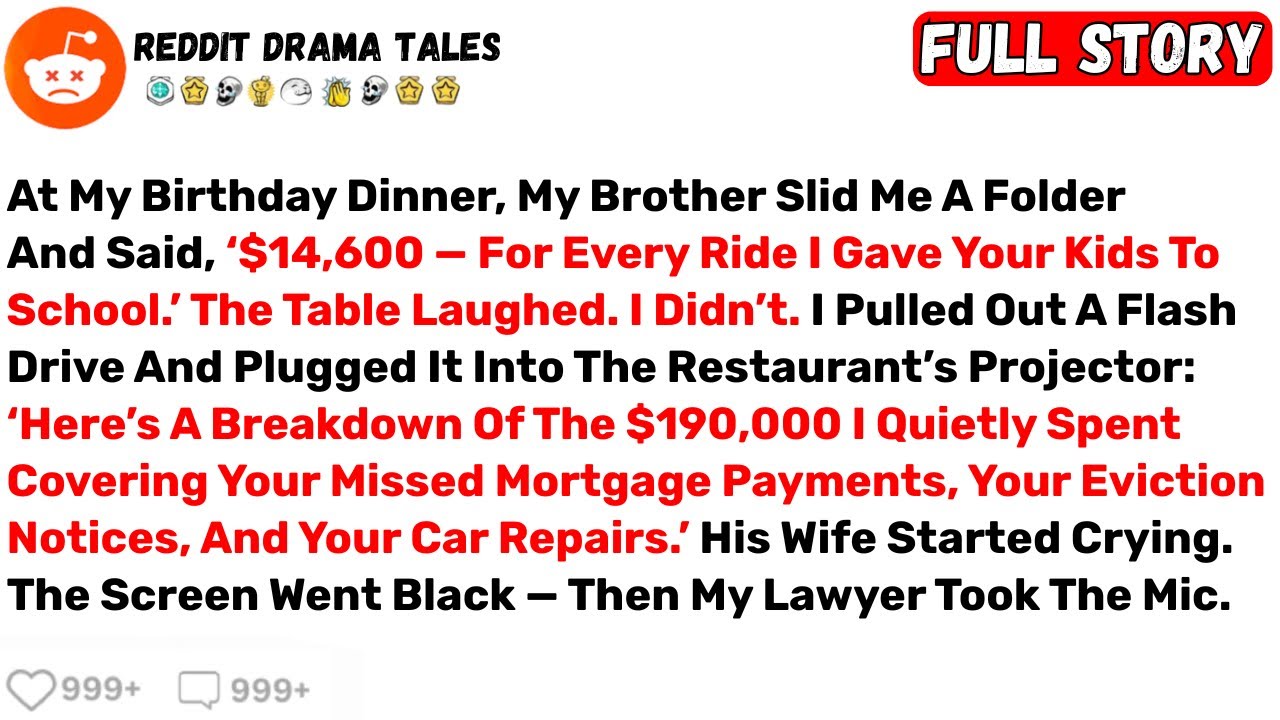
Then dessert arrived, and Greg stood up holding a manila folder. I thought he was going to embarrass me with a childhood story. I even smiled. He cleared his throat.
“Jake, happy birthday. I know you like things neat and organized, so I put this together for you. ”
He slid the folder across the table. Inside were printed invoices, dated and itemized.
“Rides to school, $10 per day, x146 days. ” Late pickup fees, missed work hours, all neatly tallied. Total due: $14,600. I looked up, thinking it had to be a joke.
Greg chuckled. “Figured I’d do the math since you love spreadsheets. That’s just for last year. I didn’t even count the early mornings.
”
Then my sister burst out laughing. “Oh my god, are you serious? ”
Greg shrugged. “Hey, gas isn’t free.
Neither is time. ”
The whole table was laughing. Except me. I didn’t laugh.
I looked down at the folder, then back up at Greg, who was raising his wine glass like he’d just delivered the punchline of the year. But they didn’t know—none of them had any idea—that I had my own receipts, years’ worth, and I’d finally had enough. I reached into my jacket pocket, feeling the flash drive I’d been carrying for weeks. It was supposed to be for a quiet conversation with my mom, a last-ditch effort to help her see what had been happening.
But as I stared at Greg, still grinning smugly, something shifted in me. Not anger—it was colder than that. It was clarity. I didn’t say anything.
I tucked the flash drive back into my pocket, closed the folder, and placed it on the table. “Thanks,” I said softly, looking him dead in the eyes. “That’s very thorough. ”
He blinked.
“I figured you’d appreciate the details. ”
“Oh, I do,” I replied, voice steady. “I really do. ”
The table laughed again, thinking I was playing along.
My mom wiped tears from her eyes and said, “Jake, don’t be so serious. Greg’s just teasing. You always take things so personally. ”
I nodded.
Sure, just a joke. But inside, something cracked. A hairline fracture that had been forming for years of being the backup plan, the emotional punching bag, the invisible support beam holding up a collapsing structure nobody ever thanked. After dinner, I drove home in silence.
I poured a glass of whiskey, sat down at my computer, and opened Greg’s folder again. Waiting in traffic—$400. Missed work from morning drop-offs—$2,300. It was absurd.
But what really got to me wasn’t the number. It was the entitlement behind it. The audacity to hand me that folder with a smile, to put a price tag on the one thing I had done out of kindness because I didn’t want his kids to suffer for their parents’ irresponsibility. That folder wasn’t a joke.
It was a message. He was telling me I owed him. Three days later, my mom called and left a voicemail I listened to twice because I couldn’t believe it. “Hi, honey.
I just wanted to talk about your brother. He’s feeling hurt that you didn’t laugh with the rest of us. He mentioned you haven’t paid him yet for all the school runs. I think you really should, Jake.
He’s been under a lot of pressure lately. I mean, you make more than him, right? It’s only fair. ”
Only fair.
I didn’t call her back. Instead, I opened the file I’d started compiling on my flash drive months ago. The night I found out Greg’s house was about to be auctioned off, I quietly paid off the $9,700 in back mortgage to keep his family from becoming homeless. I’d kept the receipts—not for leverage, just in case I ever needed to remind myself that I wasn’t crazy.
The file had grown over time. $600 for new tires. $3,200 for HVAC repair. $850 in emergency dental for one of his kids.
$190 here, $125 there—food, school supplies, utility bills. The grand total was just over $190,000. I read through the list with fresh eyes. Each entry was a little act of self-abandonment, a decision to prioritize their comfort over mine, over my sons, over my sanity.
And they laughed. That’s what they did on my birthday. They laughed in my face and handed me a bill for my own kindness. Two days later, my dad called.
He never talked long, but this voicemail was nearly five minutes. “Greg says you’ve been holding on to some documents that make him look bad. Listen, Jake, whatever you’re planning, let it go. It’s just going to divide the family more.
We’re supposed to help each other, not keep score. ”
Keep score. As if I hadn’t been playing the game alone this whole time. That night, I sat my sons down and asked them how they felt about the school ride setup.
My youngest said it was okay, but he didn’t like when Greg made them late because he needed five more minutes. My oldest admitted he’d seen Greg yelling at his own kids more than once, and it made him uncomfortable. The next morning, I emailed the school and removed Greg’s kids from my authorized pickup list. Three hours later, Greg texted: “Hey, school says you dropped my kids.
What the hell? ”
I didn’t reply. He followed up: “You seriously going to do this over a joke? Grow up, Jake.
Then I’ll send you the updated invoice. This time with emotional damage added. ”
That one made me laugh, but not in the way he wanted. Later that week, my mom called again.
“You’re creating a wedge in the family. You’ve always been so sensitive. Why can’t you just let things go? Your brother’s struggling, and you’re making it worse.
”
I tried to stay calm. “Mom, I’ve covered over $100,000 in his expenses. I never asked for a thank you. But handing me a fake bill in front of everyone—that wasn’t a joke.
That was a message. ”
She huffed. “You’re exaggerating. Greg said it was barely a few thousand for the mortgage.
You were just helping with groceries and stuff. It’s not like you saved their lives. ”
I hung up. That was the moment I realized they hadn’t just taken me for granted.
They had rewritten history in their own minds. My sacrifices were now anecdotes. My help was repackaged as minor gestures, easily minimized. A week later, Greg showed up at my house holding that same folder.
“I came to make peace,” he said, voice dripping with false humility. “Maybe I took the joke too far. Fine, I’ll wave the fee. Happy?
”
I didn’t let him in. “I think we’re past pretending. You didn’t come to apologize. You came to shut me up.
”
He stiffened. “Excuse me? ”
I stepped outside and closed the door. “You’re afraid I’ll tell people the truth about the mortgage, the car, the utilities.
”
His face went pale. “I have every receipt—every email, every bank transfer, every notarized payment record. ”
He laughed nervously. “You’re bluffing.
”
I looked him in the eye for a long, uncomfortable second. “I’m planning something, Greg. You’ll know when it happens. ” Then I walked back inside.
The truth is, I closed the door, leaned against it, and just stood there. My hands were shaking. My stomach churned. I wasn’t used to saying no.
I wasn’t used to being seen. But now that I had drawn a line, the fallout started immediately. My sister called the next day, her voice sharp. “Jake, what the hell is going on?
Greg said you threatened him, that you’re trying to destroy his family. ”
“I didn’t threaten him. I told him the truth. I’ve kept quiet for years while he treated my help like an allowance.
And he mocked me in front of the whole family. ”
She scoffed. “Oh, come on. It was a joke.
”
“It wasn’t a joke,” I said. “And even if it was, it wasn’t funny. Not to me, not to my kids. ”
She sighed like I was the difficult one.
“Jake, this is going to ruin the family. Don’t make things worse. ” Click. The cold shoulders started in the family group chat.
My mom posted a vague Facebook status about loyalty and forgiveness. Half my aunts commented things like “Family is everything. ” Greg was already painting the narrative, and he was good at it. Two weeks later, my parents hosted their annual spring barbecue.
I hadn’t missed one since I was twenty-one. This time, I wasn’t invited. No call, no text, nothing. I found out through my cousin Melissa, who texted me a photo of the setup—my dad flipping burgers, Greg and his wife laughing, my sister sipping wine.
The caption just said, “Didn’t think you were coming this year. ”
I stared at that photo for a long time. It was the first time I really felt it—not just the betrayal, but the exile. Like they’d closed the gates and locked me out.
Maybe for good. That night, after the boys went to bed, I sat on the couch in the dark holding a warm beer, feeling hollow. Like the years I spent holding up this family had been one long elaborate con, and I was the only one who hadn’t been in on the joke. But then came the slow rise.
It started with the smallest thing—a choice. I turned off notifications for the family group chat. I archived it, muted it. Then I opened a new document on my laptop and titled it “What I Want.
”
I stared at the blinking cursor for a long time, then started typing: “I want peace. I want my kids to grow up without being guilt-tripped by people who only show up when they need something. I want boundaries. I want freedom.
”
I wrote for hours, and by the time I stopped, I felt lighter. That weekend, I started cleaning house—emotionally, digitally, spiritually. I sorted through years of emails, bills, and transfers. I made copies of every payment I’d made for Greg and his family, labeled everything, filed it neatly into folders.
Not out of spite—out of clarity. I needed to see what I had done. Then I started putting that energy into myself. I’d always had a side project, an app for managing school pickups and carpools.
It started as a way to organize our weekly chaos. With the silence from my family ringing loud and clear, I had the time and motivation to take it seriously. I pulled late nights, built out the back end, created a beta version. I started reaching out to local parent groups for feedback.
The response was better than I expected. A few weeks in, a mom from the PTA asked if she could share it with her network. A month later, I got my first licensing offer from a school district representative. I wasn’t aiming to get rich—I just wanted to build something that worked.
But the money started coming anyway. Steady, clean, earned. And for the first time in years, I felt pride. Real pride.
Quiet, rooted. My oldest son noticed. “You’re smiling more,” he said one night. “Yeah,” I said.
“I like it. ”
We started doing more together—weekend trips, game nights, just sitting around and talking without the weight of family guilt hanging over me. I joined a local dads’ group. During a meeting, I shared a little of what had happened.
A retired lawyer named Steve leaned forward. “You kept records? ”
I nodded. He smiled.
“Good. Keep them. You never know when you’ll need to remind people what reality looks like. ”
Meanwhile, Greg’s life was crumbling in the background.
His wife quit her job again. Their mortgage was past due. The car I’d helped retrieve was repossessed again. This time, I wasn’t there to catch the fall.
The final straw came as a text from Greg after weeks of silence: “You really going to let your own niece and nephew get kicked out of their house? ”
No greeting, no “how are you. ” Just guilt. That was when I knew he hadn’t learned anything.
He still thought I was the backup plan. But I wasn’t the same Jake anymore. The Jake who said yes to everything—he was gone. I opened my laptop and pulled up a document I’d started weeks ago.
It had a simple title: “The Ledger. ” A comprehensive breakdown of everything I’d ever paid for, helped with, or cleaned up over the years. Not just money anymore—time, labor, lost opportunities, missed vacations, PTO burned driving his kids around. I backed everything with proof: receipts, timestamps, emails, all categorized and cross-verified.
I wasn’t building a petty invoice. I was preparing evidence. I backed it up in three places: a hard drive in a fireproof box, cloud storage under a different account, and an encrypted flash drive I carried every day. But a document doesn’t speak for itself.
So I started speaking. I started with quiet conversations. First, my cousin Melissa, the one who texted me from the barbecue. I invited her for coffee and showed her just a portion of the ledger.
Her eyes went wide. “He made it sound like you abandoned them,” she said quietly. “I did,” I replied. “But only after carrying them for years.
”
Melissa ran the extended family group chats. She organized holiday meals. I didn’t ask her to pick sides. I just gave her the truth.
Next was Steve, the lawyer. I brought the flash drive to our next meeting. He looked through the files, then leaned back. “You ever think about going public with this?
”
“Public like how? ”
He smiled. “Family meeting slide deck. Full breakdown.
These people build a house of cards on your silence. It might be time to blow gently. Not to destroy—to reveal. ”
The idea planted itself like a seed.
Later that week, I called the school district’s transportation office. The woman I spoke to was kind but firm. “We have no record of Greg’s vehicle being registered in our system. Technically, if you weren’t an authorized guardian, there were several policy violations.
”
I added that to the folder. Then I started planning the dinner. My real birthday celebration—but this time, it wasn’t just dinner. It was a presentation.
I asked my friend Nate, a corporate event planner, to help me book a semi-private dining room at the nicest Italian place in town. The same one where Greg had handed me the invoice folder. “Exactly the same,” I said. “But this time, I’m choosing the guest list.
”
The list was small and strategic: my parents, Greg and his wife, my sister and her fiancé, Melissa, and a few fence-sitting relatives. I told them all I wanted a quiet, no-gifts dinner to reconnect. Greg replied, “About time. ” My mother responded, “So glad to hear you’re coming back around.
”
They had no idea. In the weeks leading up to the dinner, I prepped everything. I compiled slides—simple, clean titles like “Mortgage Payments 2018–2021,” “Vehicle Repossessions Prevented,” “Utilities Restored,” “Education Expenses,” “Emotional Labor: Unpaid. ” Each slide had documentation.
My final slide was just a black screen with three words: “Why I Left. ”
I wasn’t looking to explode. I was looking to expose. For the finale, I asked Steve to show up halfway through.
Not to represent me—just to be there. A calm presence. A signal. I also had custom flash drives made that looked like gold keys.
Each contained the ledger, the presentation, and a personal letter. One for each family member in the room. The day before the dinner, Greg texted again: “Hey man, glad you’re coming around. We knew you’d cool off.
”
I didn’t reply. I was done replying. The dinner was set for Friday at 6:30 sharp. Same restaurant, same back room.
I arrived thirty minutes early, dressed simply—clean button-down, jeans. I set the black boxes with the flash drives beside each plate. The manager, a quiet guy named Luis who remembered the birthday debacle, nodded respectfully. “You sure about this?
”
“It’s time. ”
By 6:45, everyone had arrived. Greg strolled in with that same swagger. His wife followed, wearing a smug smile.
My sister hugged me perfunctorily. My parents were warm but cautious. Everyone assumed I was here to apologize, to make peace. They didn’t notice the projector already plugged in behind the curtain.
We ordered food and made small talk. I let them talk. I didn’t interrupt when Greg made a half-hearted joke about surprise invoices. I didn’t say a word when my sister said, “I’m just glad you’re not being dramatic anymore.
”
The waiter brought appetizers, and I let everyone get a few bites in before I stood and lightly tapped my fork against my glass. “I want to thank you all for coming tonight,” I began, calm and steady. “I invited you here because there’s something I’ve been meaning to share for a long time. ”
I reached into my pocket and pulled out the gold key-shaped flash drive.
The room looked puzzled. “Don’t worry,” I said. “I’m not handing out invoices. ” A few chuckles.
“But I am handing out the truth. ”
I nodded to Luis. He dimmed the lights and drew the curtain closed. I pressed play on the remote.
The projector flickered to life. Slide one: “$190,046. 17. ” Subtitle: “Amount quietly spent by Jake Andrews from 2017 to 2024 covering family expenses.
”
The room went silent. Click. Slide two: “Mortgage Payments. ” Greg’s name, dates, exact amounts, copies of bank transfers.
One email from his lender read, “Thank you for resolving this outstanding amount. We are cancelling the auction proceedings. ”
Greg’s wife dropped her fork. Click.
Slide three: “Car Payments, Towing and Repairs. ” Receipts, timestamps, license plates. Even the towing receipt from the night their car was impounded. My mother gasped.
Click. Slide four: “Utilities. ” Invoices from the power company, my name listed as payer on emergency restorations. Click.
Slide five: “Child Expenses. ” School shoes, field trip money, dental co-pays, lunch accounts quietly refilled. All documented. Greg turned red.
He stood up like he was about to stop the presentation. I raised my hand without even looking at him. “Sit. ”
Something in my voice made him obey.
Click. Slide six: “Messages. ” A collage of texts. My mom: “You make more.
It’s only fair. ” Greg: “I’ll add emotional damage to the invoice. ” My sister: “You’re going to ruin the family. ”
Click.
Slide seven: “Why I Left. ” Black screen, white text: “I gave. You took. And then you laughed.
”
The slide faded. I walked back to the head of the table. “Each of you has a box in front of you. Inside is a copy of this presentation, all the documentation, and a personal letter from me.
”
No one moved. Greg finally sputtered, “What the hell is this, Jake? You trying to humiliate me? This is some kind of revenge stunt?
”
I met his eyes. “No, Greg. I’m turning this into closure. ”
He tried to laugh, but it came out brittle.
“So what? You think this makes you look good? Like you’re some martyr? ”
“No,” I said.
“I don’t care how I look. I care about what’s real. And what’s real is that I was used and mocked. And when I stopped playing along, you tried to paint me as the villain.
”
My mom started crying quietly. My dad looked down at the table. My sister stared, wide-eyed and pale. Greg sneered.
“This is pathetic. ”
“Is it? Because I think what’s pathetic is handing someone a fake bill on their birthday after they spent years keeping your house from being taken. ”
I turned to the room.
“I’m not asking for thanks. I’m not asking for repayment. I’m done asking for anything from any of you. ”
Steve, who had been sitting quietly in the corner, stood up and walked over.
“I’m just here as a witness,” he said, “and to deliver a message from Jake. Any further harassment, misrepresentation, or defamation will be met with an appropriate legal response. ”
Greg looked like he was about to explode. “You brought a lawyer to dinner?
”
“No,” I said. “I brought a boundary. ”
Luis turned the lights back on. Everyone sat frozen.
I took one final breath, then reached into my pocket and pulled out a sealed envelope. “This is a donation agreement I signed this morning. My app is getting a school contract. The first ten percent of my earnings are being donated to a fund that covers emergency housing and education expenses for kids in this city.
”
I looked at Greg. “Kids who didn’t choose their parents’ mistakes. ”
His wife broke into tears. Greg stood up, fists clenched, but said nothing.
I picked up my jacket, nodded to Luis, and turned to leave. As I walked out, my mom called out, voice trembling. “Jake, wait. ”
I paused at the door and turned my head slightly.
“Thank you,” she said softly. I gave her a single nod, then walked into the night. The fallout came quickly. Greg’s circle started shrinking.
Melissa shared the ledger with a few other relatives after reading through it. My sister tried to defend him online, only to be confronted with screenshots and facts. My parents didn’t call for a while. When they did, they were different—quiet, humbled, careful.
I never rubbed it in. I didn’t need to. The truth did all the work. And me?
I kept building. My boys saw their dad stand up for himself with dignity, not rage. They saw what it looked like to say no without apology. They learned what it meant to draw a line and hold it.
One night, weeks later, my oldest son asked, “Do you think they’ll ever say sorry? ”
I thought about it. Then I smiled. “They don’t need to.
”
I had already moved on. And the next time someone tries to hand me a bill for my kindness, they’ll find the door already closed.