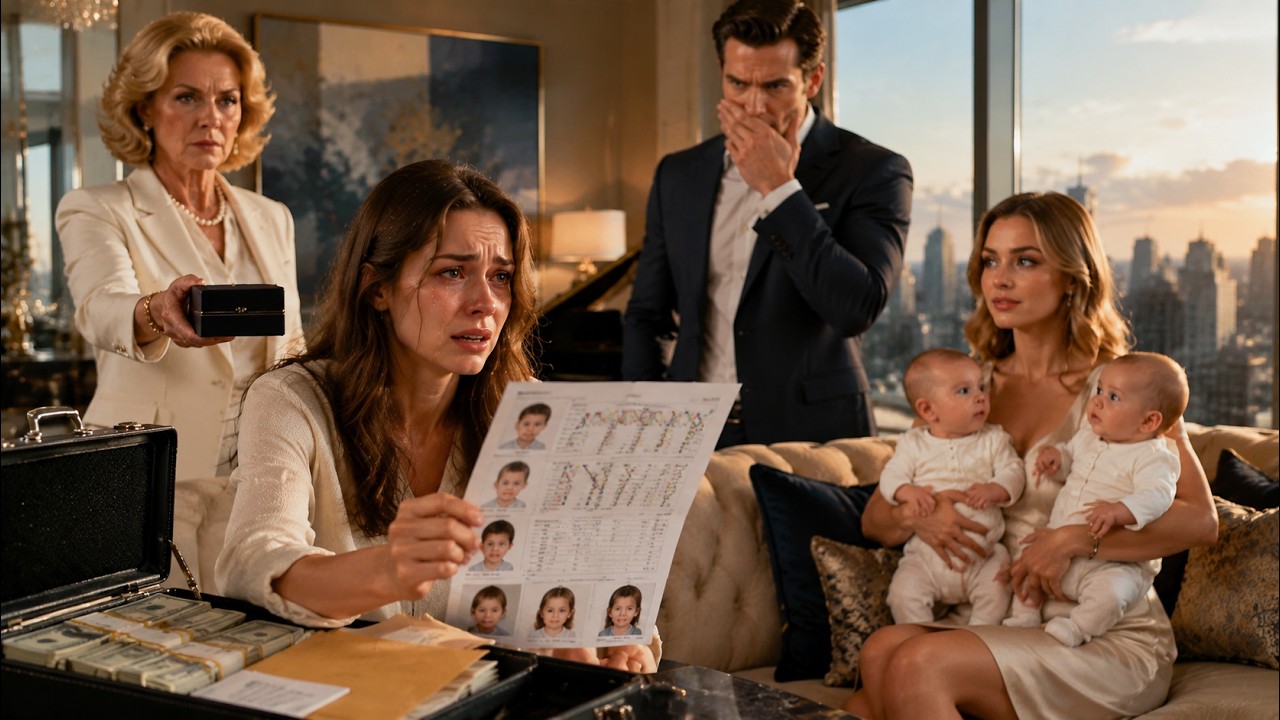
The smell of fresh-cut grass and honeysuckle hit me the moment I rolled down the car window. It was the kind of May morning that made you believe everything was going to be fine. I should have known better. My husband, Marcus, reached over and squeezed my hand as we turned onto Route 9.

Our daughter, Lily, was alone in the backseat, holding the card she’d made for Grandpa Walter—watercolor sunflowers, her name spelled in careful, crooked letters across the bottom. She’d been working on it since Tuesday. “Mama, is Grandpa going to cry? ” she asked, pressing her nose against the window.
“Miss Patterson cried when we gave her the card on Teacher Day. ”
“Grandpa might,” I said. “He’s going to love it, baby. ”
My phone buzzed.
A text from my sister, Brooke. “Emma, change of plans. Grandpa isn’t feeling well. We moved the brunch to next weekend.
No need to drive all the way out. ”
I looked up. We were four minutes from Grandpa Walter’s farmhouse. “Pull over,” I said.
Marcus glanced at me. “What? ”
“Pull over, please. ”
He eased onto the gravel shoulder.
I read him the text. He read it twice the same way I had. “Emma,” he said. “He called me this morning,” I said.
“At 8:15. He said, ‘I’ll see you girls at noon. Don’t forget I like the orange juice with pulp. ‘ Those were his exact words.
Don’t forget the pulp. ”
Marcus was quiet. Lily’s voice came from the backseat. “Are we not going to Grandpa’s?
”
I turned around. She was seven years old, with Grandpa Walter’s eyes—that specific shade of gray-blue people in our family called storm glass. She was still holding the sunflower card with both hands. “We’re going,” I said.
I texted Brooke back: “Already almost there. We’ll check on him ourselves. ” Then I put my phone in my purse and told Marcus to keep driving. We turned onto the long gravel driveway that cut through two acres of old oak trees.
I had driven this road my entire life. I knew every dip and curve, every place where the gravel gave way to packed clay, every spot where my grandfather had planted wildflowers along the fence line because my grandmother loved them—and he never stopped planting them, even fifteen years after she passed. The farmhouse sat at the end of the drive: white clapboard, black shutters, a wrap-around porch Grandpa Walter had rebuilt by hand the summer I turned twelve. He’d let me hand him nails.
He said I was his best assistant. He said that every summer for five years, even after I was old enough to know he was just being kind. There were three cars in the driveway. My sister Brooke’s silver Lexus, my brother-in-law Derek’s black truck, and a car I didn’t recognize—a newer dark blue sedan with dealer plates.
I could hear voices through the screen door, the sound of a blender, someone laughing. Marcus parked. Neither of us said anything for a moment. “She told you it was canceled,” he said quietly.
“She told me it was canceled. ”
I got out and helped Lily out of her booster seat. She took my hand automatically, the way little kids do—completely trusting that whoever is holding their hand knows where they’re going. I wished I had that kind of faith in anything right then.
I knocked on the screen door. The laughter inside stopped. Brooke appeared in the doorway, dressed up—silk blouse, earrings, her hair blown out the way she only did it when she was trying to impress someone. Her face went through about four expressions in two seconds: surprise, annoyance, something calculated, and then, settling over everything like a mask snapping into place, a stiff smile.
“Emma, what are you doing here? ”
“I’m here for the brunch,” I said. “The one Grandpa invited us to. ”
“I texted you.
He’s not feeling well. ”
“He called me this morning at 8:15,” I said. “He sounded fine. ”
Behind her, I could see into the dining room.
The table was set with the white linen tablecloth my grandmother had brought back from a trip to Vermont in 1987, the china she saved for holidays. There were flowers in the center, mimosas poured, plates with food already on them. I counted five place settings. Five, not seven.
“You weren’t on the guest list,” Brooke said, and her voice shifted into something I recognized—the tone she used when she was pretending to be reasonable while doing something completely unreasonable. “It’s a smaller gathering this year. Derek’s parents are here. There isn’t room.
”
I looked past her at the table. Derek’s parents—the couple I’d met twice in three years—had apparently taken priority over her own sister on Mother’s Day at their grandfather’s house. “Grandpa invited me,” I said again. “I’d like to say hello to him.
”
“He’s resting. I’ll tell him you stopped by. ”
And then she started to close the door. From somewhere deep in the house, a voice called out—gravelly and warm and absolutely unmistakable.
“Is that Emma? Emily, is that my Emma out there? ”
Brooke’s jaw tightened. She turned toward the hallway.
“It’s fine, Grandpa. She just—”
“Send her in. Send her and Marcus and that little girl in right now. ”
There was a silence.
Then Brooke stepped back from the door—not graciously, not warmly, but because she had run out of options. She looked at me with an expression I had seen my whole life: the look that meant *this isn’t over, I’m just regrouping. *
I walked past her into my grandfather’s house. Grandpa Walter was in his armchair by the window—81 years old, white hair, the same storm glass eyes as Lily—wearing the flannel shirt I’d given him two Christmases ago.
He looked healthy. He looked exactly like himself. When he saw Lily, his whole face changed. “There she is.
There’s my girl. Come here. Come here. ”
Lily ran to him.
He pulled her onto the armrest and wrapped one arm around her, and she showed him the card, explaining every detail of every watercolor sunflower, while he listened with his whole body—the way only people who genuinely love children can listen. I stood in the doorway and looked at the scene. Derek’s parents at the dining room table, strangers with polite smiles. Derek himself in the kitchen, his back to me, suddenly very focused on something on the counter.
Brooke behind me, close enough that I could feel her presence like a weather pattern. “Grandpa,” I said, crossing to him. “You look great. ”
“I feel great,” he said.
“Emily, you bring a man some orange juice with pulp, he’s going to feel great. Your sister told me you weren’t coming. Said you had something come up. ”
I went still.
“She said that? ”
“Said you called and canceled this morning. ”
He looked at me, then at Brooke standing in the doorway. Something shifted in his expression—not confusion.
Something older and quieter than confusion. “But here you are,” he said carefully. “So here I am,” I said. I looked at Marcus.
Marcus looked at me. We had been married six years, and he knew my face the way you know a road you’ve driven a thousand times—every pothole, every turn, every place where the light hits different. He gave me a small nod that meant, *I’m here. We’re in this together.
*
Brooke suggested we join them for brunch. The offer landed like something dropped from a height—it had the shape of generosity and the weight of an obligation. We sat down. Derek’s parents made polite conversation.
Derek refilled the mimosas with the careful focus of a man who wanted to look busy. Brooke cut her food into very small pieces. Grandpa Walter ate his eggs and watched. He had been watching for a while, I think.
I just hadn’t known what he was watching for. The conversation moved the way those conversations do—surface level, weather and grandchildren and the renovation Brooke was planning. Marble countertops, a new island, appliances she’d been researching for months. It was during that conversation that I noticed it.
The glass cabinet in the corner of the dining room—the one with the walnut frame, built into the wall, with the small brass latch my grandmother used to let me open on special occasions. The cabinet where Grandpa Walter kept his coin collection. The cabinet was empty. I set down my fork.
I looked again to make sure I wasn’t misremembering, but I had been in this dining room my entire life. I had stood at that cabinet while Grandpa Walter explained the provenance of every single piece—the 1909-S VDB Lincoln cent, the 1921 Morgan silver dollar, the complete collection of Walking Liberty half dollars he’d assembled over decades. He’d taught me the terminology before I could multiply fractions: strike quality, luster, eye appeal. He used to say that coins were how he saved history in his hands.
The cabinet was empty. The velvet display stands were gone. The felt lining had a visible rectangle of unfaded color where the cases had sat for decades. “Grandpa,” I said, and my voice came out careful.
“Where’s the collection? ”
The table went quiet. Grandpa Walter set down his orange juice. He looked at the cabinet—the way you look at something when you’re confirming what you already know.
“I was wondering when someone would ask me that,” he said. Brooke’s chair scraped back slightly. “It’s being appraised. Derek found a specialist.
We thought it was a good time to have everything properly documented, for insurance purposes, for the estate. ”
“When did that happen? ” I asked. “Recently.
Grandpa, did you know about this? ”
The table was very quiet now. Derek’s parents had the frozen look of people who have walked into something they weren’t prepared for and are calculating the fastest polite exit. Grandpa Walter looked at Brooke.
He looked at her for a long time, and then he looked at me. “Emily,” he said, “would you go into my study and bring me the brown accordion folder that’s on top of my desk? The one with the rubber band around it. ”
Brooke stood up.
“Grandpa, we’re in the middle of—”
“Brooke, sit down. ”
Quiet. Absolute. The voice of a man who had run a farm for fifty years, who had built his own porch and raised two daughters and buried his wife and kept going.
Not loud, but there was something in it that made you understand that sitting down was the only real option. Brooke sat down. I went to the study. The accordion folder was exactly where he said it would be.
Rubber band and everything. I brought it back and set it in front of him. He pulled off the rubber band and opened the folder. He took out a single sheet of paper and set it on the table.
“This came certified mail three weeks ago,” he said, “from a coin dealership in Philadelphia. A receipt for a bulk sale. ”
He slid it toward the center of the table. “412 individual pieces, including the 1909 Lincoln cent, including the complete Walking Liberty set.
” He paused. “Including the 1804 bust dollar. ”
The room was silent. I knew what the 1804 bust dollar was.
Grandpa Walter had told me about it when I was nine years old, the summer he first let me hold it in white cotton gloves. Only fifteen specimens confirmed in existence. He’d acquired it in 1978 from an estate sale in Connecticut. He told me once, quietly, that it was worth more than his house—and that he intended to give it to whichever grandchild actually listened when he talked.
“The collection,” he said, “was sold for $82,000. ”
He reached into the folder again. He placed a second sheet of paper on the table. “This is the authorization form the dealership required.
It has my signature on it. ”
He looked at Brooke. “I did not sign this form. ”
The dining room held its breath.
Derek stood up from the table—fast, the way people move when they’re following an instinct they haven’t thought through yet. “Sir, we can explain—”
“Sit down, Derek. ”
Grandpa Walter’s voice hadn’t changed. Same quiet.
Same weight. Derek sat down. “I am 81 years old,” Grandpa Walter said. He picked up the authorization form and held it toward the light coming through the window.
“I have signed my name approximately 10,000 times in my life. That is not my signature. The loop on the W is wrong. My W has a flat bottom.
Has had a flat bottom since 1962, when my sixth-grade teacher told me to stop making it look like a child drew it. ”
He set the paper down. “Someone practiced my signature and got it almost right. Almost.
”
Brooke’s face had gone the color of old chalk. Her hands were in her lap, and from where I sat I could see that she was gripping them together hard enough to turn the knuckles white. “The $82,000,” Grandpa Walter continued, still calm, still measured, “was deposited into an account I was not aware of on the same day that Derek received notice of a civil judgment against him for an unpaid debt of $78,000. ”
He looked at Derek’s parents for the first time.
“I’m sorry that you are hearing this here. That is not my choice. ”
Derek’s father had the look of a man watching a wall collapse. His mother had placed her napkin over her mouth.
“Brooke,” I said. I wasn’t angry yet. I was still in that cold, clear space before anger arrives, where everything is just facts you’re arranging in order. “You told me the brunch was canceled.
”
She looked at me. Her eyes were wet, but the set of her jaw was hard. “I didn’t want a scene. You knew I would notice the cabinet.
”
She didn’t answer. “I have been coming to this house my whole life,” I said. “You knew the second I walked into this dining room I would see it was empty. That’s why you canceled the brunch.
That’s why you told Grandpa I called to say I wasn’t coming. ”
I heard my voice stay even, and I was almost surprised. “You forged his signature to steal his life’s collection to cover your husband’s debts. And then you tried to keep me out of this house so I wouldn’t see.
”
“It’s not stealing,” she said. Her voice cracked on the last word. “We’re family. It was going to be ours eventually anyway.
”
“It was going to be mine,” Grandpa Walter said. The quietness in his voice had something else in it now—not rage, but something older. Grief, maybe. The specific grief of being proven right about something you desperately hoped you were wrong about.
“It was mine, Brooke. Not yours. Not yet. And what was mine to give, I had not given.
”
Lily was very still in her chair. She looked at me with her storm glass eyes, picking up the temperature of the room the way children do—not understanding the facts, but feeling all of the weight of them. “Can I go see the chickens? ” she asked quietly.
“Yes, baby,” Marcus said. “I’ll take you. ” He stood up and scooped her out of her chair and caught my eye on the way out. *I’ve got her.
You handle this. * Six years of marriage in a single look. When the back door closed behind them, the room was quiet again. Derek’s parents rose simultaneously, without a word, with the coordination of two people who have been together long enough to make certain decisions without speaking.
His mother touched Grandpa Walter’s shoulder as she passed. “I’m sorry, Walter,” she said simply. His father shook his hand. They let themselves out.
Then it was just us: Grandpa Walter, Brooke, Derek, and me. Derek had his elbows on his knees and his head in his hands. He looked like a man watching his own future get disassembled piece by piece. “The judgment was 78,000,” I said—not to be cruel, but because I needed the math to make sense.
“The collection sold for 82. What happened to the difference? ”
“There were fees,” Derek said. His voice was muffled by his hands.
“The dealership took a cut. There were lawyer fees for the judgment. ”
“So it’s gone. ”
He nodded.
“All of it. ”
Brooke had started crying—quiet, controlled tears. The kind that are half real and half calculation. I had watched her cry since we were children, and I knew the difference.
“I didn’t know what else to do,” she said. “He was going to lose his business. We were going to lose everything. I panicked.
I’m so sorry, Grandpa. I’m so sorry. ”
She reached for his hand across the table. He moved his hand off the table and into his lap.
“I know you’re in a difficult situation,” he said. “I understand fear. I understand the feeling that there’s no way out. ”
He looked at her steadily.
“I also know that you were in this house in March when I had the flu, and you sat beside me and brought me soup—and while I was sleeping, you went into my study and took documents that were not yours to take. You did that while I was sick and trusting you. And then you lied to your sister to keep her away from this house today. ”
Brooke was fully crying now.
Derek still had his head in his hands. “I forgive you,” Grandpa Walter said. “In time, I will forgive you. But forgiveness is not the same as absence of consequence.
”
He folded his hands on the table. “You and Derek, I need you to leave. Not forever—but for today, and for a while after today, while I figure out what I want to do about this. ”
“Grandpa—”
“I’m asking you politely, Brooke.
Please leave my home. ”
There was a long silence. Then Brooke pushed back her chair. She picked up her purse from the floor by her feet.
She walked past me without looking at me, and for a moment I thought she was going to keep walking—was going to walk out without a word. Then she stopped. “You always took her side,” she said. She was still not looking at me—she was looking at the empty cabinet in the corner.
“Both of you. My whole life. She was always the one who listened. The one who cared.
The one who got told the stories and taught the right way to do things. I was always just there. ”
I thought about a lot of things in that pause. I thought about how that might have felt if it were true.
I thought about whether it was true, and I decided that was a conversation for another day—one that required more honesty from both of us than this moment could hold. “I do care about you,” I said. “That’s not the same as what you did. ”
She walked out.
Derek followed without speaking. The front door opened and closed. Then the Lexus started, and the black truck, and the sound of tires on gravel faded into the ordinary sounds of a May morning: birds, wind through the oak trees, the distant laughter of a child and a man looking at chickens. I sat in the chair next to Grandpa Walter.
We didn’t say anything for a moment. The empty cabinet caught the light. “Did you know? ” I asked.
“Before the letter came? ”
“I suspected,” he said. “I noticed the cabinet in February. I didn’t say anything because I thought I was getting confused.
I thought maybe I’d moved things and forgotten. ”
He was quiet. “I’m 81. You start to doubt yourself.
That’s the thing about getting old that no one tells you—you stop trusting your own memory, even when your memory is correct. ”
I took his hand. It was large and dry and rough in the specific way of hands that had worked their whole lives. I had been holding this hand since before I could read.
“What do you want to do? ” I asked. “I spoke to my attorney on Thursday,” he said. “I’m pressing charges for the forgery.
That’s not negotiable. The civil side—recovering what was sold—that’s going to be harder, and I may not get it all back. ”
He paused. “The 1804 dollar is gone.
I’ve made my peace with that. ”
I had to breathe through that. “And the estate,” he continued. “I’ve already been in touch with Gerald about changing the documents.
I want to be clear with you about what that means, because I don’t want you to feel that this is a reward, or that I’m choosing you because of today. I’ve been watching for years. I’ve been watching who showed up, who asked questions, who listened. ”
He looked at me.
“You’re the one who knows the flat bottom of the W. ”
I didn’t say anything. I just held his hand. “I’m not going to apologize,” Marcus told me later, when he was helping me load the dishwasher while Lily napped on Grandpa Walter’s old sofa under the quilt my grandmother had made in 1979.
“But I’m not surprised. ”
“I know,” I said. “She’s your sister. ”
“I know.
”
“That’s going to be complicated. ”
“I know that, too. ”
I handed him a plate, and he dried it, and I thought about Brooke standing in the doorway saying, *you always took her side. * I didn’t think it was true, but I thought there might be a real feeling buried somewhere underneath the excuse—the way real things sometimes get buried under the versions of themselves that have curdled with time and resentment and bad decisions.
I thought we might never have a conversation honest enough to reach it. I thought we might someday. I didn’t know yet which it would be. What I knew was what I had always known: the smell of this farmhouse, the particular light through the kitchen windows in the afternoon, the way Grandpa Walter’s laugh started somewhere deep in his chest and arrived late, like it had to travel a long distance to get out.
I knew the coin cabinet and what had lived in it and the stories behind every single piece. I knew where the spare key was hidden and which floorboard creaked and the best spot on the wraparound porch to watch the sun go down. I had always known these things. I had just never understood until today that knowing them meant something—that showing up and listening and asking the right questions, not because you expected anything back, but because you genuinely wanted to know, accumulates.
That becomes something. That is an inheritance, too, before it’s ever written in any document. One year later, the May light came through those same kitchen windows and fell across the same oak floors, and I was standing at the counter making coffee while Lily sat at the table carefully composing a letter to Grandpa Walter about what she’d learned in second grade that week. She did this every Friday.
It had been her idea. She had said, very seriously, “Grandpa likes to know things. ” And she was completely right. Grandpa Walter was in his chair on the wraparound porch with his coffee, the morning paper, and the new coin catalog I’d ordered for him.
He had started over methodically, beginning with Buffalo nickels, because he said they were underrated and he’d always meant to pay more attention to them. The forgery case had settled. There was restitution ordered. It would take years to recover, and it would never be complete.
Brooke and I had spoken twice. Both times were short and careful, holding the quality of two people standing at the edge of something large—not sure yet if they were building a bridge or just agreeing on where the gap was. I thought that was okay. I thought that was actually what honesty looked like when it was new.
Derek’s business had not survived. That was the consequence of the consequence, and I didn’t have strong feelings about it. Some things collapse because they were built on borrowed things that were never his to borrow. Marcus came in from the back door smelling like grass, from the lawnmower, and he kissed me on the top of my head.
Lily looked up and said, “Daddy, I’m writing to Grandpa. ”
He said, “Tell him the Phillies lost again. He’ll want to know. ”
She considered that seriously and then added it to the letter.
I carried two mugs of coffee out to the porch and sat next to Grandpa Walter and handed him one. We looked out at the oak trees and the wildflowers along the fence line that he had never stopped planting. “Emily,” he said without looking up from his catalog. He never called me Emma.
Had never once called me Emma. I used to correct people about that as a kid, and then I grew up and stopped, and when I was around him I was Emily again. “Yes? ”
“The 1879-S Morgan, reverse of 1878.
Do you remember what I told you about it? ”
I thought. “The tail feathers,” I said. “Eight tail feathers instead of seven.
That’s how you tell the earlier die from the later one. ”
He nodded. He put a small check mark next to something in his catalog. “Good girl,” he said.
I sat in the morning sun on the porch of the house that was partly mine now and drank my coffee and watched the wildflowers move in the wind. If you are out there right now feeling like the one who was excluded—the one who showed up anyway and still got the door shut in your face, the one who always noticed, always cared, always tried, and got nothing but suspicion and resentment for it—I need to tell you something. What you carry is not a burden. The fact that you pay attention, that you show up, that you remember the stories and ask the questions and actually listen to the answers—that is not your weakness.
That is the most valuable thing you have. The people who try to shut you out are usually trying to hide something. And the things worth having—the real things, the ones with history and weight and meaning—those find their way to the people who were always going to take care of them. Don’t stop showing up.
Don’t stop listening. Build your table. The right people will sit at it.