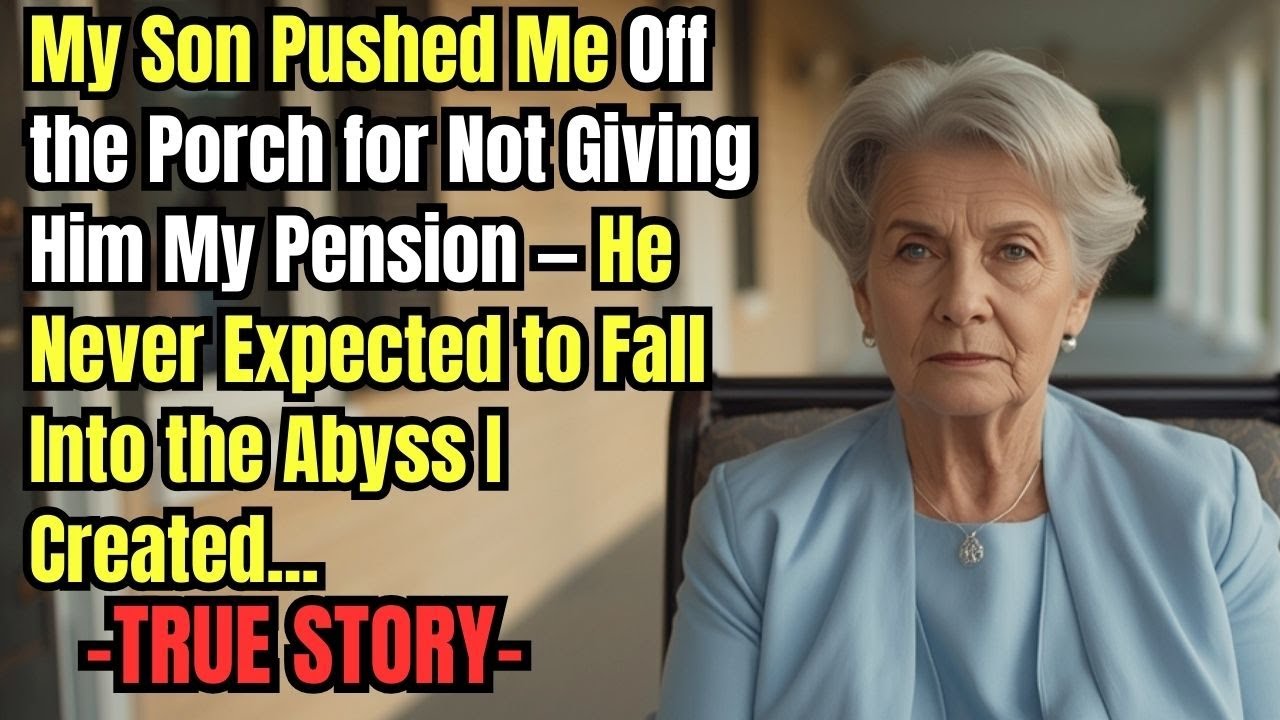
The morning air was cold enough to sting my eyes, but not cold enough to explain the ache in my bones. I stepped onto the porch slowly, steadying myself on the railing, willing my hip to cooperate. The pension envelope in my hand felt thin, almost soft, but it carried every piece of independence I had left. I had barely made it down two steps when Rowan filled the doorway like a barricade.
He leaned against the frame, tapping his fingers impatiently, eyes narrowed at the envelope instead of me. “Give it here,” he said, clipped. “I don’t have all day to listen to you complain. ”
I tightened my grip.
“Rowan, I need some of it for my medication. The doctor said I must. ”
He laughed, a hollow sound. Before I could finish, Alyssa stepped behind him, adjusting her robe like she’d been inconvenienced by getting dressed.
She scanned me from head to toe. “Medication for what? You’ve lived long enough, Elanora. The longer you hang around, the more this house pays for it.
”
Hartley leaned against the wall beside them, chewing something, and lifted his chin. “Grandma, you’re basically dead weight. ”
I don’t know why that line hurt more than the others. Perhaps because he was young enough to still learn kindness, yet old enough to choose not to.
“I won’t sign everything over,” I said. “I can’t give you the whole thing. I need part of it for my medicine. ”
Rowan stepped forward, close enough for me to see the irritation in his eyes.
“You don’t get to say no. Not anymore. ”
The porch railing pressed against my back. I could feel the last inch of space behind me—the edge of the step, the edge of safety, the edge of his patience.
He lifted his hand, not in threat, but in dismissal. That gesture frightened me more than a raised fist would have. A raised fist implies emotion. A dismissal implies nothing.
“Move,” he said. “Stop wasting my time. ”
“I won’t sign it,” I whispered. His expression hardened.
He gave me a quick shove—sharp, careless, the kind of shove people give to doors that don’t open fast enough. But my body was not a door. My body was old and brittle and tired. My foot slid off the top step.
My arms flailed once, reaching for nothing—him, air, balance—but nothing came. The boards of the porch came up fast, knocking the breath out of my lungs. My head struck the bottom step with a blunt crack. A hot, sharp pain shot through my left hip, radiating down my leg like fire pushed through a narrow pipe.
I lay curled on the cold boards, unable to move, barely able to breathe. Rowan stared down at me without shock, without regret—just a calculating emptiness. “You know,” he said calmly, “if you had fallen and died, at least I’d get the house and the pension immediately. ”
Alyssa folded her arms.
“Accidents happen. ”
Hartley shrugged, still chewing. “Grandma always falls. Maybe this time she’ll stay down.
”
The three of them stepped past me, over me, around me, as if I were a spilled bag of groceries. The door closed softly. A click. That sound hurt almost as much as the fall.
I tried to move my leg and could not. Pain climbed up my spine like a slow animal. My eyes filled, and I refused to cry until I could no longer hold the tears back. They slid into my hairline, warm against the cold wood.
I could hear my own ragged breathing. I could hear the silence from inside my own home—the silence of people who wished I were no longer alive. I thought briefly of trying to crawl, but my hip screamed at even the thought. The porch felt larger than it ever had.
Too wide to cross. Too long for anyone to notice me. I don’t know how long I lay there before I heard the sharp intake of breath. Running feet.
“Eleanor! Oh God—stay still. I’m right here. ”
Marlo’s voice cut through the cold morning full of fear and disbelief.
She knelt beside me, her hands gentle on my shoulders, her eyes full of the kind of concern I had forgotten existed. She looked at me like I mattered. Like she saw me—not the burden they claimed, not the weight they refused to carry—but a woman who had been pushed hard and left behind. “What did they do to you?
” she whispered. And for the first time that morning, I let myself breathe. —
Marlo helped me sit upright on her couch. The warmth of her living room felt foreign, almost intrusive.
After years of shrinking myself inside a house that was legally mine but spiritually theirs. She brought me a glass of water and hovered nearby, as if she sensed I might fall again even while sitting. I kept my gaze on my trembling hands because it was easier than meeting her pity. But pain has a way of unlocking doors you’ve kept sealed for years.
Memories pushed up, demanding to be acknowledged. Cruelty like Rowan’s doesn’t begin on the morning a son pushes his mother off a porch. It grows unnoticed over years—fed by entitlement, watered by resentment, protected by the silence of the person absorbing it. I had been silent for too long.
I remember Rowan at seventeen, full of restless energy and a kind of rage he thought was ambition. He wanted a pair of shoes all the boys at school wore—$250 for something he’d stain or forget within months. We didn’t have that kind of money. His father was already sick, working fewer hours, coughing more than any man his age should.
Rowan decided the solution was to sell his father’s old truck for parts. I refused. That truck was one of the last things his father still felt connected to. Rowan shouted at me for an hour that day.
“You ruined my youth,” he screamed. “Every other mother helps their kid. You hold me back on purpose. ”
His eyes were full of something hot and frantic, like he believed I was personally responsible for every disappointment he’d ever felt.
He never forgave me. He acted as if I’d stolen a lifetime from him instead of a pair of overpriced sneakers. Then came the cancer. Slow, vicious, unrelenting.
Rowan was twenty, old enough to understand mortality, too angry to accept it. I sat beside my husband at the hospital, brushing his thinning hair, doing everything the doctors told me. I cooked the meals he could tolerate. I sat up through the nights.
I held him through pain no one should endure. After he died, Rowan walked into the house as if stepping into a crime scene. He didn’t hug me or ask how I was. He looked around and said, “If you had taken better care of him, he would still be here.
”
The words struck me harder than his shove would years later. You can brace for physical pain. You cannot brace for the moment your child decides to rewrite reality so he doesn’t have to feel helpless. He carried that blame like a shield, using it whenever he wanted to silence me.
Alyssa came into our lives soon after. She loved order more than people. She saw my house as cluttered—never mind that it was her husband’s childhood home, filled with history he refused to value. When she found the old jacket my husband wore every winter, the one still smelling faintly of cedar and aftershave, she held it between two fingers like it was a rag.
“You keep things like this because you can’t let go,” she said. “It’s unhealthy. It makes the house feel suffocated. ”
I told her it wasn’t for sale.
She looked at me with thinly veiled contempt. “You are the problem here. Living in the past makes life impossible for everyone else. ”
Over time, they built a version of reality where I was not the owner of the house but merely an occupant.
“Our house, our bills, our space,” they said. If I asked for privacy, they called me dramatic. If I asked for respect, they laughed. They wanted my pension, my signature, my compliance—but never my presence.
And Hartley, poor child, absorbed every word. Children are mirrors. He heard them call me a burden, and he repeated it. One night when he was only ten, he walked past me carrying a video game console and muttered, “Useless old woman.
” He said it so casually that I knew it wasn’t an insult to him. It was a description. The cruelty in that house was not a sudden storm. It was a long winter I had survived through stubbornness and the faint hope that Rowan would one day remember I was his mother.
But as I sat in Marlo’s living room, her eyes full of worry, her hands gentle and warm, I realized something I should have understood years earlier. That house had never been my prison. I had been my own jailer—locking myself inside their bitterness, waiting for a kindness that was never coming back. “Elanora,” Marlo said softly.
“You don’t deserve any of this. None of it. ”
And for the first time in a long time, I believed someone. —
Marlo urged me to lift my arms so she could help me change out of my sweater.
Every movement sent a sharp tremor down my side, but she kept her voice calm. She guided the sleeve off one arm, then the other, folding the fabric as though it mattered, as though I mattered. “Let’s get you into something clean,” she said, reaching for the old jacket hanging on the chair beside her. It was the jacket my husband always wore when he worked in the garage—the one Alyssa loathed.
I kept it because it still felt warm in certain places, as if memory itself held heat. Marlo slipped one sleeve on gently, then paused. “There’s a tear here,” she murmured, touching the inner lining. “Did this happen today?
”
“No,” I said softly. “It’s been there a long time. ”
She pressed the lining with her fingers, and I heard something faint—paper rubbing against itself inside the jacket. She frowned.
“Elanora, there’s something in here. ”
My breath caught. The lining had ripped shortly before my husband’s final decline, and I was too consumed with caring for him to bother mending it. The jacket had simply become a relic.
Marlo gently pulled the torn fabric apart. Inside, wrapped tightly so it might have been part of the jacket itself, was a small bundle of papers bound with an old rubber band. The band crumbled the moment she touched it. She placed the bundle in my lap.
My hands trembled as I untucked the first page. The document was yellowed but intact. My husband’s name printed clearly beside mine. A land deed for ten acres in Arizona.
Ten acres I had never heard of. I turned the next page. Shares in a company I vaguely remembered him mentioning decades ago, long before Rowan was born. The numbers beside them were far higher than anything we had ever been able to imagine owning.
Underneath lay a savings booklet. The balance shocked me so deeply I stopped breathing. He had been putting money away quietly, secretly, even as he let me believe we were barely staying afloat. But the last piece of paper made my throat close.
A small sheet folded four times, creased and fragile. I recognized his handwriting immediately—bold, neat, the handwriting of a man who believed everything could be repaired with patience. It said only one sentence: *For Elanora. Open this when our son turns his back.
*
I pressed the paper to my chest. My husband had seen something in Rowan long before I allowed myself to. He had known our boy might grow into a man who could harm, who could resent, who could take without guilt. He had left these documents for me—not for us, not for Rowan, but for me.
Marlo looked at me with understanding. “He left this for you. He wanted you to be protected. ”
“Protected?
” A word I had not associated with myself in years. “He knew,” I whispered. “He knew Rowan would do something like this. ”
She nodded.
“And he gave you everything you need to rise above it. ”
I held the documents with both hands, feeling their weight. Not just financial weight—emotional weight, the weight of a man’s final attempt to protect the woman he loved. What Rowan believed he could take from me—my money, my dignity, my home—suddenly felt much smaller than the truth sitting in my lap.
—
Before Marlo even finished helping me settle deeper into her couch, I could feel something shifting inside me. She stood up, hesitated, then said, “Elanora, I need to show you something. ”
She walked to a small table near the window and picked up her tablet. When she sat down beside me again, her hand trembled slightly.
“I didn’t plan to show you this,” she said softly. “But after what happened today, you deserve to know. ”
She tapped the screen. And there I was on her porch camera, just hours earlier.
My small figure stepping out into the morning air. Rowan blocking the doorway. And then the shove, the fall, the way my body hit the wood, the way they stepped over me. I had lived it, yet watching it felt like seeing a stranger be hurt while no one helped.
I covered my mouth with my hand. Something stronger than tears rose in me—disbelief, shame, and a rage I had buried for so many years I had forgotten its shape. “That’s proof,” Marlo whispered. “That’s real evidence, Elanora.
”
I wanted to look away, but she said, “There’s more. ” And she pressed play on another clip. A timestamp flashed. Seven days earlier.
Rowan and Alyssa stood on their own porch, voices low but not low enough. “Just push her,” Rowan said. “She’s old. Nobody believes old people.
”
Alyssa’s voice followed, sharper. “Get the pension signed, then dump her in assisted living. She won’t fight it. She barely fights anything.
”
My jaw tightened. The confirmation that this was not an outburst, not frustration, not a moment of losing control—but a calculated plan. I felt something in my chest break, but not in the way things break when they are ruined. It broke in the way that frees something trapped beneath.
Marlo paused the video. “Do you want to watch the rest? ”
“No,” I whispered. “I’ve heard enough.
”
But she pressed play anyway—because truth only works when it’s faced fully. Rowan continued: “Once she signs, she’s useless. We get the house, the pension, and she can rot somewhere safe. ”
Alyssa laughed lightly.
“Perfect. She won’t even know what happened. Old people get confused. We just need to push her at the right moment.
”
The room tilted slightly, but it wasn’t the pain in my hip. It was clarity settling in—slow, sharp, undeniable. They were not impulsive. They were not angry.
They were predators. And I was prey they believed too weak to bite back. “Elanora,” Marlo said firmly, “this is elder abuse. Financial coercion.
Physical harm. Planned exploitation. This is criminal. ”
The word *criminal* hung in the air between us like a new kind of oxygen—thick, heavy, almost soothing in its certainty.
It gave structure to my suffering, a shape to my pain, something I could finally name. All those years, I blamed myself. And here, in the thin glow of Marlo’s tablet screen, the lie dissolved. It had never been me.
It had always been them. When I opened my eyes again, Marlo was watching me, waiting for me to crumble. But I didn’t crumble. Not this time.
I placed my hand gently on hers. “Thank you,” I whispered. “This time, I won’t let them win. ”
She squeezed my fingers.
“You won’t face this alone. ”
And for the first time in years, maybe decades, I believed it. —
When Marlo told me she had someone I needed to meet, I expected a kindly social worker who would pat my hand and tell me to be patient. Instead, she brought me to a quiet brick office near the courthouse.
A man with silver hair and sharp eyes stood when we entered. “Declan Thorne,” he said, shaking my hand firmly. “Marlo tells me you’ve been through hell. ”
I sat across from him, clutching the documents my husband had left behind.
Declan flipped through them like a surgeon examining X-rays—precise, unshaken. When he reached the handwritten note, he paused, then looked at me with respect. “This is not just a message,” he said, tapping the paper gently. “It’s intent.
Your husband knew exactly what he was doing. ”
He set the papers down and leaned forward. “Elanora, you have everything in your hands—not just evidence, but power. What your son did is criminal.
What your daughter-in-law encouraged is criminal. What they planned is criminal. And now you have the documents, the video, the medical proof, the witness. They’re not just going to lose.
They’re going to lose everything. ”
I felt something unfamiliar stir inside me. Strength—not loud or dramatic, but steady, grounded. The kind of strength I had forgotten belonged to me.
He talked me through each step, each right I still had. Words like trust, protective order, asset control, and civil liability circled around me, forming a net of safety I had never expected to feel again. Marlo stayed by my side, watching me not with pity, but pride. “You’re not powerless,” Declan said.
“They counted on your silence. But the moment you speak, they lose the foundation they built their cruelty on. I’ll handle the legal work. You focus on healing.
”
Healing. A word I had not let myself imagine. —
With Marlo’s help, I made the next decisions slowly but deliberately. First, I looked for a place to live that belonged only to me.
Not a mansion, just a small apartment with enough sunlight and a door that locked from the inside and stayed locked. I found one on the third floor of a quiet building with a view of a small park where children played and old couples walked hand in hand. The landlord was kind. He helped me up the stairs during the tour and said, “We can install a railing here if you need one.
”
No one had offered me something like that in decades. I signed the lease with a steady hand. Next was the doctor. The fall had bruised more than bone.
But he examined my hip, ran scans, and told me the healing would be slow but certain. “You caught it early,” he said. “If you rest and follow instructions, you’ll walk without pain again. ”
The physical therapy sessions began soon after.
Each time I lifted my leg, each time I gripped the railing, each time I breathed through the ache, I felt something rearranging inside me. I was not just rebuilding muscle. I was reclaiming my place in the world. And then one quiet morning, standing in my new kitchen unpacking mismatched plates Marlo had brought over, I realized I was smiling.
Not politely. Not out of habit. A real smile, small but true. For years, I believed my purpose was to hold together a family that had long stopped seeing me as part of it.
I believed love meant endurance, and endurance meant silence. But in that small apartment, surrounded by things that were mine and mine alone, I understood something I should have known long ago. I had survived not because they valued me, but because I had value—even when they refused to see it. Marlo visited often.
She never hovered, never patronized. She simply existed beside me in a way that felt safe. And every time I took a step without my cane, every time I woke without fear, I felt a piece of my old self return. I was not done fighting.
But for the first time, I was fighting for myself. —
Declan called two days after our first meeting. His voice was calm but charged with quiet urgency. “Elanora,” he said, “I’m ready when you are.
Everything is in place. ”
Everything. The documents, the evidence, the years of silence I had mistaken for endurance. I sat in my new kitchen, holding the phone to my ear as sunlight pulled across the floor.
For once, I did not feel like an old woman bracing for whatever blow life would deliver next. “Let’s do it,” I said. My voice did not tremble. The next morning, Marlo drove me to Declan’s office.
The ride was quiet but not strained. She glanced over a few times as if checking whether I might change my mind. She should have known better by now. I was not turning back.
Inside, Declan had everything laid out—a neat stack of forms, signatures marked, tabs placed with precision. “This,” he said, motioning to the first set, “is your living trust. ”
The words felt heavy in the air. A living trust is not just a legal structure.
It’s a declaration. It’s the moment someone decides who their life truly belongs to. He explained the terms, but I already knew what mattered. Rowan’s name was not there—not as beneficiary, not as executor, not as anything.
In the beginning, removing him felt like betrayal. Now it felt like survival. I signed each page with deliberate strokes. My hand did not shake.
Each signature was a soft, firm rejection of the boy who had grown into a man who wanted me gone. “With this trust,” Declan said, “everything you own becomes legally untouchable. Rowan can never challenge it. ”
He moved the signed trust aside and lifted the next file.
“Now,” he said, “the elder abuse case. ”
Hearing it said aloud felt like someone naming a wound I had been too embarrassed to show. But the moment he opened the file, shame gave way to something sharper. Within the folder were printed screenshots from Marlo’s camera footage—the shove, the fall, my body hitting the porch, their indifference.
Beside those images lay copies of my medical reports and the physician’s statement confirming the nature of my injuries. And finally, transcripts of Rowan and Alyssa’s conversation about pushing me, signing my pension, disposing of me in assisted living. Of all the weapons a person can wield, truth is the one that cuts deepest. “With this,” Declan said, “a criminal investigation becomes not just possible—it’s inevitable.
The state will pursue charges, and they will win. ”
He moved to the final step. “The land ownership hearing has been scheduled for this afternoon. Given the documentation your husband left you, plus the trust paperwork and evidence of coercion, the judge will have no choice.
”
I nodded. My husband’s foresight had become my shield. —
When we arrived at the courthouse, my cane tapped steadily against the tiled floor. No part of me felt small.
No part of me felt helpless. The hearing itself was brief, almost shockingly so. The judge reviewed the deed and trust documents, scanned the video evidence, and repeated one phrase that felt like a verdict on my entire last decade: “Clear intentional misuse of property. Wrongful occupancy.
Immediate removal ordered. ”
Immediate removal. Two words Rowan never thought would apply to him. Declan placed a reassuring hand on my shoulder.
“This is the beginning,” he said softly. “Not the end. ”
The consequences formed quickly, like dominoes toppling in perfect alignment. Rowan’s accounts were frozen by the bank the next morning—standard procedure during an elder abuse investigation.
He called furious, demanding answers, but was told he could not access a cent until the investigation finished. He tried another bank. Same response. Then came the call from his workplace.
Someone had forwarded news of the investigation. No company wants to be associated with a man under criminal scrutiny for hurting his seventy-eight-year-old mother. He was dismissed within hours. As for Alyssa, she tried to distance herself immediately, but the recorded conversation was too damning.
The authorities listed her as a cooperating conspirator. Her employer, a school, placed her on leave. No parent wants their children around someone who laughs while another human being suffers. Their world shrank rapidly.
And mine finally began to expand. —
One afternoon, while sipping tea in my new apartment, I realized I had not felt fear all day. My hands were steady. My breath was smooth.
For the first time in years, I could look toward tomorrow without bracing myself. It was not vengeance. It was a reclamation. The part of me that had disappeared beneath years of enduring cruelty was standing again—fully, quietly, unmistakably present.
I knew the day would come, but I did not expect it to come so quickly. It was early morning when Declan called. “Elanora,” he said calmly, “the enforcement order has been issued. They will be there today.
”
I nodded even though he could not see me. There was no fear, no trembling anticipation—only quiet, steady acceptance. Justice has its own rhythm. Sometimes slow, sometimes sudden, but always exact.
Marlo insisted on being with me. “You shouldn’t face this alone,” she said. So we sat in her car, parked across the street from the house that had once been mine—though Rowan had always insisted otherwise. The police cars arrived first, two of them.
A sheriff’s vehicle followed, and behind it, a county officer holding a clipboard. Rowan stepped onto the porch as if ready to challenge the sky itself. He was barefoot, disheveled, angrier than I had ever seen him. The officer read from the order, voice steady.
“Mr. Rowan Ashwood, by directive of the county court, you are required to vacate this property today. Immediate removal enforced. ”
Rowan blinked, furious and confused.
“What the hell are you talking about? This is my house. ”
The officer did not flinch. “No.
Legally, it has never been your house. ”
I watched Rowan’s face twist—first disbelief, then indignation, then something like fear. “She can’t do this,” he shouted. “She can’t.
She is my mother. ”
But even as he screamed the word *mother*, it sounded hollow coming from him. A word he had not earned in years. Alyssa stepped out next, mascara smudging, tears staining her cheeks.
“What are we supposed to do? ” she cried. “Where are we supposed to go? ”
The officer’s expression was sympathetic but resolute.
“Anywhere,” he said. “Anywhere that is not someone else’s legally protected property. ”
I felt a strange sensation in my chest. Not joy, not spite, but release.
Like an old rope breaking after being pulled too tight for too long. Hartley burst outside next, still in pajamas. “Grandma ruined everything,” he shouted across the yard. “She took everything from us.
”
A third officer turned toward him. “Your father made his own decisions. She didn’t do this to him. ”
Hartley looked blindsided, as if the world had betrayed him by refusing to confirm the version of events he had been fed.
For a moment, I saw the child he once was—the one who could have become kind if he had been taught how. Then he turned away and slammed the door. Inside, the officers supervised the removal of belongings. Rowan tried arguing, tried intimidating, tried playing the victim.
None of it mattered. The order was clear. The evidence was overwhelming. Within an hour, bags were on the lawn, boxes stacked crookedly.
Alyssa paced in circles, crying into her hands. Rowan shouted into his phone. “They froze my accounts,” he yelled. “They can’t do that.
”
The sheriff corrected him. “They can. And they did. ”
“My job fired me,” he shouted next.
The sheriff looked unimpressed. “If they fired you, they had reason. ”
Alyssa’s phone kept buzzing—messages from the school board, from her supervisor, from colleagues who had seen the news reports. She dropped the phone once, picked it up again, then finally threw it into a box and burst into fresh tears.
“This is impossible,” she whispered. “We did nothing wrong. ”
It was such a fragile lie. It broke the moment the words left her mouth.
As the officers provided final instructions, Alyssa pulled Rowan aside. I watched her body tense, watched her hands slice sharply through the air as an argument erupted. When she stepped out again, she had a suitcase in her hand and a numb look in her eyes. She walked to a waiting Uber without looking back.
Rowan followed her halfway down the walk, calling her name, begging, bargaining, threatening. But the car door shut, and the vehicle pulled away. He stood alone on the lawn, stunned, breathing hard, fists clenched. The sheriff handed him a copy of the ruling.
“You may arrange to collect the rest of your belongings later with escort. For now, you must leave. ”
And just like that, he was no longer standing on a porch he never owned. When the officers left, Rowan paced the sidewalk like a restless shadow.
Then he called out loud enough for the whole street to hear: “Mom! Mom, I know you’re there. Talk to me. Please talk to me.
”
Marlo looked at me without speaking. I kept my eyes forward, hands folded in my lap. I did not step out of the car. I did not lean toward the window.
I did not answer. I let the silence speak for me. Because for the first time in his life, Rowan was feeling the consequences of his own choices. And for the first time in mine, I did not feel responsible for softening them.
—
I had just finished watering the small fern on my windowsill when I heard the knock. It was hesitant at first, then frantic, then so familiar my body recognized it before my mind could. “Mom, please. Mom, open the door.
”
Rowan’s voice was raw, stripped of the arrogance that once coated every word. I placed the watering can on the counter and walked slowly toward the door. My hip ached, but I no longer feared that ache. Pain, I had learned, is not a cage once you finally know the way out.
When I opened the door, Rowan stood there on his knees. His clothes were wrinkled, his hair disheveled, his face swollen from crying. I had seen him cry before as a child, when scraped knees and broken toys felt like the end of the world. This was not that.
This was a man realizing he had become the architect of his own ruin. “Mom,” he choked out, reaching for me but stopping halfway. “Mom, I have nothing left. Alyssa is gone.
Hartley was taken. They froze everything. Everything. Mom, I’m begging you.
Please help me. I have no one. ”
There it was. The sentence I had once waited to hear—not the words themselves, but the vulnerability beneath them.
Years ago, I would have lifted him off his knees, held his face in my hands, told him we would find a way. Back then, I believed a mother’s love could heal anything, even wounds she did not inflict. But I was not that woman anymore. I stepped closer—not to comfort him, but to see him clearly.
His eyes were desperate, searching for the mother who had always softened, always yielded, always forgave before being asked. But she was gone. Or maybe she had never existed the way he imagined. Maybe she had simply been quiet for too long.
“Rowan,” I said gently. “Stand up. ”
He did, slowly, wiping his face with the back of his hand. “I’m sorry,” he whispered.
“For everything. I don’t know why I did any of it. I was angry. I was stupid.
Please, Mom. Just let me come inside. ”
I shook my head. Not in anger, not in triumph, just acceptance.
“The day you pushed me off that porch,” I said, “was the day I stood up from twenty years of pain. You didn’t break me. You opened my eyes. ”
He stared at me, confused, as if expecting some hidden softness to reveal itself.
“I forgive you,” I said. And I meant it—not for him, for myself. Forgiveness is not a gift to the person who hurt you. It is freedom from the weight they left behind.
“But I will not give you the chance to hurt me again. ”
His lips trembled. “You’re my mother,” he whispered, almost in disbelief. “And I loved you more than you ever understood,” I replied.
“But loving you never meant erasing myself. Not anymore. ”
He reached out again, palms open. “Please just let me in.
One night. One meal. I have nowhere. ”
I stepped back, my hand on the door.
“Rowan, I hope you find your way—truly. But this—” I gestured around my quiet apartment, the soft light, the air finally free of tension. “This is my home. My peace.
My beginning. ”
“Mom, please. ”
I closed the door. Not quickly, not angrily.
For once, the door closed on him, not on me. The soft click echoed through the hallway like the end of a long, sorrowful song. I stood there with my hand on the doorknob, listening to the muffled sound of his sobbing fade, then footsteps retreating down the hall. I walked back into my small living room—the one filled with plants Marlo helped me choose, with books I finally had time to read.
I brewed myself a cup of tea, opened the window to let in the evening air, and sat down at the little table by the window. Cars passed below. Children laughed somewhere in the distance. The world moved forward, with or without the people who once tried to break me.
And quietly, in that new space of freedom, I whispered to myself: “This is the life you deserved all along. ”
I was no longer someone’s burden. No longer someone’s scapegoat. No longer surviving.
I was living—finally, fully, and entirely on my own terms.