
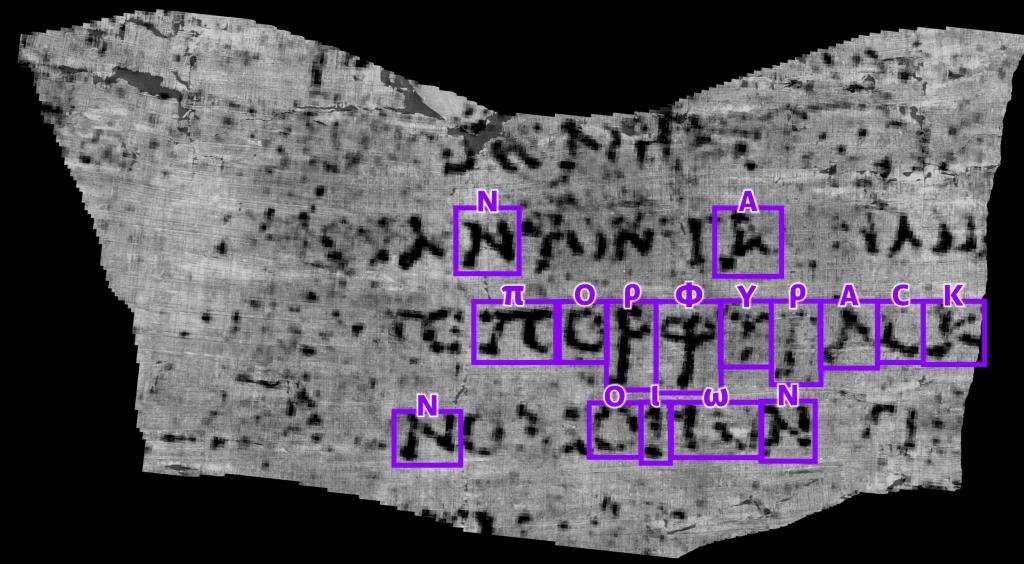
In a stunning breakthrough that bridges ancient history and modern technology, a 21-year-old computer science student named Luke Farritor has successfully deciphered the first word from the long-mysterious Herculaneum scrolls. These scrolls, which were carbonized during the catastrophic eruption of Mount Vesuvius in 79 CE, have baffled scholars for centuries, but Farritor’s achievement shines a light on their hidden secrets.
Farritor, a student at the University of Nebraska-Lincoln, triumphed in the Vesuvius Challenge, a groundbreaking initiative aimed at unlocking the secrets of these fragile artifacts. Discovered in the 1700s in a villa thought to belong to Julius Caesar’s father-in-law, the scrolls have remained largely unreadable due to their delicate condition. However, advances in artificial intelligence (AI) are finally making it possible to study these ancient texts without physically unrolling them.

The Vesuvius Challenge, spearheaded by Brent Seales from the University of Kentucky and supported by Silicon Valley funding, has attracted over 1,500 research teams eager to tackle this unique puzzle. Farritor’s monumental discovery of the word “porphyras,” an ancient Greek term meaning “purple,” was made possible through a machine learning algorithm he developed. This remarkable feat not only earned him a $40,000 prize but also paves the way for the potential decoding of the remaining 800 scrolls.
Participants in the challenge utilized 3D X-ray imaging techniques, which allowed them to explore the scrolls’ intricate details without physical contact. The challenge builds on Seales’ previous work, which successfully used CT scans to virtually unwrap the En-Gedi Scroll in 2016. The unique challenges posed by the Herculaneum scrolls, particularly their carbonized state and the use of charcoal ink, required innovative approaches to deciphering the texts.

Farritor’s algorithm honed in on subtle surface textures known as ‘crackle,’ which another contestant, Casey Handmer, had identified in the scans. This crackle pattern indicated the presence of ink, prompting Farritor to train his model to recognize and interpret the letters. His efforts culminated in the groundbreaking revelation of the word “porphyras,” marking a significant advancement in the quest to unlock this ancient library.
The implications of this discovery extend far beyond Farritor’s personal achievement. Papyrologist Federica Nicolardi from the University of Naples Federico II expressed her enthusiasm for the potential impact on our understanding of the ancient world. She noted that the texts preserved in the Library of Herculaneum are unique, offering new insights that could expand our knowledge of ancient literature.
Reflecting on the collaborative nature of the Vesuvius Challenge, Seales remarked, “We were able to enlist more than a thousand research teams to tackle a problem that typically would involve only a handful of people.” The challenge continues to motivate researchers globally, with a grand prize of $700,000 awaiting those who can identify four separate passages of at least 140 characters.
Seales envisions a future where machine learning could unlock other “invisible libraries,” including texts hidden within medieval book bindings and ancient Egyptian mummy cases. As Farritor continues to apply his models to other sections of the scrolls, the anticipation builds for what other ancient words and stories might soon be revealed. What other secrets lie within the ashes of history, waiting to be uncovered?


