On March 18, 1877, a volunteer force of buffalo hunters launched a dawn assault on a Comanche camp in Yellow House Canyon, near present-day Lubbock, Texas. The attack, intended as a decisive strike, quickly turned into a desperate defensive fight that exposed the mounting violence between commercial hide hunters and Plains tribes during the final years of the Southern buffalo herds. The confrontation grew out of a conflict known as the Buffalo Hunters’ War, a largely overlooked chapter of the Old West in which industrial-scale hunting and federal policy collided with the survival of both the bison and the Comanche way of life. By the mid-1870s, the American bison population, once numbering inthe tens of millions, was in freefall.
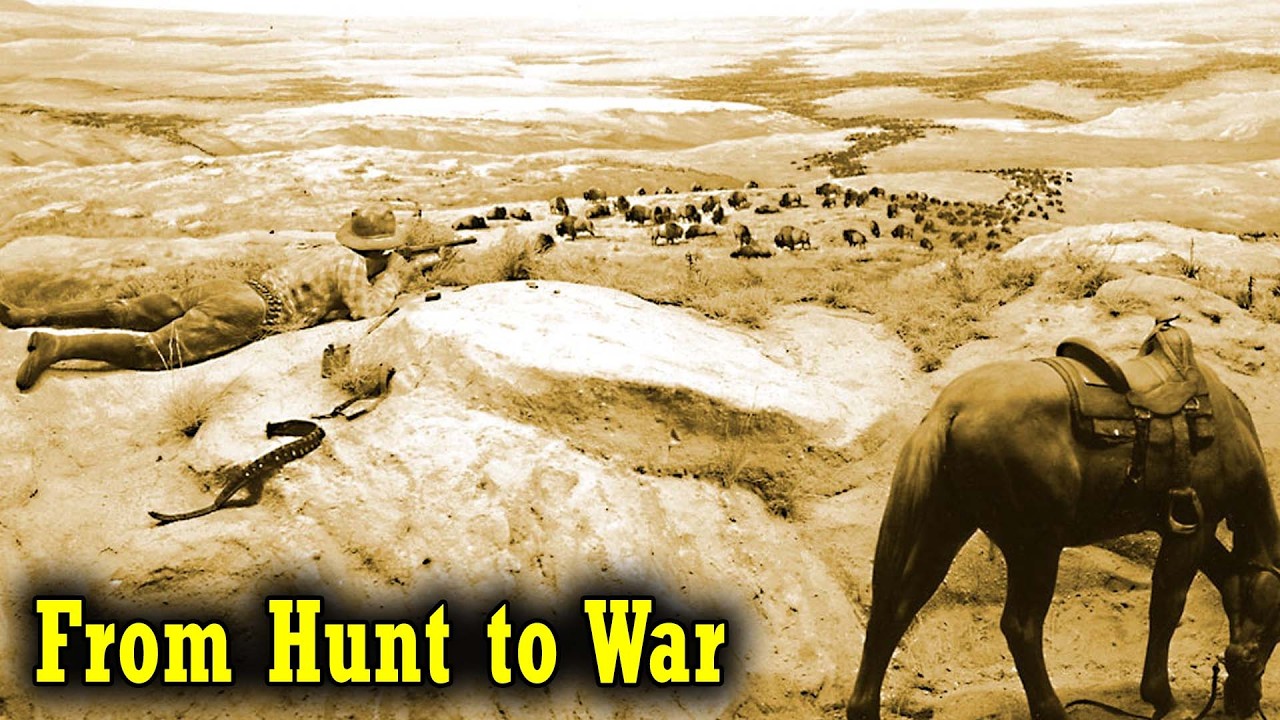
Federal strategy encouraged the reduction of herds to weaken Plains tribes, while the economic downturn known as the Panic of 1873 pushed thousands of men into the commercial hide trade. Buffalo hunting had become a coordinated industry, with organized crews of hunters, skinners, cooks, and support workers supplying Eastern markets with leather and robes. In December 1876, Comanche leader Black Horse led around 170 people, including members of his band and a young captive named Herman Lehmann, onto the Staked Plains of West Texas. The group had permission to hunt, as government food supplies at the Fort Sill reservation were running short.
But as they traveled, they found widespread evidence of commercial buffalo harvesting, with large quantities of meat left unused. Disturbed by what they saw, Black Horse and his followers chose not to return to the reservation, instead wintering in Pocket Canyon and preparing to respond to the intruders. Their frustration was part of a broader unrest among Plains tribes, who had already reported similar conditions farther north at the Darlington Agency in Oklahoma. The commercial trade had grown rapidly around Fort Griffin, Texas, where entrepreneur Charles Rath established the trading post known as Rath City along the Brazos River in 1875.
The outpost attracted dozens of hunters, including future lawman Pat Garrett, and newspapers as far away as Fort Worth began publishing hide prices tied to markets like Galveston. By 1877, the Southern Plains hide industry was worth over a million dollars, drawing hunters from regions like Kansas, where buffalo were already becoming scarce. One such hunter, Charles Buffalo Jones, later admitted he was concerned about the scale of the harvest, but continued due to financial pressures. As spring approached in early 1877, Black Horse’s group began taking action against hunters operating inthe region.
In one of the first incidents, they confronted Marshal Sewall, a hunter working near the headwaters of the Salt Fork. Sewall died during the encounter, and nearby hunters who escaped made their way to Rath City to report the news. A group of armed men returned to the site, buried Sewall, and captured a Comanche individual known as Spotted Jack before returning. Other camps, including those associated with Pat Garrett and Willis Glenn, reported similar raids in which supplies and horses were taken.
As word spread, hundreds of hunters andre frontiersmen gathered at Rath City, organizing themselves into adefensive and pursuit force under the guidance of Smokey Hill Thompson, an experienced plainsman. One group stayed behind to protect the settlement, while another prepared to track the Comanche band. Leadership of the expedition was given to Hank Campbell, with Jose Tafoya, a guide familiar with the region and prior service with military campaigns such as the Battle of Palo Duro Canyon, serving as scout. Navigation proved extremely difficult across the vast, largely featureless Staked Plains, and even experienced frontiersmen like Charles Buffalo Jones later admitted they were uncertain of their exact position.
After several days of travel, including an early error when Tafoya led them off course, the expedition reached the rugged edge of the Caprock near what is now Post, Texas. They located the Comanche encampment in Yellow House Canyon and prepared a coordinated approach, leaving supplies behind to move faster under cover of darkness. During the night of March 17th, Tafoya briefly led the party down the wrong branch of the canyon before correcting course. Once in position, the force divided into three units: two mounted groups along the canyon rim on opposite sides, and a third group proceeding on foot along the canyon floor toward the camp.
At first light on March 18th, they advanced simultaneously, attempting to catch Black Horse’s band by surprise. The Comanche, however, regrouped quickly. Realizing the attacking force was relatively small, warriors organized a defense while others climbed the canyon slopes to gain higher ground. From these positions, they challenged the hunters and disrupted their formation, using their knowledge of the terrain to spread out along the canyon edges.
They also used environmental tactics, such as smoke from burning grass, to limit visibility and movement. Reports from guide Jose Tafoya suggested the defenders included not only Comanches but also allied Apache fighters. Several hunters were injured in the exchange, including Joe Jackson, who had to be pulled back to safety. At one point, a mounted warrior attempted to rally a counterattack, drawing the attention of hunters like Jones, who warned his companions to remain alert to flanking maneuvers.
Despite their efforts, the hunters found themselves increasingly outnumbered. By mid-afternoon, the expedition’s leader ordered a withdrawal toward Buffalo Springs, using diversion tactics, including controlled fires, to obscure their movements. After several days of travel, the survivors made their way back to Rath City, though some participants remained seriously injured and not all would recover. Historical accounts of the encounter vary widely, particularly regarding casualty numbers.
US Army reports, based on later interviews with Comanche participants, estimated several dozen losses among native forces, though such figures remain debated by historians. Records for the buffalo hunters are even less consistent, with different sources offering conflicting numbers. The outcome strengthened Black Horse’s resolve. In the weeks that followed, his group carried out additional raids against buffalo hunters, targeting isolated camps and disrupting their operations.
On May 1st, a large number of warriors rode into Rath City, creating chaos as they moved through the settlement and drove off many of the horses belonging to the hunters. In response, the US Army assigned the 10th Cavalry Regiment to pursue Black Horse’s band. After a brief engagement, most of the Comanche group chose to return to the reservation. The Battle of Yellow House Canyon is often viewed as one of the final significant confrontations between native groups and buffalo hunters on the High Plains of Texas
Within just a few years, the Southern buffalo herds had declined dramatically.
Hunters such as Joe McCombs, who had once collected hundreds of hides within a few months, began to notice fewer animals and thinning herds. This rapid decline reflected the unsustainable scale of commercial hunting during that period. One of the era’s most notable figures, Charles Buffalo Jones, later dedicated much of his life to preserving the species he had once helped exploit. In 1902, he played a key role in early conservation efforts at Yellowstone National Park, helping establish herds that contributed to the species recovery.
What began as a profitable frontier industry ultimately led to near extinction, followed by one of the earliest conservation movements in North America. The Buffalo Hunters’ War stands as a revealing chapter of the Old West, where profit, survival, and cultural survival collided on the open plains. In its aftermath, the near disappearance of the buffalo reshaped the land, the people, and the future of the American frontier itself