Hollywood built its stagecoach legend from the outside looking in. Audiences were taught to admire the racing horses, the towering driver, and the heroic passengers framed against a glowing sunset. It looked like freedom in motion across an open frontier. But what the cameras always avoided was what happened the second the door closed and the romance collapsed fast.
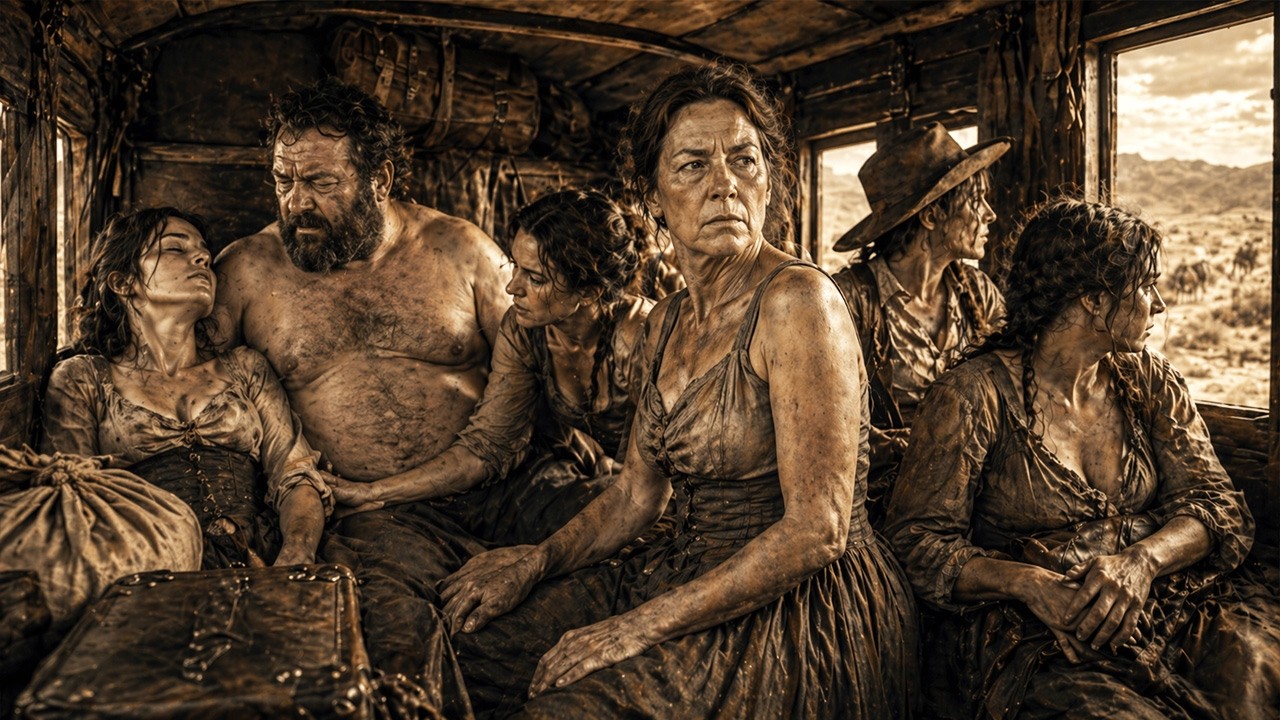
The truth is that stagecoach travelin the Old West rarely felt like a grand adventure and far more often felt like being locked inside a rolling box designed to test exactly how much misery a human body could absorb. The famous Concord stagecoach became the symbol of American frontier expansion because it was tough enough to survive brutal roads. It was not built for comfort. It was built to keep moving, whether carrying passengers, gold, or mail.
That single detail changes everything about how the West should be understood: wide open on the outside, cramped chaos inside. _
The misery began immediately. A coach filled with strangers meant your knees pressed into someone else’s legs, your shoulder rubbed against a man who had not bathed in days, and there was no room to stretch, lie down, or escape. Dust pushed through every crack and curtain until it coated clothes, skin, hair, and teeth.
On dry routes, the inside turned into a moving cloud of grit. On hot days, sweat mixed with it. On long trips, the smell of bodies, leather, stale clothes, and human waste became something passengers remembered for years. This was not an accident of bad luck.
It was business. Stagecoach companies were not selling comfort; they were selling movement. Mail had to move, gold had to move, and passengers had to move, with speed and volume valued far above human comfort. By the late 1850s, long-distance lines crossed enormous parts of the country, with some services like the Butterfield Overland Mail running day and night over thousands of miles with very little real rest.
That ambition sounded modern and exciting on paper. In reality, it meant days of shaking, dust, heat, cold, and exhaustion that would wear down even the strongest travelers in modern times, let alone in an un-sprung wooden coach_
The design itself worked against the passengers. Leather straps suspended the coach body to handle rough terrain, but that meant endless swaying and jolting. Every rut threw bodies sideways, every rock sent shocks through spines, every hole snapped necks forward and back.
This was not travel; it was a beating repeated mile after mile. Even without a bullet wound or a broken arm, passengers could step out of the coach half-destroyed: aching spines, ringing heads, churning stomachs, burning eyes, and shattered nerves. The road did not need to kill you to leave its mark; it only needed to keep hitting you long enough_
And then there was the air itself, something Hollywood never lingers on. Real passengers had no choice but to breathe dirt.
Dust settled on faces, dried out throats, filled mouths with grit. After enough hours, breathing itself felt heavy. A person can tolerate discomfort for a short time, but when the dirt, heat, hard seats, and constant jolting never stop, the body does not recover. It only gets more exhausted.
That exhaustion opened the door toan even deeper kind of strain\
Crowding created its own tension. Passengers were pressed against strangers for hours, sometimes much longer, with almost no privacy and no escape from someone else’s smell, nerves, or sickness. Small irritations grew quickly: a crying child, a sour temper, a bad odor, a nervous passenger asking too many questions. Each one added pressure.
Many stagecoach lines kept moving at night, meaning proper sleep was rare. A passenger might drift off for a few minutes while sitting upright only to be jerked awake by the next rut. After days of that pattern, thoughts slowed, tempers shortened, and fear became harder to control. A sound outside seemed larger than it was.
A shadow looked suspicious. A normal delay felt like the beginning of disaster_
Hunger did not offer relief. At remote stations, food was whatever happened to be available, and often it was old, poorly stored, or unsafe. Water quality was its own gamble.
A passenger who ate bad meat or drank tainted water could fall ill very quickly, and on a frontier route that was far more serious than it sounds today. A stomach problem in a city is miserable; in the middle of the long journey, it could become a crisis, with weakness, fever, vomiting, or dehydration turning into an extreme danger far from any real treatment. ||||
When considering danger, outlaws often come to mind first. Yes, robberies were real, because stagecoaches carried money, mail, gold, and valuables, making them obvious targets.
Companies knew this, which is why armed guards riding beside the driver became part of the enduring image. But robbery was only one part of the fear. In fact, what often tormented passengers most was waiting—watching every bend, every rider in the distance, every lonely stop. Even when nothing happened, the possibility of violence never fully left them.
This steady tension changed the mood inside the coach. At the start, people talked, joked, and acted confident. A few days later, many fell quiet, too sore to relax, too tired to think clearly, and too uneasy to trust the road ahead. The journey stripped away excitement and left raw endurance behind.
That was often the true horror of stagecoach travel: the road did not have a face, the dust did not, the hunger did not, and the exhaustion did not. The most dangerous part was rarely one dramatic event; it was the accumulation of endless smaller ones
For many passengers, the deep suffering was not merely physical or economic. It was psychological. A long trip across dangerous country could leave people jumpy, sleepless, suspicious, and permanently shaken, especially if they witnessed robbery, deadly accidents, attacks, or sudden death along the route.
Modern viewers sometimes imagine trauma as something only studied in later wars, but human beings did not suddenly invent psychological damage in the 20th century. Frontier travelers carried terror with them for years, even if their world lacked the language to describe it. Men who were expected to stay tough often said little. Women were expected to move on.
Children absorbed what they saw and kept going because there was no other choice. That silence became part of the myth, because when painful experiences are not fully described, legends rush in to replace them. Heroic stories are easier to repeat than anxious memories_
||||
Beyond the physical suffering, the stagecoach revealed uncomfortable truths about how the West actually worked. The frontier liked to present itself as a place where old class and social barriers disappeared.
Yet the coach kept reproducing them in miniature. Wealthier passengers could afford better seats and treatment, while poorer travelers got whatever space was left, sometimes riding outside with the baggage. Status still mattered. Money still mattered.
Respectability still mattered. The West did not magically erase class divisions; it simply repackaged them under the language of opportunity_
The exclusion extended even further. Many groups found the open horizons closed in practice. Native Americans, Chinese laborers, immigrants, and others faced open discrimination, either through company rules or through decisions made by drivers and agents who decided who was welcome and who was not.
Even before formal systems of segregation hardened in later decades, habits of exclusion were already shaping who could move freely, who had to wait, and who was treated as a problem rather than a paying customer. This matters because the stagecoach was supposed to represent civilization pushing westward, yet civilization on those routes often meant institutionalized inequality backed by private business interests
The frontier was also shaped by companies chasing profit with almost no concern for fairness. Stage lines did not exist to make life easier for ordinary people; they existed to move mail, money, and passengers in ways that generated revenue. Whenever comfort or safety got in the way of that goal, comfort and safety usually lost.
Crowded cabins, brutal schedules, unreliable treatment, inflated fares, and weak accountability were not random flaws in an otherwise noble system. They were a predictable result of a business model that rewarded speed, volume, and control. On some routes, passengers paid enormous sums for the chance to endure terrible conditions because the companies operating those lines controlled access to movement itself. If you wanted to go west quickly or carry valuables or reach a growing settlement on time, you often had no alternative.
That gave transportation firms extraordinary leverage, and they were not shy about using it
The irony is hard to miss. For generations, Americans were taught to see the stagecoach as proof of frontier courage, when it also served as proof that corporations understood something very early: if people are desperate enough, they will pay dearly for discomfort, risk, and false promises. The dream of the West kept customers coming, but the reality of the trip showed what happened when hope met monopoly. The company sold a vision of a better life, yet the journey itself revealed that ordinary travelers had very little power once they climbed aboard\
So when Hollywood presented the stagecoach as a symbol of national courage, it was telling a comforting story rather than the complicated truth.
The real stagecoach was not just a vehicle that carried people across the country. It was a moving display of power, money, inequality, and fear, a rolling lesson in how expansion really worked, who benefited most, and what ordinary people were expected to endure in silence to keep that expansion moving. The discomfort, the dust, the class divisions, the discrimination, and the corporate greed behind the journey were the parts the camera always cut away from. Because once you admit what stagecoach travel actually felt like, the whole myth of the romantic, freeing frontier starts to fall apart, and what remains is the far more honest story of endurance, survival, and the harsh cost of building a nation_
||||
Contrary to the polished legend, real stagecoach travel often made outlaws seem like leas frightening part of the journey, because at least outlaws had a face and a clear motive.
The road itself, however, did not relent; the dust, hunger, exhausted nerves, and constant jolting never gave a moment’s peace. A wheel hitting the wrong angle or a horse losing balance could tip the coach or break it apart with terrifying speed, turning passengers into loose bodies inside a rolling box of wood and iron. A fall tothe ground could mean broken bones, crushed limbs, or worse, and if the horses panicked, the chaos multiplied. Before anyone even considered robbers, they already had excellent reasons to fear the ride itself_.
The slow breakdown of body and mind, added to the social humiliations hidden inside the cabin, proved that the deadliest enemy for many Westward travelers was never a single dramatic event_. It was the total experience of being locked inside a machine built to extract maximum movement from those who could afford no other way across the frontier_