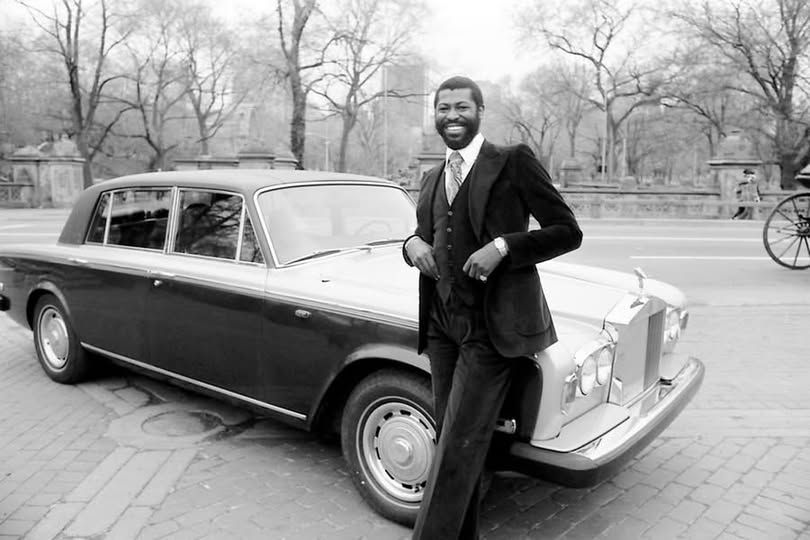
The Rolls-Royce was suddenly moving too fast.
Tanika Watson looked at Teddy Pendergrass behind the wheel and immediately knew something was wrong.
“Teddy… slow down.”
But he wasn’t accelerating.
He was fighting the car.
His hands tightened around the steering wheel as the massive Rolls-Royce raced along Lincoln Drive in Philadelphia.
“I realized he was struggling with the wheel,” Tanika would remember decades later.
Then—
BANG.
Metal folded.
Glass shattered.
The Rolls-Royce slammed into a tree.
And in a matter of seconds, one of the biggest stars in soul music went from the height of his career to trapped inside the wreckage of his own car.
Beside him was a woman almost nobody knew.
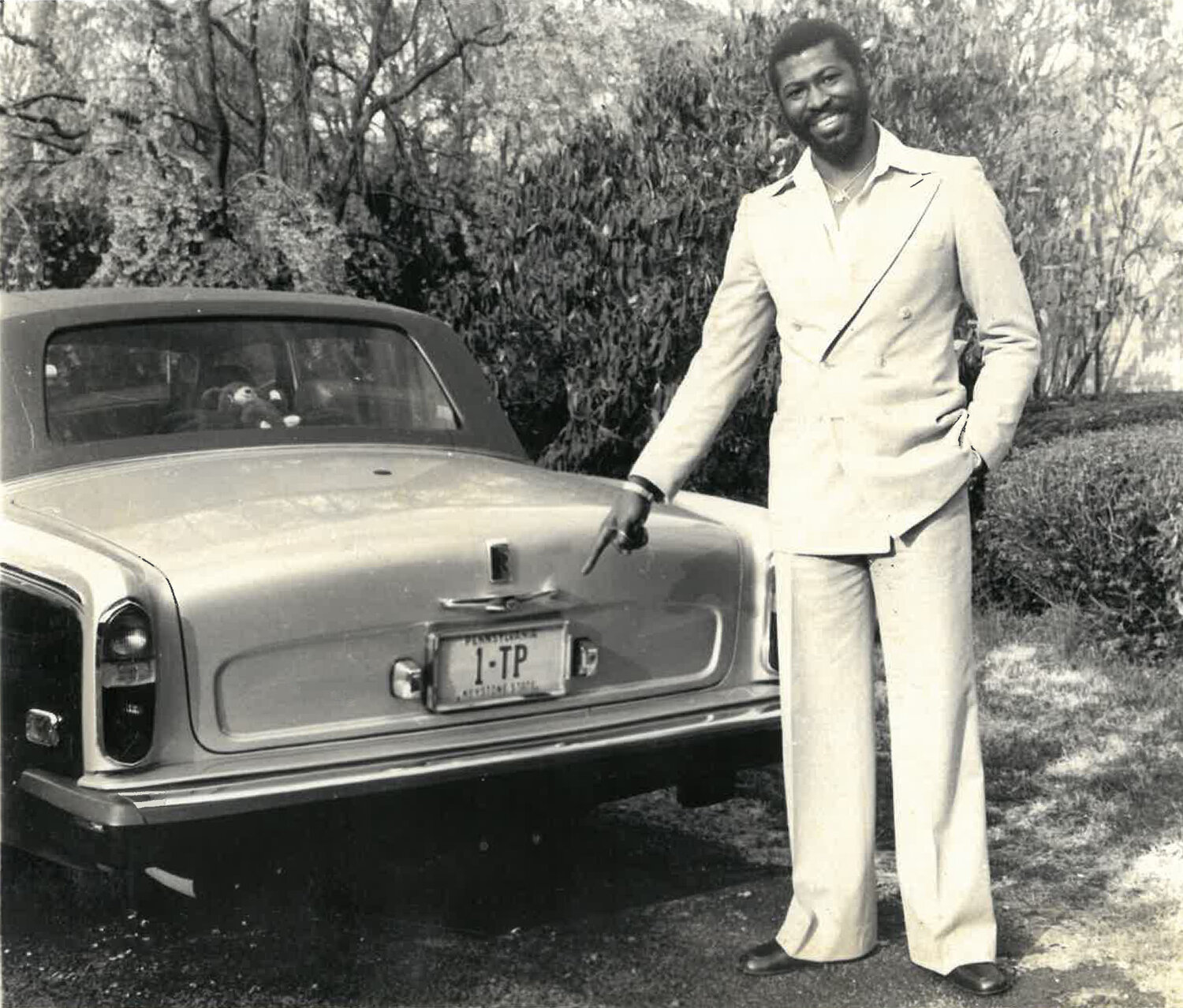
Her name was Tanika Watson.
Within days, however, millions of people would know who she was.
And instead of asking only what had happened to Teddy Pendergrass, newspapers began asking another question:
Who was the mysterious woman riding beside him that night?
March 18, 1982.
Teddy Pendergrass was thirty-one years old and one of the most recognizable voices in American R&B.
He had already conquered the music world as the powerful lead singer of Harold Melvin & the Blue Notes before becoming an enormously successful solo artist.
His voice was unmistakable.
His stage presence was magnetic.
His concerts drew devoted audiences, particularly women.
Songs like “Close the Door,” “Turn Off the Lights,” and “Love T.K.O.” had transformed him into a major sex symbol.
Teddy wasn’t simply successful.
He seemed unstoppable.
And then came that night in Philadelphia.
Teddy was driving his Rolls-Royce through the East Falls section of the city with Tanika Watson in the passenger seat.
According to reports, no other vehicle was involved.
Somehow, Teddy lost control.
The Rolls-Royce left the road and struck two trees.
The impact was devastating.
For approximately forty-five minutes, Teddy and Tanika remained trapped inside the wreckage while rescuers worked to free them.
Tanika escaped with relatively minor injuries.
She suffered bruising from the impact and chipped a tooth.
Teddy’s injuries were catastrophic.
His spinal cord had been severely damaged.
The singer who had commanded stages across America would never walk again.
He was paralyzed from the chest down.
But even before the full extent of Teddy’s injuries became public, another story was beginning to grow around the crash.
Because people wanted to know who had been sitting beside him.
And Tanika Watson would soon find herself at the center of an extraordinary media storm.
For nearly thirty years, she largely remained silent about what happened that night.
Then, in 2014, she appeared on Oprah: Where Are They Now? and finally told the story from her perspective.
And according to Tanika, her connection with Teddy had begun years before the accident.
Back in the 1970s, she lived near a recording studio Teddy frequently used.
She knew exactly who Teddy Pendergrass was.
Everybody did.
His music was everywhere.
Her family listened to him.
She was a fan herself.
And she remembered thinking he was extraordinarily handsome.
Then one day, while walking down the street near her home, she noticed a Rolls-Royce.
The driver called her over.
It was Teddy Pendergrass.
But Tanika didn’t immediately recognize what was happening.
In fact, the expensive car made her suspicious.
She wasn’t accustomed to seeing people casually driving Rolls-Royces through the neighborhood.
She later joked that she initially thought Teddy might be a pimp.
So she ran away.
But that strange encounter wasn’t the last time their paths crossed.
Eventually, Teddy and Tanika became acquainted.
Then came March 18, 1982.
That evening, Tanika was with Teddy when he offered to drive her home.
“Would you like a ride?”
“Sure.”
She climbed into the Rolls-Royce.
At first, there was nothing extraordinary about the drive.
Just two people traveling through Philadelphia at night.
Then the car began accelerating.
Faster.
And faster.
Tanika became frightened.
She looked toward Teddy.
At first, she thought he was deliberately speeding.
Then she saw his face.
Something was wrong.
He wasn’t playing around.
He wasn’t trying to impress her.
He was struggling.
According to Tanika’s later account, Teddy appeared to be fighting desperately with the steering wheel.
The car was out of control.
There was almost no time to react.
Then came the impact.
A deafening crash.
The front of the Rolls-Royce crumpled against the trees.
Everything stopped.
For a moment there was only confusion.
Pain.
Broken glass.
Twisted metal.
Tanika realized she was injured, but conscious.
Teddy was in much worse condition.
She tried to help him as much as she could while they waited to be rescued.
Eventually, emergency crews reached them.
And according to Tanika’s recollection, something about those first moments after the accident showed just how famous the man beside her really was.
The press seemed to appear almost immediately.
Remember, this was 1982.
There were no smartphones.
No Twitter.
No Facebook Live.
No ordinary bystander could instantly broadcast footage around the world.
Yet news that Teddy Pendergrass had crashed his Rolls-Royce traveled quickly.
He was that famous.
Tanika was taken away for medical treatment.
Her injuries were minor compared with Teddy’s.
At first, she didn’t even know how badly he had been hurt.
Then she saw the newspapers.
Teddy Pendergrass was paralyzed.
The realization hit her hard.
The man who had been sitting beside her only hours earlier—the charismatic performer who moved freely across stages in front of thousands—had suffered a spinal cord injury that would permanently change his life.
Tanika wanted to see him.
She went to the hospital.
But according to her account, she never got through the door.
A woman confronted her.
“You’re not going to see him.”
An argument followed.
Tanika eventually left.
She tried to reach Teddy after the accident but was unsuccessful.
And then, just two days after the crash, the story took another dramatic turn.
The media began digging into Tanika Watson’s private life.
They learned that she was a transgender woman who had undergone gender-affirming surgery several years earlier, reportedly around 1977.
She had worked as a nightclub performer and aspiring model and had also done sex work.
Suddenly, the focus wasn’t only Teddy’s condition.
It was Tanika.
Headlines began emphasizing who she was and why she had been in Teddy Pendergrass’s car.
Rumors exploded.
Speculation spread about Teddy’s private life and about what the two had supposedly been doing before the accident.
For Tanika, the experience was devastating.
She had survived a terrifying car crash.
A man she knew had suffered life-changing injuries.
And almost immediately afterward, deeply personal details about her life were being exposed publicly.
For decades, the mystery surrounding that night continued.
Different stories circulated.
People speculated about the cause of the crash.
Others focused almost entirely on the identity of Teddy’s passenger.
But Tanika maintained that the truth was far less sensational than the rumors.
According to her account, Teddy had simply offered her a ride.
Then the Rolls-Royce began speeding uncontrollably.
She saw him struggling with the steering wheel.
And seconds later, they crashed.
No second vehicle.
No dramatic chase.
Just a luxury car suddenly out of control and a few terrifying seconds that changed two lives.
Teddy Pendergrass faced the hardest battle of his life.
Doctors initially gave him little reason to believe he would regain movement below his chest.
For a performer whose body had been such an important part of his stage presence, the psychological impact was enormous.
Everything had changed overnight.
His independence.
His career.
His identity.
His future.
But Teddy refused to disappear.
He underwent rehabilitation and gradually learned how to rebuild his life as a quadriplegic.
And eventually, something remarkable happened.
He returned to music.
In 1984, Teddy released Love Language.
Then, on July 13, 1985, millions of television viewers witnessed an unforgettable moment.
Live Aid.
Philadelphia.
Teddy Pendergrass appeared onstage in a wheelchair.
The crowd erupted.
It was his first live performance since the crash.
Three years earlier, he had been pulled from the wreckage of a Rolls-Royce with a devastating spinal injury.
Now he was back in front of an audience.
He couldn’t perform the way he once had.
But the voice was still there.
The presence was still there.
Teddy Pendergrass was still there.
Meanwhile, Tanika Watson largely disappeared from the public narrative.
For years, people discussed her without hearing much from her.
She became “the passenger.”
The mysterious woman.
The person whose identity had fueled decades of gossip.
But she was also someone who had been inside that car.
Someone who had watched Teddy fight the steering wheel.
Someone who heard the impact.
Someone who survived.
And someone who had tried to visit him afterward.
More than three decades later, she finally sat down publicly and told the story herself.
Not the tabloid version.
Not the rumors.
Her version.
She remembered Teddy as a superstar, yes.
But she also remembered the man who stopped his Rolls-Royce and called her over on a Philadelphia street.
The handsome singer she initially ran away from.
The man who later offered her a ride home.
And finally, the terrified driver struggling desperately with a car he could no longer control.
For Teddy Pendergrass, March 18, 1982 divided his life into two parts.
Before the crash—
and after it.
Before, he was one of R&B’s most electrifying performers, seemingly approaching even greater fame.
Afterward, he had to learn how to live inside a body that no longer responded the way it once had.
But for Tanika Watson, that night created another dividing line.
Before the crash, she was largely unknown outside her own world.
Forty-five minutes trapped inside Teddy Pendergrass’s wrecked Rolls-Royce changed that forever.
Within days, strangers knew intensely personal details about her.
And for decades, people constructed their own versions of what happened.
That’s perhaps the most haunting part of the story.
Two people entered that Rolls-Royce that night.
Both survived.
But neither walked away with the same life they had before.
Teddy lost the physical freedom that had defined his electrifying performances.
Tanika lost something less visible—the ability to control her own story.
And it would take more than thirty years before the woman sitting beside Teddy Pendergrass that night finally stepped forward and said:
This is what I remember happening.