“Please… let me go with my wife. She’s pregnant.”
John Jacob Astor IV stood on the freezing deck of the Titanic as the ship slowly disappeared beneath him.
Beside the lifeboat was Madeleine—his eighteen-year-old wife, five months pregnant with his child.
Only months earlier, their marriage had scandalized New York.
People whispered about their age difference.
His friends had turned against him.
Members of high society had snubbed his young bride.
So Astor had taken Madeleine away, hoping that by the time they returned, the gossip would finally be over.
Instead, they booked passage home aboard the most famous ship in the world.
Now, in the darkness of April 15, 1912, Astor watched Madeleine climb into a lifeboat.

He asked whether he could accompany her because of her condition.
The answer was no.
Women and children first.
Astor stepped back.
Madeleine sailed away.
She would never see her husband alive again.
And the child inside her would enter the world four months later carrying the name of a father he had never met.
But the tragedy aboard Titanic was only the final chapter of a scandal that had begun years earlier.
Because John Jacob Astor wasn’t simply another wealthy passenger.
He was one of the richest men in America.
And Madeleine wasn’t simply his wife.
She was a teenager young enough to be almost the same age as his own son.
John Jacob Astor IV had been born into a world most Americans could barely imagine.
Born in 1864, he inherited one of the most powerful names in American society.
The Astors represented old money, influence, real estate, and social prestige.
John attended Harvard and eventually became involved in managing the enormous family fortune.
He invested.
He wrote.
He served in the military.
And he expanded the family’s already formidable presence in New York real estate.
In 1897, he opened the Astoria Hotel beside the Waldorf Hotel built by his cousin and rival William Waldorf Astor.
Eventually, the properties became associated with one legendary name:
The Waldorf-Astoria.
But behind Astor’s enormous wealth was a personal life that would eventually become irresistible material for the newspapers.
In 1891, John married Ava Lowle Willing.
It was exactly the kind of marriage expected from two people occupying America’s highest social circles.
Their wedding took place at her family’s mansion in Philadelphia.
Their honeymoon stretched from the Poconos to Europe.
They eventually had two children.
Their son, Vincent, was born in 1891.
Their daughter, Ava Alice, followed several years later.
From the outside, they appeared to have everything.
Money.
Children.
Status.
Properties.
A name recognized throughout America.
But appearances were deceptive.
After nearly two decades of marriage, the relationship collapsed.
And in 1909, John and Ava divorced.
Today, the divorce of two wealthy celebrities might generate headlines for several days and disappear.
In Astor’s world, it was something far more serious.
Divorce carried social consequences.
Especially among America’s old-money elite.
And especially when allegations of infidelity surrounded the breakup.
Suddenly, the private problems of one of America’s most prestigious families became newspaper material.
The Astors could no longer control the story.
And then John made a decision that turned an embarrassing divorce into a full-blown society scandal.
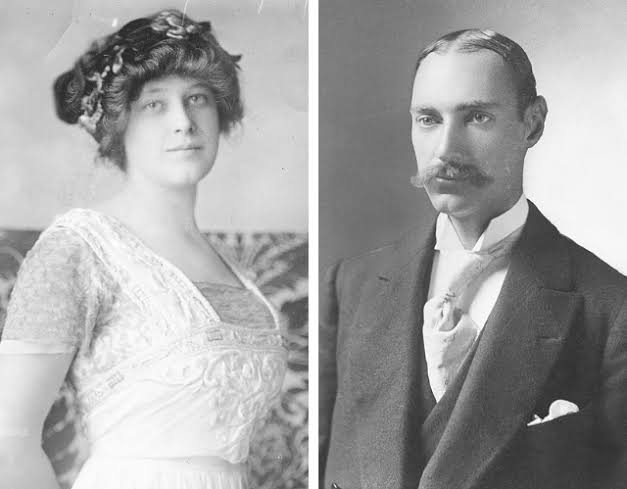
He fell in love with Madeleine Talmage Force.
She was beautiful.
Young.
Socially connected.
And eighteen years old.
John was forty-seven.
Even more awkwardly, Madeleine was only slightly older than Astor’s own son, Vincent.
The age difference wasn’t quietly ignored.
People talked about it openly.
Newspapers covered it.
Friends judged him.
Members of society who had once welcomed Colonel Astor began treating his relationship as an embarrassment.
The richest man in the room suddenly became the man everyone whispered about.
But John wasn’t backing down.
Neither was Madeleine’s family.
Whatever people thought of their relationship, Madeleine would not simply remain the rich older man’s young companion.
Marriage was coming.
And when it did, the outrage intensified.
On September 9, 1911, John Jacob Astor IV married eighteen-year-old Madeleine Force.
For John, it may have represented the beginning of a new life.
For New York society, it was scandal.
The consequences became almost absurd.
One newspaper even reported the story of a distant Astor relative who lost a painting job simply because his employer discovered that he was related to John Jacob Astor.
The scandal had become attached to the family name itself.
And the most painful rejection came from the social world the Astors had helped create.
For years, Manhattan’s elite had revolved around an exclusive group popularly known as “The Four Hundred.”
The term was closely associated with Caroline Astor—John’s own mother.
These were supposedly the people who represented the highest level of New York society.
The families with the right names.
The right fortunes.
The right invitations.
The right marriages.
John belonged to that world by birth.
Madeleine did not receive the same welcome.
In early 1912, the couple was expected to host a major social event.
But reports indicated that Madeleine had been snubbed.
The message was obvious.
John Jacob Astor might possess an extraordinary fortune.
But money could not force society to embrace his teenage bride.
So John did what extremely wealthy people often did when home became uncomfortable.
He left.
He took Madeleine on an extended honeymoon.
They traveled through Europe.
Then Egypt.
Away from New York, they could escape the newspapers, the whispers and the people who looked at their marriage with contempt.
And during that honeymoon, Madeleine became pregnant.
That changed everything.
Eventually, they needed to return home.
And an extraordinary opportunity appeared.
A magnificent new ocean liner was preparing for its maiden voyage across the Atlantic.
RMS Titanic.
It was enormous.
Luxurious.
Technologically impressive.
For a couple accustomed to the finest things money could buy, Titanic was the obvious way to return to New York.
John and Madeleine booked first-class passage.
They weren’t traveling alone.
Because Madeleine was pregnant, Astor had arranged for additional assistance, including a private nurse.
They boarded Titanic at Cherbourg, France.
To other passengers, the couple immediately stood out.
There was Colonel Astor—the immensely wealthy American businessman.
And beside him was Madeleine.
Young.
Pregnant.
And already famous because of the scandal surrounding their marriage.
The gossip had followed them onto the ship.
Then came the night of April 14.
At approximately 11:40 p.m., Titanic struck an iceberg.
At first, many first-class passengers didn’t understand the seriousness of what had happened.
The ship seemed too enormous to be vulnerable.
Too sophisticated.
Too luxurious.
Too safe.
But below deck, seawater was entering compartments.
The impossible was happening.
Titanic was sinking.
As the danger became clear, John focused on Madeleine.
Whatever society thought of their marriage no longer mattered.
Whatever newspapers had written no longer mattered.
There was only one thing that mattered now.
Getting his pregnant wife off that ship.
John helped Madeleine toward the lifeboats.
Her maid and nurse were with her.
When the time came, Madeleine was placed aboard a boat.
Astor reportedly asked whether he might accompany his wife because she was pregnant.
He was refused.
The evacuation policy prioritized women and children.
Astor did not force his way aboard.
Instead, he remained behind.
Think about that moment.
This was a man whose wealth could open almost any door in America.
He had lived in mansions.
Built luxury hotels.
Moved among America’s most powerful families.
His name could influence businessmen, politicians and society figures.
But on the deck of Titanic, none of it mattered.
His money could not buy another seat.
His name could not stop the ocean.
His fortune could not keep the ship afloat.
Madeleine’s lifeboat descended toward the freezing Atlantic.
John remained on Titanic.
The distance between husband and wife slowly increased.
Then darkness swallowed the ship.
At approximately 2:20 a.m. on April 15, Titanic disappeared beneath the Atlantic.
More than 1,500 people died.
John Jacob Astor IV was among them.
Madeleine survived.
But for a short time, even newspapers struggled to determine who had lived and who had died.
Early reports contained significant errors.
Some papers initially listed Astor among the survivors.
It was understandable why people might believe it.
Surely one of the richest men aboard Titanic would have found a way off.
Surely first-class status would have protected him.
But it hadn’t.
Soon, the truth arrived.
John Jacob Astor IV was dead.
He was forty-seven years old.
Unlike many Titanic victims, however, his body was eventually recovered.
He was later buried at Trinity Church Cemetery in Manhattan.
The man who had spent his final months being ridiculed for marrying Madeleine had died after ensuring that she had a place aboard a lifeboat.
And Madeleine was carrying his final child.
Four months after Titanic sank, on August 14, 1912, she gave birth to a boy.
His name was John Jacob Astor VI.
The newspapers would eventually nickname him the “Titanic baby.”
His father had never seen him.
But Astor had remembered the unborn child in his estate planning.
The boy received a trust worth millions of dollars.
Madeleine also received substantial financial provisions.
There was, however, an important condition attached to part of her inheritance.
She could benefit from certain trusts and property as long as she did not remarry.
Eventually, Madeleine chose another life.
She remarried.
And by doing so, she surrendered some of the benefits connected to Astor’s estate.
Her later romantic life would bring its own difficulties and scandals.
But the shadow of Titanic never entirely disappeared.
Madeleine had been only eighteen when she married one of America’s richest men.
Nineteen when she watched him remain aboard the sinking Titanic.
And nineteen when she gave birth to his son.
She died in 1940 at only forty-six years old.
Yet more than a century later, the image of John and Madeleine Astor aboard Titanic remains strangely powerful.
Because their story contains almost everything that fascinated America during the Gilded Age.
Extreme wealth.
Old-money society.
Divorce.
A controversial romance.
A forty-seven-year-old millionaire marrying an eighteen-year-old woman.
Social rejection.
Pregnancy.
And finally—
Titanic.
There is also a bitter irony hidden inside the story.
John Jacob Astor had helped build the Astoria Hotel.
After Titanic sank, investigations were launched into the disaster.
And the American inquiry unfolded in New York, including proceedings associated with the Waldorf-Astoria.
A building connected to the Astor family’s enormous fortune became part of the setting in which people tried to understand the catastrophe that had killed John himself.
But perhaps the greatest irony is much simpler.
Before Titanic, society treated John Jacob Astor as a man powerful enough to create his own rules.
He had wealth almost beyond comprehension.
When his first marriage collapsed, he chose another woman despite public condemnation.
When society rejected Madeleine, he simply took her around the world.
He seemed capable of buying distance from almost every consequence.
Until the Atlantic.
On Titanic’s final night, John Jacob Astor became exactly what everyone else aboard that ship became:
A human being trying to survive.
His fortune couldn’t protect him.
His family name couldn’t protect him.
The social world that had spent months gossiping about his marriage couldn’t protect him.
And perhaps that is why one of the final images associated with his life remains so haunting.
A pregnant nineteen-year-old Madeleine sitting inside a lifeboat in the freezing darkness.
Titanic behind her.
Her husband still aboard.
Only months earlier, newspapers had treated their marriage like entertainment.
Now the scandal meant nothing.
Madeleine had escaped.
John hadn’t.
And somewhere beneath her coat was the unborn son who would carry the Astor name into another generation.
The child who would grow up surrounded by enormous wealth…
but would never once hear his father’s voice.