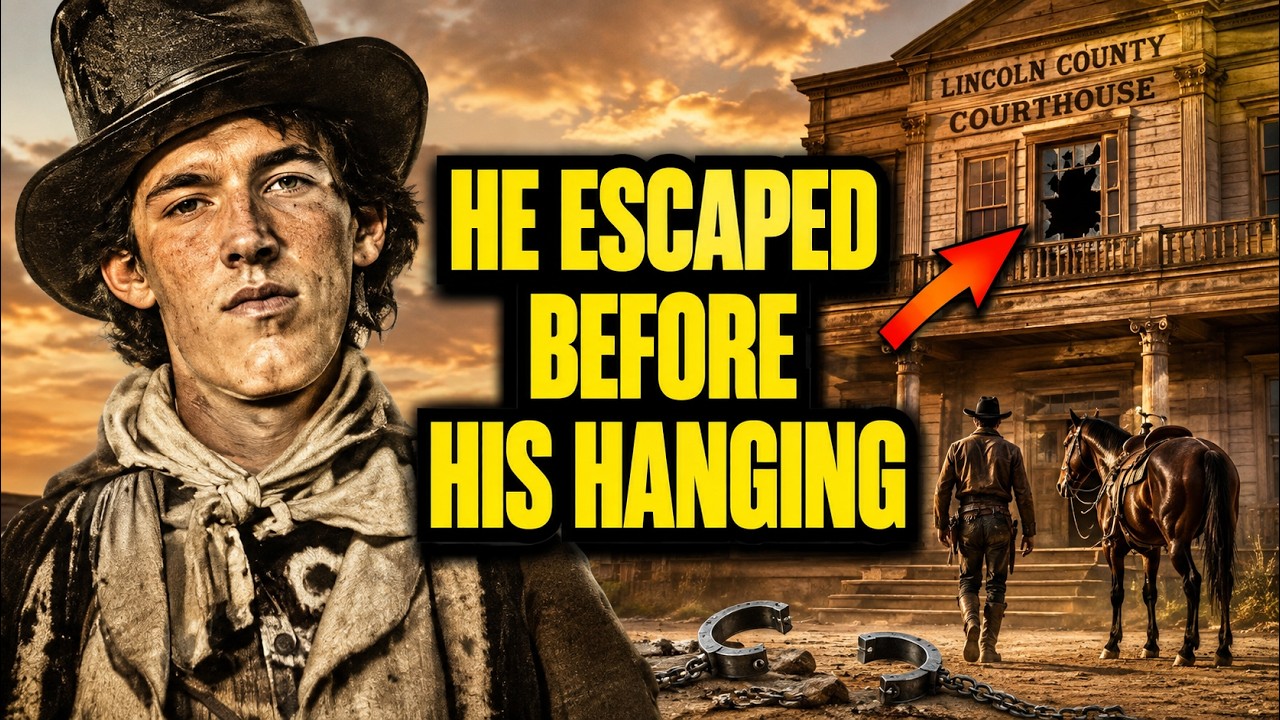
Billy the Kid was just 15 days away from execution when he escaped from a heavily guarded courthouse in Lincoln, New Mexico, leaving two dead lawmen behind. But the story behind that escape is more complex than the legend suggests, and several widely repeated details do not hold up under closer examination. The escape did not begin with a sudden arrest or a minor sentence. By April 1881, Billy was already a condemned prisoner.
Pat Garrett and his men had captured him in December 1880 near Stinking Springs after an extensive manhunt across the New Mexico Territory. He was taken to Mesilla for trial, where the main charge was the murder of Lincoln County Sheriff William Brady during the Lincoln County War of 1878. Billy was part of a faction known as the Regulators, a group that began with legal authority but drifted into outlawry as the conflict escalated. Several men took part in the attack on Brady, yet Billy became the only person convicted of murder related to the entire conflict.
A jury found him guilty of first-degree murder, and Judge Warren Bristol formally sentenced him on April 13, 1881. The execution date was set for May 13 in Lincoln. A popular story claims the judge told Billy he would be hanged three times, and that Billy responded with an insult of his own. There is no reliable court record confirming such an exchange ever took place.
The real situation was serious enough without it. Billy was returned to Lincoln under guard and handed over to Garrett at Fort Stanton on April 21. By the time he arrived, only 22 days remained before his scheduled execution. That deadline explains why the stakes were so high.
He was not trying to avoid another trial, a fine, or a few years behind bars. In the eyes of the law, his remaining time was already being measured in days. He had escaped from custody before, and everyone responsible for guarding him knew it. While held in Santa Fe after his capture, he and other prisoners attempted to dig through an adobe wall before officials discovered the effort.
That failed attempt should have made the danger impossible to ignore. And yet, Lincoln County did not have a secure jail ready for a prisoner facing death. The sheriff was forced to turn an ordinary frontier building into an improvised death cell, and that decision created the opportunity Billy needed. The building where Billy was held was the old Murphy-Dolan store, often referred to as the House during the Lincoln County War.
It had previously served as headquarters for the commercial faction opposed to John Tunstall and Alexander McSween, the men Billy had supported. By 1881, the county had purchased the building and used it as a courthouse, government office, residence, and temporary jail. It was a large two-story adobe structure, but it was never designed to contain an outlaw determined to escape. Billy was kept in a second-floor room near the northeast corner.
Reaching that room required climbing the back stairs, entering the hallway, passing through Garrett’s office, and crossing another door. The room had windows overlooking the street. At first glance, this arrangement seemed difficult for anyone trying to flee. Billy was handcuffed and shackled at the legs.
Two guards were assigned to him, and the only natural route to the ground floor ran through a narrow staircase. The weakness lay in the details. The staircase included a turn that briefly blocked one person’s view of another. There was also a room containing additional firearms on the same floor.
Some interior doors were ordinary building doors, not reinforced prison doors. The guards also had to manage other prisoners, arrange meals, and supervise routine trips outdoors. There was no large backup team ready to replace them instantly if something went wrong. The building only worked so long as every guard followed routine perfectly and Billy never found a single moment of privacy.
Garrett later admitted the precautions were inadequate and that carelessness played a large role in the escape. That admission matters because the courthouse was not defeated by a tunnel, a secret passage, or a large rescue party. The building’s weaknesses made the escape possible without any outside attack. Garrett chose Deputy Sheriff James W.
Bell and Deputy Marshal Robert Olinger to watch Billy. The two lawmen did not have a similar relationship with their prisoner. In Garrett’s later account, Bell was described as a sober officer who had not been actively involved in the Lincoln County War. Billy reportedly trusted him more and appeared to be on friendly terms with him.
Olinger was different. He and Billy had been on opposite sides during the years of violence in Lincoln County, and there was personal animosity between them. Later stories often describe Olinger as constantly provoking the prisoner, but the exact wording of those confrontations cannot be confirmed. What is certain is that neither man expected Billy to accept his sentence quietly.
He remained chained by hands and feet, and the guard stayed with him in the room rather than leaving him alone behind an ordinary cell door. Billy had been at the courthouse for about a week by April 28. During that time, he could observe how meals were served when other prisoners were moved, which guard stayed behind, and how the trip to the rear yard worked. There is no definitive evidence he laid out a complex plan days in advance, but he had enough time to study the routine.
The most significant change came when Garrett left Lincoln. On April 27, the sheriff traveled toward Las Tablas and White Oaks to handle tax business. That meant the most experienced lawman responsible for Billy was out of town the following evening. On April 28, Olinger took the other prisoners across the street for dinner.
Bell remained alone upstairs with Billy. This did not leave Billy unguarded, but it removed the second officer and created a brief window in which a single mistake could change everything. No surviving records prove a gang was waiting outside, or that a lookout was sending signals from the hills, or that a group of cowboys had prepared fresh horses. The opportunity came from the usual schedule inside the courthouse.
One guard was eating across the street. One guard was handling Billy alone. Garrett was miles away, and there was no organized reserve force standing at the door. The biggest mystery is how Billy obtained his first firearm.
Popular accounts often present a single version as established fact, but the available evidence does not support that level of certainty. Pat Garrett published his own account in 1882, about a year after the escape and after Billy’s death. Garrett was not in Lincoln when it happened. He explicitly acknowledged that the opening moments had to be reconstructed from Billy’s later statements, limited information from a courthouse employee named Jais, physical evidence, and what seemed most probable.
According to Garrett’s account, Billy asked Bell to take him downstairs to the rear yard where the outhouse was located. On the way back, Bell allowed Billy to walk ahead of him. Once Billy passed the turn in the staircase and disappeared from Bell’s view, he hurried upstairs, entered the room where additional weapons were stored, obtained a revolver, and returned to the staircase before Bell caught up with him. Another widely circulated account says Billy freed one of his hands, struck Bell with an open shackle, and seized Bell’s gun during the struggle.
A third story claims a friend had hidden a pistol inside the outhouse before the escape. That hidden-pistol story is famous, but there is no strong contemporary evidence for it. All these versions cannot be correct. The most responsible interpretation is to separate what is known from what is merely speculation.
Bell took Billy downstairs. The two men began returning toward the second floor. Billy preceded Bell near a blind turn. Somehow he gained control of a firearm, and Bell was shot while trying to exit the rear area.
Billy also managed to free his hands. Bell could not explain what happened. Billy left no complete written account, and Garrett arrived after the scene had already changed. The strongest evidence points to Billy exploiting the staircase, the nearby weapons room, or Bell’s own gun during a brief moment when Bell could not see him.
There is no reliable evidence of a secret tunnel or an organized rescue force. On the evening of April 28, Billy asked Bell to accompany him downstairs. A prisoner still bound by hand and leg irons still had to be taken outside for basic needs, so the request did not seem unusual on its face. The rear route forced both men through the narrow stairway to the shed behind the building.
The decisive moment came on the return trip. Billy moved ahead, reached the turn, and disappeared from Bell’s direct line of sight. What happened next lasted only seconds. Whether Billy reached the weapons room or took Bell’s gun during a struggle, he suddenly had a firearm.
Bell tried to flee toward the back gate but was shot and died there. The first phase of the escape was over before anyone across the street realized what had happened. Billy was not yet completely free. His legs were still chained.
The building held other people, and Olinger was close enough to hear the gunshot. Billy had a short window to find another position before the second guard returned. He moved through the upper rooms and reached Garrett’s office, where Olinger had left his own shotgun. Leaving that weapon inside the same building as the prisoner was one of the most serious security failures of the day.
Billy now had access to a window overlooking the yard and the road. The courthouse design that seemed useful for watching him now gave him a fortified position above anyone returning through the gate. This was not a long gunfight between equal forces. It was a sudden shift caused by surprise.
Bell was alone. The staircase hid him from view, and additional weapons were within reach once the first guard fell. By the time nearby people reacted to the sound, Billy had turned from a chained prisoner in a guarded room into someone controlling the upper floor of the courthouse. Olinger heard the gunfire while across the street with the other prisoners.
Instead of waiting for a larger group, he ran straight back toward the courthouse. Jais tried to warn him that Bell had been shot, but the warning came as Olinger was entering the yard. Billy had already taken position at an upstairs window with Olinger’s own shotgun. He called down.
Olinger looked up at the building, and Billy fired. Olinger was killed within sight of the courthouse. Accounts differ on Billy’s exact words before and after the shot, and many versions were later polished for books, newspapers, and Wild West tales. The core fact is not disputed.
Billy used Olinger’s own weapon from an upper window and killed the second guard. That left both officers assigned to guard him dead while Garrett was still out of town. This also changed the problem facing everyone on the street. They were no longer dealing with a prisoner trying to slip quietly out a back door.
Billy controlled an elevated position, could watch more than one side of the building, and had access to other weapons stored inside. Some later accounts imagine the scene as a full-scale battle between Billy and the entire town. It was not that. No organized posse formed.
There was no senior officer directing a response. Most people outside were civilians or prisoners who had just left a dinner table. Even after killing Olinger, Billy could not simply run to a horse and flee. His leg iron still restricted his movement.
He called to Jais and ordered him to bring a tool that could help remove or separate the restraints. Garrett’s account says a file was thrown up to the window. Later versions mention a pick or another heavy tool. The exact tool matters less than the result.
Billy freed one leg enough to move, although part of the iron and chain may have still been attached when he left. He then ordered Jais to saddle a horse belonging to Billy Burt, a county official. That process did not go smoothly. The horse broke free and ran around the yard, delaying the escape.
Another prisoner named Andrew Nimley was asked to catch it and bring it back. During this time, Billy moved between rooms, windows, and the porch, watching the street and warning people not to interfere. Garrett later wrote that Billy stayed at the courthouse for nearly an hour after killing the two guards. That long delay is one of the more surprising parts of the story.
He was not hiding in darkness, nor had he ridden miles away before anyone noticed. People could see him, hear him, and watch the attempts to control the horse. Garrett claimed Billy was laughing, shouting, and walking around the porch as if he felt no pressure at all. Later stories added details about singing and other theatrics, but those should be treated with caution.
What can be said with confidence is that Billy remained in control long enough to deal with the restraints, gather what he needed, and arrange transportation. He also made it difficult for anyone in the nearby hotel to leave quickly and raise an immediate alarm. When the horse was ready, Billy came down the stairs and mounted in full view. He reportedly asked people to tell Billy Burt he would return the horse.
He then rode west toward Fort Stanton with part of the chain still hanging from his leg. A few miles outside Lincoln, he turned north toward Las Tablas instead of staying on the main road. That mattered because any quick pursuit first had to determine which direction he had taken. Garrett did not learn of the escape until April 29, when a message reached him at White Oaks.
He returned to Lincoln on April 30 and went out searching with volunteers. By then, Billy’s trail had gone cold. A few days later, Burt’s horse came back near Lincoln dragging a rope. Billy may have released it, or someone helping him may have returned it.
There were later reports of Billy at Las Tablas, where he obtained another horse, before moving toward the Fort Sumner area. The logical choice for an outlaw under a death sentence would have been to head south toward Mexico and disappear. Billy did the exact opposite. He stayed in the region he knew well, moving between ranches, sheep camps, and communities where he had friends and acquaintances.
Those relationships provided shelter, food, newspapers, and warnings about lawmen’s movements. This does not prove anyone helped plan the courthouse escape, but it explains how he remained free afterward. He understood the trails, settlements, and people of eastern New Mexico far better than most officers sent to find him. His first escape horse did not carry him all the way to safety.
His local knowledge and personal network of loyalties allowed him to stay on the run. One question has haunted the story since 1881. Why did no one stop him? Garrett believed fear was the main reason, although he admitted some local sympathy may have played a part.
Lincoln was still divided by memories of the Lincoln County War. Billy had enemies there, but he also had friends and people who believed he had been treated unfairly. Even residents who did not support him had practical reasons to stay away. Two trained guards were already dead.
Garrett was absent. Billy was watching the street from the upper floor and had access to the courthouse weapons. No one knew whether other outlaws were nearby or whether Billy intended to shoot anyone moving toward the building. Any civilian stepping into the open would have been acting without orders, without a plan, and without knowing who would back him.
The other prisoners across the street were not in a state of readiness, and the surviving local officers had no time to organize before Billy took control of the scene. Later writers sometimes described the town as completely paralyzed, while others claimed some men could have stopped Billy but chose not to. Those statements mostly came from memories recorded years afterward and are difficult to verify. The simpler explanation is a mixture of confusion, fear, divided loyalties, and the absence of leadership.
Garrett himself did not blame the townspeople entirely. In his book, he described the escape as a result of mismanagement and carelessness, admitting his own precautions were not strong enough. The image of a fearless outlaw facing down an entire town makes a powerful story, but the real failure came earlier. A prisoner under a death sentence was kept in an ordinary courthouse.
Official weapons remained nearby. The guards divided their attention, and the sheriff left for other business. Once Bell and Olinger were gone, Lincoln had no immediate system for regaining control. Billy remained free for 77 days after leaving the courthouse.
Garrett searched quietly rather than leading a large public manhunt through every settlement. He believed Billy would stay near Fort Sumner, although many assumed the outlaw would cross into Mexico. That judgment proved correct. Billy kept moving through the Pecos area and relied on people who knew him.
On July 14, 1881, Garrett and two deputies entered Fort Sumner looking for information. Near midnight, Garrett encountered Billy inside the home of Pete Maxwell and shot him. Billy was about 21 years old. His final escape from the courthouse extended his life by less than three months, but it completely transformed his reputation.
News of the escape spread far beyond New Mexico, and the story gained new details almost immediately. The main early account came from Garrett’s 1882 book, which remains essential but cannot be considered a neutral police report. Garrett had already killed Billy by the time the book appeared, and journalist Marshall Upson helped write it. Garrett also admitted he had reconstructed the opening moments from limited testimony and physical evidence.
Later writers repeated some of his claims, changed others, and added scenes that seemed convincing even without recorded eyewitnesses. Some details are supported by strong evidence. Billy was under a death sentence. Garrett was out of town.
Olinger took the other prisoners to dinner. Bell and Olinger were killed. Billy removed his restraints, took Burt’s horse, and left Lincoln on April 28. Other details remain unverified.
Historians still argue over how Billy obtained his first pistol, whether he took Bell’s gun or reached the weapons room, whether a friend placed a gun outside, what words he spoke at the windows, and whether he sang as he left. Even the famous bullet hole displayed inside the old courthouse is disputed. A popular story connects it to the shot that killed Bell, but researchers have not found enough early documentation to prove the visible hole was made during the escape.
The courthouse itself still stands at the Lincoln Historic Site, where its rooms, stairs, windows, and yard show why the building worked as a county office and failed as a secure prison.