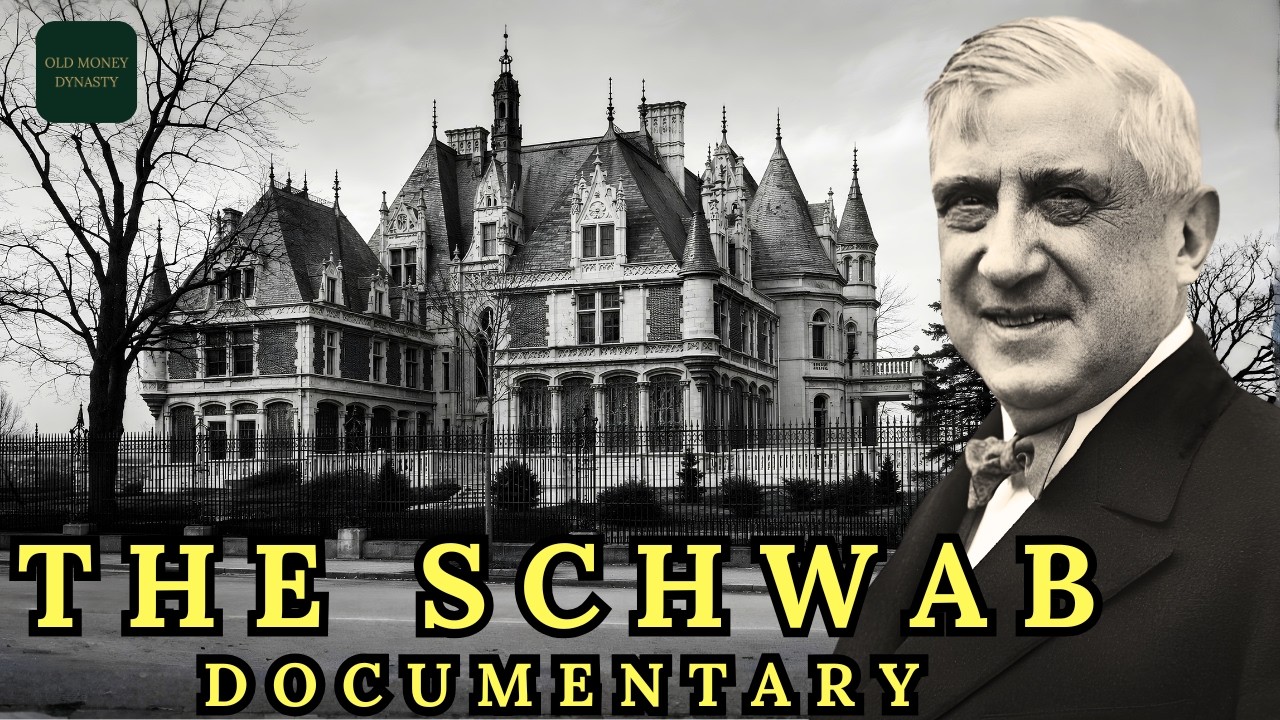
The richest man in America could not give his palace away, and on March 31, 1948, a two-ton steel ball swung into the northwest tower of the largest private residence Manhattan has ever seen, collapsing the dream of a titan who ended his life owing more than he owned.
The first blow from the wrecking crane struck the château at noon as a crowd lined Riverside Drive, watching a monument to a forgotten age meet its brutal end. The stone held briefly against the weight of the steel, but the second swing opened a hole twenty feet below the crown, and by the fifth strike, the tower surrendered, sending five tons of masonry crashing into the street in a cloud of white dust. A reporter for the Times noted that the children in the crowd were delighted, but the older spectators stood silent, understanding that the fall of this house marked the death of an era in New York history.
 What came down that afternoon covered an entire Manhattan city block, an edifice of 75 rooms and 50,000 square feet of floor space, surrounded by lawns and terrace gardens on all four sides, a distinction no other private residence in this city has ever achieved before or since. Inside there was a chapel with a pipe organ built into its structure, a private power station in the cellar feeding 6,000 light bulbs, and a service tunnel beneath the garden so that coal and groceries could be delivered to the house unseen. By the time the wrecking ball hit it, this palace had stood empty for nine years, and the man who built it, before his death, had tried to give it away—not sell, but give—offer the entire property to the City of New York for free, and the mayor had refused it without ceremony.
The man who built it was Charles M. Schwab, a name that once commanded the heights of American industry and then descended into financial ruins. He began his working life at 17, carrying survey stakes around the steel mills of Western Pennsylvania for a dollar a day, which equals about $60 in today’s currency, and rose by pure talent and sheer persistence to become the president of the first billion-dollar corporation in the history of the world.
At the end of his life, he owed more than he owned, a reversal so complete that his estate, valued at hundreds of millions in his prime, was sold off piece by piece, the metal and marble stripped by scavengers before the wrecking crew even arrived.
The mayor who refused his gift was Fiorello LaGuardia, a man who grew up on an army post in Arizona and began his working life as an interpreter on Ellis Island. Short, loud, permanently rumpled, LaGuardia rode out with fire companies and read the comics on the radio when newspaper deliverers went on strike, and New York liked him a great deal for it—a populist in a office who had no desire to live like a rich man in a French château. When Schwab approached him with the offer of a free palace, LaGuardia refused, and the refusal was not an act of temperament but a cold calculation of fiscal reality: a building that size is expensive simply to stand still in.
By the middle of the 1930s, the property taxes alone reportedly rose above $60,000 a year, a sum that in today’s money is close to $1. 5 million, buying nothing at all, not a single light switched on or a single room heated. On top of that came the coal for the private power plant and the wages for the twenty servants needed to keep the place from rotting, costs City Hall would have had to find every year out of public funds in the middle of the Great Depression, all to give one elected official an address no one asked for.
New York had no official mayoral residence at the time; mayors lived wherever they had lived before taking office, and the arrangement had never caused anyone much difficulty. Schwab was not solving a problem for anybody; he was handing over a liability and hoping it would be received as a size of majestic gift.
This was not his first attempt to be rid of the place. As early as 1930, a New York paper carried a report that the block had been sold and an apartment building would rise in the mansion’s place, but the story faded when no buyer actually signed. What New York chose instead some years later tells you what the place considered reasonable: Gracie Mansion, a wooden country house put up by a merchant at the end of the 1700s, became the mayor’s official home in 1942.
Installed in public park at the top of the east side, the choice was a Victorian cottage with a wide porch, and LaGuardia starting there, leaving the Riverside dream to decline alone and untouched.
When Schwab died in September died 1939 of heart disease, eight months after the death of his wife, his will handed the property to the city in a bequest that was also declined. Title passed to Chase National Bank, which held the property as custodian and set about finding an occupant, any occupant. According to a wire report last year of the war, the bank offered the house for rent at $75,000 per year—in today’s money, over $1 million—and it found no tenant.
The bank’s own spokesman made very little effort to talk the place up, and so a structure of 75 rooms stood available for most of a decade to anyone willing to live in it, taken by a city that refused, at any rent that no one would pay, and in the end, the only serious offer came from a buyer who wanted to tear it down.
 Nine years is a long stretch for a building of that size to sit unoccupied on a public street; a child who started school on West 74th Street the year Schwab died would have been most of the way with his schooling before the crane arrived. The war found some use for parts of the building, though not one anybody had imagined when it was finished. Sections were partitioned into apartments, and on the terrace lawns, where gardeners had once kept formal beds and clipped hedges, somebody planted a victory garden and grew vegetables in it.
The last year of the war … Then in 1947, the Prudential Insurance Company bought the block for, reported some figures vary, somewhere above a million. The price mattered less than the intention: Credential wanted the ground. The company said from the outset the mansion would come down and apartments would replace it.
The doors were opened first so buyers could come in and strip out anything worth carrying away. Bronze fittings, stained glass, paneling and carved marble went into the hands of spectators, while S. Archer Gibson, the man who had played the chapel organ for years, walked through his old room and put his hand on the cabinet without writing down what he said, if he said a word.
The organ could not be gotten out; it was cut to fit that chapel and its unique space, which was exactly why it sounded the way it did, and now the pipe instrument was to come down with the walls. A man named Eric Stone drove down from New Canaan in Connecticut at the last possible hour and bought it, took it apart piece by piece and carried it out. Part of the organ went to a house in Camden, Maine, where it went on being played, and the mahogany doors and carved marble went across the river into Our Lady of Lebanon Cathedral in Brooklyn, where they still stand.
You can walk in and put your hand on them, which is more than can be said for the rest of the structure. Everything else came down through the spring of 1948. ,
The story of this house begins with the land itself: 865,000 dollars, the price Charles Schwab paid in 1901 for a piece of ground on the west side of city, a sum newspapers reported at the time as the largest ever paid for a building lot in New York. But before Schwab owned it, the ground belonged to orphans. The Orphan Asylum Society had moved there in 1839 when the district called Bloomingdale only 5 miles north of hot part of the town, distance from the crowding and the fevers downtown.
As 188 boys and girls were living there in one year, and the total budget to come to $37,000, a little over $1 million now, paid for everything—clothing, bedding, fuel, laundry, doctor, and the wages of the teachers and matrons who looked after them. Sixty years later, the city caught up and surrounded the place; the society moved to Westchester, and the land went on the market.
Two halves of one orphanage sold within a few years of each other; one became the Ansonia, an enormous apartment hotel on Broadway that is still standing. The other became a house for two people. The first man to buy Schwab’s half was Jacob Schiff, a banker at Kuhn, Loeb & Company, rich enough to build whatever he liked, wherever he wanted.
He bought the ground, however, did not build on it, because his wife refused to make the move; she said if she went to live out on the drive, she would never see her friends again. So Schiff sold the land on, and the buyer was Charles Schwab. Then that conversation happened a second time in a different household: Rana Schwab did not want to go also, and her reasoning ran along identical lines—her friends were on the east side of the park, and she believed that crossing it would cost her every one of them.
 He signed for it anyway.
Central Park functioned as a wall; society had settled along its eastern edge and had no particular reason to cross. The Fifth Avenue houses stood close enough to be within calling distance, and the machinery of visiting cards and afternoon calls depended on that closeness. Particularly, a mile west meant that you were out of the system, and the west side carried its own difficulties: an elevated railway ran up Ninth Avenue, dropping noise and soot on everything underneath it; below Riverside Park, New York Central ran freight at ground level.
The river view came with a working railway at the bottom of it. But the developers had an answer ready: Riverside Drive was to become the next avenue of the rich, the Hudson was finer of them than anything the far side of the park could offer, and the ground was cheap enough to build on properly. A handful of wealthy men believed, and Schwab believed harder than any of them: be paid so and paid accordingly.
The design of the house was a work of historical quotation. The front of the house came from the Château of Chenonceau, the exterior staircase from the one at Blois, and yet another displayed elements from Chin. Three really chateaus in the Loire Valley of France, built in the 1500s for kings, were copied for the architect.
Schwab hired Maurice Hébert, a French architect almost unknown outside and small circle, describing himself as a specialist in the reproduction of historical exteriors and classical interiors. The scale of project was extensive: a quarry was opened up, Peaks to supply just this one building; more than 100 artists, modelers, and engineers worked on it; and the construction ran a year late and over budget. The front doors, containing bronze, were said to weigh between a ton and a ton and a half, and a New York Times described them in reference to bronze doors of the capital in Washington.
Inside, there were four stories with a footprint of the full width of the property, and at the heart of the plan was a chapel, two stories high and large enough to seat a full orchestra. A pipe organ was built into the structure, and Schwab had it enlarged twice, spending roughly the same sum twice, 7 years apart, with each enlargement running close to $800, 000 in today’s money, some costs itemized to the half dollar. Underneath all of this was a natatorium—an indoor swimming pool, 20 ft by 30, lined in glazed brick roofed in glass—and a gymnasium 50 ft long and a bowling alley.
Electricity came from a generating plant in the cellar, the lamps and three elevators and a system for cooling the air in summer, which is to be known as air conditioning, remarkably ahead of his time for a private shouldn’t. The service tunnel ran beneath the garden for deliveries, a lodge for receiving goods, the garage held four motorcars at a moment when most of New York still moved on horse, and the rooms were done in a style of a European monarchy, a different reign in each, sent by dinner under Louis XIV, or the library reproducing Fontainebleau, the main hall of Francis I, and the parlor from the Petit Trianon of Versailles. The amount of decoration was 75 rooms.
A railroad company, the whole household of object was two people: Charles and Rana Schwab, the owner 13th on the first list of richest men, and his wife, who had argued against the move. After his monumental rise to the top of the steel empire, Schwab’s career peaked quickly. In 1901, he negotiated the creation of United States Steel Corporation with J.
P. Morgan, then was made its first president at 38, only to be forced out of the presidency and $2. 5 years later after a scandal over gambling in Monte Carlo and criticism of his management style.
 He then turned that would be his true legacy: Bethlehem Steel, the company he bought with his own money, the pioneer of rolled steel beams that allowed the construction of skyscrapers that would eventually make his own castle obsolete.
Bethlehem made the wide-flange beam, the structural steel shape that is a cross-Section capital H, and that is the most consequential object in this story. It carries far more load for weight than previous shapes, goes up faster because there’s less to assemembly on site, and after standard engineers can place floor over floor and keep going considerably higher than ever before. Within a few years, the company was the largest supplier of structural steel to the American construction industry, and second largest steel producer in the country, providing the skeletons of the town’s many skyscrapers.
During World War I, was put in charge of the Emergency Fleet Corporation, building ships and found historic, war considered a “prophet of death”.
The consequence of his own achievement was the demolition of his house: a beam that lets you build 16 stories does not only change what a building looks like; changes what the ground underneath is worth. That aside in Manhattan as an arithmetic problem where the best you can put on it is one house. Its value is capped by what a single wealthy family will pay to live in it; fit the same land with an apartment block, and its value is set by hundred.
Two quarters are not close, and the gap between them expands year after year. The consequences arrived in the 1920s, and the largest private residence New York had ever seen—the Cornelius Vanderbilt II house of 130 rooms on 57th street—was pulled down in 1926; the rest of the beneath Fifth houses followed through that decade and the next. On Riverside Drive, its own even began.
The Dow Jones of New York had begun, and with a wall.
The Schwab family fortune itself collapsed with the Great Depression, wiping out the stock values with that and his health. His wife Rana, who had loved the house but retreated into it, died in January 1939; he died eight months later, in a rented apartment, leaving an estate over $24 million in debt against $353,000 in assets. The estate’s executors, including his own brother, sold the Bethlehem stock at the bottom of the market; when war orders flooded in within three years, those same shares would make the estate solvent.
But the chance was gone—the empire gone, the house gone, everything.
The pred of $865,000 was the largest sum ever paid for the land, but the building of the new block after demolition swallowed that on a stone in account. Today, 19 stories of red brick stand on that block, with 636 families inside. The story of Charles Schwab is a fable of the cycle of wealth, talent and timing—a man who helped raise the skyline that would bring his own house down.
He was the only one of the three gigantic steel millionaires who built in Manhattan; Carnegie’s house is the Cooper-Hewitt Museum, and Frick’s is the art museum, but what was the only dwelling that was a home until it was nothing at all. That turned out to be the one thing a Manhattan block cannot go on being.