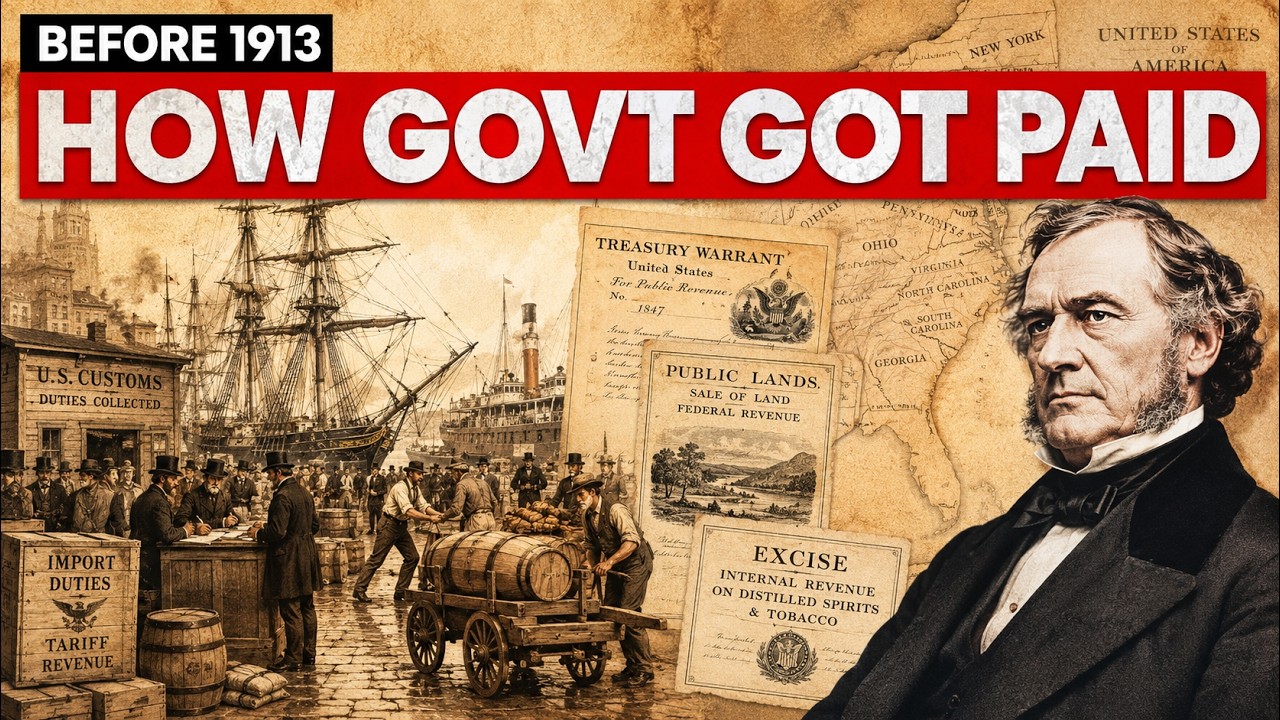
For more than a century, the United States had no permanent federal income tax.
No federal government taking a percentage of every worker’s paycheck.
No annual income-tax ritual resembling the system Americans know today.
Yet during those years, the United States fought wars.
Maintained an army and navy.
Purchased enormous territories.
Built federal institutions.
Expanded from the Atlantic toward the Pacific.
Paid government employees.
Serviced its debts.
And transformed itself from thirteen former colonies into one of the world’s great economic powers.
So where did the money come from?
The answer begins with something that sounds almost impossible today:
For much of early American history, Washington could finance itself largely without taxing individual incomes at all.
But that system carried weaknesses of its own.
And when America finally abandoned it, the change didn’t simply create another tax.
It fundamentally altered the relationship between Washington and the American citizen.
To understand why, we have to go back to a moment when the United States had exactly the opposite problem.
The government wasn’t collecting too much money.
It could barely collect anything.
The American Revolution ended in 1783.
The United States had won independence.
Financially, however, the new country was in serious trouble.
The war had produced enormous debts.
The federal government operating under the Articles of Confederation possessed no independent general power to tax citizens.
Congress could request money from the states.
But requesting money and receiving money were very different things.
States could delay.
States could refuse.
And many did.
The government that had defeated Britain was struggling to pay its own obligations.
That weakness became one of the pressures pushing American leaders toward the Constitutional Convention of 1787.
The men gathered in Philadelphia understood a basic truth:
A government that cannot reliably finance itself cannot reliably govern.
So the new Constitution gave Congress broad authority to collect taxes, duties, imposts and excises.
But the Constitution also treated certain “direct taxes” differently.
Those taxes faced an apportionment requirement among the states according to population.
That restriction would later become enormously important in the battle over income taxation.
For the moment, however, Washington had another solution.
Instead of looking primarily at what Americans earned—
the government looked at what entered American ports.
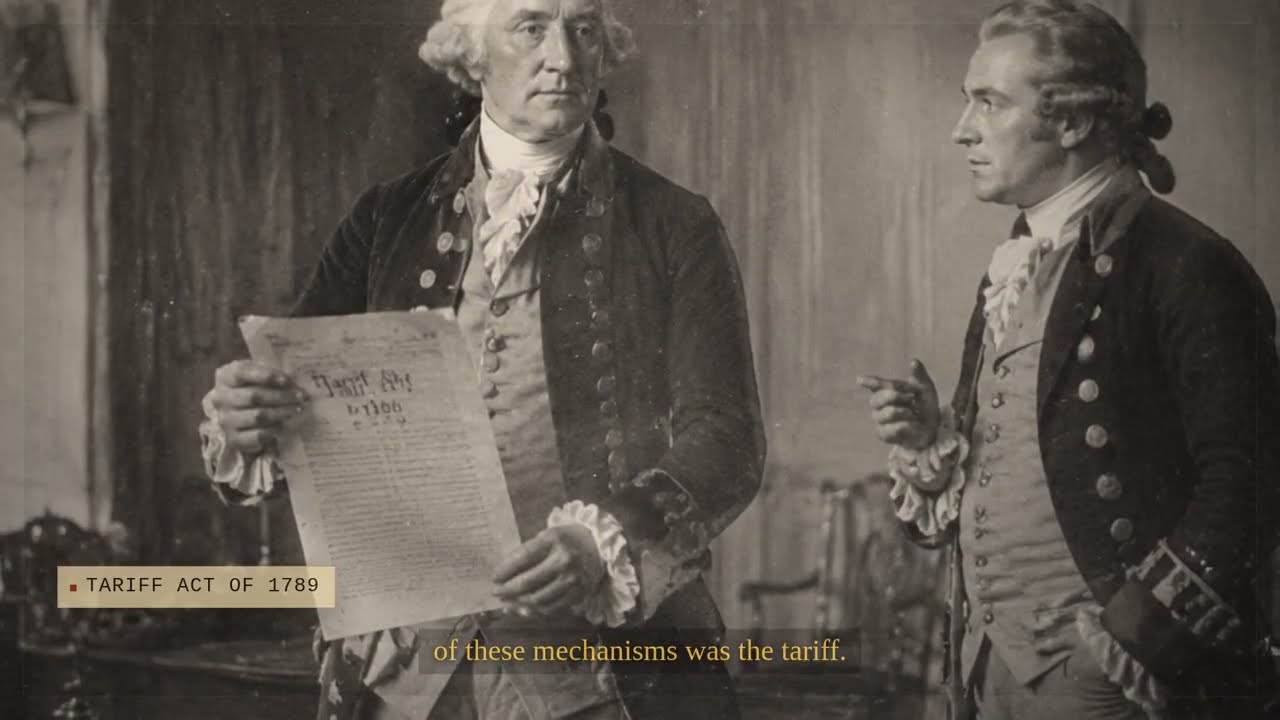
In 1789, one of the new federal government’s first major laws established tariffs.
Foreign goods arriving in the United States could be charged customs duties.
British textiles.
European manufactured goods.
Wine.
Sugar.
Tea.
Thousands of products entered American ports.
And before those goods reached consumers, customs collectors were waiting.
From an administrative perspective, the system had a major advantage.
America didn’t need tax officials investigating millions of individual households.
International commerce moved through a relatively limited number of ports.
Place customs officers there.
Inspect cargo.
Calculate duties.
Collect money.
The government could raise substantial revenue before imported goods even entered the domestic market.
Alexander Hamilton understood the potential immediately.
As the first Secretary of the Treasury, Hamilton faced an extraordinary challenge.
The country had debts.
Its credit was uncertain.
Its financial institutions were young.
Its political survival was still fragile.
Hamilton wanted federal revenue that was reliable enough to restore confidence in American government debt.
Tariffs became central to that system.
But Hamilton saw another advantage.
Tariffs didn’t merely raise money.
They could also make foreign manufactured goods more expensive.
That gave emerging American producers protection against better-established European competitors.
Revenue and industrial policy could operate together.
And during the early decades of the republic, customs duties became the backbone of federal finance.
For long periods before the Civil War, they supplied the overwhelming majority of Washington’s revenue.
The government could operate without asking most Americans to calculate their annual income and surrender a percentage of it.
But Hamilton knew dependence on foreign trade created risk.
If imports collapsed—
revenue collapsed with them.
He wanted another source of money.
And that decision nearly produced an armed rebellion.
Whiskey.
Today it sounds almost ridiculous.
But in 1791, whiskey became the center of a confrontation over how much power the new federal government really possessed.
Congress imposed an excise tax on distilled spirits.
To policymakers in the East, the logic seemed reasonable.
The government needed revenue.
Distilled alcohol was widely produced.
Tax it.
But on the western frontier, whiskey wasn’t simply something people drank.
For farmers separated from eastern markets by terrible roads and enormous distances, turning grain into whiskey solved a transportation problem.
Corn and rye were bulky.
Whiskey was compact.
Durable.
Valuable.
In some frontier communities, it effectively functioned as a medium of exchange.
Then Washington demanded a tax on it.
Resistance spread.
Federal revenue officials were threatened.
Some were assaulted.
Property was attacked.
Those cooperating with tax collectors could face intimidation.
By 1794, resistance in western Pennsylvania had escalated dramatically.
Armed men confronted federal authority.
For President George Washington, the issue had become larger than whiskey.
The Constitution was only a few years old.
If armed resistance could nullify a federal law whenever a region disliked it, what exactly did federal authority mean?
Washington responded with overwhelming force.
Thousands of militia were mobilized.
The president himself traveled west with the force for part of the campaign—an extraordinary demonstration of federal resolve.
The rebellion collapsed without the enormous battle some had feared.
But the political lesson was unmistakable.
Americans might accept taxes collected indirectly through commerce.
Taxes that arrived directly at their farms, businesses and homes felt different.
More personal.
More intrusive.
More dangerous.
Thomas Jefferson understood that resentment.
When his political movement came to power, internal taxes became a target.
In the early Jeffersonian period, federal excise taxes were repealed.
Washington returned to heavy dependence on customs duties.
And for decades, a recognizable pattern emerged.
Peace meant tariffs could carry much of the burden.
War meant Washington suddenly needed more.
The War of 1812 forced the government to seek additional revenue.
Internal taxes returned temporarily.
Then many disappeared again after the emergency.
That pattern tells us something important about early American attitudes toward federal taxation.
Direct or internal federal taxes were often viewed as extraordinary instruments.
Tools to be used when necessity demanded them.
Not necessarily permanent features of everyday life.
Why could America operate this way?
Because the federal government itself was tiny compared with the institution Americans know today.
There was no Social Security.
No Medicare.
No Medicaid.
No enormous modern regulatory state.
No sprawling network of federal benefit programs.
Federal civilian employment was small.
Government expenditures represented a comparatively limited share of the national economy.
Washington simply didn’t need trillions of dollars because Washington wasn’t attempting to perform trillions of dollars’ worth of functions.
But tariffs weren’t its only resource.
America possessed something European governments could only envy.
Land.
An astonishing amount of land.
As the United States expanded westward, the federal government gained control over enormous territories.
Those lands became both a political weapon and a financial asset.
The government surveyed them.
Divided them.
Sold them.
Land policy changed repeatedly as Washington experimented with price, minimum acreage and payment terms.
And settlers moved west.
For the Treasury, land sales generated meaningful revenue.
During speculative booms, the sums could become enormous.
The federal government wasn’t simply collecting taxes.
It was monetizing the physical expansion of the country.
That process, however, cannot be separated from the darker history behind it.
Much of the land eventually opened to white settlement had been inhabited and claimed by Native peoples.
Federal expansion involved treaties, coercion, warfare, displacement and forced removal.
So when land sales produced revenue, those dollars were connected to a territorial expansion whose human cost was immense.
Still, from a purely fiscal perspective, the system gave Washington another stream of money unavailable to mature European states.
Tariffs at the ports.
Land sales in the West.
Excises when necessary.
Debt when emergencies demanded it.
For a relatively small federal government—
the system could work.
And during Andrew Jackson’s presidency, something remarkable happened.
The national debt was essentially eliminated.
For a brief moment in the 1830s, the United States reached a position that sounds almost unimaginable today.
Washington owed virtually nothing.
But the achievement didn’t mean America’s fiscal problems were permanently solved.
Because the system depended on something crucial.
The federal government’s needs remaining relatively limited.
Then came the Civil War.
And everything broke.
April 1861.
Fort Sumter.
War.
Within months, federal spending exploded beyond anything Americans had experienced.
Armies had to be raised.
Soldiers paid.
Weapons manufactured.
Railroads used.
Ships built.
Supplies purchased.
Hospitals operated.
Food transported.
The Union was attempting to fight an industrial war across an enormous continent.
Tariffs couldn’t come close to paying for it.
Washington needed money immediately.
So Congress crossed a line.
In 1861, the federal government enacted an income tax.
For the first time, Washington was directly taxing individual income on a national scale.
The first version was limited and administratively weak.
Then Congress returned in 1862 with something far more ambitious.
A progressive income tax.
Different rates applied to different levels of income.
But even that was only part of the wartime revolution.
Congress taxed almost everything it could reach.
Alcohol.
Tobacco.
Manufactured goods.
Professional activities.
Luxury items.
Financial transactions.
Businesses.
Inheritances.
The logic was brutally simple:
War consumed money faster than the old revenue system could produce it.
So the government expanded taxation wherever revenue could be found.
And then came another transformation.
The federal government needed an institution capable of collecting all of it.
Congress created the Office of the Commissioner of Internal Revenue.
An administrative machine began spreading across the country.
Assessors.
Collectors.
Clerks.
Revenue districts.
The ancestor of today’s Internal Revenue Service had arrived.
Yet taxes still weren’t enough.
The Union borrowed enormous sums.
Government bonds were sold.
And Washington issued paper currency known as greenbacks.
The Civil War wasn’t financed by one magic source.
It was financed through taxation, borrowing and monetary innovation on a scale previously unimaginable.
But here’s the crucial part:
The income tax was still viewed as an emergency measure.
The war ended.
Years passed.
And in 1872—
the federal income tax disappeared.
America returned once again to a world where most citizens owed Washington no tax on their personal income.
For another generation, customs duties and excise taxes carried most federal revenue.
It looked as though the experiment with income taxation might remain a Civil War artifact.
Then America became extraordinarily rich.
And that created a new problem.
By the late nineteenth century, industrialization was transforming the country.
Railroads.
Steel.
Oil.
Banking.
Manufacturing.
Corporate empires.
Fortunes appeared on a scale ordinary Americans could barely comprehend.
Rockefeller.
Carnegie.
Morgan.
Vanderbilt.
The Gilded Age created astonishing wealth.
It also created astonishing inequality.
And the tariff system that had served Washington for generations began looking increasingly unfair.
Why?
Because tariffs ultimately influenced prices.
When imported goods were taxed, consumers could pay more.
And poorer households spent a larger percentage of their income on necessities.
Critics argued that the system therefore placed a disproportionate burden on ordinary consumers.
At the same time, protected industries had powerful incentives to lobby Congress.
A higher tariff could shield an American manufacturer from foreign competition.
That might protect American jobs.
But it could also protect profits.
Suddenly tariffs weren’t merely about financing government.
They were about who won and who lost inside the American economy.
Farmers in the South and West became increasingly angry.
Workers questioned why enormous fortunes seemed comparatively protected while ordinary consumers paid higher prices.
Populists and progressives began asking a politically explosive question:
Why tax what people buy instead of taxing what wealthy people earn?
The idea of a permanent income tax returned.
In 1894, Congress tried.
The Wilson-Gorman Tariff Act included a federal tax on higher incomes.
The target was relatively narrow.
Most Americans wouldn’t have paid it.
The wealthy would.
Then the Supreme Court intervened.
In Pollock v. Farmers’ Loan & Trust Company, the Court struck down critical portions of the income tax.
The constitutional issue revolved around direct taxation and apportionment.
For income associated with property, the Court concluded that the tax ran into the Constitution’s restrictions on unapportioned direct taxes.
The decision detonated politically.
To opponents of the income tax, the Constitution had done exactly what it was supposed to do.
It had restrained federal power.
To progressives and populists, the decision proved something very different.
They believed America’s constitutional system was protecting accumulated wealth from taxation while ordinary consumers continued carrying the burden through tariffs.
Now the fight was no longer simply over tax rates.
It was over the Constitution itself.
If the Constitution blocked the income tax—
change the Constitution.
But that is extraordinarily difficult.
A constitutional amendment requires overwhelming political support.
For years, the movement continued.
Then an unexpected figure helped break the stalemate.
William Howard Taft.
Taft was no radical populist.
He was a Republican president with a conservative temperament.
Yet in 1909, he supported sending an income-tax amendment to the states.
The proposed amendment was concise but revolutionary.
Congress would have power to tax incomes “from whatever source derived” without apportionment among the states and without regard to census or population.
The amendment directly removed the constitutional obstacle that had haunted earlier income-tax efforts.
Then the states began voting.
One after another.
The political climate had changed dramatically since the 1890s.
Progressivism was rising.
Public hostility toward concentrated corporate wealth was intense.
Tariff politics remained bitter.
And arguments that wealthy Americans should contribute a greater share toward federal expenses had become increasingly popular.
Then came February 3, 1913.
The Sixteenth Amendment was declared ratified.
A constitutional barrier more than a century old had effectively been overcome.
Congress now possessed a durable constitutional foundation for federal income taxation.
Later that year, lawmakers acted.
The Revenue Act of 1913 established a new income tax.
But if you were an ordinary American family—
you probably didn’t pay it.
That is one of the most important details in this story.
The original tax was aimed overwhelmingly toward higher incomes.
A basic rate applied above substantial exemptions, with additional surtaxes climbing on very large incomes.
Only a small percentage of households were affected.
For most Americans, nothing disappeared from the weekly paycheck.
There was no modern payroll withholding.
No vast majority filing the kind of income-tax return familiar today.
To millions of people, the Sixteenth Amendment may have seemed like a way to make the wealthy finally contribute more.
But the constitutional machinery was now in place.
And almost immediately—
history tested it.
World War I began in Europe in 1914.
The United States entered the conflict in 1917.
War once again demanded enormous revenue.
But this time Washington possessed something Lincoln’s government had needed to construct during an emergency.
A permanent constitutional income-tax system.
Rates rose dramatically.
The number of taxpayers expanded.
Federal revenues surged.
The income tax demonstrated what its supporters had always believed.
It could raise enormous amounts of money from a modern industrial economy.
It also demonstrated what opponents had feared.
Once the federal government possessed the power, the scale of taxation could expand rapidly when political circumstances demanded it.
After the war, rates declined.
But the income tax didn’t disappear.
That was the difference between 1865 and 1918.
After the Civil War, America eventually dismantled the wartime income tax.
After World War I, the system stayed.
Then came the Great Depression.
The New Deal.
Social Security.
A federal government assuming responsibilities earlier generations could scarcely have imagined.
But even then, the transformation wasn’t complete.
For income taxation to become the mass system Americans recognize today, Washington needed one more innovation.
And it arrived during another war.
World War II.
Federal expenditures were exploding.
Millions of additional Americans now owed income tax.
There was a practical problem.
How do you reliably collect taxes from tens of millions of workers?
The answer was withholding.
Instead of waiting for workers to calculate a large annual obligation and then send Washington the money—
employers would deduct taxes directly from wages.
Before workers received their pay.
That changed everything.
The federal income tax became woven into the ordinary rhythm of employment.
Work.
Earn.
Tax deducted.
Receive what’s left.
Week after week.
Month after month.
For generations born afterward, this became normal.
So normal that it’s difficult to imagine the alternative.
But an American born in 1880 had experienced both worlds.
As a young adult, that person could earn wages without routinely surrendering a portion through permanent federal income taxation.
By middle age, the Sixteenth Amendment existed.
By old age, withholding might be taking federal taxes before the paycheck ever reached their hands.
Within one lifetime—
the relationship between labor and Washington had been transformed.
So was America better before 1913?
That’s where this story becomes more complicated than nostalgia.
The old system had advantages.
It required a smaller federal tax bureaucracy.
Most Americans had little direct interaction with federal revenue collectors.
The government’s fiscal capacity was more limited.
But those limitations also meant federal services were far more limited.
There was no national retirement system resembling Social Security.
No Medicare.
No Medicaid.
No modern federal safety net.
Working conditions could be brutal.
Child labor was widespread.
Economic catastrophe could destroy a family with little public assistance.
And tariffs themselves weren’t free.
Consumers ultimately bore economic costs.
Protected industries benefited.
Political favoritism flourished.
Public-land revenue also carried the moral burden of America’s expansion and Native dispossession.
There was no magical age when government cost nothing.
Someone always paid.
The mechanism simply changed.
Before 1913, Washington relied heavily on taxes attached to commerce and consumption.
After 1913, it gained far greater access to income itself.
And that changed what the federal government was capable of becoming.
That’s the deeper story.
Not that America once operated without taxes.
It didn’t.
Not that tariffs somehow produced free government.
They didn’t.
The real transformation was about where Washington collected its money—
and therefore how much money Washington could potentially collect.
Tariffs depend on trade.
Excise taxes depend on consumption.
Land can only be sold once.
But income is generated again and again.
Every year.
Every month.
Every paycheck.
And once the federal government possessed a constitutional mechanism for reaching that enormous stream of economic activity, the ceiling on federal fiscal power became dramatically higher.
That doesn’t automatically make the system good.
It doesn’t automatically make it bad.
But it made a different kind of government possible.
Look again at the timeline.
Tariffs become the financial foundation of the new federal government.
Washington attempts an internal whiskey tax.
Resistance becomes rebellion.
1800s.
Customs duties dominate federal finance.
1830s.
Land revenues boom and the national debt briefly disappears.
Civil War destroys the old fiscal equilibrium.
Income taxation and a national internal-revenue bureaucracy expand.
The income tax is repealed.
Congress tries again.
The Supreme Court blocks it.
A constitutional amendment is proposed.
The Sixteenth Amendment is ratified.
Then World War I arrives.
Rates climb.
The system survives peace.
The federal government expands.
And in 1943—
taxation enters the paycheck itself.
Seen from that perspective, 1913 wasn’t the beginning of the story.
It was the moment a battle more than a century old finally crossed a constitutional threshold.
Hamilton wanted reliable federal revenue.
Frontier farmers resisted internal taxation.
Jefferson dismantled excises.
Lincoln revived direct taxation to save the Union.
Gilded Age reformers demanded that great fortunes carry more of the burden.
The Supreme Court stood in the way.
Progressives changed the Constitution.
And war transformed a tax on the affluent into one of the financial foundations of the modern American state.
So when someone asks:
“How did America survive before the federal income tax?”
The answer is surprisingly straightforward.
Tariffs.
Excise taxes.
Public-land revenue.
Borrowing.
And, during emergencies, temporary internal taxes and other extraordinary financial measures.
But the more interesting question is what happened when that system could no longer satisfy America’s politics, wars and ambitions.
Because once Washington gained permanent access to individual income—
the argument was no longer simply about how to fund the government.
It became an argument about how large that government should be.
What responsibilities it should assume.
Who should pay for them.
And how much power citizens were willing to give Washington in exchange.
More than two centuries after the Whiskey Rebellion, Americans are still arguing about exactly the same thing.
Who pays?
How much?
For what?
And who gets to decide?
That is why the history of the income tax isn’t really a story about accounting.
It’s a story about power.
And the most consequential moment wasn’t when Americans first paid an income tax.
They had done that during the Civil War.
It was the moment America decided that this time—
the power to tax income would never have to disappear again.