The small blonde girl who stands at the exact center of Diego Velázquez’s masterpiece Las Meninas died just after 2:00 in the morning on March 12, 1673, inside the Imperial Palace in Vienna. She was 21 years old, and her body had been pregnant seven times in six years. Before the day ended, her husband’s physicians cut her open.
Inside her uterus, they found a dead son, four months along, delivered under the knife. The report was written up and sent to Madrid, where her mother had once been the 16-year-old bride of her own uncle, and where nobody in the court thought that arithmetic worth remarking on. Most people have seen her face without knowing it.
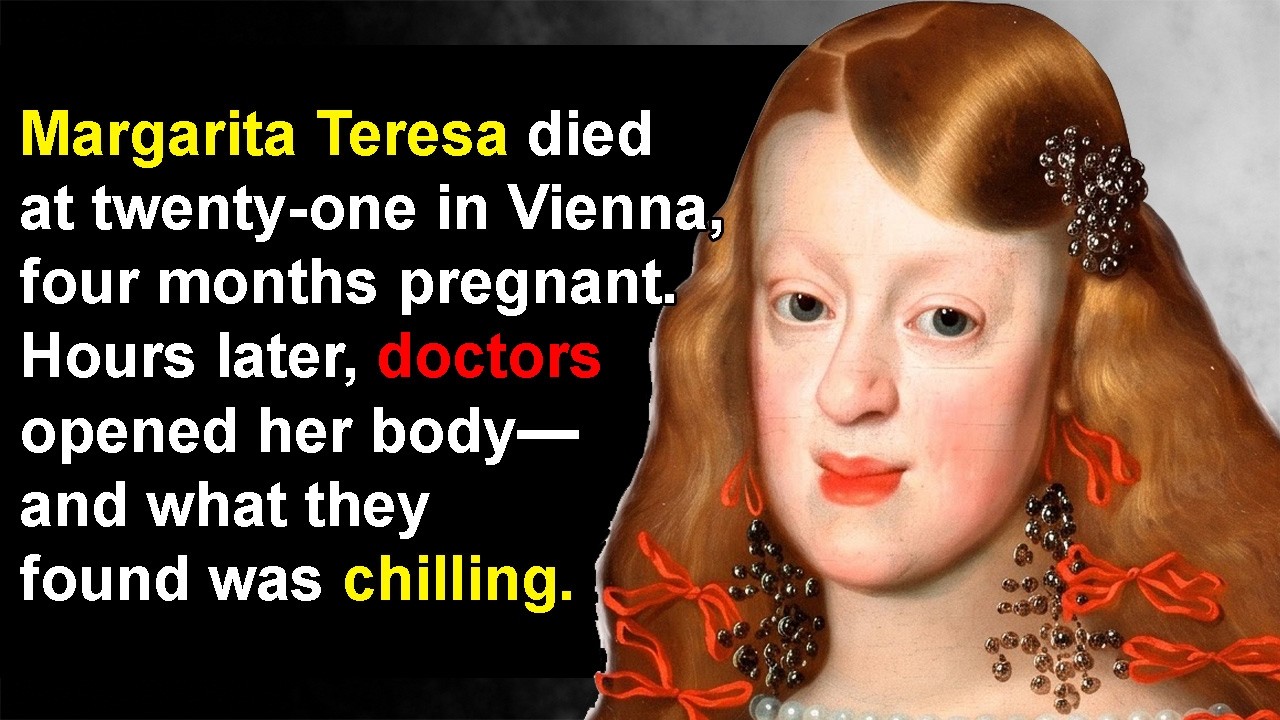 She was never a symbol. She was a treaty paid out of her own flesh, and she just ran out of body to pay with.
Margarita Maria was born on July 12, 1651, in the Royal Alcazar in Madrid. Her father, Philip IV, was 46. Her mother, Mariana of Austria, was 16.
Mariana had been engaged to Balthazar Charles, the prince who was supposed to inherit Spain. When that boy died at 16 in 1646, the Spanish court did not release the bride. They handed her to the father instead.
They married in October 1649, when he was 44 and she was 14. She was also his sister’s daughter. The parents of the girl in the painting were uncle and niece, and nobody in Madrid found that worth a comment.
It was the family business model.
That model produced a brutal nursery even by 17th-century standards. Maria Ambrosia arrived in 1655 and lived days. Felipe Prospero arrived in December 1657, sickly and epileptic, and died a month before his fourth birthday.
Fernando Tomas came in 1658 and lasted months. Of the five children of that incestuous marriage, only two reached adulthood: Margarita and the boy born in November 1661, who would become Charles II, the last Habsburg king of Spain, a man so twisted by genetic error that he couldn’t chew his own food. For a few years, Margarita was simply the daughter who lived.
Philip, a king whose reign was a long accounting of defeats, called her in private letters “my joy.” That was love, but it was also commodity.
Between the ages of two and eight, she sat for Velázquez and his workshop again and again, not out of paternal pride but for export. The portraits were shipped to Vienna as documentation. This is the child.
This is how she grows. This is what she will do for you. The painting that made her immortal, Las Meninas from 1656, shows her in white and silver in the center of a room full of support staff, the maids of honor, the dwarfs, the dog, the chaperone, and the painter watching from behind a canvas.
Her parents appear only as a reflection in the mirror at the back, watching from a distance. That reflected distance was also accurate. The paintings were never meant to hang in Madrid.
They were catalogs. Everyone was looking.
In 1659, Philip offered his daughter to the Emperor’s house. On April 6, 1663, the public betrothal was announced. She was 11.
 Leopold I was 22. The marriage contract was signed that December. Then the only man who called her joy died, and the terms got worse.
Philip IV died September 17, 1665. His will confirmed the Austrian marriage, but it also placed Margarita in the succession line for the Spanish throne, behind her brother, the toddler Charles. Every court in Europe could read the document.
If the sickly boy died, an empire would pass through his sister. She was 14 years old and instantly the most valuable body on the continent.
The proxy wedding was held in Madrid on April 25, 1666. The groom wasn’t there. A duke stood in.
Then the machinery took over. She left Spain three days later and never saw the place again. The journey took over seven months, south to Denia, then a fleet, a pause because unwell, ashore at Finale Ligure in August, an entry into Milan in September, then a formal handover at Roveredo, where her Spanish escort surrendered her to Austrian officials like freight.
She met the man she had married for the first time on November 25, 1666. He was her mother’s brother. She entered Vienna on December 5, and married him in person on December 12.
She was 15 years and 5 months old. He was 26.
The festivities included an open-air theater built to hold 5,000 people, and the moment they ended, the only work Vienna wanted from her began. She never adapted. She kept her Spanish household, her confessors, her musicians, her language.
She called him “uncle,” which had the advantage of being true. In six years and three months of marriage, she was pregnant seven times. First a son, Ferdinand Wenzel, born September 28, 1667, who lived 107 days.
Then a dead heir and a burnt palace in one winter. The Viennese court concluded that someone had to be responsible, and the record says the grieving 16-year-old empress had a candidate.
The capital’s Jewish community had lived in the Unterer Werd for decades. According to a long line of German and Jewish historiography, Margarita became one of the driving voices calling for their removal. She blamed them for the dead son and the fire.
She was not alone. The bishop, a Jesuit, and the city’s burghers pushed the same way, and some of those burghers had debts that an expulsion would erase. The Privy Council took the decision on June 19, 1669; a patent followed August 2.
 More than 1,600 people were driven out of Vienna in the first wave, with the whole operation estimated in the thousands. The synagogue site was handed over to a church. History calls it the second Vienna deportation, and that is what it was.
She had only the authority of a grieving mother and future queen of a dying line, but she used it.
Then she went back to work. Maria Antonia was born January 18, 1669, and would survive childhood, the only one who would. Johann Leopold was born February 20, 1670, died the same day.
Two miscarriages are placed in this stretch. Maria Anna Josepha was born February 9, 1672, died 14 days later. Four live birth, three small coffins.
In 2009 a genetic study in PLOS ONE rebuilt 16 generations of the Spanish proband pedigree. Charles II’s coefficient was 0. 254, which is higher than what brother-sister mating produces.
Their mother’s was 0. 155, higher than first cousins. The study found that first-cousin mating was linked to a 17.
8% penalty on survival to age ten. There was no number for Margarita, but she was not losing a run of bad luck; she was losing to arithmetic.
The seventh pregnancy began in late 1672, and it was run like a diplomatic operation because that was exactly what it was. The Spanish midwife arrived on January 11, 1673, to take charge. Leopold kept a calendar, noting her period was 20 days late and she had been nauseous for nine.
A 21-year-old had been pregnant almost continuously since 15. She attended carnival anyway. She returned home with a cough that never cleared.
It settled into her chest as thick mucus, pain, fever, breathing difficulty. On March 8, Leopold noted she had been fighting a throat and chest complaint for three weeks. Nobody in the room treated it as an emergency.
She was four months along, and winter catarrh was ordinary.
On the night of March 10 she deteriorated fast. By the morning of March 11 her Spanish confessor had been called; she confessed, received communion, and took extreme unction. That same noon the Swedish diplomat Pufendorf recorded what the physicians said: she had no more than two hours.
 She said her goodbyes to those in the room. Then she lived another fourteen hours. She never fell into a coma.
She talked almost to the end, in Spanish, in a language most of the room didn’t speak. She died just after 2:00 a. m.
on March 12, 1673, in the Hofburg, at 21 years and 8 months.
Two claims circulate and both are wrong. She did not die in labor; there was never a delivery. And she was not poisoned, no diplomat, physician, or report frame it as anything other than the path of illness.
What happened to her body that same day is grimmer than either rumor. Before the afternoon ended the physicians opened her. They found a son.
The Spanish physician’s report, sent back to Madrid, described the male fetus of about a handspan, well-formed, no defect, dead a little more than a day. She had carried a dead son through the last night of her life, and the Jesuits, who wrote her heart and viscera, recorded her remains.
Leopold did not stay long. He left the palace for several days. On mid-March he wrote to his ambassador in Madrid: “I know what I have lost and how we loved each other.”
In another letter he called the dead son a dreadful blow, then said he would submit it to God, not argue. Her sarcophagus bears the entire account in Latin. 21 years, 8 months.
6 years as empress. Mother of four imperial children, three of them waiting in heaven, one left behind. And carrying a fifth whose birth the world had never meant.
Seven months and three days after her funeral, Leopold married Claudia Felicitas of Tyrol, who was dead within three years. A third wife finally produced the sons that carried on the Habsburg line. The claim that Spain still wrote for her, that family on the Iberian throne, passed on without Margarita.
It went to Maria Antonia, the daughter who survived, who died at 23. It passed to that daughter’s boy Joseph Ferdinand, who was found dead in a velvet cap in 1699, at age 6. Charles II finally gave out on November 1, 1700.
Europe fought 13 years over the empty chair. The Habsburgs lost Spain anyway. All that remains of the last fetus is a line in a doctor’s report, and a line of Latin on his mother’s coffin.
The girl in the painting was a product, a way of transmitting a throne. She was left with nothing but a line, and she used it, then she was used. History does not care where the fault lines belong.