In a quiet command tent in September 1944, with the weight of a continent’s liberation hanging in the balance, a Canadian general faced down the most powerful military figure in the British Empire. The confrontation was not fought with artillery or armored divisions, but with a single, carefully crafted letter that would forever alter the balance of power within the Allied command.
The simmering tension between Field Marshal Bernard Montgomery and Lieutenant-General Harry Crerar reached its boiling point on the second anniversary of the disastrous Dieppe Raid. While Montgomery demanded the presence of all his army commanders for a critical strategy session, Crerar made a decision that would echo far beyond the trenches of Europe. He chose to honor the nearly 1,000 Canadian soldiers who had perished two years prior on the blood-soaked beaches of Dieppe, rather than answer the immediate call from his superior.
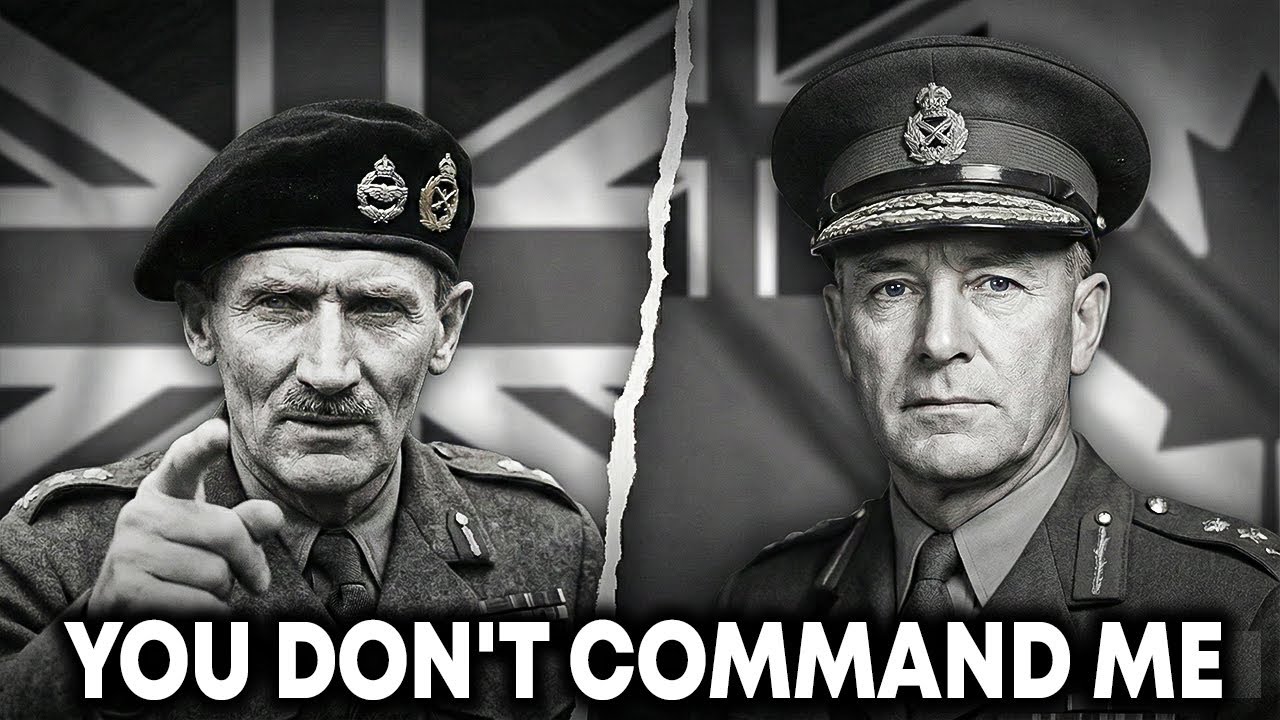 Montgomery, the hero of El Alamein and the architect of victory in North Africa, viewed obedience as the absolute currency of military command. To him, Crerar’s absence was not an act of remembrance but a deliberate slap in the face, a mutinous act of insubordination that threatened the sacred chain of command. In the British field marshal’s eyes, every soldier in the 21st Army Group, regardless of their nationality, was a tool to be wielded in his grand strategic design.
He demanded absolute, unyielding loyalty; anything less was a betrayal.
The fallout was immediate and withering. Montgomery, fuming with icy rage, drafted a letter that wasted no time on diplomacy or understanding. It was an ultimatum of imperial authority, a career-ending missile designed to crush the Canadian commander’s resistance.
The message was terrifyingly simple and final. Apologize publicly and submit to British authority, or pack your bags for England in shame. The expectation was absolute compliance from a Dominion officer who owed fidelity to the Crown.
Montgomery saw the chain of command as a sacred covenant between leader and subordinate. His successes from North Africa to the Normandy breakout, had been built on his relentless, iron-fisted control and his demand for precision. He had given Britain back its pride, and in return, he expected deference on a molecular level.
He believed Crar, the unassuming general from British Columbia, would crumble under the weight of his fury.
However, Montgomery’s calculation was fundamentally flawed. He was operating on an outdated or perhaps willfully ignored, worldview. He assumed Harry Chare was a colonial subordinate bound to London by imperial destiny.
He believed Quebec’s motherland held ontological superiority. But Crar was not playing that game. He was not frightened by the threat of dismissal.
When Montgomery’s ultimatum landed, Chrar did not panic. There was no frantic communication and no frantic plea for forgiveness. Instead, in a moment of extraordinary clarity and courage, the Canadian general crafted a response that would sever the colonial ties binding his nation to the British throne.
He didn’t try to negotiate or feign medicinal reasons for his absence. He went on the offensive.
Chrar’s reply was a masterclass in political defiance. He looked the British Empire in the eye and informed him that he could not be fired at a whim. His command was not a favor to him by field marshal’s discretion, it was a trust held by the Canadian government.
 If Montgomery wanted his exit, he would need to present it before the full Canadian cabinet in Ottawa, be prepared to publicly justify his dismissal of a sovereign commander.
The message was a bomb, and its payload was the topic of sovereignty. The very notion of “Overlord Command” shuddered upon its arrival. Montgomery realized in that moment that his authority had boundaries, and they were blocked by the political realities of Canada’s constitutional status.
The Canada at war was not a billion-dollar colony, but a proud nation with its own declaration of war, its own budget, and its own promise to its fallen sons.
Montgomery underestimated the fact that the quiet men who carried the scars of the war were neither pliable nor obedient. He did not foresee that a quiet general would act, not as a subordinate, but as a partner on the world stage. Chrar’s refusal to bend was a direct declaration that the sovereign parliament in Ottawa held the levers of command, not Downing Street in London.
The balance of power had shifted.
The one-sentence response—and it was essentially this threat to the Ottawa card became an eternal precedent for the rest of the Second World War. It drew a line in the sand that a British marshal could not cross without turning a private conflict into an international relations crisis. A single letter had shattered the illusion that the Dominions were children in the British family responsible.
Montgomery, facing the threat of having to politically explain his actions to the Canadian government, backed down. It was a humiliating retreat for the great British strategist. He quietly retorted, and the official records of the incident were tucked away, lest they undo the carefully managed image of a unified Allied front.
But everyone who had seen the communication understood the shifting tectonic plates of relations.
For the 175,000 soldiers under the Chrar’s command, it was a revelation. Here was a leader who demanded significant battle deaths be honored and not erased in the face of military bureaucracy duress. The memory of the seas staining the sand at Dieppe of Chrar’s memory was not bias, but a sacred trust.
Finally, had the high command acknowledged that a Canadian life mattered more than a British timetable?
 The ripples of that single act of defiance extended far beyond the immediate tactical reality. For the soldiers who fought up the Italian Boot and through the liberation of Netherland, it ignited a deep, personal pride. They were no longer appendages of the imperial army but the proud vanguard of a self-respecting nation.
This gave a deeper purpose to their sacrifices in the mud and flames of their award.
The impact resonated in the political chambers of Ottawa too. For decades, Canadian leaders had been working toward diplomatic recognition of self-rule, but it was the battlefield that firmly proved the country’s sovereignty. The moment that General Chrar.
Playing Ottawa against the Empire gave root to the future as a leadership within the United Nations. It made action fact.
The story of a September 1944 letter matters beyond its military context because it captures the danger of diplomacy. A country doesn’t step into the global arena through petitions, but through the silent, decisive courage of a General not to tell the empire, no. By refusing to apologize and risking his entire career for solemn remembrance, Chrar articulated a foreign policy of mutual respect.
It signifies the cultural end of the colonial era. The dreamy old order, where anyone wearing a red uniform was simply a being of the remote King, was dead. Instead, the letter’s unwritten content declared that allied nations marched together in equality, not in the shadow of one great power’s authority.
The empire’s grip on global command was now on the clock, and the timers were ticking.
Ultimately, it wasn’t artillery that ended symbolic empires; it was the willingness of a determined leader to look at the eviction letter, and answer not with submission but with backbone. In that mythic letter, the UK realized it was no longer the sole orchestrator of the war effort. Dominion forces were to be dealt with as political entities equal in sovereignty.
Harry Chrar’s name should have been written into Canadian history books with more ink. He gave up the chance for easy promotion, a smooth path in the command structure, and the quiet life of a good garrison soldier. Instead, he chose being the father to a battlefield.
He chose his men, his nation, his authority, and the greater precedent.
 By choosing his principles over ambition, he ironically preserved his command and advanced the national interest. The quiet tenacity of that action built respect that no amount of battle might could have earned. It transformed the Canadian from activist lobbying for a seat at the table to the creator of the table itself.
The next time you contemplate the Canadian military legend, think of the quiet moments of courage, and the time when a bureaucrat who did not desire glory out-witted a man who craved it. The scene at Dieppe, the tactical sacrifice, did it not die at the hands of the enemy, but it was kept alive through honor. Respect on the battlefield.
The echo of this moment still resonates in modern geopolitics. The virtue of a nation that fully aligns and stops acting as a satellite. It’s a message to any international commander that the day of running roughshod over allies will be charged.
The sovereignty of a democratic nation cannot be offloaded.
In the end, as the war in Europe drew to its close, Chrar was not leading as a soldier under Montgomery but been seen. His mandate was to take southern liberation, saving the Danish and Dutch from famine and reprecautions, with a command given, not as a subordinate, but as an equal to a sovereign power.
It’s why the force is remembered not with the anger of a mere colonial unit, but as the sacrifices of Canadians. The history of the Canadian nationhood can have a tentative timeline: The Statute of Westminster recognized the 1931 authority, but it wasn’t until a tent in the quiet hours of September 1944 that the world recognized the brunt of their courage.
The Crown could enforce the a loyalty of its citizenry, but it could not command the soul of a sovereign state. Churette’s choice to stand up to power enables the right of an allied government to remain principal over its own national interests. He unlocked the door of the road towards the backdrop of the Pentagon Board.
And in that bitter month, the war had won not only the field but the metaphor. The idea of the Commonwealth as equals. The empire may have raged, but as the dusk settled, the Canadian general had transformed the bright world order into a new and one of multilateral mutualism.
And it all started with a matter of State due.