The sheriff was already standing on the front porch.
The children were watching from the upstairs window.
Their mother was crying in the kitchen.
And the father kept repeating the same sentence to the banker.
“I paid you every month.”
The banker didn’t argue.
“I know.”
“For five years.”
“Yes.”
“Then how can you take my house?”
Because the loan was over.
Not paid off.
Over.
The family had spent five years making mortgage payments—
and still owed almost the entire principal.
Now the bank wanted the remaining balance in one lump sum.
Immediately.
Thousands of dollars.
The father didn’t have it.
So he asked the only question that mattered.

“Can I refinance?”
The banker looked at him.
“No.”
The bank had stopped lending.
Credit had frozen.
The Great Depression had arrived.
And by sunset, a family that had never missed a payment could lose the home they thought they were buying.
That sounds insane today.
But before the modern mortgage—
that was how American home finance often worked.
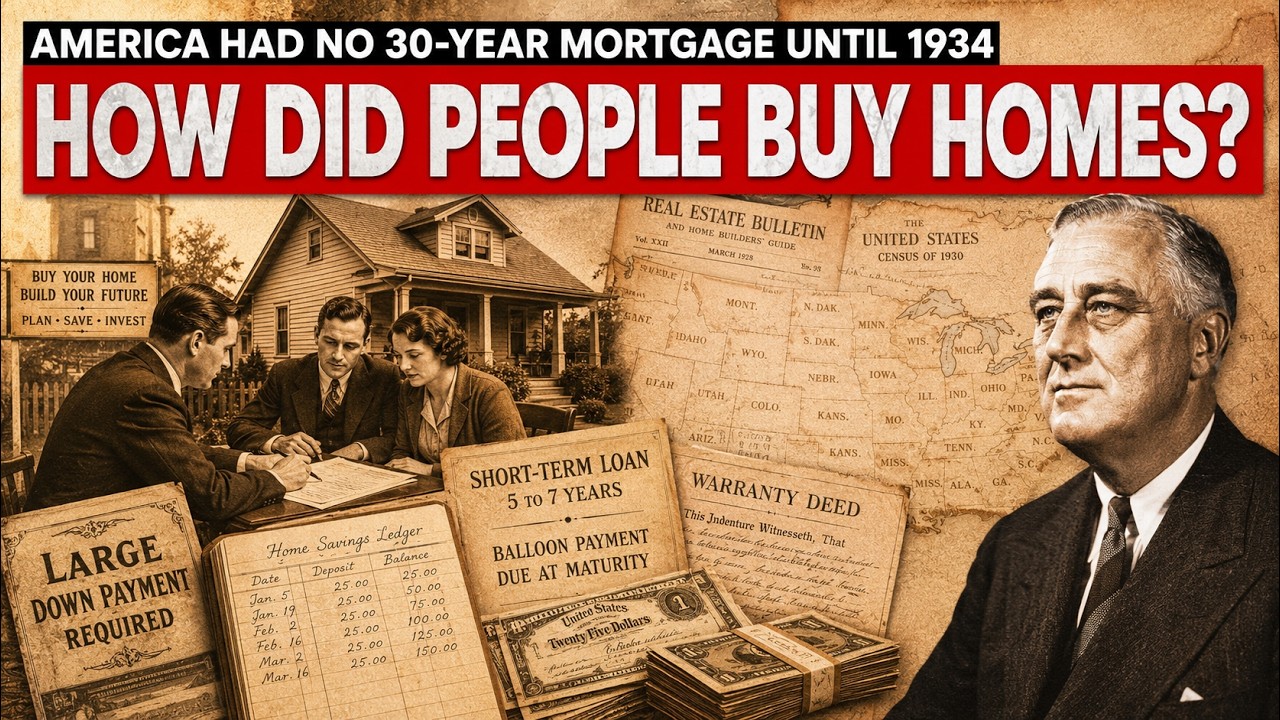
Three years.
Five years.
Maybe ten.
Huge down payment.
Interest every month.
Then one enormous balloon payment waiting at the end.
You could do everything right—
and still lose the house.
And by 1933, this system was collapsing so violently that nearly a thousand American families a day were reportedly facing foreclosure.
Banks were failing.
Borrowers couldn’t refinance.
Half the nation’s mortgages were in trouble.
Homeownership itself was beginning to look like a broken promise.
Then Washington stepped in and did something radical.
It changed the mortgage.
Not the interest rate.
Not the paperwork.
The entire structure.
Longer terms.
Smaller down payments.
Fixed payments.
Principal reduced every month.
Government insurance.
And eventually—
thirty years to pay.
The mortgage Americans now treat like a natural part of life was born because the old system almost destroyed American homeownership.
But to understand how shocking that change really was—
you have to understand how difficult owning property had always been.
Long before Americans borrowed money for houses—
they fought for land.
After the Revolution, the federal government controlled enormous western territories.
Millions of acres.
But ordinary settlers faced a problem.
The government’s early land system favored large purchases.
Huge parcels.
Hundreds of acres.
Too expensive for many working families.
So settlers improvised.
Some bought from speculators.
Others simply moved onto land before they legally owned it.
Build a cabin.
Clear trees.
Plant crops.
Stay.
Then hope the government eventually recognized your claim.
In early America, ownership often began with an axe—
not a mortgage.
Then came 1862.
The Civil War was raging.
And Abraham Lincoln signed the Homestead Act.
The promise was extraordinary.
Claim up to 160 acres.
Live there.
Improve it.
Farm it.
Stay long enough—
and the land could become yours for a relatively small filing cost.
Millions of acres eventually moved into private hands through homesteading.
This helped populate huge portions of the West.
But there was a catch.
The Homestead Act solved the problem of acquiring rural land.
It did almost nothing for the factory worker in Philadelphia—
the machinist in Cleveland—
the immigrant family in New York—
who did not need 160 acres.
They needed a house.
And in the industrial city—
buying one was brutally difficult.
Imagine a modest home costs $4,000.
The bank says:
“Bring me $2,000.”
Half.
Before the loan even begins.
A worker earning only a few hundred dollars a year could spend years trying to save the down payment.
And that assumes nothing goes wrong.
No illness.
No unemployment.
No children.
No rent.
No food.
For millions of workers—
homeownership was mathematically out of reach.
But suppose somehow you found the money.
Now came the mortgage.
Again—
do not picture the mortgage you know today.
The bank might lend only half the home’s value.
The term might last three to five years.
And many loans did not amortize the way modern mortgages do.
You paid interest.
Month after month.
But the principal barely moved.
Then the maturity date arrived.
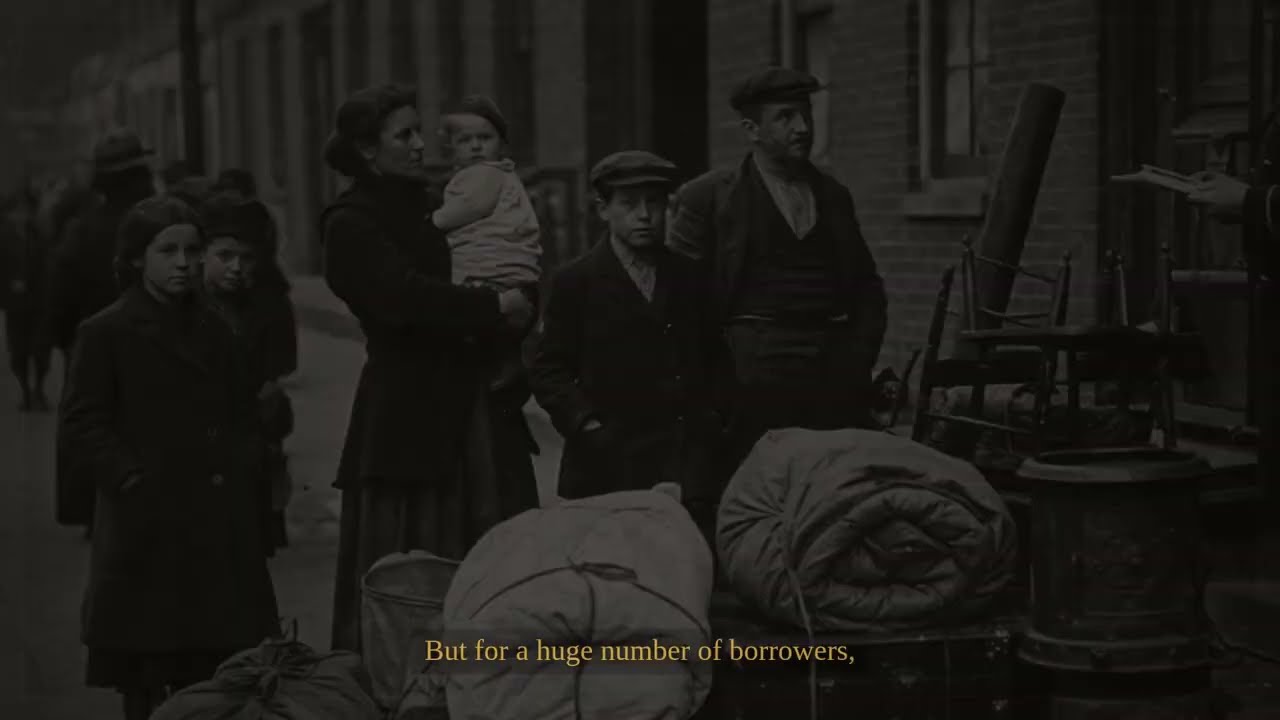
The lender wanted the entire remaining balance.
One payment.
The balloon.
This meant many borrowers never truly expected to pay off the mortgage from wages.
They expected to refinance.
Finish one loan.
Start another.
Then another.
As long as banks kept lending—
the system survived.
But that meant something terrifying:
You did not completely control whether you kept your house.
The bank did.
Because even if you made every payment—
you still needed someone to refinance you when the clock ran out.
The house might feel like yours.
Legally—
the countdown belonged to the lender.
And working people knew it.
So they built another system.
Building and loan associations.
Neighbors pooling money.
Workers helping workers finance homes.
A member contributed savings.
Other members contributed.
The association accumulated capital.
Then one family borrowed to build or buy a home.
As they repaid the loan—
the pool replenished.
Another family borrowed.
Then another.
Unlike many conventional short-term mortgages, building and loans often offered longer repayment periods and amortization.
Now a monthly payment could actually reduce what you owed.
You could see the debt getting smaller.
The institution was local.
Members often had a stake in it.
It felt less like dealing with distant finance—
and more like a community helping itself.
By the early twentieth century, these associations had become enormously important.
This is why It’s a Wonderful Life later made the Bailey Building and Loan the moral center of its story.
George Bailey wasn’t protecting some boring financial institution.
He was protecting a path to ownership.
A way for ordinary people to stop paying rent forever.
But even building and loans couldn’t solve everything.
American cities were growing too fast.
Housing demand was exploding.
Wages weren’t keeping pace everywhere.
Then came the 1920s.
And for a few years—
everything looked brilliant.
Jobs.
Construction.
Cars.
Consumer credit.
Stock speculation.
Housing.
America was borrowing.
Mortgage debt expanded rapidly.
Homeownership rose.
More families began reaching for the dream.
But underneath that optimism—
the same dangerous structure remained.
Short-term mortgages.
Balloon payments.
Second mortgages.
Sometimes third mortgages.
Higher leverage.
Families depending on future refinancing.
The entire system relied on one belief.
Banks will keep lending.
Then October 1929 arrived.
And that belief died.
The stock market crashed.
Businesses failed.
Workers lost jobs.
Then banks began failing.
Thousands.
And when banks fail—
credit disappears.
That is catastrophic when your mortgage requires refinancing.
Picture another family.
They have lived in the same house for four years.
The father still has the paperwork.
Every payment receipt.
Every month marked.
Now the loan matures.
He walks into the bank.
“I need to renew.”
The banker says:
“We can’t.”
“Why?”
“We’re not lending.”
He tries another bank.
No.
Another.
Closed.
Another.
No credit.
But the loan doesn’t care that the economy collapsed.
The balloon payment is still due.
So the house goes into foreclosure.
Now multiply that scene by hundreds of thousands.
Families losing homes.
Banks inheriting properties they don’t want.
Property values falling.
More mortgages going underwater.
Banks becoming weaker.
Credit tightening further.
More foreclosures.
A financial death spiral.
By the spring of 1933, foreclosures had reached terrifying levels.
The system wasn’t merely hurting homeowners anymore.
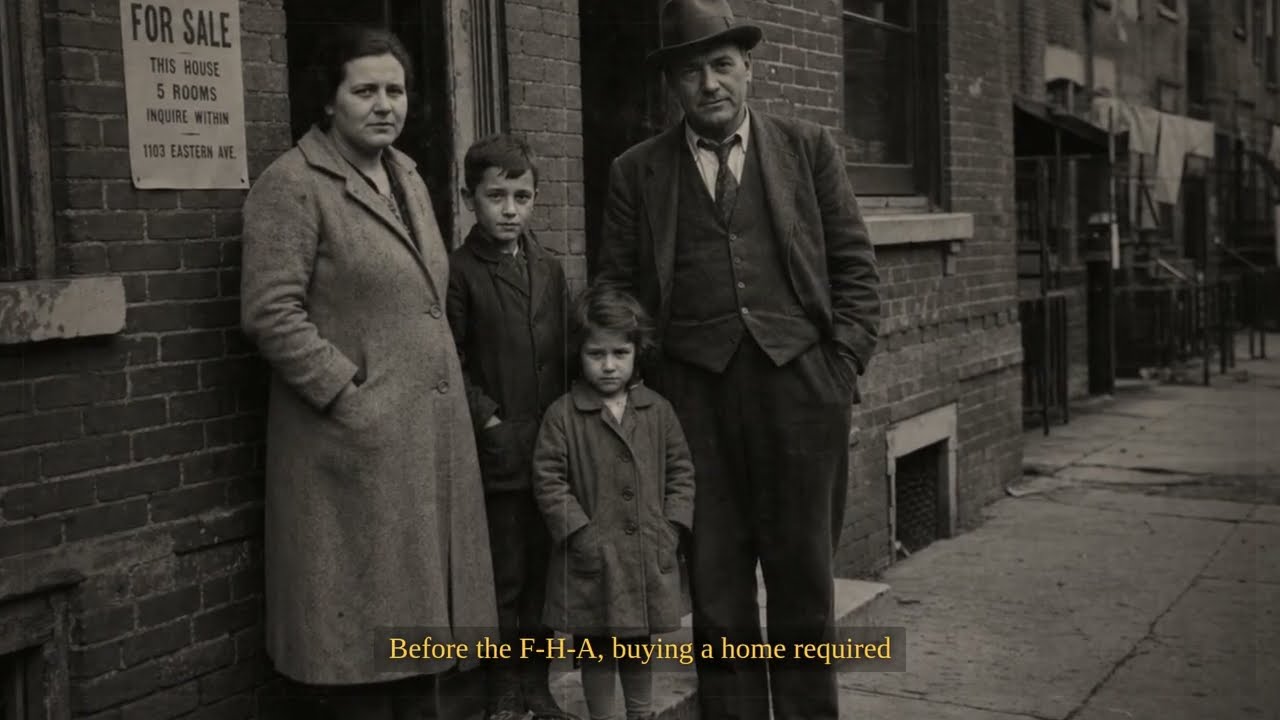
It was destroying the institutions that financed them.
Washington could no longer treat housing as a private problem.
If nothing changed—
homeownership itself might collapse.
And so the federal government began rewriting the rules.
First came rescue.
The Home Owners’ Loan Corporation.
HOLC.
The government acquired troubled mortgages from lenders and refinanced them.
The new structure was dramatically different.
Longer terms.
Lower rates.
Most importantly—
amortization.
Now every monthly payment did two things.
Paid interest.
Reduced principal.
For the first time, a struggling homeowner could look at the mortgage and know:
If I keep paying—
this eventually ends.
No cliff.
No giant lump sum waiting at the finish line.
The HOLC refinanced more than a million mortgages.
Families stayed inside their homes.
But this was emergency medicine.
America still needed a permanent solution.
That arrived in 1934.
The Federal Housing Administration.
FHA.
And this is where American home finance began becoming recognizable.
Banks had been traumatized by the Depression.
Why make another mortgage?
What if the borrower defaults?
What if property prices collapse again?
The FHA changed the answer.
The government would insure qualifying mortgages.
If the borrower failed—
the lender had protection.
That made banks willing to lend.
But the federal government also demanded different loan structures.
Longer repayment.
Full amortization.
Lower down payments.
More predictable terms.
Fixed rates.
The old mortgage said:
“Give me half the price now—
pay interest—
and come back in five years with the rest.”
The new model increasingly said:
“Make manageable payments for years—
and with each payment, own a little more.”
That difference completely changed who could buy.
A family no longer needed to be rich enough to save half the house price.
A middle-class salary could now potentially support ownership.
But the thirty-year term did not appear fully formed overnight.
Early FHA mortgages were shorter.
Terms gradually lengthened.
Eventually twenty years became twenty-five.
Then thirty.
The exact term changed slowly.
The principle changed immediately.
Time became part of affordability.
Instead of requiring more money today—
America gave borrowers more years.
That made the monthly payment smaller.
And that single idea opened homeownership to millions.
But it created another problem.
If a bank lends money for twenty or thirty years—
that money is locked up for twenty or thirty years.
How do you keep making new mortgages?
Enter Fannie Mae.
The federal government created the Federal National Mortgage Association.
Fannie Mae.
The idea was simple but revolutionary.
A local lender makes a mortgage.
Then sells it.
The lender receives cash.
Now it can make another mortgage.
Then another.
And another.
The mortgage itself could move into a secondary market.
Suddenly, home lending was no longer limited to whatever savings existed inside one local town.
Capital could flow nationally.
This transformed the mortgage from a local banking product—
into part of a national financial system.
Then World War II ended.
Millions of veterans came home.
And the system exploded.
Young men returned from Europe and the Pacific.
Many wanted the same things.
Marriage.
Children.
A job.
A house.
But America had barely built civilian housing during the war.
Demand was enormous.
The GI Bill helped unlock it.
Government-backed loans for veterans.
Low rates.
Very small down payments.
Sometimes essentially none.
Compare that with only a generation earlier.
Old system:
Bring fifty percent.
New system:
You served.
The government will stand behind the loan.
The difference was enormous.
Then builders changed the scale.
William Levitt saw the demand.
Long Island.
Farmland.
Thousands of acres.
Instead of building one custom house at a time—
use industrial production.
Specialized crews.
Repeated designs.
Standard materials.
House after house.
Levittown.
Affordable suburban homes appearing with stunning speed.
Now imagine the returning veteran.
He had spent years in uniform.
Maybe he grew up renting.
Maybe his parents could never afford a house.
Now he walks into a lender—
gets a government-backed mortgage—
and moves into a brand-new home.
Front yard.
Driveway.
Children.
Car.
Thirty years to pay.
The modern American suburb was born from that financial structure.
Not just architecture.
Finance.
No long mortgage—
no affordable monthly payment.
No affordable monthly payment—
no mass suburbia.
The mortgage literally reshaped the map.
But it did not reshape it equally.
A Black veteran returned home wearing the same uniform.
He had fought in the same war.
Risked the same life.
The GI Bill existed for him too.
On paper.
Then he tried to buy a house.
And discovered another system waiting.
Redlining.
Government housing agencies and private institutions classified neighborhoods by perceived lending risk.
Race became deeply embedded in those judgments.
Neighborhoods with Black residents were often labeled hazardous.
Mortgage insurance became harder to obtain.
Private banks followed.
Developers restricted who could buy.
Suburban projects such as Levittown initially excluded Black families.
So one veteran could return home—
buy a suburban house—
begin building equity—
watch the property appreciate—
and eventually pass wealth to his children.
Another veteran could return home—
and be locked outside the same system.
Same country.
Same war.
Different opportunity.
That difference compounded for decades.
Because a house is not merely shelter.
It becomes collateral.
Inheritance.
College money.
Retirement wealth.
A down payment for the next generation.
The system that created mass middle-class wealth for millions—
also excluded millions from accessing that wealth on equal terms.
That is part of the mortgage story too.
Not a footnote.
A structural consequence.
By the 1960s, the long-term mortgage had become so normal that Americans forgot how new it was.
Thirty years.
Fixed rate.
Amortization.
A house slowly becoming yours.
The terrifying five-year balloon mortgage felt ancient.
Then America made a familiar mistake.
It began believing the system could not break again.
Fast forward.
2000s.
Housing prices rise.
Lenders loosen standards.
Mortgage products become more aggressive.
Adjustable rates.
Low introductory payments.
Complex structures.
Loans issued to borrowers who were increasingly vulnerable.
And once again, one assumption held everything together:
Housing prices will keep rising.
If there’s trouble—
refinance.
If refinancing fails—
sell.
Someone will buy.
Then prices stopped rising.
Borrowers defaulted.
Mortgage securities imploded.
Banks panicked.
Credit froze.
Fannie Mae and Freddie Mac were placed into federal conservatorship.
Millions of families faced foreclosure.
Different era.
Different financial instruments.
Same fundamental lesson.
A housing system built on endless confidence can collapse very quickly.
So now look at the mortgage Americans know.
Thirty years.
Three hundred sixty payments.
Fixed interest.
Principal declining.
The ability to refinance.
Government-backed structures around much of the market.
A national secondary mortgage system.
None of this is natural.
None of it was inevitable.
It was built after catastrophe.
Every piece solved a failure that came before.
Balloon payments destroyed stability—
so mortgages amortized.
Huge down payments excluded ordinary families—
so requirements fell.
Banks feared long-term lending—
so government insurance reduced risk.
Local lenders ran out of capital—
so secondary markets emerged.
Veterans came home needing houses—
so the GI Bill accelerated access.
Then millions of families entered the housing market.
And America changed.
Suburbs.
Highways.
Shopping centers.
School districts.
Commuter culture.
Home equity.
Generational wealth.
All built partly on one financial innovation:
Give ordinary people decades—
instead of years—
to buy the place where they live.
That’s the real significance of the thirty-year mortgage.
It didn’t simply make debt longer.
It transformed a house from something ordinary families struggled to finance—
into something millions could slowly own.
But never forget what came before.
A father standing in a bank.
Receipts in his hand.
Five years of payments behind him.
Children sleeping in the house.
Then one sentence:
“The loan is due.”
“But I paid every month.”
“That was the interest.”
“What about the house?”
“You still owe the principal.”
“Can I refinance?”
“No.”
And that—
more than any policy paper—
is why the modern mortgage had to be invented.