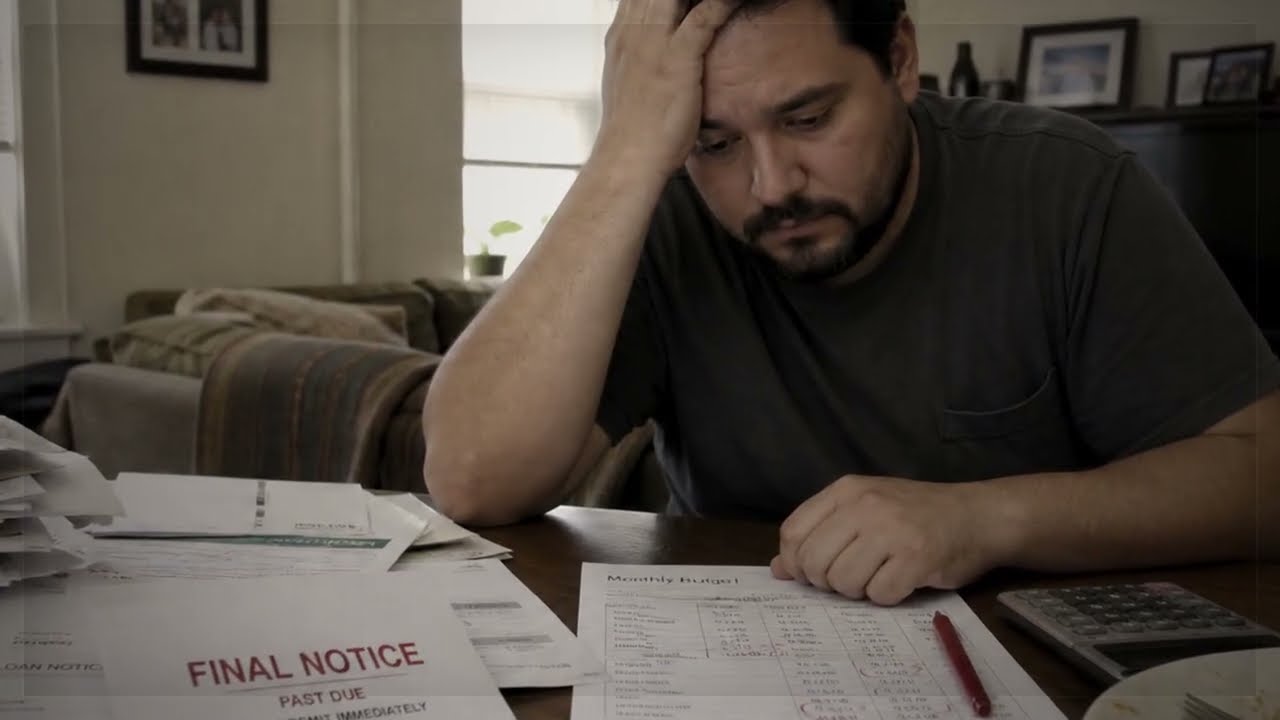
She was eighteen years old.
Sitting at a kitchen table.
Her mother was beside her.
A laptop was open.
And on the screen was a number she barely understood.
$38,000.
She had never earned $38,000.
Never paid rent.
Never had a full-time job.
Never bought a car.
But within minutes—
she was about to agree to repay that amount over years of her adult life.
She clicked.
Accepted.
Signed electronically.
And just like that—
the debt existed.
No dramatic warning.
No banker looking her in the eye.
No one saying:
“This could still be following you when you’re thirty-five.”
Or forty.
Or older.
She was simply doing what millions of American teenagers had been told to do.
Go to college.
Borrow what you need.
Get the degree.
The future will take care of the rest.
Today, tens of millions of Americans carry student loan debt.
For some, the monthly payment affects where they live.
Whether they buy a home.
Whether they marry.
Whether they have children.
How much they save.
When they can retire.
But here’s the part that makes this story so strange:
For most of American history—
this system did not exist.
No federal student loan portal.
No FAFSA loan offer.
No Sallie Mae.
No seventeen-year-old agreeing to decades of repayment before attending their first college lecture.
And yet Americans still went to college.
They became doctors.
Engineers.
Teachers.
Scientists.
Lawyers.
Business owners.
So how?
How did an entire country educate generations of students before debt became the entrance fee?
The answer is uncomfortable.
College used to be radically different.
At first, almost nobody went.
Then America built public universities.
Then the government paid veterans to attend.
Then Cold War fear created the first federal student loans.
And somewhere along the way—
the question changed.
It stopped being:
“How do we make college affordable?”
And became:
“How do we make sure students can borrow enough to pay whatever college costs?”
That shift changed everything.
Go back to colonial America.
Harvard.
William and Mary.
Yale.
These were not mass public universities.
They were small.
Elite.
Religious.
And overwhelmingly designed for young men from families already positioned near the top of society.
A farmer’s son did not grow up assuming:
“One day, I’ll go to college.”
Most people had no need for a degree.
You farmed.
Learned a trade.
Entered an apprenticeship.
Worked in a shop.
Joined the family business.
Education happened through family, church, community and practical training.
College served a narrow purpose.
Clergy.
Law.
Medicine.
Leadership.
And because very few people attended—
America did not need a giant system of student finance.
The families sending sons to college were often already capable of paying.
Tuition could also be surprisingly low by modern standards.
Some public institutions later charged little or nothing.
Housing costs were modest.
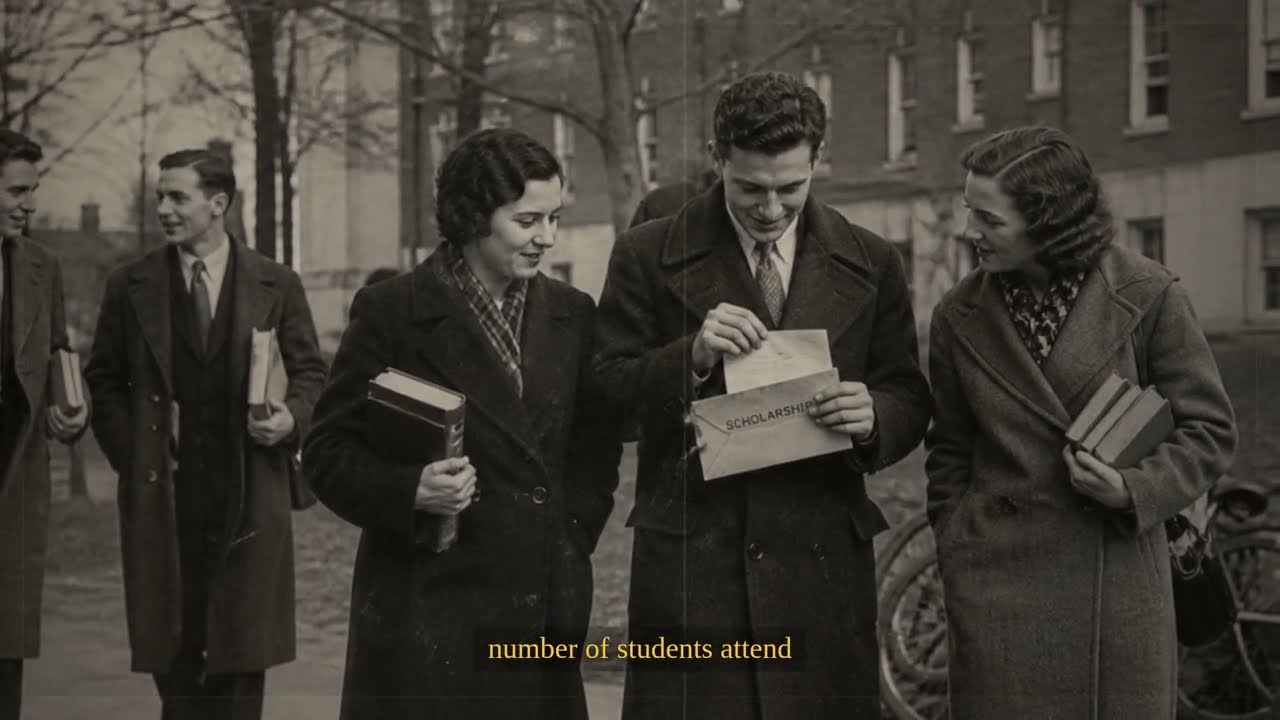
The system wasn’t generous.
It was exclusive.
That distinction matters.
College was cheap partly because America had not yet tried to send millions of people there.
Then the country began asking a more radical question.
What if higher education wasn’t just for wealthy families?
What if farmers and mechanics deserved it too?
That idea took physical form during the Civil War.
The country was tearing itself apart.
And Abraham Lincoln signed the Morrill Land-Grant Act.
The concept was astonishing.
The federal government would grant land to states.
The states could use or sell that land to help finance colleges teaching agriculture, engineering and practical sciences.
This was not Harvard’s old model.
It was education tied directly to economic development.
Farmers.
Mechanics.
Industrial workers.
People building a modern nation.
Institutions created or strengthened through the land-grant system would eventually become major universities.
Iowa State.
Kansas State.
Cornell.
Wisconsin.
Nebraska.
And many others.
The philosophy was clear:
Education could serve the public.
Therefore, the public could help finance it.
A second Morrill Act in 1890 expanded the system and helped drive the creation or designation of public institutions serving Black students in segregated states.
The structure remained unequal.
Racial discrimination was embedded deeply in American education.
But the idea of publicly supported higher education was becoming part of national policy.
And for decades—
that public support helped keep tuition comparatively low.
Students still needed money.
Books.
Housing.
Food.
Transportation.
But the mathematics could work.
A summer job could actually matter.
Part-time employment could cover a meaningful portion of costs.
Families could save.
Churches helped.
Community organizations helped.
Universities offered scholarships.
Some institutions created small student-loan funds of their own.
Harvard had such a fund as early as the nineteenth century.
But these were not giant national debt systems.
For many students—
the primary strategy was still brutally simple.
Work.
Imagine college in the 1930s.
You spend the summer working.
Construction.
Farm labor.
A factory.
A store.
You save.
Then return to campus.
Maybe you work in the dining hall.
The library.
Maintenance.
You stretch every dollar.
Nobody calls this remarkable.
It’s expected.
“Working your way through college” wasn’t motivational poster language.
It was an actual financial model.
And it worked because tuition and wages had not yet separated the way they would later.
Was college accessible to everyone?
Absolutely not.
Millions never attended.
Racial barriers.
Gender barriers.
Class barriers.
Geography.
Family responsibility.
The old system excluded enormous numbers of talented people.
But here’s the crucial point:
The students who did attend usually were not being asked to finance an entire university education with decades of personal debt.
Then World War II changed the scale.
Not with loans.
With grants.
June 1944.
Franklin Roosevelt signed the GI Bill.
Millions of servicemen were going to come home after the war.
Washington feared what would happen if they flooded immediately into the labor market.
The Depression was still a living memory.
So the federal government did something extraordinary.
It invested in them.
Tuition.
Books.
Living allowances.
Training.
Home-loan benefits.
For education, this meant many veterans could attend college without borrowing money.
The government paid.
Think about how different that philosophy was.
A veteran did not receive a document saying:
“Here is $20,000. Pay it back over the next fifteen years.”
The message was closer to:
“You served the country.
Now the country will help educate you.”
And millions accepted the offer.
Campuses exploded.
Classrooms overflowed.
Universities expanded.
New buildings appeared.
Veterans who would never have considered themselves “college material” became students.
Engineers.
Doctors.
Teachers.
Businessmen.
Scientists.
The American university changed from an elite institution into something approaching mass higher education.
By the late 1940s, veterans represented an enormous portion of college enrollment.
And this wasn’t charity.
Washington saw it as economic policy.
Educated workers earn more.
They produce more.
They pay taxes.
They buy homes.
They create businesses.
They contribute to growth.
The GI Bill helped build the postwar middle class.
But again—
access was not equal.
Black veterans often faced discriminatory admissions systems, segregated institutions, unequal local implementation, and barriers that prevented them from benefiting at the same scale as white veterans.
The program was transformative.
It was also deeply shaped by the racial structure of the country administering it.
Still, one lesson seemed undeniable.
Direct public investment in education could change millions of lives.
Then came a metal ball in the sky.
And America’s philosophy began shifting.
October 4, 1957.
Sputnik.
The Soviet Union launched the first artificial satellite.
A small sphere.
A radio signal.
Beep.
Beep.
Beep.
But in Washington—
panic.
America had won the war.
Built the atomic bomb.
Led the industrial world.
And now the Soviet Union had beaten it into space.
Suddenly America’s schools looked like a national-security problem.
Were there enough engineers?
Enough mathematicians?
Enough scientists?
Was the United States falling behind?
The response came fast.
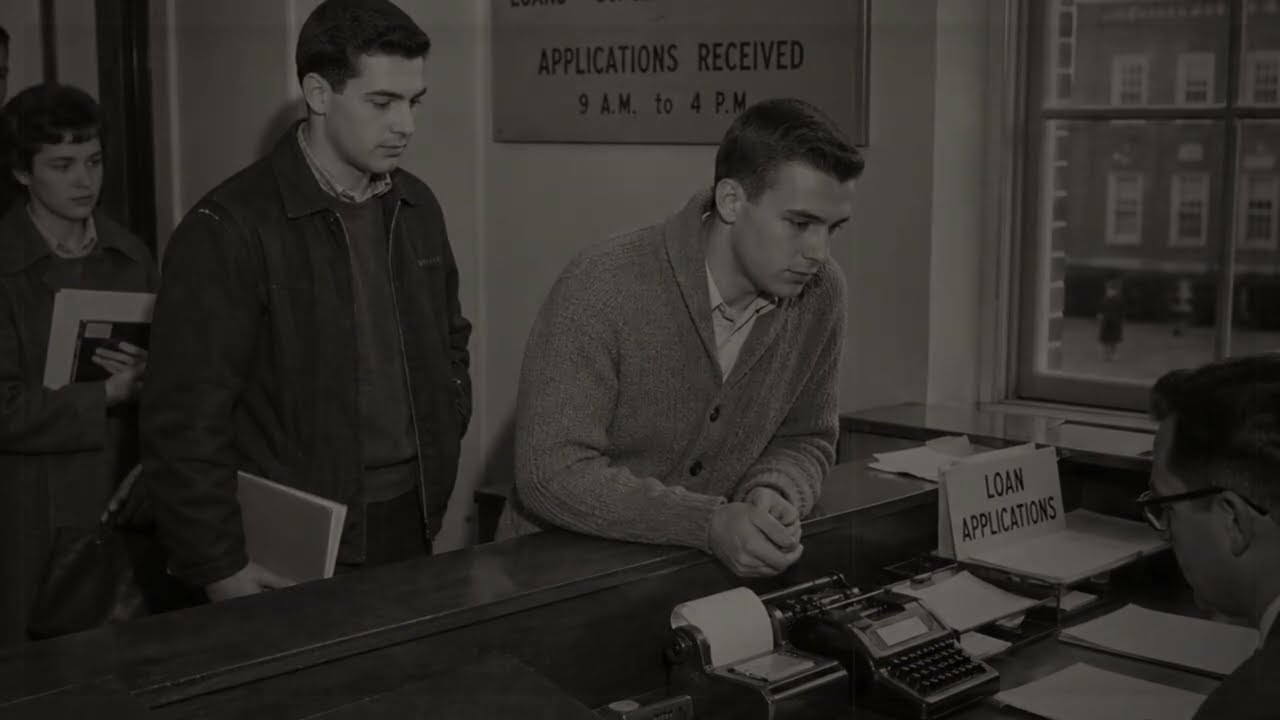
National Defense Education Act.
And inside that legislation was something new.
Federal student loans.
Not loans for everyone.
Not yet.
The program targeted fields considered strategically important.
Science.
Engineering.
Mathematics.
Education.
The loan limits were comparatively small.
Interest was low.
Repayment could extend over years.
Teachers could receive partial cancellation under certain conditions.
But the principle had entered federal policy.
Instead of simply funding institutions—
Washington could lend money to students.
Student debt had arrived.
Quietly.
As a Cold War weapon.
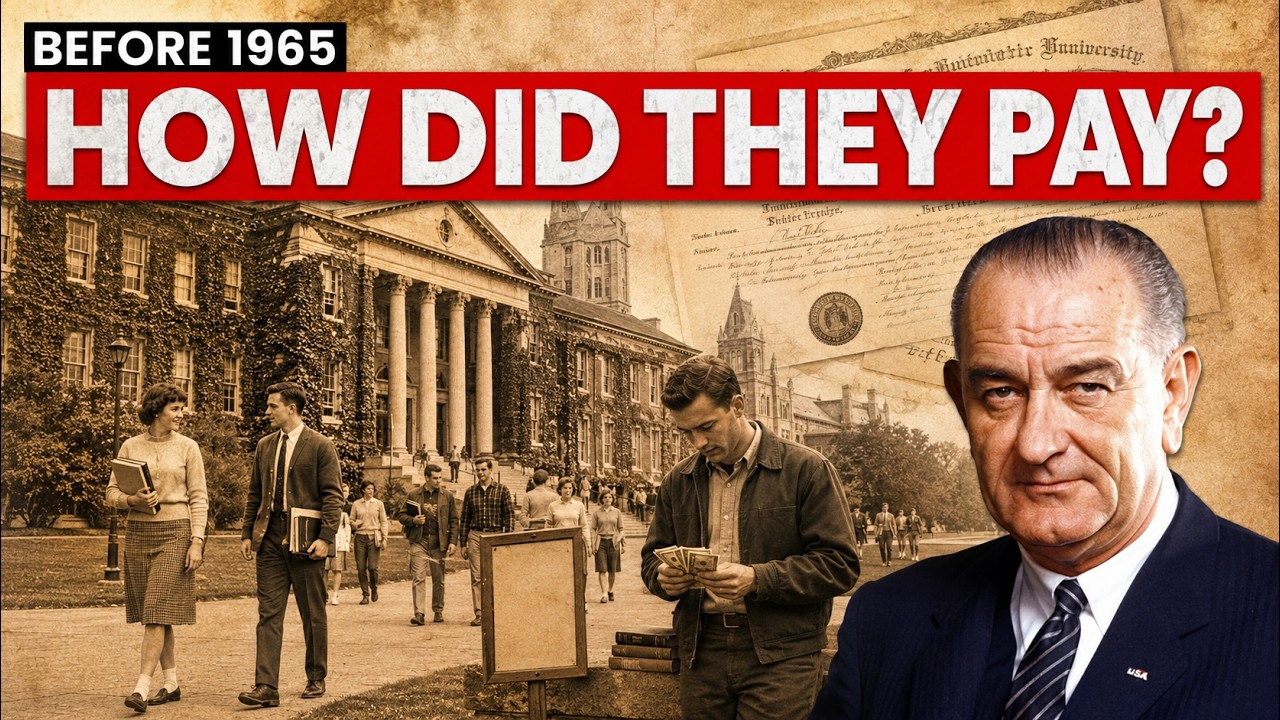
Then came Lyndon Johnson.
And the narrow experiment became a national system.
November 8, 1965.
Southwest Texas State College.
Johnson returned to the school where he had once worked his way through his own education.
He understood poverty personally.
He believed education could break it.
And he signed the Higher Education Act.
The law dramatically expanded federal involvement in college access.
Grants.
Institutional support.
Teacher programs.
And a broad federal guaranteed-loan system.
Private banks would make student loans.
The federal government would guarantee them.
If the student defaulted—
Washington absorbed much of the risk.
This made lenders far more willing to hand money to young borrowers with no credit history and no assets.
The goal was admirable.
A poor kid shouldn’t be blocked from college simply because his family couldn’t write a tuition check.
But hidden inside the solution was an enormous change.
The government was no longer only asking:
“How much should society invest directly in education?”
It was also asking:
“How much credit can we make available to the student?”
At first, that did not look dangerous.
Tuition remained relatively low.
State governments still heavily subsidized public universities.
Borrowing amounts were manageable.
A graduate could repay.
The system looked successful.
Then Washington expanded it.
Pell Grants.
Direct aid for low-income students.
No repayment required.
That same period also brought Sallie Mae—
the Student Loan Marketing Association.
Its purpose was to create liquidity in the student-loan system.
A bank makes a loan.
Sallie Mae can purchase it.
The bank gets money back.
Then lends again.
Student debt becomes scalable.
And something else happens quietly.
The loan stops being just a relationship between one student and one lender.
It becomes an asset.
Something that can be held.
Bought.
Sold.
Managed.
Once debt becomes an asset—
the financial system has a reason to create more of it.
More students.
More loans.
More volume.
At the same time, another shift was beginning.
States started pulling back from the level of support that had historically kept public tuition low.
The student increasingly became the funding mechanism.
And by the late twentieth century—
one philosophical argument was winning.
College is not primarily a public good.
It is an individual investment.
The graduate earns more.
Therefore—
the graduate should pay more.
That sounds logical.
Until the cost of the investment begins rising much faster than the ability to pay for it.
Imagine two students.
One attends a public university in 1965.
The state subsidizes a large portion of the real cost.
Tuition is modest.
He works during summer.
Maybe receives family help.
Maybe a small scholarship.
Maybe a small loan.
Now place another student in the same university decades later.
The state contribution has weakened.
Tuition is dramatically higher.
Housing is higher.
Fees are higher.
The campus employs entire administrative structures that barely existed in the earlier era.
The school competes with other institutions through amenities.
New dormitories.
Fitness facilities.
Student centers.
Athletics.
Marketing.
The second student cannot cover this with a summer job.
The gap is too large.
But the government does not say:
“The price has become impossible.”
It says:
“Here is more credit.”
And that distinction becomes the engine of the entire system.
Price rises.
Loan limits expand.
Price rises again.
Parents borrow.
Students borrow.
Graduate students borrow more.
Universities know the financing pipeline exists.
The question isn’t necessarily:
“Can the family afford this?”
It’s increasingly:
“Can the family finance this?”
Those are not the same thing.
Then the lending system expanded again.
Middle-income families gained broader eligibility.
Parent PLUS loans appeared.
Unsubsidized federal loans expanded access regardless of financial need.
Students could borrow even when interest began accumulating immediately.
Each policy had a defensible goal.
Don’t lock out middle-income families.
Help parents.
Help independent students.
Help graduate students.
Expand opportunity.
But every expansion delivered more purchasing power into the higher-education market.
And whenever a market gains more purchasing power without enough pressure on price—
prices can rise.
Then another actor arrived.
The for-profit college industry.
Early 2000s.
Television.
Late night.
An advertisement appears.
“Train for a new career.”
“Earn your degree online.”
“Change your life.”
The target audience was often not the wealthy eighteen-year-old heading to an elite campus.
It was the single mother.
The laid-off factory worker.
The veteran.
The low-income adult desperate to escape a bad job.
Schools aggressively recruited them.
And because federal aid could follow the student—
the schools had access to enormous streams of government-backed money.
For-profit enrollment surged.
Some institutions provided legitimate training.
Others produced disastrous outcomes.
High debt.
Low completion rates.
Weak labor-market results.
Defaults.
At their peak, these schools represented a relatively small share of total enrollment but a disproportionately large share of federal aid and loan defaults.
The logic had become dangerous.
The student thinks:
“The government is willing to lend me this money. The school must be worth it.”
The school thinks:
“The government will finance the student. Enroll them.”
The lender thinks:
“The loan has federal protections.”
Everyone has a reason to continue—
except the borrower who eventually has to repay.
Then the economy collapsed.
Again.
Great Recession.
Jobs disappear.
Millions of people make a rational decision.
Go back to school.
Get more skills.
Wait out the recession.
Enrollment rises.
But state governments are in crisis too.
Tax revenue collapses.
Budgets are cut.
Public universities lose funding.
They raise tuition.
So at exactly the moment when people have less income—
college becomes more expensive.
Students borrow more.
Then graduate into a weak labor market.
The old promise—
“Get the degree and the salary will make the debt manageable”—
begins breaking for larger numbers of people.
A teacher graduates with debt.
A social worker graduates with debt.
A nurse.
A public defender.
A student who never completes the degree.
A graduate who earns far less than expected.
The balance sits there.
Interest continues.
Years pass.
And something America originally created as a small strategic Cold War program becomes one of the largest consumer-debt systems in the world.
Now return to the eighteen-year-old at the kitchen table.
She doesn’t know any of this.
She sees:
Tuition.
Aid.
Expected family contribution.
Loan.
Accept.
To her, the loan is not a political philosophy.
It’s not the legacy of Sputnik.
Or Johnson.
Or state budget cuts.
Or Sallie Mae.
Or Reagan-era fights over public funding.
Or the rise of for-profit education.
It is simply the number between her—
and the future everyone told her she needed.
So she accepts.
And this is where the entire history becomes personal.
Because student debt is unlike many other forms of debt.
A mortgage buys a house.
An auto loan buys a car.
The asset can potentially be sold.
The education loan buys something intangible.
A possibility.
A credential.
A hoped-for income.
If the degree transforms your career—
the calculation may work beautifully.
If it doesn’t—
you cannot return the degree to the university and ask for your money back.
The debt remains.
That is the gamble.
And millions of Americans were encouraged to take it at eighteen.
But here’s the part people often romanticize incorrectly.
America before student loans was not educational paradise.
Poor students were excluded.
Black students were excluded.
Women faced barriers.
Rural students had limited options.
Elite colleges remained elite.
Millions of Americans simply did not attend.
The old system was affordable partly because access was narrower.
The challenge was real:
How do you expand college to people who could never previously afford it?
Federal aid was one answer.
Loans were one answer.
And loans unquestionably opened doors for millions.
The problem was not simply that loans existed.
The problem was what happened when loans became the answer to almost every price increase.
College costs rise?
Borrow more.
State funding falls?
Borrow more.
Graduate school costs more?
Borrow more.
Parents cannot pay?
Parents borrow too.
At some point—
access and affordability stopped meaning the same thing.
America created access to expensive education.
But access financed by debt can become another form of exclusion.
You can enter.
You simply spend the next twenty years paying for the entrance.
Look at the historical sequence.
Land-grant colleges:
Public assets used to build institutions.
GI Bill:
Government directly pays educational benefits.
NDEA:
Small targeted loans for Cold War priorities.
Higher Education Act:
Broad federal loan guarantees.
Pell:
Direct grants for low-income students.
Sallie Mae:
Liquidity for the lending market.
State disinvestment:
More cost shifts to families.
Expanded loan eligibility:
More borrowing.
For-profit boom:
Federal aid becomes a business model.
Great Recession:
State funding falls while borrowing rises.
And eventually—
trillions in outstanding debt.
No single law created the crisis.
No single president.
No single university.
No single bank.
It was built piece by piece.
Every generation solved one problem—
and left another behind.
Make college accessible.
Make loans easier.
Expand enrollment.
Protect lenders.
Help parents.
Help graduate students.
Keep universities operating.
Every decision could be defended separately.
Together—
they created a machine.
And the machine had one assumption at its center:
A degree is valuable enough that the student can borrow now—
and pay later.
For millions, that assumption worked.
For millions of others—
later arrived with a much bigger bill than expected.
That’s why the question—
“How did people afford college before student loans?”—
has an answer much more complicated than:
“They worked harder.”
No.
They lived in a different system.
Fewer people attended.
Public universities received stronger subsidies.
Tuition was dramatically lower.
Families could cover a larger share.
Students could earn a meaningful fraction through work.
Grants and institutional aid existed.
And at several key moments—
the federal government invested directly rather than demanding repayment.
America did not discover some magical new cost of education in the twenty-first century.
It changed who was expected to carry that cost.
Once, government and institutions carried more.
Gradually—
the student carried more.
And debt filled the gap.
That is the real transformation.
Not from cheap college to expensive college.
From collectively financed college—
to individually financed college.
And once the individual becomes responsible—
the consequences follow the individual too.
The university gets paid.
The professor gets paid.
The landlord gets paid.
The loan servicer gets paid.
The student graduates.
Or doesn’t.
And whatever happens next—
the balance follows them home.
So imagine that eighteen-year-old again.
She closes the laptop.
The application is finished.
She feels relieved.
She got the money.
College is possible.
Everyone congratulates her.
No one says:
“You just entered a financial system that did not exist when your grandparents were your age.”
No one says:
“The amount you owe may shape the next two decades.”
No one says:
“Your government once treated higher education very differently.”
She only hears:
“You’re going to college.”
And maybe that’s the strangest thing about America’s student debt system.
It became enormous—
without ever feeling dramatic at the moment people entered it.
No factory closing.
No market crash.
No sheriff standing at the door.
Just a teenager—
a screen—
a checkbox—
and one quiet click.
Accept Loan.
The debt begins there.
But the story began generations earlier—
when America stopped asking how cheaply it could educate its citizens—
and started asking how much it could help them borrow.