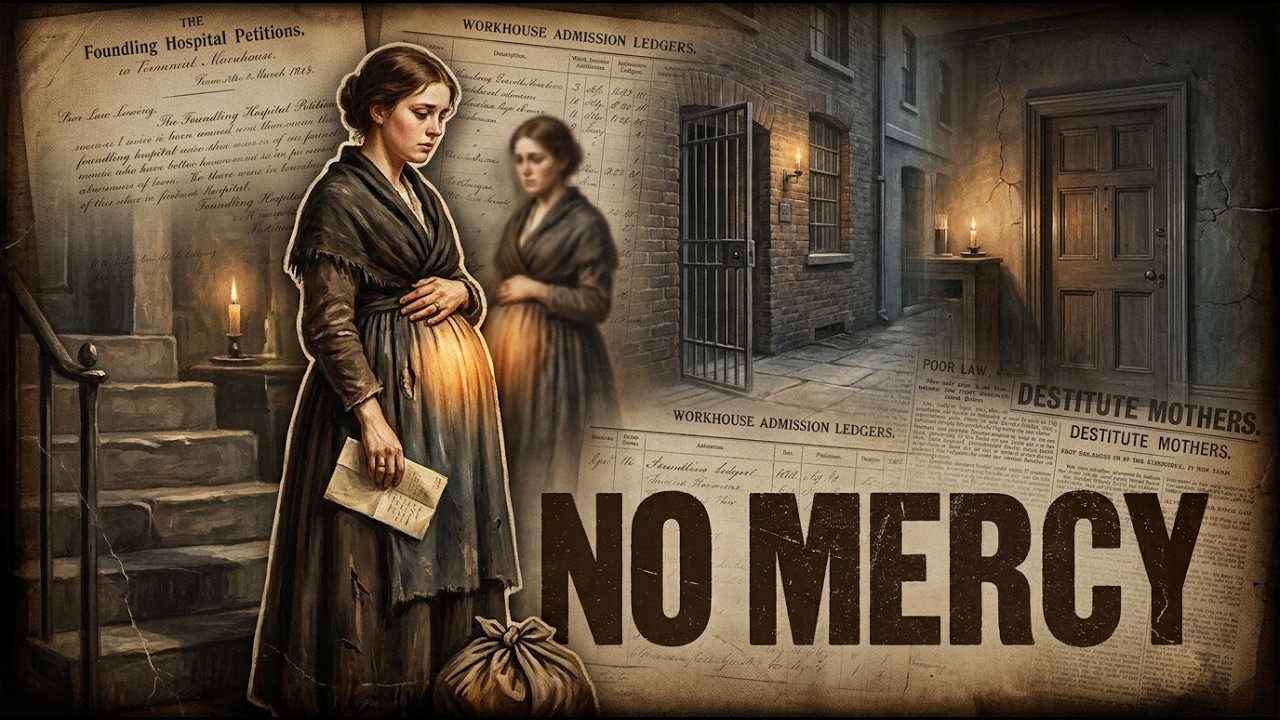
The clatter of a carriage wheel on wet cobblestones was the loudest sound in Kennington, but for Sarah Farquhar, the silence inside her own head was deafening. In 1853, the governess sat with a pen in her hand, the weight of a confession pressing down on her chest, and wrote a simple, devastatingly clear sentence that would echo through history as a damning indictment of an entire era: “If I expose the matter to my friends, I am disgraced forever.”
That letter, preserved in the silent, dusty archives of the Foundling Museum, survives alongside her name. Her child, her future, and the decades she had left to live do not survive in any public record, and it is precisely that absence, that void in the historical narrative, that makes her story representative. The myth of the Victorian era is a gilded cage, a handsome portrait painted in gaslight and velvet, hiding the screams of a vast machinery designed to crush a specific class of people.
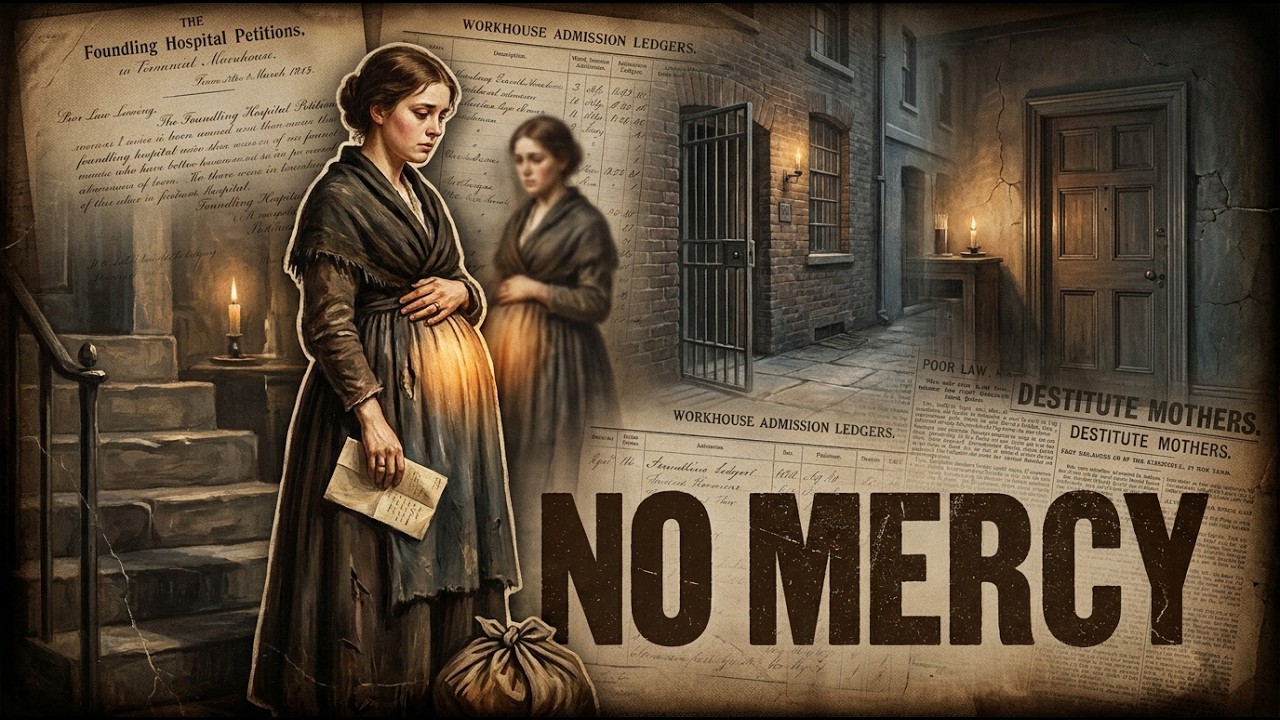 Beneath the polite veneer of church, parliament, and the drawing-room, a parallel civilization existed, a brutal infrastructure for the dispossession of the “fallen woman” which operated with the cold, dispassionate efficiency of a public utility.
To understand the scope of the devastation, one must abandon the romantic distortion of the bonnet. The destruction of unmarried mothers in Victorian England was not simply a matter of social snubbing; it was a dependence within the law, a grim fiscal policy enacted in Westminster and enforced by the police, the magistrates, and the moral majority. In the 1860s, when a papal emissary toured the island nation and reported to the Vatican that an estimated thirteen thousand English infants were being murdered every year by their own mothers, the figure was contested among Parliamentarians, yet the phenomenon—which historian Ann Higginbotham has documented in forensic detail—was debated openly and with a total absence of the moral horror it should have provoked.
This essay is not a work of historical revisionism about exceptional monsters; it is a surgical dissection of a system that Parliament built, the Church endorsed, and respectable society maintained, using working-class women as the fuel for its maximization of social purity.
The mechanics of this machine began not with a child, but with a document. In the household of a Victorian middle-class family, the domestic servant was the engine of order. But her life was a prison of dependency.
She possessed no legal autonomy, no income of consequence, and slept in a room that was not her own. Her single most valuable asset was her character reference, given by her employer. When she discovers she is pregnant, the terror of exposure is not merely a fear of embarrassment; it is the anticipation of structural annihilation.
When her mentor learns of the pregnancy, the dismissal is immediate. She is turned out of the doors with or without her reference depending on the employer’s grace, which is rarely given. Without that reference, she cannot be hired.
She is effectively rendered unemployable by a system that simultaneously condemns her for her condition and prevents her from ever rectifying it.
 From the moment she steps onto the cold London pavement, every subsequent door is not a door; it is a trap designed to clamp shut. The law, specifically the Poor Law Amendment Act, had been the first and most lethal assault. By abolishing the legal right of a woman to compel a father to contribute to his child’s maintenance, Parliament created a grotesque equation.
A man could father a child and disappear legally, leaving no financial trace, while the mother was held the sole legal, moral, and financial guardian of an infant she could not sustain. Contemporary research from the University of Cambridge analyzed records across London and found the abstruse truth: only twenty percent of unmarried fathers in the capital paid even a single penny toward their child. This £0 owed, the entire weight of the child’s existence fell onto the woman with the velocity of a stone dropped from a great height.
The father was free, either through legal loopholes or brute financial impunity, while the woman was castrated—she was legally separated from ever being able to negotiate her own condition.
Her next recourse was the workhouse, that coercive horror. To a nation that defined self-sufficiency above all, the workhouse was not meant to be a charity refuge, but a punishment for the sin of female poverty. A woman in her ninth month of pregnancy entered the grim walls and scrubbed floors until her water broke.
She delivered her child and was given very fourteen days, a brutal fortnight. Upon expiration, she had to choose between remaining with her child, forced to surrender him to institutional care that provided statistically disastrous survival rates, or leaving with her two-week-old infant into the cold winter of London with no job, no respite, and no subsidy. One can excuse the system’s cynicism, for it was working perfectly to its design: it created a class that would disappear into the void.
For those who sought to preserve their own lives in the eyes of what traced it politely as respectability, the Foundling Hospital held a sliver of hope. Yet the institution’s gate was guarded. It was a single oppressive valve.
 The woman had to provide a written petition and two character references from respectable householders. She had to prove she had been seduced, not chosen; seduced, not seductive—all within the strict framework of male governors who decided her own fate, demanding proof of employment beyond her. The hospital only accepted first offenders and would evaluate her entire story before deciding if she was worthy of mercy.
It prioritized her restitution back to the role of a servant in society over the welfare of the child she was surrendering. It asked, in pain, to demonstrate that she was a victim rather than a woman capable of desire. Many were turned away, leaving them in the desperation of the streets.
And it is here that the system reached its terminal and most macabre logic: the trade of baby farmers. A woman with no money, no work, no guardian, and no options was left with one final way back to work: to pay an unlicensed neighbor to care for her infant away from the public eye. A complete regulatory vacuum existed.
The women who bought this service were not those contrary to the social contract; they were precisely the women hoping to climb back into employability. The baby farmers in charge, however, operated a business model where the business seen was not keeping the child alive, but disposing of its burden. The historical records of a Mrs.
Waters in South London are a grotesque ledger: she was convicted of the murder of her wards, while her other grave sites are uncovered in the abandoned streets. Another woman allowed over sixteen children to die in her care of bronchitis, malnutrition, and melancholy. The records of the Lambeth workhouse note that of the surviving infants rescued, nine died of fluid in the brain.
Yet, stomach churningly, this was rationalized by sections of the press and public as a relief to the mothers who could not afford their existence. This is the haunting echo of the logistics of the age, where a man’s inability to pay for his child’s milk was the equivalent of signing its death sentence.
 The Magdalene Laundries were the final, grim warehouse for those who did not manage to mechanically dispose of the child but couldn’t keep them. Institutions presented as refuges for the fallen, they were systematized forced labor camps. The women, sealed behind walls with their infants relinquished for adoption or death, were worked as unpaid servants, their labor sold to laundries in the city block while the institution collected the profits.
Archaeological digs beneath the sites have revealed more than trinkets; they have revealed mass graves, a testament to the bodies that the system discarded. The woman had fallen so low along the social ladder that she became a ghost, a prisoner of reverence.
Analyze the moral theology of the Victorian era that built this. The Victorian ideal of the “Angel of the House” was a perfect, chaste, domestic priestess, a woman of purity and refinement. Yet it was a stratagem applicable only to the married middle and upper class women, whose economic security was a given.
For that reason, the working-class woman was excluded from virtue simply by the fact of her working. She could not possess the same ideal because his employment, her waitress, her maid, her neighbor, her lack of a drawing room, meant she was exposed to the environment and temptations in a way the drawing room was designed to obscure. She was cast, not as a pure soul, but as a potential temptress.
Victorian morality did not just fail to protect her; it actively worked against her, creating the conditions of poverty that placed her in domestic servitude, placing her in close proximity to a master who could exploit her with a legal impunity, and then punishing her for the pregnancy the system exposed her to. The state demanded that she be responsible for a seduction it had structured and protected, while the man who was her moral equal, who was her employer, walked away without a mention in the record the system left behind.
The historical landscape is not entirely dim. There are victories to be recorded. The family law reform of the 1960s and 80s and the legal status of illegitimacy was stripped, legal abortion was decriminalized, the workhouse was dismantled, and the psychological and economic support for single mothers—though still contested—exists.
But the thesis of the era persists from the hidden, stayed document and parliamentary scandals. The wondering accuracy is that the architecture was not built by a sudden evil or a societal madness. It was built through deliberate choices—by drafting the Poor Act, by allowing the poor law to justify punitive measures, by allowing the middle classes to turn their faces away from the infanticide filings.
It is not enough to know the bonnets and tea. To remember the past is to understand the mechanics we have inherited, to ensure we no longer place the blame on the woman who walks the streets with a child, while ignoring the justified system that kills the children of the poor before we even ask their names.