Her father told one lie—
and the king decided she could die for it.
A young woman was dragged into a room filled from floor to ceiling with straw.
The door closed behind her.
Then came the impossible command:
Turn it into gold before morning.
She couldn’t.
Nobody could.
And when she finally broke down in terror—
something entered the room.
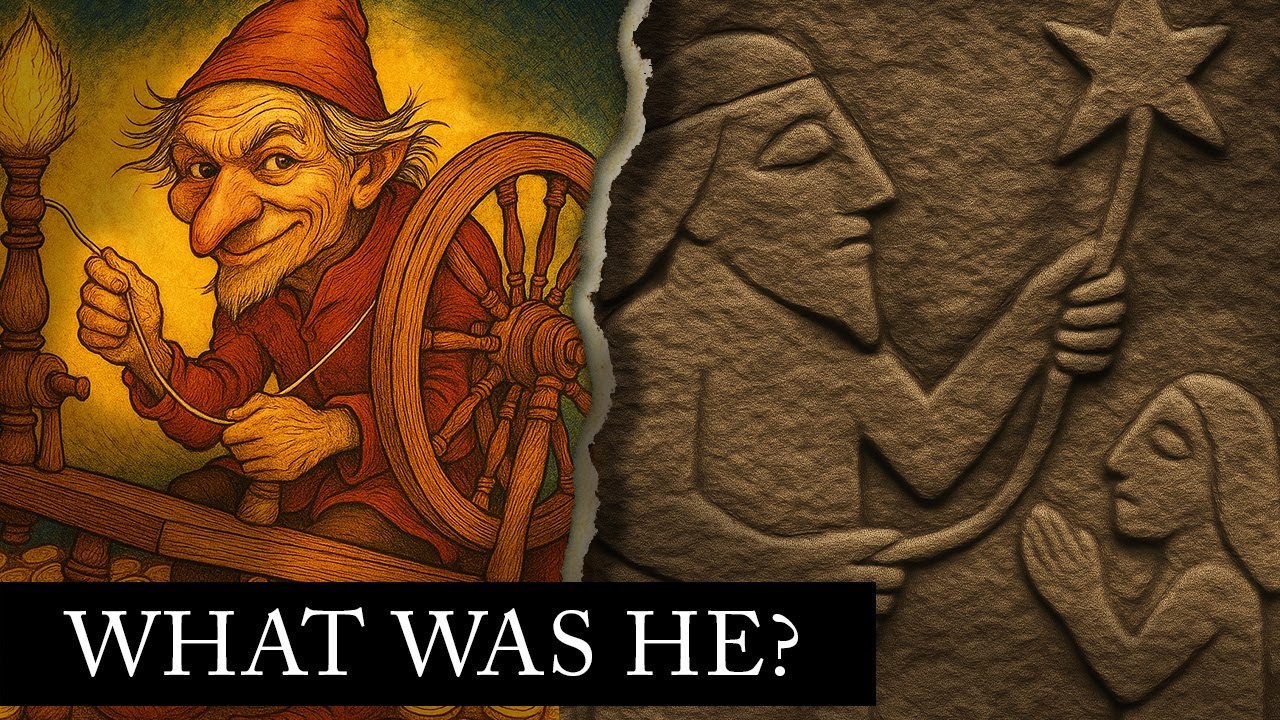
A small, unnatural stranger.
He could do what the king demanded.
Straw became gold beneath his hands.
But miracles were not free.
The first night, he took her necklace.
The second, her ring.
Then the king demanded more.
And the girl had nothing left.
So the stranger asked for something she did not even possess yet.
Her first child.
Desperate to survive the night—
she agreed.
Years later, when he returned to collect the debt, she discovered there was only one thing in the world powerful enough to stop him.
Not gold.
Not soldiers.
Not the authority of the king.
A word.
His name.
Rumpelstiltskin.
And the moment she spoke it—
his power over her collapsed.
That is the children’s story.
But there is something deeply strange buried inside it.
Why should a supernatural being capable of transforming worthless material into gold care whether a human knows his name?
Why does he want a child instead of the enormous fortune he can apparently create whenever he chooses?
Why is spinning connected to impossible transformation?
And why do versions of this basic story pattern appear far beyond the Brothers Grimm?
Because Rumpelstiltskin may preserve pieces of ideas far older than the book in which most of us first encountered him.
Ideas about transformation.
Fate.
Sacrifice.
Secret knowledge.
And perhaps most importantly—
the ancient belief that knowing the true name of something could give you power over it.
To understand why, we have to go backward.
Before the Brothers Grimm.
Before printed fairy tales.
And perhaps—
much farther than that.
The familiar story begins with a miller.
Poor.
Ambitious.
Desperate to impress a king.
So he boasts.
His daughter, he claims, possesses an extraordinary ability.
She can spin straw into gold.
It is a ridiculous lie.
But the king does not laugh.
He sees profit.
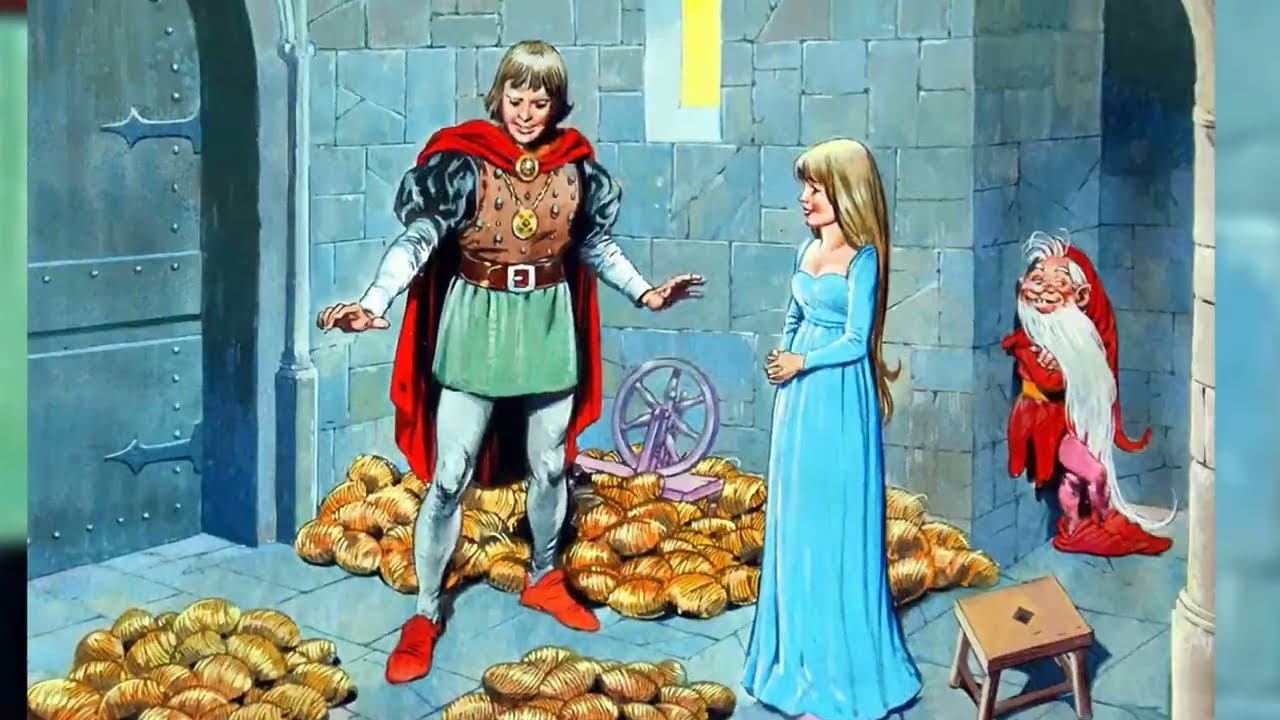
The daughter is brought to the castle and locked inside a room piled with straw.
A spinning wheel waits.
The king gives her until morning.
Produce gold.
Or face a terrible punishment.
The girl is completely helpless.
Then the stranger appears.
Small.
Mysterious.
Possessing exactly the power she needs.
“What will you give me?”
She offers her necklace.
He sits at the wheel.
The spindle turns.
The straw disappears.
Gold takes its place.
Morning arrives.
The king sees the treasure.
And instead of releasing her—
he becomes greedier.
A larger room.
More straw.
More gold.
Again the stranger appears.
This time she gives him her ring.
Again—
gold.
Then comes the third room.
More straw than before.
The king promises that if she succeeds again, he will make her his queen.
But she has nothing left to pay.
The little man proposes another bargain.
When she becomes queen—
her firstborn child belongs to him.
The girl is trapped between a future horror—
and an immediate one.
So she says yes.
The gold appears.
The king keeps his promise.
She becomes queen.
Time passes.
Then a child is born.
And the bargain she made in desperation becomes real.
The stranger returns.
He wants the baby.
The Queen begs.
Gold?
He doesn’t want it.
Land?
No.
Jewels?
No.
He can apparently produce wealth himself.
Then he says something revealing.
Something living is more precious to him than all the treasures in the world.
Eventually, he gives her one final chance.
Three days.
Guess his name—
and she keeps the child.
The Queen begins desperately searching.
Common names.
Rare names.
Names collected from across the kingdom.
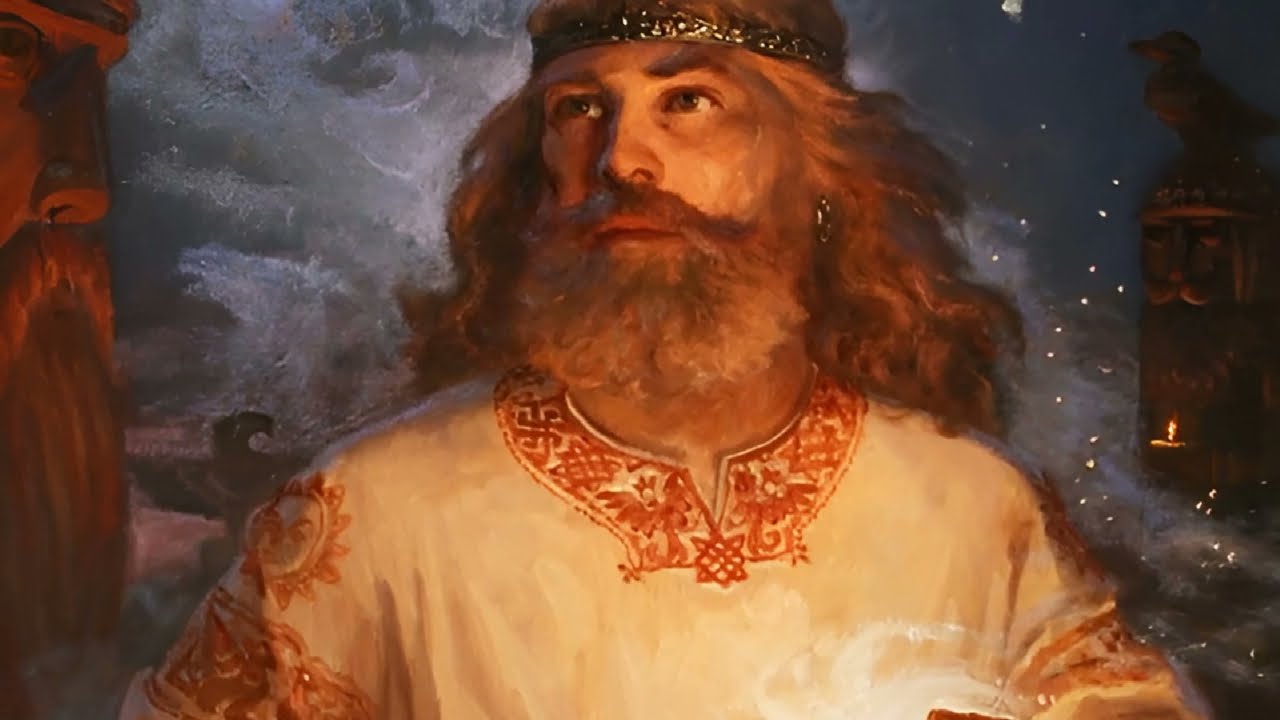
Nothing works.
Then a messenger returns with a strange story.
Far away—
deep in the woods—
he saw a tiny figure dancing around a fire.
The figure was singing.
And inside the song—
he revealed the secret.
His name.
Rumpelstiltskin.
The creature returns to the Queen.
Confident.
She begins guessing.
Wrong.
Wrong.
Wrong.
Then she looks at him—
and speaks the word he never expected to hear.
“Rumpelstiltskin.”
Everything changes.
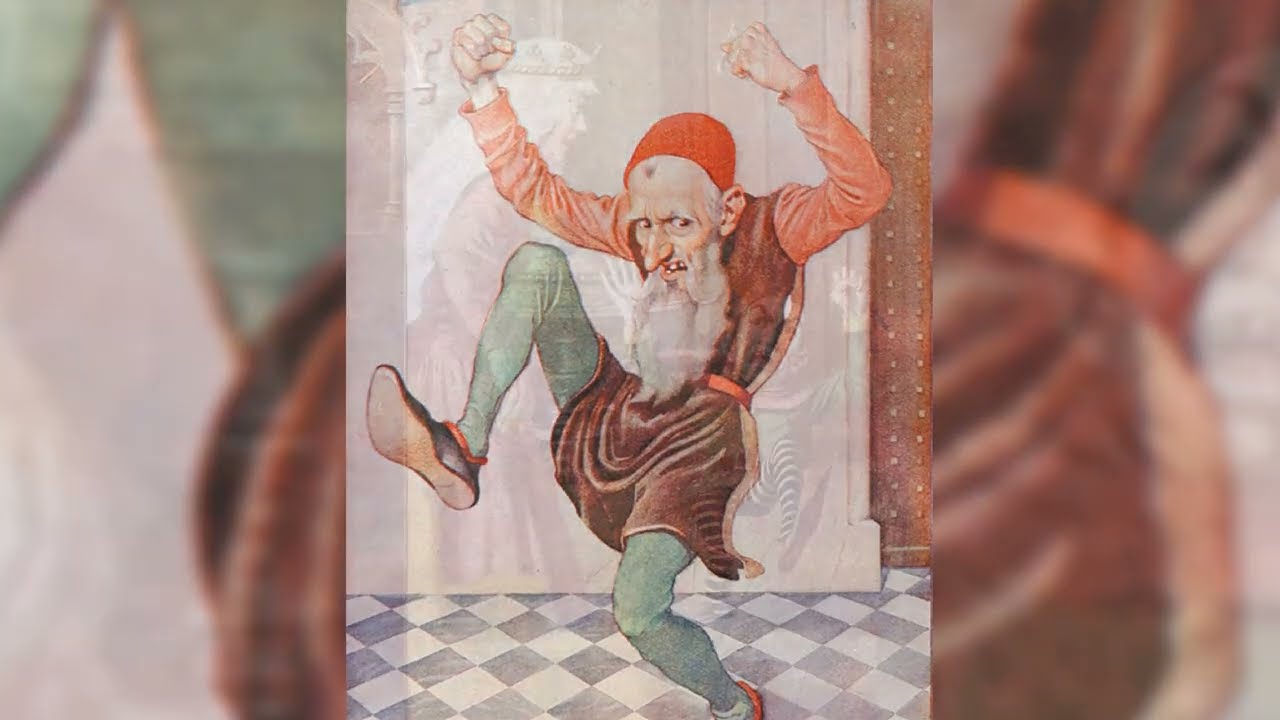
The little man explodes in fury.
In the Grimms’ famous version, he stamps his foot into the ground—
then, in the darker ending, tears himself apart.
The child remains with the Queen.
The bargain is broken.
And Rumpelstiltskin disappears.
It sounds bizarre.
Until we begin pulling the story apart.
Jacob and Wilhelm Grimm published their version in the early nineteenth century.
But the Grimms were not simply inventing children’s entertainment.
They collected and edited oral traditions.
Stories already moving through families and communities.
Stories that existed before they reached the printed page.
And Jacob Grimm believed some folklore preserved fragments of much older myth.
For a long time, that idea was extremely difficult to test.
Oral stories leave no manuscripts.
A storyteller can die without leaving a sentence behind.
But modern researchers have attempted something unusual.
Instead of looking only at surviving books—
they compared related folktales across languages and cultures.
In a widely discussed 2016 study, researchers used methods inspired by evolutionary biology to investigate relationships between Indo-European folktales.
Languages can be arranged into historical families.
English and German are related.
Latin produced Romance languages.
Sanskrit belongs to the Indo-European family.
Greek represents another branch.
If similar stories occur across branches whose languages separated long ago—
researchers can attempt to reconstruct whether parts of those stories might also predate the separation.
It is not a time machine.
It cannot recover the exact words spoken around a prehistoric fire.
But it can suggest that certain narrative families may be extraordinarily old.
Rumpelstiltskin belongs to a folktale type commonly identified as ATU 500—
“The Name of the Supernatural Helper.”
The details vary enormously.
But the structure is recognizable.
A person faces an impossible task.
A supernatural helper appears.
The helper demands payment.
A terrible bargain follows.
Then the human discovers the being’s hidden name.
Knowing the name breaks its power.
That structure may have very deep roots.
But this does NOT mean Bronze Age parents were telling the exact Grimm version of Rumpelstiltskin.
No surviving four-thousand-year-old manuscript tells us that.
The names would have been different.
The characters may have been different.
The object being transformed may have been different.
What may be ancient—
is the skeleton.
And that skeleton contains several ideas that appear again and again in ancient religion and mythology.
Start with spinning.
Today, spinning thread sounds domestic.
Ordinary.
A craft.
But in ancient mythology—
thread could represent something far greater.
Life itself.
The Greek Moirai—
the Fates—
controlled the thread of human existence.
One spins.
One measures.
One cuts.
Birth.
Life.
Death.
Human existence imagined as fiber.
The Norse Norns likewise became associated with fate and the ordering of lives beneath the cosmic tree Yggdrasil.
Across Indo-European traditions, weaving and binding could become metaphors for destiny and cosmic order.
That makes the spinning wheel in Rumpelstiltskin more interesting.
The miller’s daughter cannot control what is happening to her.
Her father creates her fate through a lie.
The king controls her body through power.
Then Rumpelstiltskin arrives—
and literally sits down at a spinning wheel.
He takes the material in front of him—
and transforms her destiny.
Straw becomes gold.
Prisoner becomes queen.
Poverty becomes wealth.
Death becomes survival.
One turn of the wheel—
and fate changes.
Then there is gold.
Gold is wealth.
But historically it has also carried associations with divine brilliance, incorruptibility, kingship and permanence.
Unlike iron, it does not rust away.
It shines.
It survives.
To transform ordinary straw into gold is therefore more than an economic miracle.
Symbolically—
it is transformation from worthless to precious.
Mortal to enduring.
Base material to perfected material.
That resemblance eventually makes the story feel almost alchemical.
Alchemy became famous for the dream of transmuting base metals into gold.
But alchemical traditions were also filled with symbolic transformation.
Purification.
Perfection.
Change of state.
The transformation of matter reflecting the transformation of the practitioner.
Does that mean Rumpelstiltskin was secretly an alchemist?
We cannot establish that.
The folktale does not give us a laboratory manual hidden inside a spinning wheel.
But the symbolic resemblance is powerful:
A mysterious outsider possesses secret knowledge.
Ordinary matter enters his hands.
Something impossible emerges.
And knowledge comes at a price.
That pattern may point us toward another ancient class of mysterious figures.
The smith.
Imagine metalworking before metallurgy becomes ordinary.
You live in a world of wood.
Stone.
Bone.
Then someone places a strange rock into a furnace.
Fire roars.
Smoke rises.
The material changes.
Liquid metal emerges.
It is shaped.
Cooled.
Hammered.
Then the smith hands you something impossible.
A blade.
A tool.
An object harder and more powerful than what came before.
To people who did not understand the chemistry, metalworking could look almost supernatural.
And across mythology, smiths repeatedly occupy strange positions.
Powerful.
Necessary.
Sometimes physically separated from ordinary society.
Sometimes connected to gods.
Sometimes associated with underground spaces, fire, mountains or secret knowledge.
In Norse mythology, dwarven craftsmen create impossible treasures.
Thor’s hammer.
Odin’s ring.
Other objects possessing supernatural qualities.
Greek mythology gives us Hephaestus—
divine smith and master craftsman.
Ancient Near Eastern traditions also associated divine or semi-divine figures with craftsmanship and metallurgy.
Later religious traditions contain stories about beings teaching humanity dangerous or forbidden knowledge.
The Book of Enoch, for example, associates the Watchers with prohibited teachings, including aspects of weapon-making and metallurgy.
Again—
none of this proves Rumpelstiltskin was originally a Bronze Age metalworker.
That leap would go beyond the evidence.
But the comparison reveals a recurring archetype.
A strange outsider.
Secret technical knowledge.
Transformation through craft.
Power ordinary people cannot reproduce.
And a price attached to accessing that power.
Rumpelstiltskin does not merely possess gold.
He possesses the knowledge required to make it.
That makes him more powerful than the king.
The king can command.
The Queen can plead.
But only the little stranger understands the transformation.
Until she discovers his name.
Before we reach that—
we have to confront the darkest part of the story.
The child.
Why does Rumpelstiltskin want a baby?
The story never gives us a satisfying answer.
And that silence is unsettling.
If he wanted wealth—
he could simply keep some gold.
If he wanted political power—
he could bargain with the king.
Instead, he waits.
The girl becomes Queen.
She gives birth.
Then he returns.
He wants something living.
This has encouraged generations of readers to connect the story with older ideas about sacrifice and supernatural bargains.
Across many ancient religions, people offered valuable things to divine powers.
Food.
Animals.
Weapons.
Jewelry.
Precious objects.
And in some ancient societies, there is evidence—or serious scholarly debate—concerning forms of human or child sacrifice.
The subject requires caution.
Carthaginian tophets, for example, have generated a long-running archaeological debate about whether cremated infant remains represent sacrificed children, children who died naturally, or some combination depending on period and context.
Biblical texts also preserve intense cultural memories and prohibitions surrounding child sacrifice.
And one of the most famous stories in Genesis places Abraham in the horrifying position of being commanded to offer Isaac—
before the sacrifice is stopped.
The important connection is not:
“Rumpelstiltskin proves ancient Europeans sacrificed firstborn children.”
It does not.
The connection is symbolic.
What is the greatest payment a supernatural power could demand?
Not what you own.
What you love.
Not gold.
Life.
The Queen’s child is valuable precisely because it cannot be replaced.
And Rumpelstiltskin understands that.
But then he makes a mistake.
He gives her a way out.
His name.
Why should that matter?
This may be the oldest-feeling idea in the entire story.
Because throughout human history—
names have often been treated as more than labels.
In modern life, a name identifies you.
In many magical and religious traditions—
a name can define you.
Reveal you.
Bind you.
To know the correct name of a supernatural being can mean knowing something about its essence.
Ancient Egyptian mythology contains one particularly striking example.
In a famous myth involving Isis and Ra, Isis seeks access to Ra’s secret name.
Ra possesses many names—
but one hidden name carries extraordinary significance.
Through cunning, Isis forces the god toward revealing it.
Knowledge of the divine name becomes power.
The idea appears in different forms elsewhere.
Sacred names can be restricted.
Protected.
Written carefully.
Spoken only in specific contexts.
Invocation requires precision because naming summons identity.
Later Jewish, Christian and Islamic mystical traditions developed enormously complex ideas surrounding divine names, sacred language and the power of words.
And centuries after the period of the historical King Solomon, magical texts attributed to Solomon portrayed him as possessing authority over supernatural beings.
One particularly famous work is the Testament of Solomon.
It is not a contemporary historical account of the biblical king.
It is a much later magical text.
But its logic is fascinating.
Supernatural beings are summoned.
Questioned.
Identified.
Names matter because identification creates a form of authority.
That pattern resembles Rumpelstiltskin remarkably well.
The Queen cannot defeat him physically.
She cannot buy him.
She cannot command him through royal authority.
She defeats him by discovering what he is called.
And not merely what other people call him.
The name he believes nobody knows.
The hidden name.
That transforms the final scene.
Rumpelstiltskin enters expecting victory.
He believes the child is his.
The Queen guesses.
He laughs.
Another guess.
Wrong.
Then she speaks:
“Rumpelstiltskin.”
For the first time—
he is powerless.
Why?
Because the secret is no longer his.
He has been identified.
Exposed.
Named.
The unknown has become known.
And that is a remarkably ancient form of magic.
But there is another strange detail.
How does the Queen discover the name?
Rumpelstiltskin reveals it himself.
Not in conversation.
In song.
A messenger sees him alone beside a fire.
Dancing.
Chanting.
Celebrating.
His own voice betrays him.
That matters because magical speech in ancient traditions is often rhythmic.
Chanted.
Sung.
Repeated.
Language becomes ritual.
Words do not simply describe reality.
They act upon it.
Creation itself is sometimes imagined through speech.
Genesis famously begins its creation sequence through divine command.
God speaks—
and reality responds.
Ancient Egyptian theology also developed traditions in which divine thought and speech participate in creation.
Words can create.
Words can summon.
Words can bind.
Words can reveal.
Then Rumpelstiltskin gives the Queen the most powerful weapon against him—
a word.
His own.
Perhaps that is why his name sounds so strange.
Rumpelstiltskin.
The German Rumpelstilzchen evokes an odd little rattling or clattering figure.
Almost comic.
Almost mechanical.
Exactly the kind of name nobody would guess accidentally.
And across variants of the supernatural-helper tale, the being’s name often remains unusual.
Memorable.
Alien.
A linguistic lock.
The protagonist cannot reason it out.
The name must be discovered.
Because knowledge—
not strength—
wins the story.
And once you see that pattern, Rumpelstiltskin stops looking like a random little fairy-tale villain.
He becomes something much harder to classify.
What is he?
A trickster?
Possibly.
A demon?
Some retellings certainly make him feel demonic.
A forgotten household spirit?
Perhaps.
A distorted memory of specialist craftsmen?
Interesting—but unproven.
A remnant of an older supernatural-helper tradition?
Almost certainly closer to the folkloric question.
And maybe trying to force him into one identity misses the point.
Stories change because people change.
A supernatural craftsman in one century becomes an imp in another.
A spirit becomes a demon.
A ritual becomes a children’s game.
A sacred transformation becomes spinning straw into gold.
The meaning changes—
while the structure survives.
That is how oral tradition can preserve something without preserving its explanation.
And that may explain why Rumpelstiltskin feels simultaneously ridiculous and terrifying.
Look at him through modern children’s illustration.
Tiny man.
Funny clothes.
Strange dance.
Absurd name.
Almost comic.
Now remove the illustration.
A young woman is imprisoned by a king.
A supernatural stranger appears at night.
He possesses secret knowledge capable of transforming matter.
He accepts personal objects as payment.
Then demands her first child.
He lives beyond ordinary society.
His identity is hidden.
He sings alone around a fire.
And the only way to break his claim is to discover his true name.
That is not particularly cute.
It sounds like myth.
It sounds like ritual.
It sounds like a story designed for a world in which the forest began just beyond the firelight—
and people believed things lived inside it.
Then consider the final transformation.
At the beginning, the girl has no power.
Her father speaks for her.
The king commands her.
Rumpelstiltskin bargains with her.
Every man in the story controls some part of her fate.
Her father creates the lie.
The king creates the impossible task.
The supernatural helper determines the price.
But at the end—
the Queen wins through knowledge she obtains herself.
She learns.
She names.
And the moment she names the thing controlling her—
it loses its power.
That may be the most enduring meaning of the story.
Not gold.
Not spinning.
Not even the child.
Naming.
Because humans have always feared what they cannot identify.
A strange sound outside the village.
A disease without a name.
A force of nature nobody understands.
A spirit.
A demon.
A secret.
Give the unknown a name—
and suddenly it becomes something the mind can confront.
Perhaps that is why the motif survived.
Thousands of years can change almost everything.
Kingdoms disappear.
Languages divide.
Religions rise.
Gods are forgotten.
Metalworking stops looking like magic.
Spinning stops determining the economic survival of entire households.
Yet the underlying fear remains.
You need something desperately.
Someone offers it.
The price seems distant.
So you agree.
Then one day—
the debt comes due.
And the only thing standing between you and catastrophe—
is discovering the truth about who made the bargain.
Now imagine the story before it had its modern name.
Before Germany.
Before the Brothers Grimm.
Before castles.
Before queens in illustrated books.
Go backward.
Past medieval Europe.
Past Rome.
Past Greece.
Far enough that the printed page disappears.
The details dissolve.
We cannot know exactly what remains.
Maybe there is no straw.
Maybe no king.
Maybe no spinning wheel.
Maybe no Rumpelstiltskin.
But perhaps there is still a desperate human being.
An impossible task.
A mysterious helper.
A terrible price.
And a secret name.
A storyteller sits beside a fire.
The listeners know that the world beyond the light is dangerous.
They know certain people possess knowledge others do not.
They know promises matter.
They know some bargains cannot be undone.
They know names can carry identity.
The storyteller reaches the final moment.
The supernatural being arrives.
It believes it has won.
Then the human speaks its hidden name.
And suddenly—
the thing from the darkness is afraid.
That image survives.
Century after century.
The creature changes.
The language changes.
Eventually somebody calls him Rumpelstiltskin.
Then the Brothers Grimm write him down.
Then children meet him in books.
And thousands of years after the oldest possible ancestors of the tale—
we are still repeating the same warning:
Be careful what you promise when you’re desperate.
Be careful who offers you impossible things.
And if something powerful refuses to tell you what it really is—
find out its name.
Because in this story—
gold never defeats the monster.
Power never defeats him.
A Queen’s crown never defeats him.
Knowledge does.
And perhaps that is the ancient secret that survived when everything else was forgotten.
Rumpelstiltskin could turn straw into gold.
He could bargain for a future child.
He could accomplish the impossible.
But there was one thing he could never allow a human being to possess.
His true name.