The silence from the Allied high command was deafening, a stark contrast to the thunder of artillery that had echoed through the Vosges Mountains just hours before. General Jacob L. Devers stood on the west bank of the Rhine River on November 23, 1944, staring at the prize that had eluded every other Allied commander.
His Sixth Army Group had just achieved the impossible, shattering German defenses in terrain deemed impassable in winter and racing to the river’s edge weeks ahead of schedule. The German 19th Army was in full retreat, the back door to Bavaria lay wide open, and the heart of the Nazi war machine was 𝓮𝔁𝓹𝓸𝓼𝓮𝓭. Yet instead of receiving orders to exploit this catastrophic breach, Devers received a single, cold directive from Supreme Headquarters that would freeze the entire front and alter the course of the war.
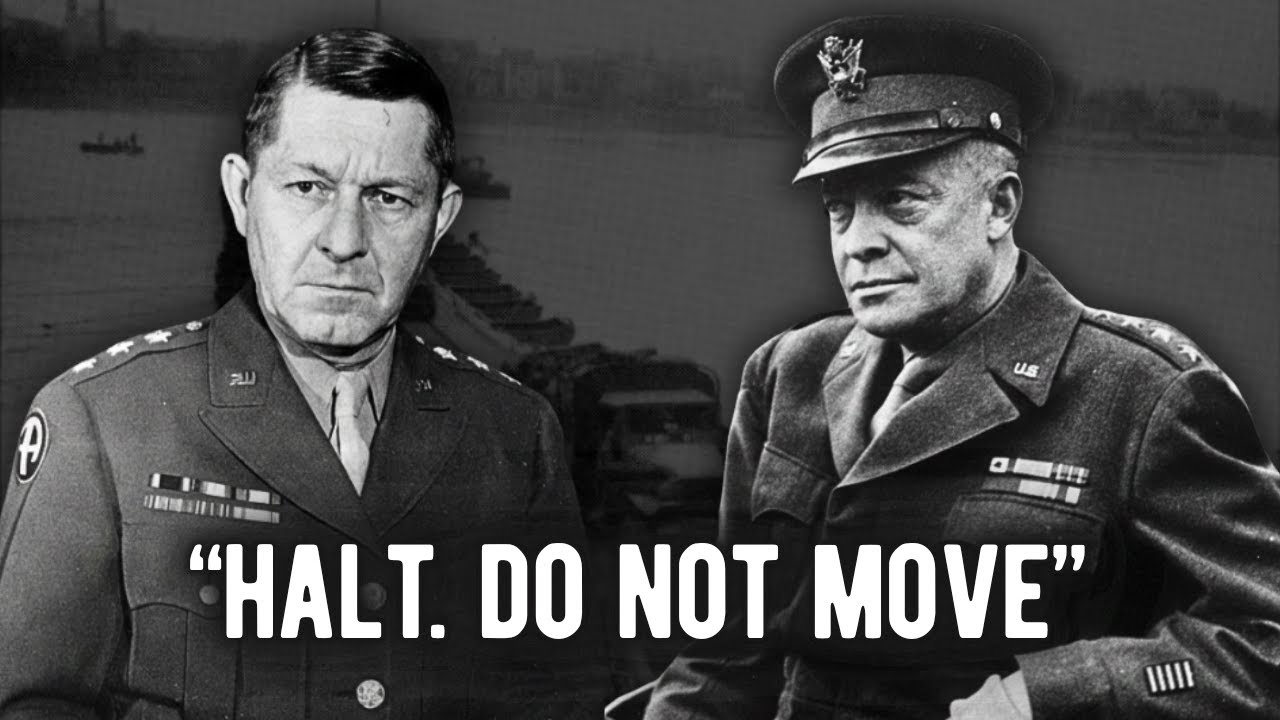 It was not a command to advance, but a stark, inexplicable order to halt.
The history books have long enshrined the narrative that the Allies breached the Rhine in March 1945, with the desperate heroism at the Ludendorff Bridge at Remagen serving as the climactic death blow to the Third Reich. We are taught that this victory was hard-fought, necessary, and achieved only after the bloodiest winter of the war in the frozen Ardennes. But a deeper examination of the military record reveals a suppressed version of events, one where the bloodbath of the Battle of the Bulge was not an inevitability but a direct consequence of a strategic decision made by Dwight D.
Eisenhower. The truth is that the Allies had the opportunity to cross the Rhine four months earlier, and the man who made that opportunity possible was not Patton, Bradley, or Montgomery, but the largely forgotten Jacob L. Devers.
His success was so profound, so rapid, that it threatened the carefully constructed egos and political strategies of the high command, leading to an order that arguably prolonged the war and cost tens of thousands of American lives.
To comprehend why a general standing on the precipice of total victory was ordered to stand down, one must first understand the stark contrast between Devers and the flamboyant warriors who dominate the popular memory of the conflict. George S. Patton was the archetypal cavalryman, a brash, pistol-packing aristocrat who craved glory and headlines.
Devers, his West Point classmate from 1909, was his complete antithesis. While Patton gravitated toward the cavalry and individual heroism, Devers chose the field artillery, a branch defined by calculation, logistics, and complex coordination. This fundamental difference in temperament dictated their entire careers.
Patton sought the decisive duel; Devers built the systems that made victory possible. When World War I erupted, Patton rode into battle on tanks and returned a decorated hero, while Devers was deemed too valuable as an instructor at Fort Sill, Oklahoma, and kept stateside to train others. Missing the Great War seemed like a career death sentence, but it transformed Devers into the army’s premier builder and organizer.
By 1939, Army Chief of Staff George Marshall needed a fixer, not a prima donna, and he turned to Devers. Handed the command of Fort Bragg, essentially a small outpost in a pine forest, Devers performed an industrial miracle. In less than a year, he oversaw the construction of 2,500 buildings and 93 miles of paved roads, bypassing standard procurement red tape to hire civilian contractors and transform the base into a training metropolis for 67,000 men.
This cemented his reputation as the army’s firefighter, the man to call for jobs too big or complex for anyone else. However, it also branded him with a stigma that would haunt him in Europe. To the combat fraternity of Eisenhower, Bradley, and Patton, Devers was viewed as a staff officer, a builder, a school teacher.
He didn’t drink late into the night with Eisenhower or cultivate a rugged persona for the press. Known as “Smiling Jake” for his infuriatingly steady optimism, he led by competence rather than charisma, a modesty that made him an outsider in a war dominated by massive egos.
In 1941, Marshall promoted Devers to command the Armored Force, handing him the keys to the army’s most lethal weapon. Immediately, he walked into a philosophical civil war over the role of the tank. Lieutenant General Leslie McNair, commander of Army Ground Forces, championed the “tank destroyer” concept, arguing that tanks should not fight other tanks.
He believed American tanks were strictly for exploiting breakthroughs and attacking infantry, and if they encountered German armor, they should retreat and call for fast, lightly armored tank destroyers. McNair’s logic was obsessed with speed and mobility, famously declaring that the anti-tank gun was the answer, not a heavier tank. Devers, with the cold precision of an artilleryman, recognized this doctrine as a death trap.
 He understood ballistics and knew that on a fluid battlefield, you cannot ask an enemy tank to wait while you call for backup. He coined a maxim that should have been the army’s motto: “The best way to beat a tank is with a better tank.”
Devers knew the Germans were fielding monsters like the Tiger and Panther, machines with frontal armor so thick that standard Allied guns would bounce off them. He oversaw the rollout of the M4 Sherman, a marvel of reliability and logistics, but he knew it was a middleweight fighter stepping into the ring with a heavyweight champion. In 1943, Devers pushed for a solution, throwing his weight behind the secret T-26 project, later known as the M26 Pershing.
This was a true heavy tank with a high-velocity 90mm gun capable of punching through a Tiger’s armor from a mile away. As preparations for D-Day ramped up, Devers made a specific, urgent request for 250 of these tanks to be produced immediately and shipped to England to lead the invasion. Washington said no.
McNair and the War Department rejected the request, claiming the heavy tanks would be too difficult to ship and, most fatally, that they simply weren’t necessary. The high command had swallowed their own propaganda, betting the lives of American tankers on a flawed doctrine. The bill came due in the summer of 1944 in Normandy, where American crews watched their shells ricochet harmlessly off German panzers while their own Shermans caught fire with a single hit, grimly nicknamed “Ronsons” for lighting up the first time, every time.
The Pershing tanks that could have saved thousands of lives were still sitting on drawing boards, delayed by the very men who had ignored Devers’ warnings.
While Devers fought losing battles with the bureaucracy, he was about to be given a chance to prove his strategic genius in the field, albeit on a front nobody else wanted. In early 1944, as the spotlight turned to the imminent invasion of Normandy, Devers was effectively evicted from his command in Britain and transferred to the Mediterranean theater, a move whispered to be a polite form of exile. While the world’s cameras focused on the beaches of Normandy, Devers was handed Operation Dragoon, the invasion of southern France.
The mission was hated by the British, with Winston Churchill fighting tooth and nail to cancel it in favor of a strike into the Balkans. On August 15th, 1944, Devers unleashed his answer. The landings on the French Riviera were a masterclass in amphibious warfare, incorporating lessons from the bloodbaths of Italy and Omaha Beach.
But the real genius was in what happened next. His primary objective was the capture of the deep-water ports of Marseille and Toulon, which Allied planners estimated would take weeks or months. Devers’ forces did it in days.
This logistical victory is often glossed over, but it was arguably the most important of 1944. While the ports captured by Eisenhower’s armies in the north had been demolished by the retreating Germans, securing Marseille intact opened a massive artery of supply. Within weeks, the southern campaign was pumping in one-third of all supplies reaching the Allied front.
Without the fuel flowing through Devers’ ports, Patton’s tanks in the north would have run dry long before reaching the German border. With the ports secure, Devers ordered the chase. What followed was a blitzkrieg in reverse, with the Sixth Army Group tearing up the Rhône Valley, devouring territory at a rate that embarrassed the planners at Supreme Headquarters.
They advanced nearly 400 miles in just 30 days, decimating the German 19th Army. On September 11th, near Dijon, Devers’ forward scouts made contact with Patton’s right flank, connecting the Allied front into a continuous wall of steel stretching from the English Channel to the Mediterranean. In just one month, the exiled general had delivered a miracle, managing a complex coalition with temperamental French generals and moving an entire army group across France at breakneck speed.
 By the autumn of 1944, Devers was controlling a juggernaut with the shortest and most efficient supply lines on the continent. He was poised to strike the decisive blow, but his spectacular success had created a dangerous new problem. He was performing too well, and in the political ecosystem of the Allied high command, he was beginning to look less like a subordinate and more like a rival to the protected favorites in the north.
By October, Devers faced an obstacle that was supposed to be insurmountable: the Vosges Mountains. In military history, no army had ever successfully attacked through them in late autumn and won. The terrain is a nightmare of sharp peaks and dense forests that turn into a frozen hellscape by November.
The German high command was counting on this natural wall to buy them the winter to regroup. Devers didn’t care about history; he cared about momentum. Utilizing tactical flexibility rare in the rigid American command structure, he unleashed his forces into the treacherous passes.
The fighting was brutal, hand-to-hand combat in freezing blizzards, but his relentless pressure broke the German spine.
On November 23rd, the incredible happened. French armored divisions under Devers’ command burst out of the mountains and reached the Rhine at Strasbourg. They had done the impossible, standing on the German border weeks ahead of schedule.
The German 19th Army was routed, and the road into the Black Forest and Munich was practically undefended. This was the decisive moment. Devers radioed headquarters, ready to cross, flank the entire German army, and drive deep into the enemy heartland.
The reply from Eisenhower fell like a guillotine. Facing critically low supplies until the port of Antwerp could be opened, and sticking to his “broad front” strategy, Ike decided he couldn’t support two offensives at once. He chose to gamble on Montgomery in the north, viewing Devers’ success in the south as a strategic distraction rather than a breakthrough opportunity.
The tragedy of this order cannot be overstated. While Devers was forced to sit idle on the banks of the Rhine, Adolf Hitler was stripping his southern defenses to mass his remaining panzers in the center. Because he didn’t have to worry about Devers crossing the river, Hitler felt safe enough to launch his massive gamble in the Ardennes.
On December 16th, 1944, the Battle of the Bulge erupted. The very disaster that Devers’ advance might well have disrupted had now come to pass. Historians argue that if Devers had been threatening Munich from the south, Hitler would have been forced to divert his panzers to stop him, potentially robbing the Ardennes offensive of its striking power.
Then the situation got worse. As panic spread through Supreme Headquarters over the German breakthrough, Eisenhower made a decision that nearly destroyed the Allied alliance. Fearing his lines were too thin, he ordered Devers to retreat, specifically to abandon the city of Strasbourg and pull back to a safer defensive line.
For the French, this was unacceptable. Strasbourg was the symbol of French sovereignty, and to abandon it meant leaving its population to the vengeance of the returning Gestapo. General Charles de Gaulle threatened to pull all French forces out of the Allied command, and the coalition was on the brink of collapse.
 Devers found himself alone in the middle of a political hurricane. He was a soldier who obeyed orders, but he knew this order was morally and strategically wrong. In a masterclass of “Smiling Jake” diplomacy, he managed to walk a razor’s edge.
He stalled, negotiated, and quietly defied the spirit of the retreat order. While technically obeying the letter of it, he shifted his lines but refused to give up the city. When the Germans launched their secondary offensive, Operation Nordwind, aiming to recapture Strasbourg in January, Devers’ thin lines held, fighting without the reinforcements pouring north to Patton.
By February 1945, the crisis had passed, and Devers turned his attention to the Colmar Pocket, the last stubborn foothold of German troops west of the Rhine. In one of the most grueling battles of the war, his forces finally crushed the pocket, capturing over 22,000 prisoners and clearing the west bank of the river once and for all. Devers had saved the alliance, held the ground, and cleaned up the mess, but the shadow of November remained.
He had been the first to the river, but the politics of the war ensured he would be the last to cross it.
As the war in Europe ground to a halt in May 1945, Devers had one final crisis to manage, not with the Germans, but with his own allies. It was known as the Stuttgart incident. French forces had captured the city, a prize that fell within the designated American occupation zone, and refused to leave when ordered.
Eisenhower was furious, ready to cut off supplies to the French army, a move that would have poisoned diplomatic relations for decades. Once again, Devers stepped into the breach. He drove to Stuttgart personally, looked at the ruined city, the proud French soldiers, and the map, and with the pragmatic wisdom that defined his career, he quietly redrew the boundary lines, effectively handing the city to the French and diffusing the bomb.
It was a thankless act of statesmanship that saved Eisenhower from a diplomatic disaster, yet Devers received almost no credit for it. When the guns fell silent, the great generals began their second campaign: the battle for history. Eisenhower rode his fame to the White House, Bradley wrote best-selling memoirs, and Patton died young, sealing his legend as a tragic warrior poet.
Devers did none of these things.
He returned to the United States and quietly oversaw the demobilization of the army he had helped build. He never wrote a memoir to set the record straight, never gave interviews attacking Eisenhower for the halt order, and never disparaged Patton for hogging the limelight. He simply went home.
This silence wasn’t weakness; it was character. As his biographer, historian James Scott Wheeler, observed, Devers possessed an extraordinary ability to cut through red tape and solve complex problems, but more importantly, in an era of massive egos and toxic blame games, he never blamed subordinates for his own mistakes and never lost faith in his superiors. While others pushed their subordinates down to climb the ladder of history, Devers lifted them up.
He took the heat for failures and let his men take credit for victories. In his final years of service, he turned his visionary mind toward the future, becoming one of the earliest advocates for the military use of helicopters and pushing for lighter, more rapid-fire infantry weapons, laying the groundwork for what would become the M16 rifle. The modern, mobile, high-tech US Army that fought the Cold War was built on the blueprints Jacob Devers drew up.
Jacob Loucks Devers died in 1979 at the age of 92, the last surviving four-star commander of World War II. He was buried at Arlington National Cemetery, not far from the men who overshadowed him in life. His story matters because it represents a truth often uncomfortable to admit: the best man for the job isn’t always the one on the magazine cover.
He was the general who built the training camps, fought for the better tanks, secured the supply lines, and arrived at the finish line first. He opened the door to victory in 1944, and when politics slammed that door in his face, he saluted, held the line, and did his duty. He was the quiet architect of the Allied victory, and it is long past time that we remember his name.


