Christina of Denmark spent her life playing a game she never chose, and in 1552, that game finally destroyed everything she had built. Days after the French king personally assured her that her lands were safe, he ordered an invasion of Lorraine anyway. The betrayal was swift, but the price she paid for it was far worse than losing territory. Born in 1521 as a princess of Denmark, Christina’s life was chaotic from the start.
Her father, King Christian II, was deposed before she turned two, forcing the family into exile in the Netherlands. Her mother, Isabella of Austria, died when Christina was just four. Her father spent years trying to reclaim his throne, but in 1532, he was captured and imprisoned by his uncle, the sitting Danish king. That same year, Christina’s brother died, making her and her older sister Dorothea the heirs to a throne they could not access.
As wards of their uncle, Holy Roman Emperor Charles V, the sisters became diplomatic assets. Christina’s first marriage, arranged when she was barely a teenager, was to Francesco II Sforza, the Duke of Milan, a man nearly 30 years her senior and in failing health. When the marriage was proposed, her aunt Mary of Hungary delayed the match by claiming Christina was ill, but in May 1534, at age 13, Christina wed the duke anyway. The marriage was reportedly agreeable, but it lasted less than a year.
The duke died just weeks before Christina’s 14th birthday, leaving her a childless widow. Her status made her one of the most sought-after women in Europe. In 1537, King Henry VIII of England began considering her as a possible fourth wife. Henry sent his court painter, Hans Holbein, to capture her likeness, but Christina made her feelings clear.
She posed in full mourning dress and reportedly remarked, “If I had two heads, one should be at the King of England’s disposal. ” She had personal reasons to refuse him beyond his record of broken marriages: Henry’s first wife, Katherine of Aragon, was Christina’s great-aunt. Mary of Hungary supported the rejection, and in January 1539, Henry finally abandoned the pursuit. In 1539, Christina fell in love with René of Chalon, Prince of Orange.
The match was widely supported, including by her sister, but Charles V had other plans. In October 1540, he ordered René to marry Anne of Lorraine and arranged for Christina to marry Anne’s brother Francis. Christina complied and married Francis in 1541. She gave birth to a son, Charles, in 1543, and a daughter, Renata, in 1544.
The marriage came with a political minefield. Lorraine sat between France and the Holy Roman Empire, and when war broke out between those powers in 1542, Christina spent years trying to keep her new homeland neutral. The conflict ended in 1546, but tragedy soon followed. In the summer of 1545, Christina gave birth to a daughter named Dorthea.
Weeks later, her husband died, leaving her a widow for the second time and regent for their young son. Competing factions immediately fought over control of the regency. Christina, exhausted by the political maneuvering, postponed her husband’s funeral and retreated to a remote estate with her newborn. Eventually, she agreed to share the regency with her late husband’s brother.
Even as she managed Lorraine, the threat of France loomed. King Henry II of France viewed the duchy as a strategic target, especially because of Christina’s ties to Charles V. In April 1552, with French forces approaching, Christina traveled to meet Henry personally. She begged him not to invade and insisted Lorraine was neutral.
Henry looked her in the eye and said her lands were safe. Days later, France invaded. After taking the capital of Nancy, Henry issued a brutal demand. Christina and her pro-Empire officials were stripped of power.
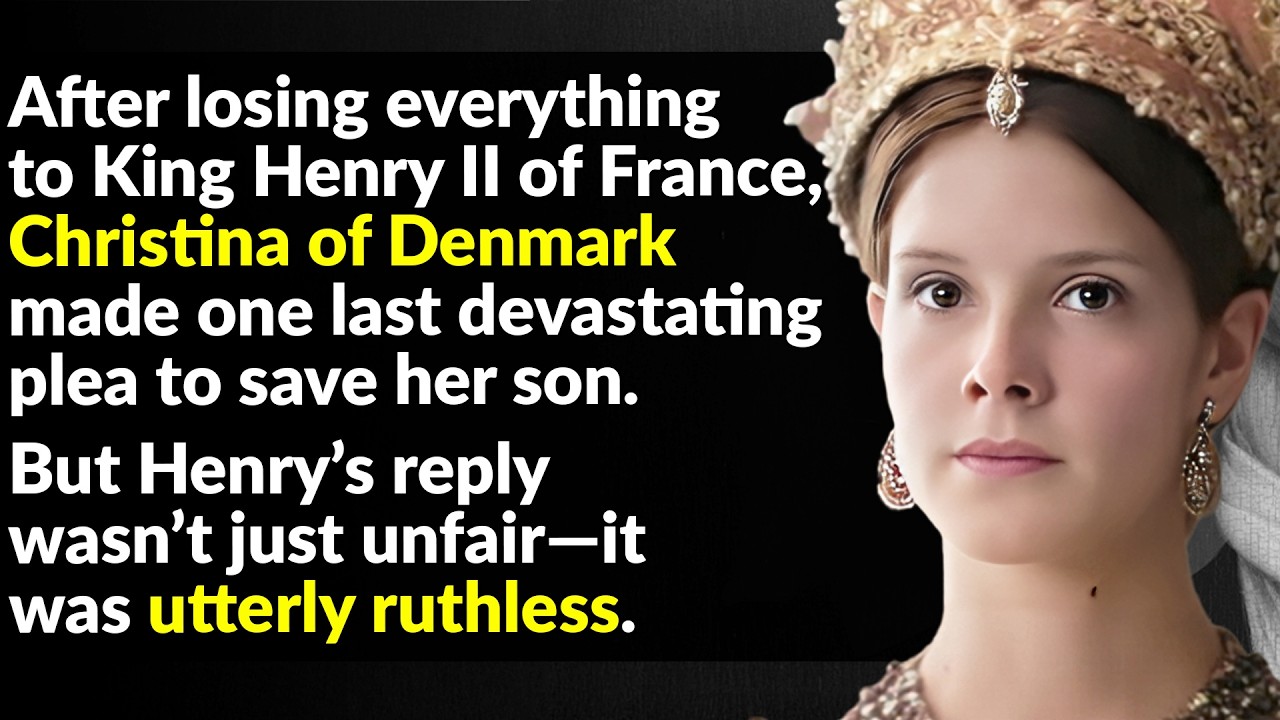
Her regency was handed to her brother-in-law. And most devastating of all, her son Charles was taken from her and sent to the French court to be raised under Henry’s control. Desperate, Christina made a final plea. She dressed in widow’s weeds, entered the hall where Henry was seated with his court, and begged him to take anything from her palace, so long as he left her son.
Henry’s reply was cold: Lorraine was too close to the Empire, both physically and by blood, for him to return the boy. He had Christina escorted out. Though Henry initially allowed her to remain in Lorraine, he soon changed his mind. Christina was pushed into exile and returned to Brussels, where her aunt Mary of Hungary gave her shelter.
She refused all offers of remarriage and focused on recovering her son. Her cousin Philip of Spain, now married to Queen Mary I of England, complicated her efforts. Philip was openly fond of Christina, which caused friction with his wife. When Christina visited England in 1557 on a diplomatic mission, she failed to complete it.
Mary reportedly never even allowed her to see Princess Elizabeth, and Christina returned to Brussels with nothing accomplished. In May 1558, Christina finally reunited with her son Charles for the first time in six years. They met at a border village, and she spent precious time with the teenager. That September, her uncle Charles V died.
The shock killed Mary of Hungary as well, leaving Christina without her two strongest supporters. In 1559, Christina declined to attend her son’s wedding. The bride was Claude of Valois, the daughter of King Henry II, the man who had abducted Charles as a child. The old wounds may have been too fresh.
In her later decades, Christina returned to Lorraine and became a trusted adviser to her son and daughter-in-law, even managing to counter the influence of Catherine de’ Medici at the court. She also pursued her family’s lost crowns. After her father’s death, she convinced her childless sister Dorothea to transfer their father’s contested titles to her, and she styled herself queen of Denmark, Norway, and Sweden. She spent years trying to arrange her daughter Renata’s marriage into the Scandinavian royal houses in hopes of reclaiming the Danish throne, but the plans came to nothing.
In 1578, Christina retired to Tortona, Italy, a territory she had acquired through her first marriage. She ruled there for 12 years, reportedly fairly and justly, until her death in 1590, just after her 69th birthday.