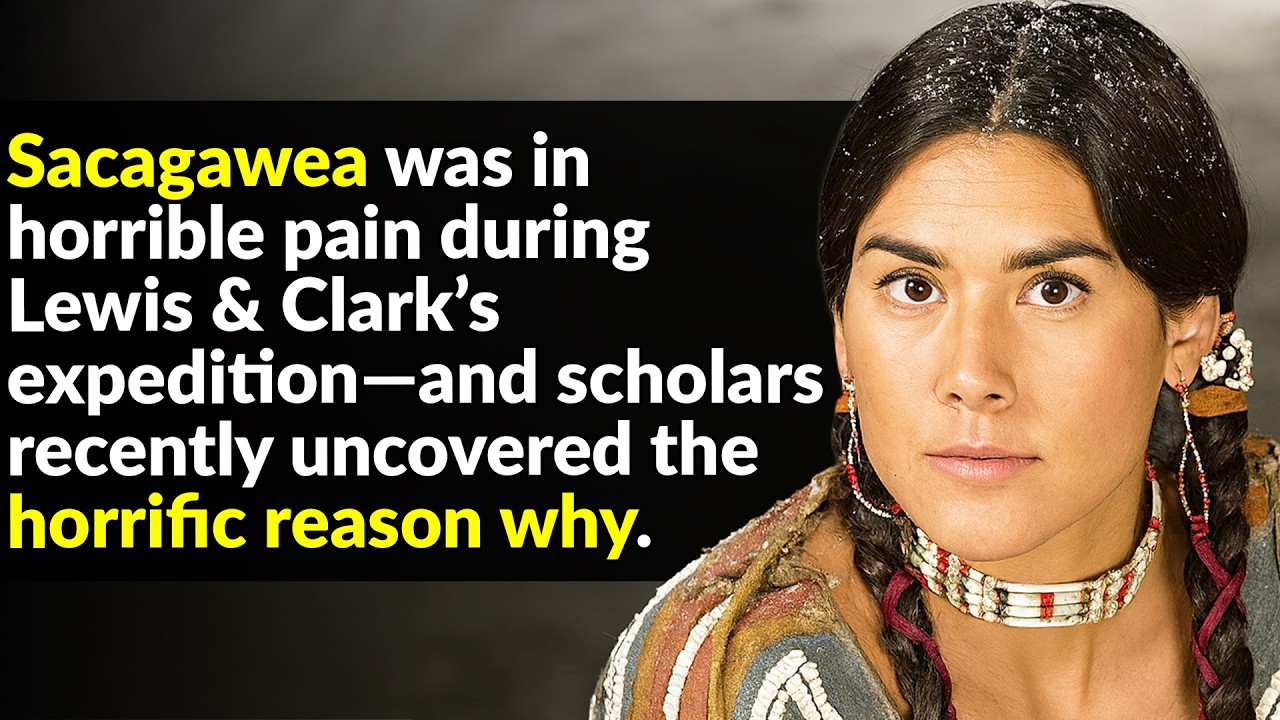
Sacagawea was in severe physical distress during the Lewis and Clark expedition, and historians have recently identified what they believe was the underlying cause. The Shoshone woman, celebrated for carrying her infant son across the American West while serving as interpreter and guide, endured far more than the grueling conditions of the journey itself. Born around 1788 in the mountainous region along the border of present-day Montana and Idaho, Sacagawea was a member of the Shoshone tribe. When she was roughly 12 years old, her life was shattered by a raid from the Hidatsa, an enemy tribe.
During the attack, several of her people were killed, and she was taken captive. Accounts differ on the details of her captivity. Some versions say she was forced to serve as little more than a servant for three years. When she turned 16, her captors sold her to Toussaint Charbonneau, a French Canadian trader with a documented history of violent behavior toward women.
Other versions of the story claim he won her in a gamble. Charbonneau, some 30 years her senior, was already married to another Shoshone woman, and according to some sources, he had previously profited from selling women into slavery. In November 1804, shortly after her marriage, Sacagawea met Meriwether Lewis and William Clark. The two explorers were assembling a team to map the newly acquired territories of the Louisiana Purchase and needed indigenous guides and interpreters.
They thought little of Charbonneau but recognized his young wife’s value. Months before departure, Sacagawea gave birth to her first child, a boy named Jean Baptiste Charbonneau. According to some accounts, she consumed crushed rattlesnake during labor in an attempt to speed up the delivery. Just weeks after giving birth, she embarked on the expedition in April 1805, carrying the newborn on her back.
Jean Baptiste proved more than a passive companion. Clark quickly grew fond of the boy, nicknaming him Little Pomp. The baby’s presence also served a practical purpose, helping to reassure other tribes that the expedition was peaceful. Sacagawea’s own role was indispensable.
She interpreted between the explorers and indigenous peoples, prepared food, foraged, gathered medicinal plants, and kept camp functioning under punishing conditions. Her composure was tested when the group approached terrain she recognized. It was the same land where the Hidatsa had kidnapped her years earlier. Witnesses noted that she did not cry when she realized where she was.
On May 14, 1805, an incident nearly cost the expedition its critical supplies. Charbonneau, steering one of the boats, panicked during a sudden gust of wind and nearly capsized the vessel. As he sat paralyzed, Sacagawea retrieved valuable papers and equipment that had fallen overboard. Lewis later wrote that Charbonneau was a man of no peculiar merit and the most timid waterman in the world.
Charbonneau’s failures were not limited to seamanship. A month after the boating incident, Sacagawea fell dangerously ill and, according to expedition journals, went out of her senses. Historians now believe she was suffering from gonorrhea contracted from her husband—a conclusion that gives grim context to Clark’s journal entry from the period: “If she dies, it will be the fault of her husband, as I am now convinced. ”
Despite the illness, Sacagawea recovered enough to continue.
The expedition soon reached Shoshone lands, the place where she had lived as a child. This time, her emotional reserve broke. She sang and danced with joy, startling her companions. She also encountered people from her past, including a girl who had escaped captivity and returned home—a reminder of a life Sacagawea never got to live.
The reunion became more profound when she met the tribe’s chief, Cameahwait. He was her brother. Clark recorded that Sacagawea danced at the joyful sight, and Lewis noted that all present were moved by the family reunion. Another diary entry describes how Sacagawea immediately threw her blanket over her brother as a sign of affection and began to cry.
The siblings spoke privately, and for the rest of the night, Sacagawea could not stop weeping. In some versions of the story, she also encountered the man her family had once promised her to in marriage. Her marriage to Charbonneau remained a source of documented suffering. A Clark diary entry from November 1804 describes an incident in which Charbonneau beat Sacagawea so brutally for speaking to another indigenous woman that the explorers intervened and reproved him severely for his brutality.
Conditions worsened in the autumn of 1805. The expedition’s surroundings were so barren that even Sacagawea, who could normally find food anywhere, returned empty-handed. The travelers grew so desperate that they ate bear fat in an attempt to survive. Lewis and Clark consistently described her in glowing terms—as plucky, determined, intelligent, cheerful, resourceful, tireless, and faithful.
Clark declared that Sacagawea “inspired us. ”
When the expedition finally reached the West Coast, Sacagawea made one of her few personal requests. Hearing that a beached whale had washed ashore, she insisted on seeing it for herself. She marveled at the enormous creature and the Pacific Ocean.
It was one of her last genuinely joyful moments. The return journey was difficult. For weeks, Jean Baptiste was dangerously ill, and the entire expedition worked together to help the baby recover. He eventually pulled through.
By late 1806, more than a year after the journey began, Sacagawea and her family returned to the Hidatsa. Clark had grown so attached to her son that he wanted to adopt the boy. The family lived with the Hidatsa for three years before accepting Clark’s invitation to visit him in St. Louis, Missouri.
They settled in the city but seemed to prefer the wilderness. Before they could leave, Sacagawea made a devastating choice. Recognizing that Clark’s wealth and clear affection for her son could give Jean Baptiste a better life than she could provide, she and Charbonneau left the boy with Clark in 1809. Jean Baptiste attended school in St.
Louis and later became an explorer himself. Sacagawea was pregnant with her second child at the time. Her pregnancy was extremely difficult, leaving her ill and weak, but she gave birth to a daughter, Lizette, in 1812. She would not live to see her daughter grow up.
In December 1812, Sacagawea became gravely ill. Historians attribute her death to a putrid fever or possibly typhus. She died on December 20, 1812, at around age 24. Some historians have disputed this account.
In the early 1900s, a scholar claimed Sacagawea had lived until 1884 and died in Wyoming. After more than a century of investigation, most historians reject these claims, believing that the woman buried there—sometimes called the Wind River Sacagawea—was a different person. After Sacagawea’s death, Charbonneau accepted Clark’s offer to formally adopt his other child, Lizette, while he returned to his old fur trading pursuits. Lizette’s fate is largely unknown; she likely died sometime during childhood.
Charbonneau went on to marry at least five different women. His last marriage took place when he was 70; his bride was 14. Sacagawea’s legacy endured long after her death. Her face appeared on U.
S. currency, and the river where she rescued the expedition’s priceless documents now bears her name. A famous romantic narrative has often linked her to William Clark, fueled by his nickname for her, “Janie,” and his protection of her from her abusive husband. Most historians, however, do not believe the pair were secretly in love.
They cared for each other deeply, but there is no credible evidence of a romantic affair. Understanding Sacagawea’s story is complicated by the fact that everything known about her was recorded in journals written by others. No documents written by her survive. What is known is that she was born to be an adventurer.
Depending on the translation, her name appropriately means either “boat launcher” or “bird woman. ” In both cases, exploring the world was part of her destiny.