The forced march of a thousand of Weimar’s most distinguished citizens through the gates of Buchenwald on April 16, 1945, was a calculated act of psychological warfare that shattered the carefully constructed fiction of German innocence. General George S. Patton, a man hardened by the brutality of North Africa and the Battle of the Bulge, had been physically sickened by what he had witnessed at the camp just days earlier.
His response was not merely punitive but pedagogical, a brutal lesson designed to ensure that the educated elite of a nation could never again claim ignorance of the industrial-scale murder conducted in their name.
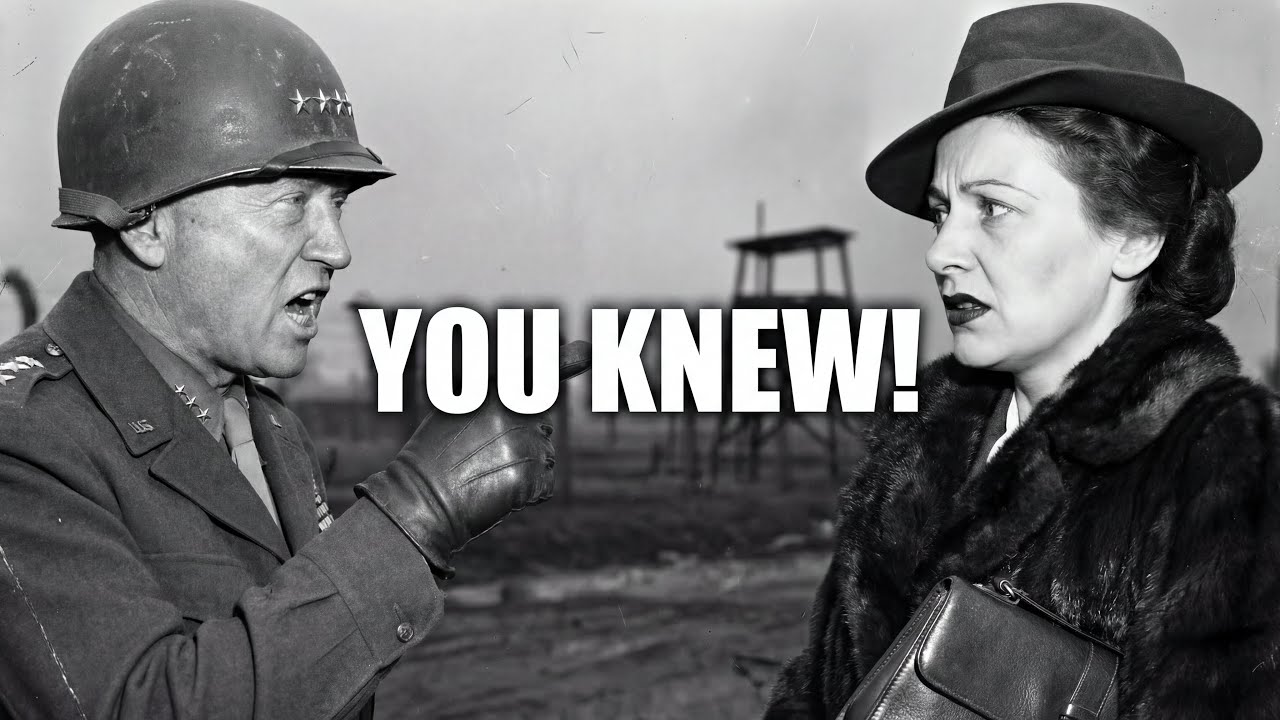 The orders were delivered that morning by American military police, who moved through the grand villas of Weimar with cold efficiency, instructing doctors, lawyers, professors, and politicians’ wives to prepare for an outing with the general. No destination was given, no explanation offered, leaving the assembled crowd to speculate that they were being summoned for a formal reception with the American occupation force. They arrived in their finest attire, fur coats and fedoras, fresh lipstick and polished shoes, a tableau of respectability that would soon be grotesquely juxtaposed against the reality of human depravity.
The column of one thousand marched under armed escort along a dusty road into the forested hills, a five-mile journey that took them past the very chimneys whose smoke they had watched for eight years. The proximity of the camp to their city was not a secret; SS officers had shopped in their boutiques and attended their concerts, living as neighbors while overseeing a system of mass starvation and murder. As the procession approached the gates, the initial confusion and indignation among the citizens began to curdle into a dawning, horrific realization that this was no diplomatic 𝒶𝒻𝒻𝒶𝒾𝓇.
Patton’s targeting of the elite was a deliberate strategic choice, rooted in his understanding that the working class could be dismissed, but the professionals and intellectuals would shape the postwar narrative. These were the individuals most likely to claim ignorance, to retreat into the defense of the bystander, and to rebuild a society on a foundation of convenient amnesia. By forcing them to confront the evidence directly, Patton aimed to preemptively dismantle the alibi of the entire German upper class, ensuring their complicity was not just suspected but witnessed.
The scene that greeted them inside Buchenwald defied the limits of human comprehension, a landscape of horror that no amount of wartime propaganda could have fabricated. Corpses were stacked like cordwood in the courtyard, their emaciated forms reduced to skeletal frameworks, while the crematorium ovens still held the charred bones of the recently incinerated. The living survivors, twenty thousand of them, moved like ghosts, their bodies ravaged by starvation and disease, many weighing less than eighty pounds and too weak to stand, their eyes reflecting a depth of suffering that seemed to erase all humanity.
Margaret Bourke-White, the legendary Life magazine photographer, captured the faces of the citizens as they filed past the evidence, her images revealing a spectrum of human emotion that would become iconic. Some fainted, collapsing into the arms of strangers as their fine clothes were soiled by the mud of the camp. Others vomited, their bodies rejecting the visual and olfactory assault of decomposing flesh and the acrid smell of death that permeated the air.
Many wept uncontrollably, their tears a mixture of genuine horror and the desperate realization that their world had irrevocably changed.
The tour was meticulously planned by American officers to maximize psychological impact, guiding the citizens through a sequence of specific horrors designed to build cumulative devastation. They were shown the crematorium, the piles of dead, the barracks where survivors lay dying despite medical care, and finally, the room containing the macabre artifacts of the SS. Shrunken heads, preserved as trophies, and lampshades made from tattooed human skin were displayed, objects so grotesque that they seemed to belong to a different reality, yet stood as undeniable proof of the depths of Nazi depravity.
The reactions of the citizens followed a predictable pattern, a progression from physical shock to emotional collapse, and finally, to a desperate attempt at denial. Some claimed the emaciated prisoners must have been criminals who deserved their fate, while others suggested the Americans had staged the entire scene to discredit Germany. These defenses crumbled as the sheer scale of the evidence overwhelmed any possible alternative explanation, leaving the citizens stripped of their defenses, forced to confront the monstrous reality of what their nation had done.
The choice of Weimar was particularly devastating, as the city was celebrated as the heart of German classical culture, the home of Goethe and Schiller. The juxtaposition of this intellectual and artistic heritage with the barbarism of Buchenwald, located just five miles away, was a symbolic indictment of the entire German cultural tradition. The camp had operated since 1937, its existence known to the population, its smoke visible, its smell occasionally carried by the wind, yet the citizens had chosen not to see, not to ask, not to know.
 Patton’s motivation was not purely humanitarian; it was also a act of revenge, a way to humiliate the German elite and destroy their claims of moral superiority. He had vomited at the sight of Ohrdruf, a subcamp of Buchenwald, and the experience had fundamentally altered his understanding of the war. The general, who would later become infamous for his anti-Semitic remarks and his slapping of a shell-shocked soldier, was in that moment driven by a rage that transcended politics, a primal fury at the evil he had witnessed.
The forced tour at Weimar became a model for the entire Allied occupation, replicated at camps across Germany in the following weeks and months. At Dachau, citizens from Munich were marched through the gates; at Bergen-Belsen, German civilians were forced to assist with the burial of tens of thousands of typhus victims. The principle was established that civilian populations bore responsibility for the crimes of their governments, and that the defense of ignorance was no longer acceptable.
Eisenhower, who had visited Ohrdruf with Patton and Bradley, understood that the documentation of these horrors was essential to prevent future denial. He invited congressional delegations, British parliamentarians, and journalists to witness the camps firsthand, believing that unimpeachable witnesses would be necessary to counter the inevitable claims of propaganda. The photographs, films, and testimonies created during this period became the foundational evidence of the Holocaust, a bulwark against the denial that emerged almost immediately.
The citizens who returned to their homes that evening were fundamentally changed, though the nature of that change varied widely. Some committed suicide within days, unable to live with the weight of what they had seen. Others retreated into silence, refusing to discuss the experience for the rest of their lives.
The mayor of Weimar, who had been responsible for compiling the list of the thousand, killed himself shortly after the tour, his death a testament to the psychological devastation wrought by the confrontation.
For the survivors of Buchenwald, the forced tour was a complicated and ambivalent experience. On one level, it was a vindication, a moment when their tormentors’ neighbors were finally forced to acknowledge the reality of their suffering. On another, it was inadequate, a few hours of discomfort for people who had lived in comfort while prisoners died.
Many survivors doubted the sincerity of the tears, suspecting that the citizens would return home and continue their denial in private, their guilt a performance rather than a genuine reckoning.
The legacy of Patton’s decision extends far beyond the immediate aftermath of the war, shaping the legal and moral framework of the postwar world. The principle that ordinary citizens could be complicit in genocide, that “we didn’t know” was not a valid defense, became central to the denazification process and to the development of international law. The Nuremberg Trials focused on leadership, but the forced tours focused on the guilt of the bystander, the complicity of those who chose not to act.
 The documentary record created by Bourke-White and the US Army Signal Corps has proven to be Eisenhower’s most prescient legacy. The images of well-dressed German citizens walking past stacked corpses have become iconic, used in trials, textbooks, and museums to counter the persistent claims of Holocaust denial. When deniers assert that ordinary Germans didn’t know, the photographs from Weimar provide a devastating counterargument, showing the elite of a cultured city confronting evidence they had spent years pretending didn’t exist.
The walk itself, a ten-mile round trip through the German countryside, was a physical ordeal that mirrored the psychological journey the citizens were forced to undertake. The spring weather, the dust on their fine shoes, the discomfort of the march, all served to strip away the veneer of civilization and expose the raw reality of their situation. The fur coats and high heels, so appropriate for a formal reception, became grotesque symbols of the disconnect between their comfortable lives and the suffering they had ignored.
Patton’s own contradictions, his later anti-Semitism and his resistance to denazification, complicate the historical assessment of his actions. Some historians argue that his horror at Buchenwald was genuine but temporary, a shock that faded as he became preoccupied with the practical challenges of governing Bavaria. Others suggest that his anger was directed at the perpetrators rather than sympathy for the victims, a nationalist outrage that could coexist with his personal prejudices.
The forced tour was not justice; it was a confrontation, a moment when the comfortable distance between respectable society and the machinery of murder was forcibly collapsed. It did not undo the deaths of fifty-six thousand prisoners, nor did it heal the survivors who would carry the scars of their ordeal for the rest of their lives. But it accomplished something essential: it destroyed the alibi of ignorance, ensuring that the citizens of Weimar could never again claim they didn’t know.
The question of whether the tour changed anything, whether those thousand citizens genuinely reckoned with their complicity, remains impossible to answer definitively. The historical record shows that some were transformed, becoming witnesses who testified to the truth in the postwar years. Others returned to their denial, their tears a temporary performance that allowed them to resume their lives with their consciences intact.
The truth likely lies somewhere in between, a complex mixture of genuine horror and self-serving rationalization.
What is certain is that the event was documented with meticulous care, creating a visual and textual record that has survived for decades. The photographs of Bourke-White, the film footage of the Signal Corps, and the reports of journalists like those at the New York Times, have become essential evidence against the forces of denial. Eisenhower’s fear that future generations would dismiss the camps as propaganda has been answered by this archive, a testament to the power of documentation.
The forced march of the thousand was a singular event in military history, a moment when a conquering general chose to use psychological confrontation rather than physical punishment to make a moral point. It was an unprecedented act, a deliberate attempt to force a civilian population to confront the evidence of their government’s crimes. Patton, whatever his later failings, understood that the war would not truly be won until the German people acknowledged what had been done in their name.
 The citizens of Weimar had lived beside Buchenwald for eight years, watching the smoke rise from its chimneys, seeing the SS officers in their streets, benefiting from the slave labor that sustained their economy. They had chosen not to ask questions, not to investigate, not to acknowledge the horror that was happening just five miles from their homes. The forced tour was a reckoning, a moment when their willful blindness was shattered by the undeniable evidence of their own eyes.
The walk through Buchenwald was not a single afternoon of discomfort; it was a permanent mark on the consciousness of those who experienced it. The images of the dead, the smell of the crematorium, the faces of the living skeletons, would haunt them for the rest of their lives. Some would speak of it, others would remain silent, but none could forget.
The forced tour ensured that the memory of Buchenwald would be carried into the postwar world by those who had most wanted to deny it.
The legacy of April 16, 1945, is a complex one, a mixture of justice and vengeance, of pedagogy and punishment. It established a precedent that would shape the moral landscape of the twentieth century, the principle that complicity through inaction is a form of guilt. The citizens of Weimar were not murderers, but they had enabled murder through their silence, their indifference, their choice not to know.
The forced tour was a confrontation with that complicity, a demand that they acknowledge their role in the machinery of death.
As the sun set on that April afternoon, the thousand citizens made their way back to their villas, their fine clothes soiled, their faces etched with the horror of what they had seen. They had left as respectable members of a cultured society; they returned as witnesses to the darkest depths of human depravity. The walk had taken them from the comfortable world of Goethe and Schiller to the brutal reality of Buchenwald, and there was no going back.
The alibi of ignorance was gone forever, replaced by the undeniable knowledge of what their nation had done.