Newly rediscovered court records from the 1881 Tombstone gunfight are challenging the long-held popular image of Wyatt Earp as a straightforward Wild West hero. The original 36-page coroner’s inquest papers, missing for decades, were found in 2010 by Cochise County court staff clearing storage at the Bisbee courthouse. The Arizona State Library later digitized them and posted them online in July 2014 through the Arizona Memory Project. These are legal documents taken under oath shortly after the shooting on October 26, 1881.
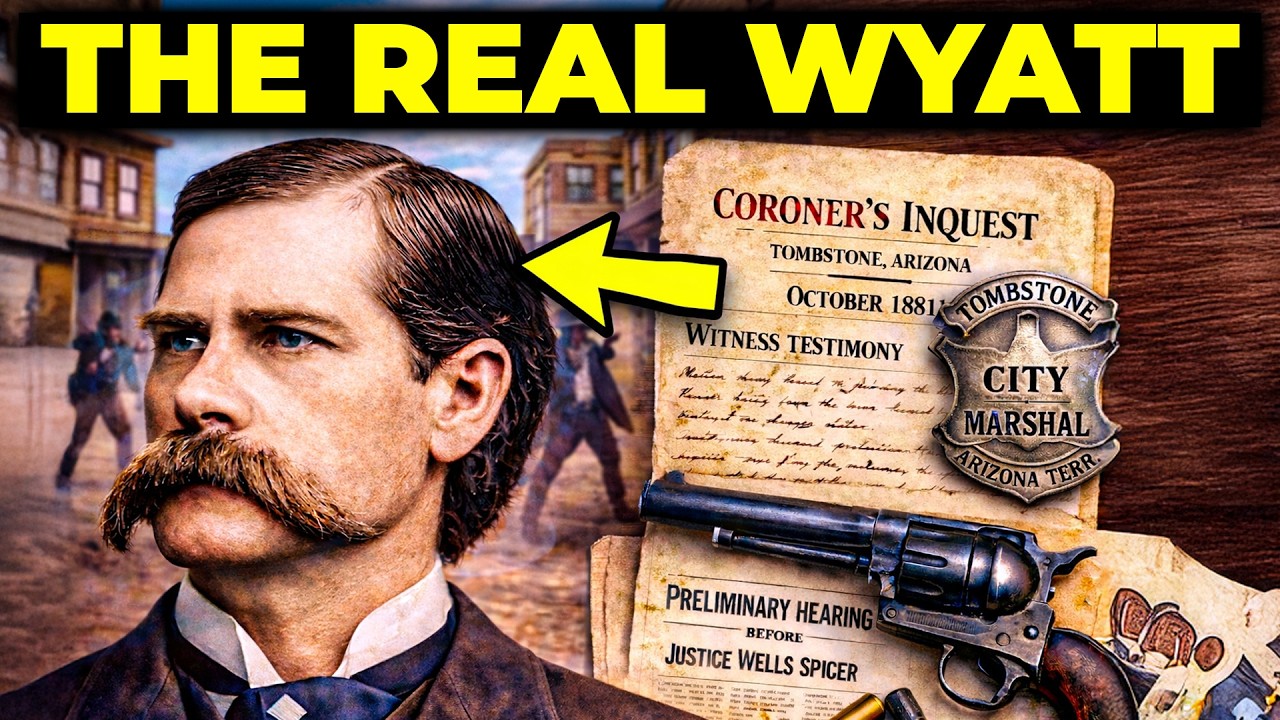
Unlike later memoirs, Hollywood films, or legends passed down through generations, they capture the moment while the case was still fresh. The records show a more complicated figure: a man tied to saloons, gambling, local politics, and personal feuds. The records immediately challenge the notion that Wyatt Earp was the central lawman of the confrontation. Sworn testimony identifies Virgil Earp as Tombstone’s chief of police and a deputy US marshal, with Morgan as a paid special policeman and Wyatt acting in a special capacity under Virgil’s authority.
Judge Wells Spicer later used the same language, describing the Earps as regular or specially appointed officers. Contemporary reports point to Virgil, not Wyatt, as the more central official figure in the actual gunfight. Wyatt’s own sworn statement from November 16, 1881 cuts through the legend even more directly. Asked his occupation, he replied, “Saloon keeper at present,” adding that he had also been a deputy sheriff and a detective.
At the time, Tombstone had exploded from about 100 people in March 1879 to over 7,000 by late 1881. Wyatt held a 25% interest in a faro game at the Oriental Saloon in exchange for providing security. This blended identity was consistent with his earlier life. After serving as constable in Lamar, Missouri, Wyatt faced allegations of embezzlement, left town in 1871, and was later arrested on a horse theft charge in Indian Territory, though never tried.
He was also arrested in Peoria, Illinois, for offenses connected to brothels, and later worked in prostitution establishments in Wichita before joining the police force there and in Dodge City. Records show Wyatt and his brother Morgan were caught in raids on brothels in 1872, paying fines on two separate occasions. The most revealing part of Wyatt’s testimony concerns a deal he described involving a stage robbery. He told the court he believed Bill Leonard, Harry Head, and James Crane were behind the March 15, 1881 robbery in which Bud Philpot was killed.
He admitted he wanted to be sheriff of Cochise County and believed capturing the robbers would help him with voters and business interests. Wyatt said he approached Ike Clanton, Frank McLaury, and Joe Hill with a backchannel offer, wanting them to put him on the trail so he could make the arrests while keeping their role hidden. According to his testimony, Joe Hill handed over his watch, chain, and between two and three hundred dollars to Virgil Earp before leaving under the plan, but Hill returned saying he had arrived too late because Leonard and Head were already dead. By the time the gunfight was hours away, the conflict had become openly personal.
Ike Clanton spent the night of October 25 into October 26 drinking and making threats against Doc Holliday and the Earps. Around 1:00 in the afternoon on October 26, Virgil disarmed Ike and brought him before Justice Wallace, resulting in a fine of $25 plus costs. Wyatt testified he was tired of being threatened and believed the other side intended to murder him and his brothers. He described slapping Tom McLaury outside the courtroom, drawing his pistol, telling him to “Jerk your gun and use it,” and striking him on the head with the revolver.
The gunfight itself took place in a vacant lot behind the OK Corral at the end of Fremont Street, not inside the corral. History. com says the shootout lasted about 30 seconds and involved around 30 shots. The court record contains conflicting testimony about who fired first.
Wyatt claimed Billy Clanton and Frank McLaury began to draw when Virgil ordered them to surrender, and that the first two shots were Billy’s and his own. But witness William Claiborne testified that Tom McLaury threw open his coat to show he was unarmed, and that Doc Holliday and Morgan Earp fired almost instantly. Another witness, Addie Borland, said she could not tell which side fired first and saw no hands raised in surrender. After the coroner’s verdict named the shooters without clearly condemning or excusing them, Ike Clanton filed first-degree murder charges against the Earps and Doc Holliday.
The preliminary hearing before Justice Wells Spicer lasted nearly a month, became the longest in Arizona history, and involved 30 witnesses. On November 7, Spicer unexpectedly revoked Wyatt Earp’s and Doc Holliday’s bail and sent them to jail, where they remained for 16 days. On November 30, Spicer ruled there was no sufficient cause to believe the defendants guilty of murder and ordered them released. He wrote that the defendants were fully justified if the confrontation began the way Wyatt described it.
But he also criticized Virgil for using Wyatt and Holliday in that moment, calling it an injudicious and censurable choice because both men had obvious quarrels with those they were sent to confront. The shooting did not end the violence. On December 28, 1881, Virgil Earp was ambushed and badly wounded, leaving his arm largely useless for the rest of his life. Wyatt became a Deputy United States Marshal the next day.
On March 18, 1882, Morgan Earp was murdered while playing pool, with the shot narrowly missing Wyatt’s head. Wyatt then joined a federal posse and began what became known as the Vendetta Ride. On March 20, he and his group killed Frank Stillwell in Tucson. Over the following weeks, they killed Florentino, Indian Charlie Cruz, and Curly Bill Brocius, and possibly more.
Arizona authorities later sought Wyatt’s extradition from Colorado, but Governor Frederick Pitkin refused. Wyatt spent his final years trying to push back against stories he thought were false. In a 1925 letter quoted by HistoryNet, he complained, “Notoriety has been the bane of my life. I detest it.
” But the legend moved faster than the documents. Stuart N. Lake approached Wyatt in late 1927 about a biography, and Josephine Earp became deeply involved in shaping what could be said. Lake’s 1931 Wyatt Earp: Frontier Marshal established the fictionalized portrait of a fearless lawman.
Lake sold the rights to Fox Film for $7,500, and Frontier Marshal arrived in 1934. The Life and Legend of Wyatt Earp, starring Hugh O’Brian, ran for six full seasons beginning in September 1955. The rediscovered court records do not show a hidden monster, nor do they prove every accusation ever made against Wyatt. They show a much less polished man: a saloon keeper, gambler, temporary lawman, political striver, negotiator, witness, defendant, and later, a man of revenge.
The version most people know was shaped by books, films, and television. The version in the court file is rougher, less certain, and closer to the real Old West.