The smell hit them first. It was a thick, sweet, rancid stench of decay and death that clung to the back of the throat and refused to leave. When the men of the 45th Infantry Division, the Thunderbirds, breached the gates of the Dachau concentration camp on April 29th, 1945, they did not just walk into a prison.
They walked into the physical manifestation of hell, a place where the air itself was poisoned by the crimes committed there.
 The first images that greeted them were the rail cars. Thirty-nine of them sat on the tracks just outside the camp, their doors thrown open to reveal a horror that defied comprehension. Inside were the dead, thousands of them, stacked like cordwood, their bodies emaciated, their faces frozen in final agony.
These were the last transports, prisoners who had died en route or been left to rot in the cars as the SS fled from the advancing American forces.
Beyond the cars, the camp itself sprawled out, a testament to twelve years of systematic cruelty. The living prisoners were skeletal figures, their striped uniforms hanging off frames that were little more than bone and sinew. They moved with a slow, shuffling gait, their eyes sunken and hollow, staring at their liberators with a mixture of disbelief, exhaustion, and a glimmer of hope that had somehow survived the unimaginable.
The soldiers walked through the barracks, past the rows of bunks where men had died of starvation and disease. They saw the crematoriums, the ovens still containing the ash and bone fragments of the murdered. They saw the gas chambers, disguised as shower rooms, where thousands had been killed.
They saw the medical experimentation rooms, where doctors had tortured and killed prisoners in the name of science. The sheer scale of the atrocity was overwhelming.
Some of the hardened veterans, men who had fought through Sicily, Italy, and France, who had seen friends blown apart by artillery and machine-gun fire, were physically sick. They vomited. They cried.
They stood in stunned silence, unable to process the magnitude of the evil they were witnessing. One soldier, Private John Lee, later described the scene, saying they thought they knew what evil looked like after two years of fighting, but this was something else entirely. This was hell on Earth.
And in the middle of this nightmare, in a corner of the camp, stood approximately fifty SS guards. They had thrown down their weapons and raised their hands in surrender. They were the men who had run this death camp, who had overseen the torture, the starvation, and the mass murder of over 40,000 people.
They stood there, some looking defiant, others looking nervous, but all of them expecting to be treated as prisoners of war under the Geneva Convention.
The American soldiers looked at the guards. They looked at the bodies in the rail cars. They looked back at the guards.
The rage that had been building, the horror that had been suppressed, the grief that had been held back, all of it exploded in a moment of spontaneous, unplanned fury. It was not an order. It was not a premeditated act.
It was the raw, visceral response of men who had just seen the ultimate proof of human depravity.
A rifle shot rang out. An SS guard crumpled to the ground, a bullet in his head. Then another shot.
 Then another. The killing began. Some guards tried to run and were shot in the back.
Others begged for mercy, their pleas ignored. A few were beaten to death with rifle butts. The soldiers were no longer thinking about the rules of war.
They were thinking about the children’s shoes piled in warehouses, the ovens still warm, the skeletal survivors who could barely stand. Within twenty minutes, it was over. All fifty SS guards were dead.
Some of the officers present tried to stop the massacre. Lieutenant Colonel Felix Sparks, commanding officer of one of the battalions, physically intervened, putting himself between his men and the remaining guards. He screamed at his soldiers, threatened to shoot anyone who fired another round, and grabbed rifles out of their hands.
The killing stopped, but the damage was done. The story of the executions spread quickly, moving up the chain of command from division to corps to army headquarters.
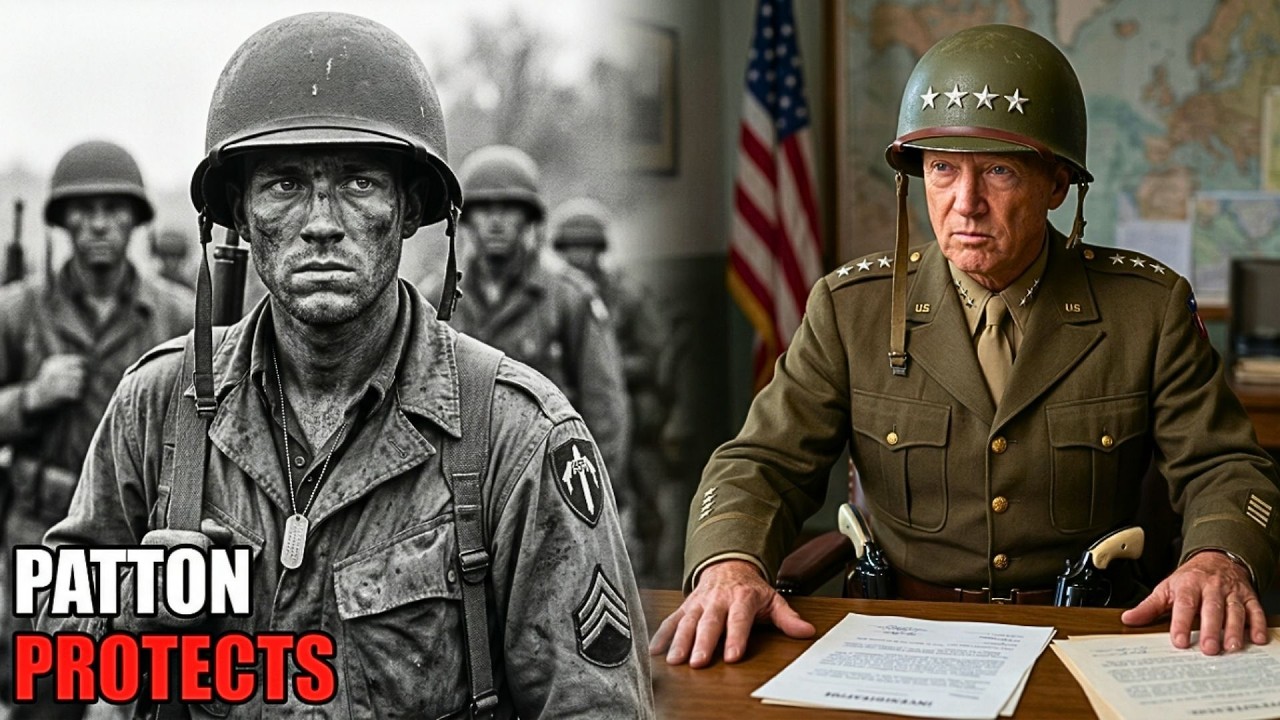
The case eventually landed on the desk of General George S. Patton. Patton had arrived at Dachau the day after liberation, walking through the same gates, seeing the same horrors.
The man who had commanded troops in two World Wars, who had seen some of the bloodiest battles in history, walked out of a barracks and vomited. He was so shaken that he ordered German civilians from the nearby town to be brought to the camp, forcing them to see the atrocities and to bury the bodies. He wanted them to understand what had been done in their name.
But then came the report about his own men. The Inspector General’s office demanded a full investigation. The Judge Advocate General’s office called it murder, a clear violation of international law.
American soldiers had executed prisoners of war. There had to be consequences. Even Supreme Commander Dwight D.
Eisenhower weighed in, sending a message that this could not be covered up, that America could not become what it was fighting against.
The pressure was immense. The case was placed on Patton’s desk with a clear expectation: prosecute, punish, and make it right. The law was clear.
The Geneva Convention was clear. The soldiers had committed a war crime. But Patton had a choice to make.
 On one side was the law, the rules of war, the principles that separated civilized nations from barbarians. On the other side were his soldiers, men who had fought for years, who had seen their friends die, who had walked into hell and responded with human rage.
Patton made his decision quickly. He called in his staff and told them to prepare a response to the Inspector General. The response was classic Patton: blunt, unapologetic, and carefully worded to protect his men while acknowledging the reality of the situation.
He wrote that he had investigated the allegations and found the evidence inconclusive. He argued that in the chaos of the camp liberation, with thousands of prisoners, scattered SS guards, and incoming fire from remaining German positions, it was impossible to determine with certainty which deaths resulted from combat and which did not.
It was technically true. The liberation had been chaotic. There had been some resistance.
But it was also deliberately misleading. Patton knew exactly what had happened. He had read the witness statements.
He knew his soldiers had executed surrendered prisoners. He continued, arguing that even if executions occurred, the emotional and psychological state of soldiers who had just witnessed the horrors of Dachau was a significant mitigating factor. He suggested that temporary insanity was not an unreasonable conclusion, a legal defense.
But Patton went further. He stated plainly that he would not court-martial soldiers for killing SS guards at a death camp. He wrote that if that made him complicit in a war crime, so be it.
But he would not destroy American soldiers for doing what he himself might have done in their place. That last sentence was the key. Patton was admitting that in the same situation, seeing the same horrors, he might have pulled the trigger too.
He was putting himself in the same moral category as his soldiers.
The response went up the chain of command and created a problem. The Inspector General’s office was furious. This was obstruction, a cover-up.
The Judge Advocate General prepared a memo arguing for Patton’s removal. If he wouldn’t prosecute, someone else should. But then something interesting happened.
The memo never went anywhere. At the highest levels of command, people started asking uncomfortable questions about what a trial would actually look like.
 Imagine the scene: American soldiers on the stand describing what they saw at Dachau. Defense attorneys putting Holocaust survivors on the witness stand. Photos of gas chambers and mass graves shown to a jury.
The verdict was almost irrelevant. The trial itself would put the entire American military justice system in an impossible position. If the soldiers were convicted, it would look like America cared more about the lives of SS guards than the victims of the Holocaust.
If they were acquitted, it would establish a precedent that war crimes were acceptable under certain emotional circumstances.
Either way, it was a public relations and moral nightmare. So the investigation quietly died, buried in paperwork, classified, marked inconclusive. The soldiers who pulled the triggers were never charged, never prosecuted, never punished.
Patton’s protection had worked. Years later, historians would debate whether this was justice or a cover-up. Some argue Patton was right, that prosecuting soldiers for human rage in the face of industrial murder would have been unjust, that the SS guards at Dachau had forfeited any claim to legal protection by their participation in genocide.
Others argue Patton was wrong, that the rule of law matters precisely when it is hardest to follow, that if we excuse war crimes when the victims are evil, we have lost the moral authority to prosecute war crimes at all. Both sides have a point. What is certain is that Patton chose his soldiers over the law.
He chose protecting men he had commanded over abstract principles of justice. He believed, genuinely, that what his soldiers did was wrong, but he also believed that punishing them would be worse.
In his private diary, Patton wrote that he could not condemn men for doing in passion what the world should have done in policy years ago. He reasoned that if killing SS guards was a crime, then everyone was a criminal for not stopping the camp sooner. That might be the most honest assessment of the entire incident.
The Dachau executions remain one of the most controversial moments of World War II, not because anyone defends the SS guards, but because it forces a confrontation with an uncomfortable truth.
War creates situations where all choices are bad, where law and justice do not align, where doing the right thing and doing the legal thing are not the same. Patton understood that, and he made his choice. The soldiers who executed those SS guards went home.
They lived their lives. Some felt guilt. Others did not.
But none faced a court-martial. Because Patton believed that some crimes committed in the face of unimaginable evil deserved understanding more than punishment. The decision he made that day in his office, surrounded by the evidence of Dachau, would forever define his legacy as a commander who stood by his men, even when they had crossed a line that could never be uncrossed.