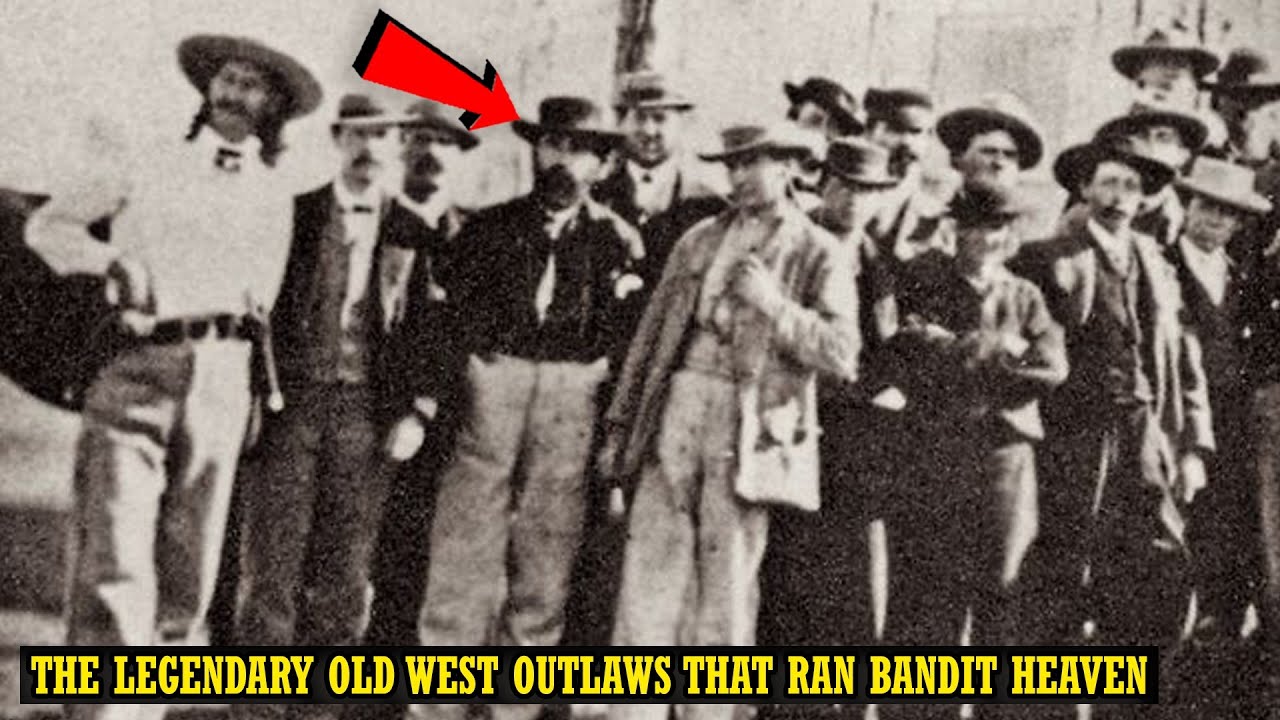
The outlaw sanctuary known as “Bandit Heaven” was more legend than location, a whispered-about hideout where the American frontier’s most notorious criminals could regroup, reload, and ride again. The men and women who ruled this criminal paradise were not simple thieves; they became folk heroes, dime novel icons, and in some cases, cold-blooded killers. John Wesley Hardin was one such figure, a man whose reputation was shaped as much by his own stories as by his actions. Only 18 years old at the time, he claimed to have outdrawn Wild Bill Hickok in a famous confrontation in Abilene, Kansas, in 1871.
The truth of that encounter remains debated, but Hardin’s violent path was already well underway, having begun years earlier in his native Texas. Hardin’s first brush with violence came at just 15, when he killed a classmate in a schoolyard brawl. His reputation as a gunslinger grew through numerous altercations, each adding to his myth. The defining phrase attributed to him, “I never killed a man who didn’t need killing,” reflects his view of himself as an enforcer of his own brand of frontier justice, though the line between self-justification and cold-blooded violence remains a gray area in his legacy.
By 1871, Hardin had already killed several men. In one of his most infamous encounters, he clashed with a group of Mexican cowboys at the end of a cattle drive along the Chisum Trail near Abilene. Tensions escalated when Hardin accused the cowboys of crowding his herd, and a simple dispute turned into a larger confrontation. According to accounts, six men were killed, with Hardin claiming responsibility for five of the deaths.
Upon arriving in Abilene, Hardin ran into Marshal Wild Bill Hickok, who enforced the town’s strict no-gun ordinance. In a famous moment, Hardin reportedly surrendered his pistols after a maneuver he later called a “road agent’s spin. ” In his autobiography, he described deliberately reversing his guns and spinning them toward Hickok with the muzzles facing the marshal. Hickok, seemingly unperturbed, responded with calm amusement and invited Hardin to the nearest saloon, but without his pistols.
Clay Allison was a lesser-known yet equally notorious figure, described by author Dale Pierce as erratic, unpredictable, and dangerous. Hailing from Tennessee, Allison was known for heavy drinking and frequenting saloons and brothels. However, it was his baffling behavior, ranging from erratic violence to moments of erratic kindness, that truly set him apart. In the summer of 1878, Allison arrived in Dodge City with one goal: to confront Wyatt Earp, the town’s assistant marshal.
The cause was deeply personal. Allison blamed Earp for the death of a close friend, George Hoy, and felt justice had not been served. Fearing his attempt might fail, Allison brought several cowboys as backup, planning for a deadly confrontation. When the moment came, however, it did not unfold as Allison had imagined.
Upon locking eyes with Earp, Allison hesitated, struck by the lawman’s cold, steely gaze. The encounter diffused quickly when Ford County Sheriff Bat Masterson quietly approached the scene, shotgun in hand. With Masterson in the picture and Earp’s composure unshaken, the cowboys wisely retreated, leaving Dodge City without further incident. Belle Starr also had her moments of boldness while in Southwest Kansas.
At the time, Belle and her husband Sam were between heists, taking a brief respite in town after pulling off a bank job. Sam slipped away to the Long Branch Saloon for some gambling and returned with his face crimson with frustration, admitting he had lost $2,000 of their stolen money. For Belle, this was more than a loss of cash; it was a challenge to her pride and control. Armed and determined, she entered the saloon, moved confidently through the room, and began taking back what had been lost.
She gathered winnings from tables and even directly from the pockets of gamblers, a swift, almost theatrical act of retribution. She calmly exited with her husband following, their pockets now filled with a $7,000 haul. Johnny Ringo’s life was marked by personal tragedy from an early age. He struggled with depression throughout much of his life, a condition that likely shaped his violent and erratic behavior.
One of the most traumatic experiences of his youth occurred when he witnessed his own father take his life while cleaning a shotgun, a moment that left lasting emotional scars. Ringo’s path to notoriety began during the Mason County War in Texas in 1875. Over the years, he formed alliances with outlaws like Curly Bill Brocius and found himself intertwined with the Clantons and McClowrys, ranching families often at odds with the law. However, his life was not as glamorous as his associations might suggest.
In July 1882, Ringo’s inner turmoil came to a head. Curly Bill had been killed during the Earp Vendetta Ride, and Ringo’s remaining companions had either fled or scattered. Feeling isolated and defeated, intoxicated and consumed by despair, he raised his Colt . 45 revolver to his head, signaling a tragic end.
He was later discovered slumped against a tree, a victim of his own inner demons. “Dirty Dave” Rudabaugh was notorious for his violent and relentless bank robberies, often leaving behind a trail of destruction. To him, the loss of life during his criminal escapades was an unfortunate but acceptable cost. In November 1880, he formed an alliance with Billy the Kid and his gang, a partnership that led them to White Oaks, New Mexico, where they killed a deputy sheriff.
Pat Garrett and his posse managed to corner the outlaws in a remote cabin near Stinking Springs. Despite being captured, both Rudabaugh and Billy the Kid managed to escape and continue their lives of crime. Rudabaugh’s time in the criminal world was rapidly coming to an end after he fled to Mexico. Involved in a dispute with a poker player who accused him of cheating, Rudabaugh killed the man.
The player’s friends tracked him down, and in a brutally fitting turn, they ended his life and desecrated his body, severing his head and parading it through town. As bold as Tom “Blackjack” Ketchum was, his punishment seemed extreme even by Old West standards. Apprehended and sentenced to death in New Mexico for the murder of a deputy sheriff, he awaited his fate in prison, where conditions were comfortable enough that he gained significant weight during the lengthy appeals process. When the time came for his execution, the executioner used a rope that was far too long, causing a gruesome result when Ketchum’s head was torn off shortly after the trap door opened.
Not all outlaws met such a final and violent end. Emmett Dalton was granted a second chance. In October 1892, he and his gang attempted a robbery in Coffeyville, Kansas. Dalton was shot 23 times but was the only member of his group to survive.
Tragically, his brothers Bob and Grat were killed in the same shootout. Despite the odds, Dalton recovered and served 14 years in prison. When released, he reinvented himself as a real estate speculator and film producer, making movies about the very gang he had once led and the lawmen who had pursued him. His story is a rare example of an outlaw who not only survived his criminal past but found success in an entirely different world.
Harvey Logan, better known as Kid Curry, was a member of the Wild Bunch and a trusted companion to Butch Cassidy. Born in Iowa, he started as a cowboy in Texas before realizing bank robberies were far more lucrative than ranch life. Over time, he earned a reputation as dangerous and unpredictable. His life came to an end in a 1904 shootout in Colorado, where he met his demise after years of living by his own violent code.
If there is a favorite outlaw in this roster, it would have to be George “Big Nose” Parrott, not so much for his criminal activities but for the bizarre circumstances surrounding his afterlife. Infamous for his exploits primarily in Wyoming, his violent career culminated in the spring of 1881 when he was arrested for the murder of a deputy sheriff and a Union Pacific detective. While Parrott’s time in jail was short-lived, his fate became far stranger. In a bid to escape custody, he was seized by a vengeful mob and lynched.
Two physicians, Thomas Maghee and John Osborne, took an interest in his body and decided to conduct an experiment, seeking to examine his brain to uncover the root cause of criminal behavior. After removing the top of Parrott’s skull, they gifted the skull cap to Lillian Heath, Dr. Maghee’s 16-year-old assistant, who would later become Wyoming’s first female physician. It is said she used the outlaw’s skull cap as an ashtray.
The doctors also removed skin from his thighs and chest, sending it to a tannery in Denver, where it was transformed into a medical bag and a pair of shoes. Dr. Osborne, who went on to become Wyoming’s first Democratic governor, wore those shoes to his inaugural ball in 1893. Parrott’s dismembered body remained in a whiskey barrel suspended in a salt solution for nearly a year while the physicians continued their studies.
Eventually, he was buried behind Dr. Maghee’s office. The body’s journey did not stop there. In 1950, workers unearthed the whiskey barrel while constructing the Rollins National Bank in Wyoming.
Inside, they found Parrott’s skull, still missing its top. Lillian Heath, by then in her mid-80s, recognized it immediately and sent her skull cap to match. To everyone’s amazement, it fit perfectly, and DNA testing later confirmed the remains were indeed Parrott’s. Today, Governor Osborne’s shoes are on display at the Carbon County Museum in Rawlins, along with the bottom portion of Parrott’s skull and his earless death mask.
One item remains notably missing: the medicine bag created from Parrott’s skin has never been found, leaving one final mystery in the story of this extraordinary man’s posthumous fame.