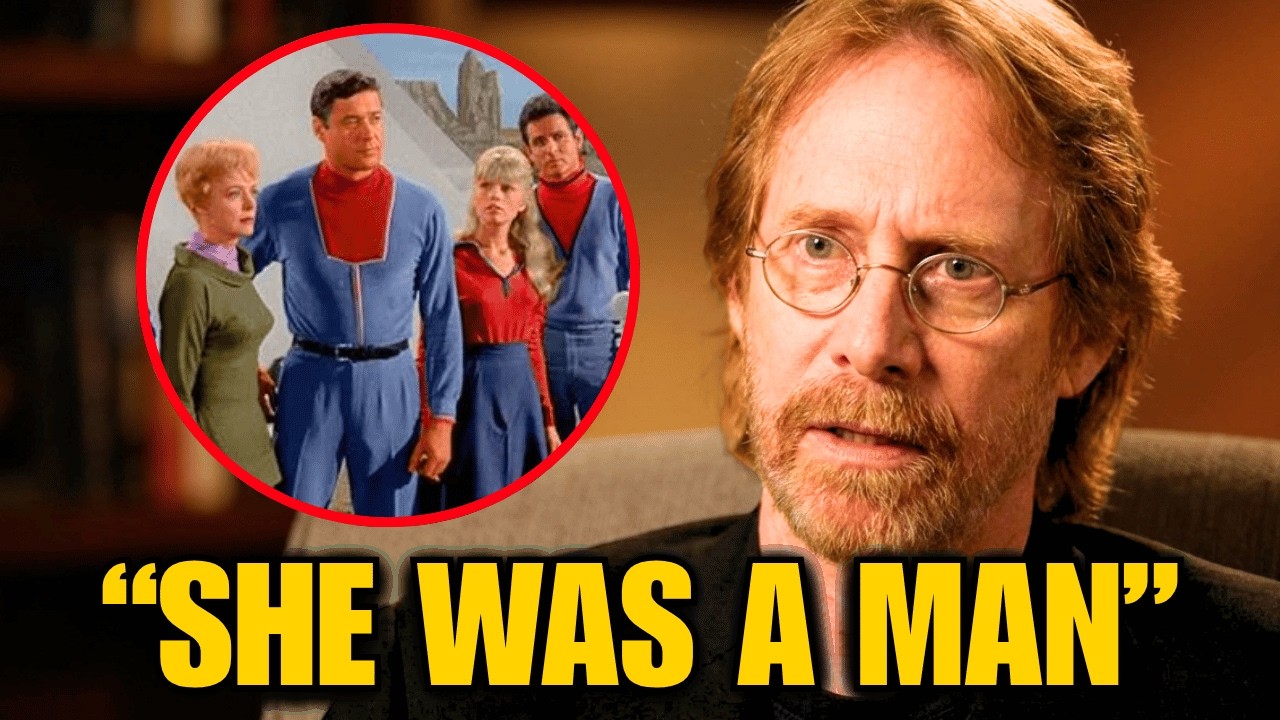
The final survivors of the Robinson family are no longer protecting the legacy of the show that defined their childhoods, and the stories they are now telling paint a portrait of an industry that discarded them without a second thought. Sixty years after the Jupiter 2 first launched into American living rooms, the secrets buried beneath the foam rubber and spray paint are finally surfacing, revealing a production defined by betrayal, physical suffering, and a single actor’s genius that rewrote the entire history of television science fiction. The passing of June Lockhart at the age of 100 on October 23rd, 2025, removed the last adult barrier between the cast and the truth they had carried for decades.
In her final interviews, Lockhart described the moment she learned the show had been canceled, and the revelation is devastating in its casual cruelty. She did not receive a phone call from a producer thanking her for three years of work, nor was she summoned to a meeting to hear the news face-to-face. Instead, she read about the end of one of the most watched science fiction programs in American history in a small notice buried in the entertainment section of her morning newspaper.
 That was the entirety of the farewell CBS offered to the cast, a cold, impersonal print announcement that ended their careers without ceremony or gratitude.
Bill Mumy, who was only 14 years old when the series concluded, carried a similar wound for the rest of his life. He told interviewers decades later that he wept when his agent called with the news, having spent the entire final season filming with the complete belief that a fourth season was already arranged. When the renewal list appeared without the Jupiter 2 on it, a childhood that had been consumed entirely by the show came to an abrupt and unceremonious end.
A boy who had grown up on that set learned his chapter was over through a telephone call, and he went home and cried.
The cast that survived stayed loyal to each other for 60 years, but the man who was supposed to die early ended up controlling the entire show, and he did it so brilliantly that even the people he outmaneuvered eventually admitted it was a masterpiece. Jonathan Harris, the irreplaceable Dr. Smith, rewrote his own character and stole the series from under the feet of its intended star.
Before he was Dr. Smith, he was a pharmacist’s son from a six-story tenement building in the Bronx who had literally invented himself from scratch, changing his surname from Kersch Suchin to Harris at 17 against his father’s furious objections.
When Irwin Allen offered Harris the role on Lost in Space, the actor looked at the character as written and immediately recognized a career trap. Smith was a cold-blooded spy who killed a guard in the pilot’s opening minutes and reprogrammed the robot to 𝓀𝒾𝓁𝓁 the Robinson family in their sleep, designed to be despicable and eliminated within five episodes. Harris understood exactly what this meant, that a role ending in five episodes is not a career but an expensive dead end, so he started rewriting things quietly at first, arriving on set with entirely new pages of dialogue written overnight.
Bill Mumy, still a child at the time, watched this transformation and later described it with genuine awe, noting how Harris would rewrite scenes and then quietly engineer every beat of the action so that all roads led back to Smith. The cowardly eye rolls, the melodramatic wailing about his back, and the cascade of invented insults hurled at the robot, none of it appeared in any script. Harris sat up nights constructing phrases like bubble-headed booby, nickel-plated nincompoop, and bellicose bumpkin, explaining his reasoning with perfect logic that the robot was wise to Smith’s schemes and had to be attacked constantly to keep it from exposing him.
By the time Irwin Allen understood what had happened, 500 fan letters a month were pouring in for Dr. Smith, and Allen had no realistic choice but to celebrate it. He later said openly that Smith was not originally created as a comedy character, but Jonathan Harris dictated what they should do with the character.
Harris negotiated a special guest star credit on every one of all 83 episodes, reportedly the first time that billing structure had appeared on American television, but Allen’s public praise concealed a private discomfort because the actor he had hired to be his leading hero was watching his entire role dissolve in front of him.
 Guy Williams came to Lost in Space as one of the most recognizable men on American television, having spent four years as Zorro on Disney and generated $11 million in merchandise within months of his premiere. He was tall, fencing trained since age seven, and genuinely excited about playing John Robinson, the brilliant mission commander who would lead his family through the universe, and this was supposed to be his show. The transformation happened gradually enough to feel almost polite, with his screen time shrinking in season 1 as the Dr.
Smith storylines expanded, becoming a pattern by season 2 and simply the reality of the production by season 3.
Williams appeared on set, delivered a handful of lines, and stood in the background while Jonathan Harris and Bill Mumy and the robot carried the episode forward. Mark Goddard described the atmosphere directly, saying the show started going more toward the robot and Smith and there were hard feelings from Guy especially. Jonathan Harris himself acknowledged the damage, saying openly that Williams was hired to be the star of the piece and ended up with an occasional line every other week, calling it very difficult for an actor to endure, though he just did not stop doing it.
In one reported exchange with Harris, Williams erupted with the words, God damn it, I will 𝓀𝒾𝓁𝓁 you, Harris, before adding after a pause, I mean Smith, capturing something completely real about the situation. After cancellation, Williams discovered his Hollywood career had not survived being the background of his own show, but halfway around the world his situation was entirely reversed as Zorro had become a cultural institution in Argentina. The government gave him a luxury marina apartment, the wife of President Peron personally invited him to perform at a charity event, and he spent the last 21 years of his life living as something close to royalty.
On May 6th, 1989, police entered his Buenos Aires apartment after friends reported his disappearance and found him alone, a ruptured brain aneurysm having killed him approximately a week earlier at age 65. Nobody had known because he had been living alone and mobile phones did not yet exist, meaning the man promised the lead of a television series had died undiscovered a week before anyone found him in a country that loved him more than his own industry ever had. Bill Mumy later said simply that when the show ended, he never saw Guy again, not once.
Back on the studio lot where the show had been filmed, another cast member had spent three years enduring something far more physically dangerous, and the production company had decided it was not a problem worth solving. Bob May walked into the Lost in Space audition by accident while applying for a different job at 20th Century Fox, and when he climbed out of the robot suit after his first session inside, he was cut and bleeding from the metal edges. He took the job anyway, and the suit weighed approximately 200 pounds with an interior temperature that became what May later described as his own jacuzzi and sauna combined.
The costume was nearly airtight, and on at least two confirmed occasions across the three seasons, May passed out inside from lack of oxygen, his eyes rolling back and his body going limp before crew members realized something was wrong. The production company’s official response to these incidents was that there was no time to stop filming. May was a devoted smoker who puffed cigarettes inside the costume during breaks between takes, and June Lockhart recalled seeing smoke drifting through the robot seams and finding it quietly amusing.
Despite performing every physical gesture that made the robot one of television’s most beloved characters, Bob May was never credited on screen during the entire original run, not one episode in all three seasons carried his name. The practical consequence was lower pay and significantly reduced residuals, and as Lost in Space grew into a global phenomenon generating licensing income across decades, May and his wife were living in a mobile home park in the San Fernando Valley. In November 2008, the Sayre fire destroyed their home, and two months later May died of congestive heart failure at 69.
 What defined his later years was not bitterness but extraordinary generosity, as he became one of the most beloved figures on the science fiction convention circuit, staying at signing tables until every fan had their moment no matter how long it took. He said once that he would stay at any convention signing autographs until the last fan was finished or the cleaning crew forced him to leave, a man made invisible by the industry that profited from him choosing to make sure that no fan ever felt invisible in front of him.
Before there was a robot, before there was a Dr. Smith, before there was a single foam rubber alien, there was a 60-minute film that Irwin Allen believed was the best work of his career. The original Lost in Space pilot titled No Place to Hide was filmed in late 1964 on a budget of approximately $600,000, making it the most expensive television pilot ever produced at that time, with a cinematographer who had won three Academy Awards and a special effects supervisor who was a future Oscar winner.
The story was clean and entirely serious, following a family called the Robinsons launched toward Alpha Centauri and knocked off course by a meteor storm.
There was no villain, no comedy, no robot, no internal conflict, and it played like a genuine film with Will Robinson sitting around a campfire and singing Greensleeves. When Allen screened it for CBS executives, they laughed with delight and bought the series immediately, then handed him a list of demands that the pilot was too hardware driven and they wanted a recurring antagonist who could generate weekly conflict. They settled on Dr.
Zachary Smith, required a robot, and approximately 80% of that original footage was eventually cut up and inserted into the first five episodes of season 1.
The show premiered on September 15th, 1965, with the Jupiter 2 interior set costing $350,000, making it the most expensive standing television set of its era, more costly than the entire Enterprise bridge on Star Trek. The theme music was composed by a 24-year-old named Johnny Williams, who later became John Williams and wrote the scores for Star Wars, Jaws, and Indiana Jones. The rivalry between Lost in Space and Star Trek is one of the most misunderstood stories in television history because most people assume it was a fair creative contest between two equally respected shows.
In raw ratings, it was not close, as Lost in Space consistently placed between 32nd and 35th in the weekly Nielsen rankings while Star Trek never climbed higher than approximately 52nd during its entire original run. Gene Roddenberry pitched Star Trek to CBS in a 2-hour meeting, but the network was already developing Lost in Space and had no intention of buying a competing science fiction property, so Roddenberry took Star Trek to NBC. The most genuinely funny artifact of this rivalry happened during season 3 when the Lost in Space makeup team needed to create a pointy-eared alien boy and borrowed the actual molds used to make Spock’s ears.
Inside the Jupiter 2, a completely unexpected love story was unfolding as Angela Cartwright was 13 when Lost in Space began filming and Bill Mumy was 10, going through their entire adolescence together on that set. Mumy described it later with characteristic directness, saying they were each other’s first true love, and he waited until he was old enough to drive before inviting Cartwright on a proper date. They were briefly engaged in the early 1970s before ending the relationship without bitterness, and for more than 50 years they remained genuinely close friends, co-authoring multiple books and appearing at conventions together.
 While spending his working days fighting alien monsters for Lost in Space, Mumy was going home every evening and watching Star Trek with devoted enthusiasm, being in his own words a committed Trekky through the entire run of the show that was supposedly Star Trek’s rival. Decades later he made it official by appearing in a Star Trek Deep Space Nine episode where his character, a Starfleet officer named Kellen, dies in combat. Irwin Allen died on November 2nd, 1991, and Gene Roddenberry had died 9 days earlier on October 24th, the two creators leaving this world within the same 2-week window.
The end of Lost in Space is one of the most instructive stories in the history of how television treats the people who make it, as the show ran for 83 episodes across three seasons and never received a finale. The Robinson family was never rescued, never reached Alpha Centauri, never came home, and the last episode filmed ended with the family still stranded on a distant planet fully believing they were returning in 8 weeks for a season 4 that was never going to happen. CBS offered a fourth season with a 15% budget cut, Allen said no, and the show was canceled not because audiences stopped watching but because the producer refused to accept less money.
The episode that stands as the purest symbol of Lost in Space’s creative collapse aired during the final season and was called The Great Vegetable Rebellion, in which Dr. Smith picks a flower on an alien planet and is transformed into a stalk of celery. The central villain was a man in a full-body foam rubber carrot costume, and Guy Williams and June Lockhart could not get through their scenes without laughing.
Irwin Allen was so furious about their inability to maintain composure that he wrote both of them out of the next two episodes at full salary as punishment for laughing at his own show.
The episode became a symbol of collapse and then something stranger, as when TV Guide published its list of the 100 greatest television episodes in 1997, The Great Vegetable Rebellion appeared at number 76 while The City on the Edge of Forever, widely considered the single greatest hour of Star Trek ever produced, appeared at number 92. Mark Goddard had been privately warned by Guy Williams that Lost in Space was in Williams’s words a career buster, and Goddard eventually hid his association with the show when he appeared on Broadway, removing the credit from his playbill.
Jonathan Harris spent the rest of his career as a prolific voice actor, voicing Manny in Pixar’s A Bug’s Life in 1998 and appearing in Toy Story 2 the following year. When the 1998 Lost in Space film was produced, the studio offered Harris a six-line cameo, and he rejected it with words that immediately became famous in Hollywood circles, saying they offered him an innocuous six-line bit they laughingly called a cameo and he told them exactly where to shove it. A reunion film titled Lost in Space: The Journey Home was in development in the early 2000s with Harris set to star, but in November 2002 he entered a hospital for a chronic back problem and died of a blood clot.
The Netflix reboot that ran from 2018 to 2021 found an elegant way to honor what came before, giving the rebooted Dr. Smith the full name June Harris, combining June Lockhart and Jonathan Harris into a single character name. Bill Mumy appeared in the pilot as a character identified simply as Dr.
Z. Smith, Angela Cartwright played Dr. Smith’s mother in season 2, and June Lockhart at 96 years old voiced Alpha Control in season 3.
She died 2 years later at 100, peacefully in her sleep, having watched the series canceled, revived, mocked, celebrated, rebooted, and preserved across three generations of fans.
The three Robinson children who are still alive still find each other, still show up at conventions and tell stories about Irwin Allen banging his hammer against a bucket and Jonathan Harris arriving on set with 14 pages of new dialogue he had written overnight. They carry the Jupiter 2 with them not as a burden but as proof that something genuinely extraordinary happened inside that fiberglass spaceship. The Robinson family never made it home in the story, but the people who played them never stopped finding their way back to each other, and that is the version of Lost in Space that history forgot to tell.