The cold winter light of December 15th, 1944, was fading over the gardens of Versailles when General Dwight D. Eisenhower made a final, fateful decision. Inside a folder on his desk lay a draft memorandum, its language carefully measured but its intent unmistakable.
It was the beginning of the end for Field Marshal Bernard Montgomery, the brilliant but insufferable British commander who had spent months challenging Eisenhower’s authority and pushing the Allied high command to the brink of open revolt. The Supreme Commander had finally run out of patience. He was done waiting.
 The relationship between the two men had been fracturing since the late summer of 1944. When Eisenhower assumed direct command of all Allied ground forces on September 1st, Montgomery, who had led those forces through the bloody triumph of Normandy, took the demotion as a personal and national insult. He never forgave it.
Through the autumn, the British field marshal campaigned relentlessly for a single, narrow thrust into northern Germany under his own command, a strategy that directly contradicted Eisenhower’s broad front approach. The friction was not merely strategic; it was a clash of egos, national pride, and fundamentally incompatible temperaments.
Montgomery staked his enormous credibility on Operation Market Garden in September, an audacious airborne assault intended to bounce the Allies across the Rhine and end the war by Christmas. It was a gamble that failed catastrophically at Arnhem, leaving thousands of casualties and the Rhine still firmly in German hands. Rather than recalibrate his approach after the disaster, Montgomery pressed his case with even greater contempt.
He argued through back channels that he should hold authority over all Allied ground forces, a move that would have subordinated American General Omar Bradley to his command. Eisenhower absorbed the demand, reorganized his staff, and preserved his authority without open confrontation, but the cost was mounting.
In November, Montgomery sent a letter so scathing in its criticism of Eisenhower’s leadership that his own chief of staff flew to SHAEF to intercept it, fearing an irreparable rupture. The pattern was exhausting and predictable: Montgomery would demand, Eisenhower would deflect, and the alliance would hold by the thinnest of margins. But the pressure from the American side was becoming a drumbeat for action.
Bradley had reached the limits of his restraint, and Air Chief Marshal Arthur Tedder, Eisenhower’s own British deputy, was openly calling for Montgomery’s relief. The question was no longer whether Montgomery was a problem, but why nothing had been done about him.
By the evening of December 15th, Eisenhower was prepared to answer that question. The draft letter was his answer, a definitive end to the insubordination that had plagued the alliance for months. He stood at the window, the stillness of his posture betraying the resolve settling within him.
He turned back to the desk, ready to finalize the decision that would reshape the command structure of the Western Front. He never got the chance. Less than 24 hours later, the ground shook in the Ardennes.
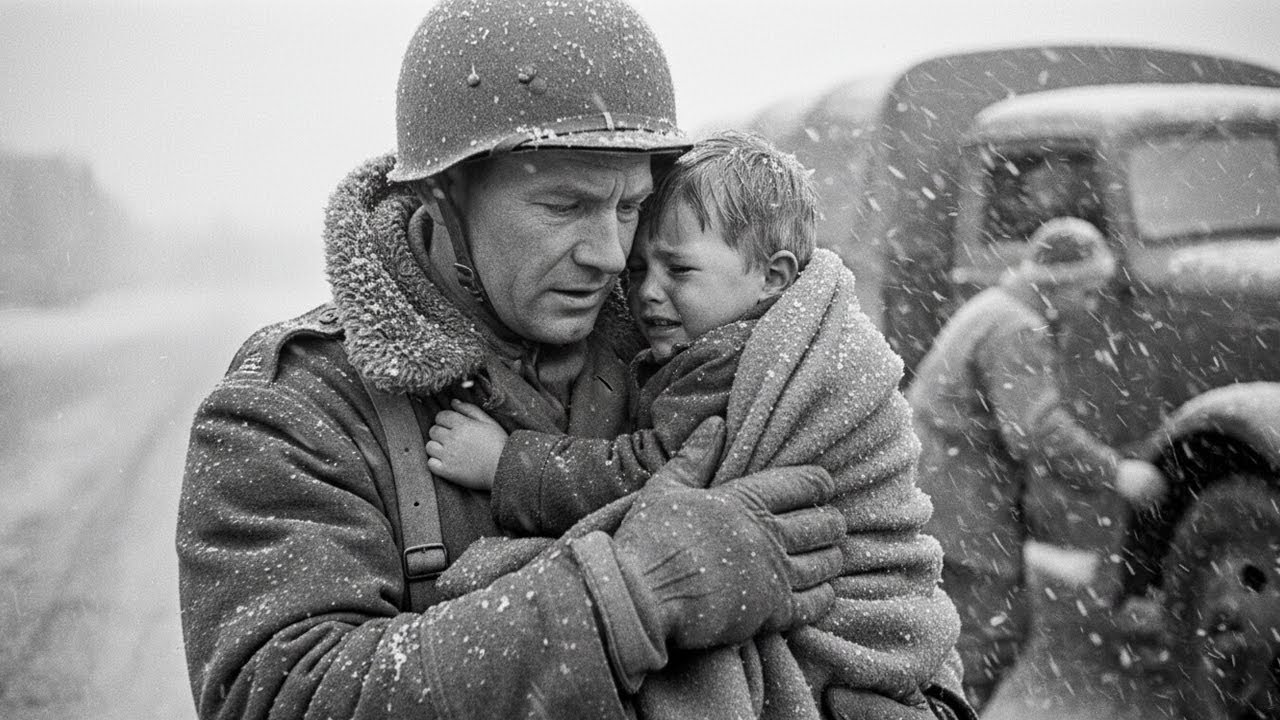
More than 200,000 German soldiers and nearly 1,000 tanks poured out of the fog and snow, and the man Eisenhower was preparing to remove suddenly became the man the Allies could not afford to lose.
The offensive was Hitler’s final, desperate gamble. Launched on December 16th, 1944, it was intended to split the Allied armies in two, seize the port of Antwerp, and force a negotiated peace. The Germans achieved complete surprise.
 Thick fog and heavy snow grounded the Allied air forces, allowing German columns to move invisibly beneath the overcast. Communications collapsed across the American front. Entire formations were overrun before they grasped what was happening.
A bulge was forming in the Allied line, deeper by the hour, threatening to sever the command structure entirely. The men who had spoken confidently of ending the war by Christmas now stared at maps showing their front splitting open.
Eisenhower grasped the scale of the crisis faster than most. The German penetration had driven a wedge so deep that Bradley, commanding from Luxembourg, could no longer effectively control the forces north of the bulge. The geography was brutal in its simplicity; orders had to travel around the German salient, slow and unreliable.
Someone positioned north of the breakthrough had to take charge immediately. That someone was Montgomery. On December 20th, Eisenhower placed the US First and Ninth Armies under the Field Marshal’s operational control.
It was a temporary measure, dictated by maps and nothing else, but the symbolism was impossible to contain. The British commander Eisenhower had been preparing to remove now commanded the bulk of two American armies in the middle of the largest battle the US Army had ever fought.
The American reaction was immediate and furious. Bradley took it as a personal humiliation, a public verdict that he had lost control of his own command. He argued against it bitterly and never entirely forgave the decision.
To his eyes, Montgomery was being rewarded for the very crisis that should have ended his influence. Montgomery’s reaction did nothing to soften the resentment. He accepted the command without visible humility, moving through the wreckage of the American front with an air of vindication.
He had always believed unified command was the answer, and now, in the worst possible circumstances, he had been proven right. Eisenhower could not afford to dwell on the irony. He had made his choice, and the choice carried a terrible double edge.
But Montgomery, whatever his faults, knew how to impose order on chaos. He arrived in the north and went to work with a cold, methodical efficiency. He sent his own liaison officers forward to map the true state of the front, refusing to act on panicked reports.
 He pulled scattered units back into coherent defensive positions, straightened the line, and assembled a reserve. The northern shoulder held. The German thrust toward the Meuse slowed and then stalled, finding no soft seam to exploit in Montgomery’s reorganized line.
As the skies finally cleared on December 23rd, Allied air power returned with devastating force, and the initiative passed back to the Allies for good. The bulge stopped growing, then it began to contract. Historians have argued about Montgomery’s role ever since, but many acknowledge the truth: his handling of the northern flank was genuinely skilled.
He steadied a front that needed steadying.
Then, Montgomery did what no German offensive could have done. On January 7th, 1945, he called a press conference. He had been advised against it, but Montgomery had never been a man to leave the record to others.
He stood before the correspondents and described the battle as he saw it, explaining how he had been called in to handle the crisis in the north and how he had marshaled the British forces to bring order to a desperate situation. The words were not entirely false, which made them so damaging. The impression they created was unmistakable: British leadership had ridden to the rescue of a beaten American army.
The reaction across Allied headquarters was volcanic. Bradley was incandescent, threatening he would not serve under Montgomery under any circumstances. Patton made his contempt known in language unfit for print.
The men who had done the dying were watching a British field marshal collect the credit.
Eisenhower’s disappointment ran deeper and quieter. He understood at once what Montgomery had done and what it would cost. The battle had been an American fight, won overwhelmingly by American blood.
To allow that truth to be obscured was not merely unfair; it threatened the very coalition Eisenhower had spent the entire war holding together. Churchill himself would later rise in the House of Commons to set the record straight, calling it an American victory. But the damage was done.
 The Battle of the Bulge had saved Montgomery. Weeks earlier, he had been a breath away from removal. Now he had performed too well, too visibly, in too important a battle to be dismissed without appearing to punish a victorious commander out of spite.
The crisis that should have ended his career had instead armored it.
In the end, Eisenhower did the hardest thing a commander can do. He set aside what he wanted and accepted what the situation required. He understood the arithmetic of the moment.
Montgomery had handled the northern shoulder skillfully. The British public and government regarded him as a hero. To remove him now would not read as discipline; it would read as an American commander punishing a victorious British field marshal out of wounded pride.
It would not weaken Montgomery; it would fracture the alliance. And so the letter was never sent. Not because Eisenhower had forgiven the insults or forgotten them, but because he grasped a truth that defined his entire command: the war could only be won by a coalition, and a coalition could not survive its most senior partners tearing one another apart in public.
The mission came first. It always had.
The war moved on without resolving any of it. In March 1945, Allied forces crossed the Rhine and poured into the German heartland. The Wehrmacht, having spent its last reserves in the Ardennes, could no longer hold anything.
On May 8th, 1945, the war in Europe ended in unconditional surrender. Eisenhower and Montgomery continued to work together through all of it, correctly, professionally, and without the slightest warmth. The partnership functioned; it never healed.
The two men had won the greatest war in history side by side and would spend much of the rest of their lives quietly disputing what the other had truly contributed. The Battle of the Bulge did more than stop Hitler’s last offensive. It also saved Bernard Montgomery’s position within the Allied command structure.
The letter that may have ended his influence was overtaken by history itself, rendered impossible not by any change of heart, but by the simple, brutal turning of events. When Hitler launched his final gamble in the Ardennes, the fate of two rival commanders became intertwined. One was preparing to remove the other.
Then the Bulge happened, and history chose a different ending.