WASHINGTON — The old man sat in the morning sun, his hands folded in his lap, his eyes fixed on the marble colossus rising before him. Fifty thousand people had come to see a monument. Robert Todd Lincoln had come to see his father.
For 57 years, he had carried that face with him everywhere. On coins. On the sides of buildings.
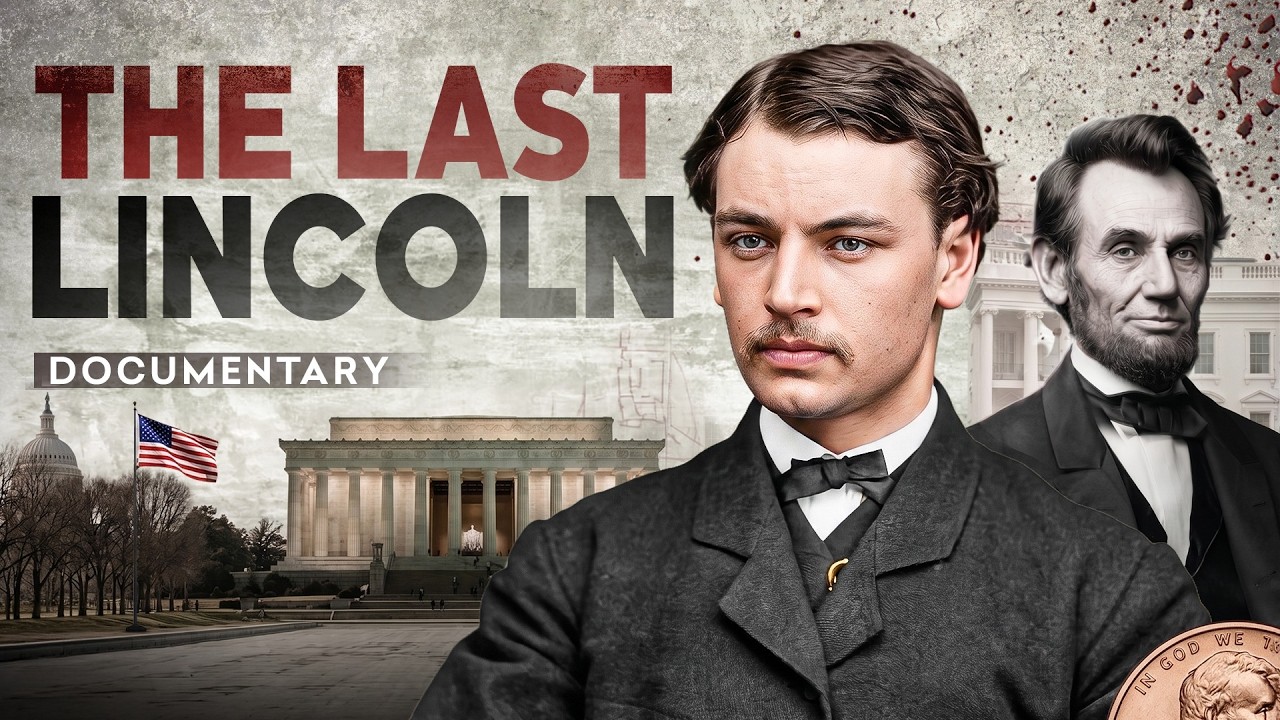 In the eyes of every stranger who recognized the name and wanted something from it. And now, on this May morning in 1922, he sat before the largest tribute of all, a 19-foot seated figure carved to look as though it were thinking about something too heavy to set down.
He had been asked to speak. He declined.
He had been asked to smile, to wave, to acknowledge the crowd that stood and applauded when he took his seat. He did none of it. He simply sat there, a heavy-set man of 78, white-haired and bearded, watching other men describe the father he had barely known.
The story of Robert Todd Lincoln is not the story of a man who failed to be his father. It is the story of a man who was never asked to be anything else.
Abraham Lincoln’s only surviving son lived for 82 years. He became a lawyer, a Secretary of War, an ambassador to the Court of St. James’s, the president of the Pullman Palace Car Company.
By any reasonable measure, he built a remarkable life. And yet he spent every year of it being asked, in every room he entered, whether he was Abraham Lincoln’s son.
He was. And it cost him more than history has ever fully recorded.
His earliest memories were of departure. His father left before he was old enough to understand where or why or how long. Abraham Lincoln was a circuit lawyer in those years, riding the judicial routes of Central Illinois, town to town, courthouse to courthouse, sometimes gone for weeks at a time.
The house on 8th and Jackson Street in Springfield would grow quiet in a particular way when he was absent. Robert learned to recognize that quiet early.
He was not the child his father seemed most at ease with. There was something between Robert and Abraham Lincoln that never quite loosened, a formality, a restraint, the particular awkwardness of a man and a boy who wanted to know each other and could never quite find the time.
The younger boys, Willie and later Tad, had something Robert did not. They had their father when he was home, when he was present, when the circuit courts released him back to Springfield for a few weeks and he could throw himself fully into the noise of ordinary life. Abraham Lincoln was a different man with those boys.
Visitors described it. His law partner, William Herndon, described it with a mixture of affection and exasperation. The president would allow Willie and Tad to interrupt cabinet meetings, to drag animals through the White House corridors, to climb across him as he tried to read, and he would not reprimand them.
Robert watched from a certain distance. He did not appear to resent it, or at least no record survives of resentment. What survives in his own careful handwriting is a precise accounting of the gap.
“During my childhood and early youth,” he wrote to a biographer, “he was almost constantly away from home, attending courts or making political speeches. In 1859, when I was 16, I went to New Hampshire to school, and afterwards to Harvard College, and he became president. Henceforth, any great intimacy between us became impossible.
I scarcely even had 10 minutes quiet talk with him during his presidency, on account of his constant devotion to business.”
Ten minutes. Four years. The most consequential presidency in American history.
Ten minutes of quiet talk.
He was 16 when he left Springfield for Phillips Exeter Academy. By the time Abraham Lincoln became the 16th president and moved the family to Washington, Robert was already pointed in the other direction. He came back for holidays, for Christmas, occasionally for summer weeks, but the White House was not his home the way it was Tad’s and Willie’s.
He arrived as a guest and left as a student.
The war pressed on him in ways that were difficult to continue ignoring. Men his age were dying in Virginia. His mother had argued fiercely against his enlisting.
His father had held the same position, gently. The argument being that a president’s son in the infantry invited a specific kind of exposure. But eventually Robert insisted.
In January of 1865, Abraham Lincoln wrote to Ulysses S. Grant asking if his son might serve on the general’s staff in a capacity that would keep him out of direct combat. He was commissioned a captain in February.
It was sometime before that commission, in the winter of 1863 or early 1864, that Robert Todd Lincoln nearly died on a train platform in Jersey City, New Jersey.
He was waiting with a group of passengers late at night, purchasing sleeping car tickets from a conductor standing at the entrance of a rail car. The platform was level with the car floor. There was a narrow gap between the two.
There was some crowding. The train began to move. Robert, pressed against the car body by the shifting crowd, lost his footing and dropped toward the gap, feet going down toward the rail, the dark space opening beneath him.
A hand caught him by the collar and pulled him back.
He wrote about the moment himself in a letter composed 45 years later to the editor of the Century Magazine, who had asked him to confirm the account. The train beginning to move, his feet losing purchase, the sudden arrest of the fall. He recognized his rescuer immediately, he said.
It was Edwin Booth, one of the most celebrated actors in America, a man whose Hamlet had run for a hundred consecutive nights in New York City. The brother of the man who would 𝓀𝒾𝓁𝓁 his father.
At 7:22 in the morning on April 15th, 1865, Abraham Lincoln stopped breathing. Robert was in the room.
He had arrived at the Petersen House, the boarding house across the street from Ford’s Theatre, where his father had been carried after the shot, sometime after midnight. Secretary of War Stanton was there. Cabinet members were there.
Surgeons were there. The president lay in a bed too short for his long body, unconscious. The wound to the back of his skull, a thing the doctors could describe but not repair.
In the front parlor of the same house, Mary Todd Lincoln was not allowed to come in. She was inconsolable. The doctors had made a decision that she was too distressed to remain at the bedside, and so she was kept at a distance, able to hear but not see what was happening in the back room.
Robert moved between the two. John Hay, the president’s personal secretary and one of Robert’s closest friends, wrote afterward that young Lincoln, after an initial outburst of grief, spent the rest of the night soothing and comforting his mother. Back and forth, room to room, the man who was dying and the woman who could not witness it.
When the breathing finally stopped, Robert was 21 years old.
There is no record of what he said in the hours that followed. There is a photograph taken some weeks later, a young man with his father’s dark eyes, dressed in mourning. He does not look broken.
He looks like someone who has decided, very recently, not to be broken.
He had no time for it. There was his mother to manage. There was a body to accompany back to Springfield.
There was a funeral, and then another funeral, and then a long train journey across a grieving country that lined the tracks for a thousand miles to watch the coffin pass.
He went back to law school in the autumn. He passed the bar in 1867. He built a practice in Chicago.
He was careful and methodical and by most accounts genuinely good at the work. Corporate law suited him. It rewarded precision, discretion, the ability to keep one’s name out of the newspapers.
He was excellent at all three.
 But the name followed him everywhere he went.
He became Secretary of War in 1881 when President James Garfield took office. He became Minister to Great Britain in 1889 when President Benjamin Harrison sent him to London. He became President of the Pullman Palace Car Company in 1897 when the founder died and the board needed someone the public would trust.
He was good at all of those, too. And yet, as he reportedly told his close friend Nicholas Murray Butler, the President of Columbia University, he was never entirely sure any of it had been truly his.
“No one wanted me for Secretary of War,” he is said to have told Butler. “They wanted Abraham Lincoln’s son. No one wanted me for Minister to England.
They wanted Abraham Lincoln’s son. No one wanted me for President of Pullman. They wanted Abraham Lincoln’s son.”
On the morning of July 2nd, 1881, Robert Lincoln was walking alongside President Garfield through the Sixth Street train station in Washington, D. C. Garfield was heading out of the city north toward a Williams College reunion.
Robert was there in his capacity as Secretary of War, a routine departure, nothing unusual.
A man stepped forward from the crowd and shot the President twice.
Garfield survived the initial wound, but the summer was long and the treatment was uncertain, and the President died in September. Robert served out the remainder of his cabinet term under Chester Arthur, as Garfield had requested. He performed the duties.
He signed the documents. He attended the meetings.
But something had shifted. He told a reporter from the New York Times, according to accounts of that day, that standing on that train platform in Washington, watching a president fall, had called up a feeling he could not easily name.
“My God,” he is reported to have said, “how many hours of sorrow I have passed in this town.”
In the years between the assassination of his father and the shooting of President Garfield, Robert had also made a decision about his mother.
Mary Todd Lincoln had grown increasingly difficult to care for at a distance. The spending, the fears, the episodes that alarmed people who encountered her. In 1875, he had arranged for a legal hearing and had her committed to a private sanatorium in Batavia, Illinois.
It was a decision that cost him enormously in the public press, and more privately, in whatever remained of his relationship with her. She escaped after several months. She sued her son.
She was eventually declared competent and released. They never fully reconciled before her death in 1882. He did not attend her funeral.
He built walls where others might have built doors. He declined most interviews. He refused most invitations that carried the Lincoln name in their letterhead.
He answered the mail he had to answer and ignored the rest. He became, over the years, a man who kept himself at a careful distance from the thing he most embodied.
But he kept going. He had always kept going. It was perhaps the most Lincoln-like thing about him.
In the autumn of 1889, he accepted an appointment as minister to the court of St. James’s and moved his family to London. His wife Mary, his two daughters, and his son, a 16-year-old boy named Abraham Lincoln the second, whom everyone in the family simply called Jack.
People who met Jack remarked on it immediately. He had his grandfather’s height, his grandfather’s build, something in the way he held himself, the easy confidence, the particular quality of attention he gave when someone was speaking to him. He was, by all accounts, everything his father had hoped the future might hold.
He was born in 1873, the year Robert turned 30, in Chicago, during what passed for peacetime. Robert named him Abraham Lincoln the second. The family called him Jack.
He grew tall early. He had good posture and quick intelligence and the particular ease of a boy who had never been made to feel small. People who spent any time with him remarked on it, on the way he listened, the way he moved, something in the architecture of his face and frame that recalled something older than himself.
He looked like Abraham Lincoln.
Robert Lincoln was not a sentimental man by temperament. He did not record his inner life in diaries or write expansively about his feelings in letters. But there is in the correspondence from his London years, the years when Jack was beside him at the American legation on Victoria Street, attending the social functions of the court of St.
James’s, studying, growing, becoming, a particular warmth that does not appear elsewhere in his papers. A loosening.
He was 50 years old when they came to London. His career was at its most distinguished. And for the first time in a long time, perhaps since Springfield, perhaps since some moment in early childhood he could not quite name, the future felt like something to look forward to.
Then Jack’s arm began to hurt.
It was a carbuncle, a deep abscess beneath the skin, the kind of infection that men in the 19th century treated as a nuisance and occasionally died from. The doctors in London opened it surgically. The procedure was straightforward.
The expectation was recovery.
The infection did not agree.
What followed was weeks, weeks of treatment and relapse, of temperature charts and consultations, of the best doctors in England being summoned to the legation and examining the boy and leaving again with careful expressions. Robert kept his diplomatic schedule as long as he could, then abandoned it entirely. He paced the corridors.
He sat beside his son’s bed. He waited.
He had waited in a room like this before. He had been 21 years old and the man dying in the bed had been the president of the United States. And there had been nothing to do then either except stay.
Jack fought. That word appears in every account, in Robert’s own letters, in reports from the doctors. He fought with what his father later described in a letter to his cousin Charles Edwards as his own marvelous pluck and patience.
There were days when the fever eased and the doctors allowed themselves a cautious phrase or two about improvement. Robert permitted himself to believe them.
On the evening of March 5th, 1890, Robert Lincoln was somewhere in the legation when one of his daughters came to find him. She said, “Go upstairs quickly.”
He was 16 years old.
Robert buried his son in London and then accompanied the body home to Springfield and laid it in the Lincoln tomb alongside the grandfather whose name he had carried, whose face he had worn, whose legacy he had been born into without asking for any of it. They were placed together in the stone chamber in Illinois that the country had built to hold its grief.
He wrote to John Hay, his old friend, the man who had stood beside him through his father’s death, the man who understood without needing to be told what the weight of things felt like.
 “I did not realize until he was gone how deeply my thoughts of the future were in him.”
That sentence contains everything Robert Todd Lincoln rarely said aloud. He had watched his father die and stood up. He had buried his mother, his brothers, kept going.
He had absorbed 30 years of being Abraham Lincoln’s son, the dinners where people wanted to touch his hand because it was the nearest thing to touching the man in marble, the letters asking him to confirm, deny, explain, defend, the thousand small surrenders of a private self to a public inheritance.
And he had kept going. He had kept going because Jack was there. Because in the room where Jack was reading or studying or simply existing with that easy confidence of his, it was possible to believe that the future held something more than the past.
After Jack, there were no more male Lincolns. Robert had two daughters. They would marry and carry other names.
The Lincoln blood would continue in a manner of speaking, but the name, the name that appeared on coins and mountainsides and the sides of schools, would not be passed down. The line ended in a London sick room on the 5th of March in 1890, when a 16-year-old boy with his grandfather’s height and his grandfather’s build could not fight the infection any longer.
Robert came home to America. He returned to his work, his law practice, his position at Pullman. He moved carefully through the remaining rooms of his life.
11 years later, on the 6th of September, 1901, the Lincoln family was passing through Buffalo, New York when a Pullman employee found Robert at the station and handed him a telegram. It read, “President McKinley has been shot.”
McKinley survived the shooting for eight days. Robert Lincoln was not at the exposition when the president was attacked. He had arrived in Buffalo as it was happening, his train pulling into the station while Leon Czolgosz stood in the line of well-wishers at the Temple of Music and fired twice at close range.
By the time Robert reached the grounds, the president had already been carried out. The wound was to the abdomen. In 1901, that meant what it had always meant.
He went to the hospital. He did what was expected of him, as he had always done what was expected of him. He waited with the others while the doctors worked.
McKinley died on the 14th of September, and Theodore Roosevelt was sworn in as the 26th president of the United States, and Robert Lincoln sat down and wrote him a letter. He knew Roosevelt. He knew the man’s energy, the appetite for the office, the particular way Roosevelt wore power as though it fit him naturally.
He chose his words carefully. According to accounts of that correspondence, he told the new president, “I do not congratulate you, for I have seen too much of the seamy side of the presidential robe to think of it as a desirable garment.”
Three presidents. 36 years. His father at Ford’s Theatre, Garfield at the Sixth Street Station, McKinley at the Exposition.
He was not a superstitious man, but he was a precise one. He could read a pattern. He is reported to have said to friends at dinners in the half-serious register of a man who has discovered his own life contains more irony than any reasonable person should be asked to absorb, that he had reached a decision.
No more presidential functions. No more White House invitations. When the subject came up, he told people, according to accounts from those who knew him, “I’m not going, and they’d better not ask me, because there is a certain fatality about presidential functions when I am present.”
He said it with just enough humor to make it bearable. He mostly meant it.
He resigned from the Pullman Company in 1911, citing his health, and retreated to a Georgian Revival house on a hill in Manchester, Vermont, a property he had built and named Hildene. It sat on a long ridge with views of the valley below, quiet in a way that Washington and Chicago had never been. He and Mary had summered there for years.
After his resignation, the visits grew longer, the gaps between them shorter, until Hildene became less a retreat and more the place where Robert Todd Lincoln had chosen to disappear.
He stopped giving interviews. He declined most invitations to speak publicly about his father. When historians wrote requesting access to the Lincoln papers, he was courteous, thorough, and largely unhelpful.
He understood better than anyone what those documents contained, the private letters, the raw material of a marriage and a presidency, the parts of Abraham Lincoln that did not resolve neatly into legend.
He had read them all. He knew which pages would resist the marble.
He burned some of them. He acknowledged this in correspondence, that he and his wife Mary had destroyed portions of his parents’ personal letters, particularly material from the years surrounding his mother’s commitment and its aftermath. He did not present it as destruction.
He presented it as judgment, as the duty of the person left standing.
He kept, however, a folder. It was labeled in careful handwriting, the MTL Insanity File. It contained the full legal record of the 1875 hearing, the affidavits, the testimony, the documented case he had built over two years to argue that his own mother could not manage herself.
He did not burn that. Perhaps he could not. Perhaps there are things a man keeps not because he is proud of them, but because destroying them would mean deciding, finally, what they meant.
He carried the folder with him, house to house, year to year, to his grave.
From the quiet of Hildene, he watched the country continue its long project of turning his father into marble. Congress appropriated funds. Architects submitted drawings.
On a stretch of reclaimed ground beside the Potomac River in Washington, workers began laying the foundation of a building designed to hold Abraham Lincoln the way a cathedral holds its saints. Enormous, permanent, above the reach of ordinary revision.
Robert followed its progress from a distance. On visits to Washington in the years the memorial was rising, he asked his driver to take routes past the construction site. He watched it from the car window.
Once, according to accounts from that period, he secured permission to enter the site while work was still ongoing to walk through the unfinished chambers before the crowds arrived, to stand beneath the incomplete columns, to see it before ceremony made it official.
He stood in the unfinished space. He looked at what his father was becoming. Then he went back to Vermont.
In the spring of 1922, an invitation arrived in Manchester. The Lincoln Memorial would be dedicated on May 30th. He was 78 years old.
The journey to Washington would require effort he was not always certain he had. His health had narrowed the range of what was possible.
He accepted anyway. There was something he needed to see.
Washington, D. C. The morning of May 30th, 1922, he arrived by car.
A heavy-set man of 78, moving carefully, helped to his seat on the National Mall as 50,000 people pressed against the cordons, and the flags stood still in the warm air.
The Lincoln Memorial rose before him, white marble, 36 columns for the 36 states of the Union at the time of the Civil War, and inside, on a throne of stone, the figure of his father, 19 ft tall, hands open, face lifted, carrying the permanent expression of a man who had outlasted everything asked of him.
When Robert Todd Lincoln reached his seat, the crowd recognized him and stood. He did not acknowledge it. He settled into his chair and looked straight ahead.
Chief Justice William Howard Taft led the ceremony. President Warren Harding spoke. Dr.
 Robert Moton of the Tuskegee Institute delivered the keynote, his words sharp and careful, and charged with a meaning the segregated crowd could not entirely contain. Speaker after speaker stepped to the microphone and praised the man in marble, the great emancipator, the savior of the Union, the rail splitter from Illinois who had risen so far and fallen so suddenly that the country had been building monuments to him ever since.
Robert had been asked to speak. He had declined. He sat and listened to other men describe his father.
He sat and let the ceremony move around him the way ceremonies do, the speeches, the music, the long pauses that are meant to feel like reverence.
He had not spoken publicly about Abraham Lincoln in years. He had given no interviews, approved no biographies, confirmed nothing that he did not have to confirm. He had spent decades holding the border between the public Lincoln and everything the public Lincoln had cost, and he was not going to surrender that border now before 50,000 strangers on a platform built to make the surrender feel like tribute.
When it was over, he got back into the car. He never appeared in public again.
The drive back to Hildene was long. The house on the Vermont hill received him as it always had, quietly, without ceremony, with the particular mercy of a place that asked nothing of the man who lived there. He walked the grounds when his health allowed.
He corresponded when he had to. He declined what he could decline.
His body in those last years was doing what bodies do at the end of a long life. The vigor that had carried him from the bar to the cabinet to the boardroom had become something slower and more careful. He moved through the house at Hildene with the deliberate economy of a man who has learned to spend his energy precisely.
On the morning of July 26th, 1926, his butler came to wake him. Robert Todd Lincoln was 82 years old.
He had outlived his father by 61 years, his mother by 44, his son Jack by 36. He had outlasted the Civil War and Reconstruction, the Gilded Age and the Progressive Era, the assassination of three presidents and the deaths of every person who had known him when he was simply a boy in Springfield watching his father pack a saddle bag.
He was found in his bed at Hildene, still. He had died in his sleep.
The newspapers ran the obituaries within hours. Secretary of War, ambassador to the Court of St. James’s, president of Pullman, son of Abraham Lincoln.
The headlines arranged his life in the order they had always arranged it. The public offices first, the inheritance last. The name that had preceded him into every room he had ever entered, printed in the largest type, as it had always been printed, as it would always be printed, as long as there were newspapers to print it.
His body lay at Hildene while the arrangements were made. The expectation, the natural expectation, the assumption that required no discussion, was that Robert Todd Lincoln would be brought to Springfield, Illinois, and placed in the Lincoln Tomb alongside his father, his mother, his brothers Willie and Tad, and his son Jack, whose body had rested there in the stone chamber since 1890.
His wife, Mary Harlan Lincoln, said no.
She put it in writing. The note, preserved among her papers, made her reasoning language that was precise and in its way absolute. She wanted her husband buried at Arlington National Cemetery, outside Washington, in a place that was his own, separate from the tomb in Springfield, separate from the mythology, separate from the marble.
She wrote that he was a personage, made his own history, and here, in her own handwriting, she underlined the next word five times, independently of his great father. And should have, she wrote, his own place in the sun.
He was interred at Arlington in 1928 in a sarcophagus designed by the sculptor James Earl Fraser. His wife Mary was buried beside him. And beside them both, moved from the Lincoln Tomb in Springfield, carried back east at his mother’s instruction were the remains of Jack Abraham Lincoln the second.
The boy who had looked like his grandfather who had died at 16 in a London sickroom who had been the last thing Robert Todd Lincoln described as the future.
Three members of the Lincoln family together in the ground at Arlington. None of them beside Abraham.
Robert had spent 60 years guarding his father’s legend. He had burned the letters that complicated it kept the folder that documented it declined every invitation that would have reduced him further to a symbol of it. He had stood at Appomattox and watched a war end and stood at Petersen House and watched his father die and stood on two more train platforms while two more presidents were shot and stood at last before a marble colossus on the mall and let other men do the talking.
And when it was finally over when the man himself was gone it was his wife who gave him the one thing 60 years of careful living had not quite managed to secure. A name that belonged only to him.
Arlington National Cemetery sits on a hill above the Potomac the river that runs through Washington the way memory runs through a life constant carrying things never entirely still. The grave is not difficult to find. A low sarcophagus of pale stone designed by the sculptor James Earl Fraser set into the hillside at a modest angle.
Three names. Robert Todd Lincoln Mary Harlan Lincoln and between them returned from the Lincoln tomb in Springfield in 1928 placed at last beside his father instead of his grandfather Abraham Lincoln the second. Jack.
The boy who had looked like the president. The boy who had died at 16 in a London sick room with as his father wrote his own marvelous pluck and patience.
Three members of the Lincoln family together in the ground at Arlington. None of them beside Abraham.
From the hillside at Arlington on a clear day, you can see across the Potomac toward the mall. The Lincoln Memorial is visible from there. The white columns, the long reflecting pool, the building that holds the man in marble.
Robert spent the last years of his life in Vermont far from Washington. But he is buried here on this hill in sight of the thing his father became.
He is not buried beside his father. He is buried facing him.
There is a detail from 1909 that deserves mention quietly near the end. On August 2nd of that year, one day after Robert Todd Lincoln’s 66th birthday, the United States Mint began producing a new coin. A penny.
It bore on its obverse a portrait of Abraham Lincoln rendered in low relief against the copper. It was the first American coin in history to carry the likeness of a real person rather than a symbolic figure. The occasion was the centennial of Lincoln’s birth.
Robert Todd Lincoln was alive. He lived for 17 more years.
For every one of those 17 years, every time he reached into his pocket at the grocer’s in Manchester, at whatever remained of the offices he still attended, in the quiet rooms of Hildene where he spent his final winters, he would have encountered his father’s face pressed into copper. The man who had been almost constantly away from home, the man he had scarcely spoken with for 10 minutes during 4 years of the most consequential presidency in American history. The man whose name had arrived like a shadow that preceded the body into every room Robert had ever entered.
Small, brown, everywhere.
He never gave the interview that would have explained all of it. What the 60 years had cost, what he had meant to protect, what he would have done differently if any of it had been his to choose. He declined every such request.
He answered the letters he could not avoid and let the others go unanswered. He kept the folder. Whatever he understood about himself, about the distance between what he had been asked to be and what he had managed quietly to become, he kept it where he kept everything that mattered most.
Behind a door he had no intention of opening for strangers.
His wife’s note asking that he be buried at Arlington was written after he was gone. She had watched him for decades carry the weight of a name that had not been designed to be carried by anyone other than the man it originally belonged to. She had watched him perform the duties, hold the borders, burn the letters, keep the folder, sit before the marble and let other men do the talking.
She understood something about him perhaps that history has always struggled to say plainly. That the story of Robert Todd Lincoln is not the story of a man who failed to be his father. It is the story of a man who was never asked to be anything else and who nevertheless, across 82 careful, private, largely uncelebrated years managed to become something the legend had never required and could not entirely account for.
Himself.
He was the boy who grew up waving goodbye. He never stopped waving. But he made it home.