The frozen earth of the Ardennes had barely absorbed the blood of December when the orders began to travel down the chain of command, carrying with them a fury that would redefine the American advance through Europe. In a war defined by strategy and logistics, a single, visceral discovery had shifted the calculus of combat, transforming a professional army into an instrument of relentless, personal vengeance.
By the first week of January 1945, the evidence was no longer rumor but documented fact, meticulously compiled and verified by military investigators. The reports that reached General George S. Patton’s headquarters in Luxembourg City detailed a litany of horrors committed against American prisoners of war during the opening days of the German Ardennes Offensive.
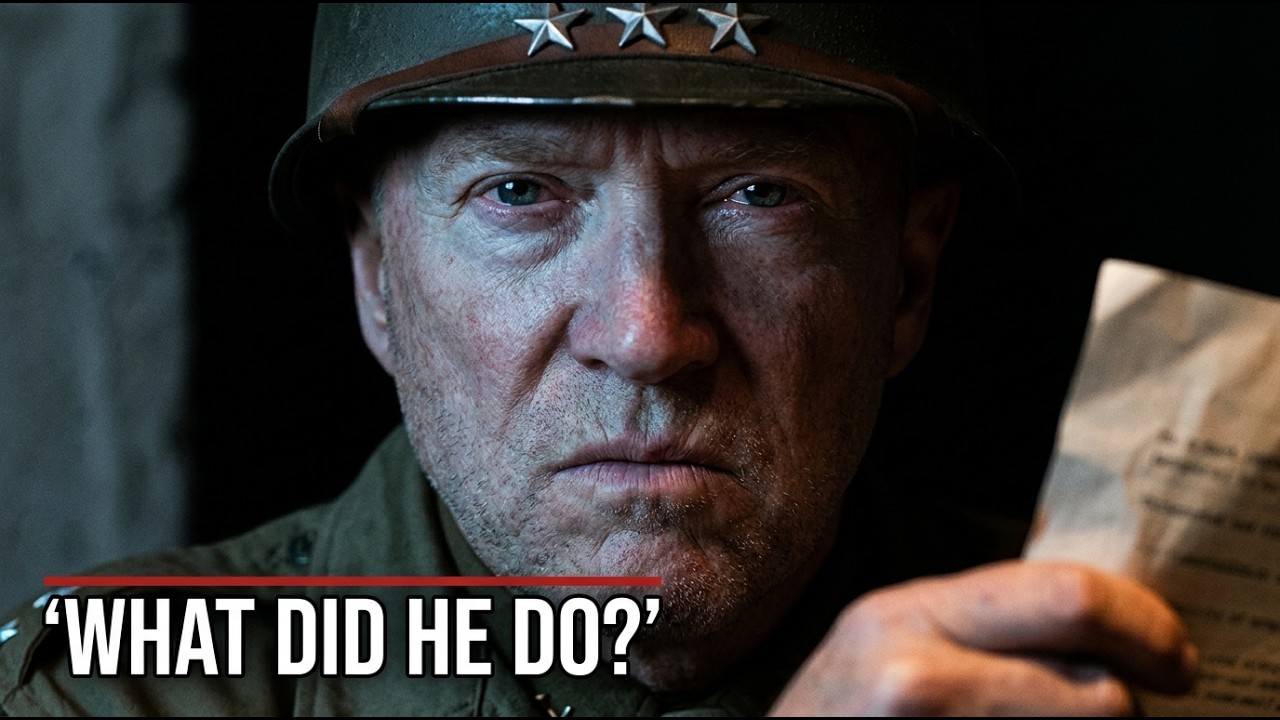 The accounts spoke of execution in open fields, of bodies discarded in roadside ditches, of systematic brutality that transcended the conventional rules of engagement. The most infamous incident, the Malmedy Massacre, had claimed the lives of 84 unarmed soldiers, but it was the accumulation of lesser-known atrocities, each with names and unit designations attached, that transformed Patton’s operational calculus.
The German offensive, launched on December 16th, had initially shattered Allied lines along a 100-mile front, catching American commanders completely off guard. Thousands of young, often inexperienced soldiers were captured in the first chaotic hours, many of them disarmed and marched eastward through the snow by Waffen SS units hardened on the Eastern Front. Among the most notorious of these formations was Kampfgruppe Peiper, led by the 30-year-old Obersturmführer Joachim Peiper, whose brutal tactics had been honed in a theater where prisoners were considered liabilities rather than responsibilities.
The massacre near Malmedy on December 17th was merely the most visible manifestation of a broader pattern of savagery that would come to define the German advance.
As the German offensive stalled and Allied forces began reclaiming lost territory, recovery teams and reconnaissance patrols encountered scenes that defied comprehension. Bodies of American soldiers, unarmed and clearly murdered after capture, were found scattered across the frozen landscape. The condition of many remains suggested treatment that went beyond simple execution, indicating deliberate, unhurried cruelty.
These findings, initially reported as isolated incidents, quickly coalesced into a damning pattern as they traveled up the chain of command. By the time they reached Patton’s desk, they were no longer scattered reports but a verified, cross-referenced dossier of war crimes.
Patton, a man whose legendary temper was as well-known as his tactical brilliance, read the accounts in silence. His diary entry from January 4th was uncharacteristically brief, noting only that he had read accounts of conduct he described as unworthy of soldiers. The restraint of his written words belied the volcanic fury that was building within him.
He understood that this was no longer a tactical problem to be solved with maneuvers and firepower, but a moral imperative that demanded a fundamental shift in how his army would conduct operations. The response he formulated would not be a single, dramatic proclamation, but a subtle, pervasive change in command philosophy that would ripple through every echelon of the Third Army
Patton summoned his senior commanders to a meeting that would alter the trajectory of the war in the West. His guidance was precise in its intent yet deliberately broad in its language, emphasizing maximum aggression, relentless forward momentum, and a prohibition on pausing to consolidate where speed could be maintained. Crucially, he directed that when engaging SS formations, the units most directly implicated in the atrocities, there was to be no hesitation whatsoever.
 He did not issue an unlawful order, he did not cross the line that would have made his men no better than the enemy, but he walked them right up to the edge of it, making it unmistakably clear that the old, cautious rules of engagement no longer applied. Every officer in that room understood the implicit permission being granted, and the weight of that understanding settled over them like a frost
The guidance filtered downward through the ranks with remarkable speed, transforming from a strategic directive into a visceral, personal mandate by the time it reached the men in the frozen foxholes. Division commanders translated it for their regimental officers, who in turn communicated it to platoon leaders. The message was stripped of military jargon and reduced to its raw essence.
The men were told, quietly and without theatrics, what had been done to their fellow soldiers. They were shown the documented facts, the names, the locations, the unit identifications. No exaggeration was needed, the truth was sufficient.
The silence that followed these briefings was more powerful than any shouted order could have been, and in that silence, a transformation occurred. The war ceased to be an abstract strategic exercise and became a deeply personal obligation, a debt owed to the fallen that could only be repaid in the currency of relentless, uncompromising advance
The effect on the Third Army’s operational tempo was immediate and measurable. Units that had spent weeks advancing in careful, coordinated steps began moving with a new, almost predatory urgency. Patrols pushed deeper into enemy territory without waiting for flanking support, accepting risks that would have been unthinkable weeks earlier.
Infantry closed distances with heavily fortified defensive positions faster than German fire plans could account for, often overrunning strong points before defenders could fully man their posts. Armored columns exploited gaps in the enemy line the moment they appeared, not after confirmation or consolidation, but immediately, turning tactical opportunities into operational breakthroughs within hours
Engagements that German planners had expected to last days were being decided in a matter of hours. A fortified crossroads, carefully prepared with interlocking fields of fire, fell before noon. A defensive line anchored on a ridgeline, dug in, wired, and presighted for artillery, was overrun by infantry that advanced through its own covering fire rather than waiting for it to lift.
 These were not reckless charges born of desperation, but calculated, aggressive maneuvers executed with professional precision. The tactics remained sound, the coordination remained flawless, but the tempo had fundamentally changed. Time, the most valuable resource in defensive warfare, was no longer being gifted to the enemy.
Every hour that German commanders expected to use for repositioning, reinforcing, or regrouping was being seized from them before they could spend it
Nothing in the American arsenal had changed. No new tanks had arrived, no new aircraft dominated the skies, no secret weapon had been deployed. What had changed was invisible and unmechanical, residing in the space between a soldier receiving an order and deciding how fast to carry it out.
A hesitation, the quiet killer of momentum, had been systematically removed from the American approach. Across the German defensive front, commanders began sending reports that shared a single, troubled observation. Something was fundamentally wrong with the Americans, something that defied conventional military analysis
Behind German lines, the reports accumulated into a pattern that staff officers found deeply unsettling. Individually, each report described a local problem, a position lost sooner than expected, a counterattack that arrived too late, a withdrawal forced before reserves could be committed. But taken together, the pattern was unmistakable.
The Americans had stopped behaving the way Americans behaved. German defensive doctrine was built on a foundational assumption that attackers would act rationally, probing carefully, pausing at strong points, and waiting for support before committing to costly assaults. In those pauses, defenders could reposition, reinforce, and reset the engagement on their own terms.
Those pauses were now gone. American forces were hitting prepared positions before defenders had finished occupying them, bypassing strong points entirely to leave them isolated and starving rather than spending hours reducing them. Armored thrusts were arriving at secondary defensive lines before word of the first breach had even reached the units holding them
 Every German calculation depended on time, and time was no longer available. Senior commanders demanded explanations from their intelligence officers, but the answers were unsatisfying. Nothing in the American order of battle had changed, no new divisions had arrived, no technological advantage had appeared.
The Americans were simply no longer behaving rationally, at least not by any rationality the German command structure could model. Reinforcements dispatched to stabilize one sector arrived to find the battle had already moved far beyond it, leaving them isolated and vulnerable. The front was becoming fluid in a way that German defensive planning had never anticipated, and the consequences were catastrophic
The momentum of Patton’s revitalized army reached its zenith when it slammed into the Siegfried Line, the formidable defensive network that German engineers had spent years constructing. Concrete bunkers, anti-tank barriers, minefields layered deep, and interlocking fields of fire had been designed to slow any assault to a crawl and bleed it dry in the process. The entire system was predicated on one assumption, that the enemy would be careful.
Patton’s army was no longer careful. The first breaches came faster than any German defensive timetable could account for. Armor pushed through gaps before engineers had finished clearing them, accepting the risk of mines and anti-tank fire with a grim determination.
Infantry followed without waiting for confirmation that the ground ahead was secure, trusting their own speed and aggression as their primary protection. Strong points that were supposed to hold for weeks became irrelevant in days, bypassed, isolated, and left to surrender once they realized no relief was coming
Between January and March 1945, Patton’s Third Army advanced across territory that should have taken months to contest, capturing tens of thousands of German soldiers and shattering entire defensive networks. The numbers told part of the story, but the momentum told the rest. The Siegfried Line, once considered an impassable barrier, had been reduced to a series of isolated, crumbling outposts.
The German high command, accustomed to the methodical, cautious approach of their Western adversaries, found itself facing an enemy that had abandoned predictability in favor of a terrifying, relentless aggression. The psychological impact on German troops was as profound as the physical losses, as morale crumbled in the face of an opponent that seemed driven by something beyond mere military objectives
In the end, Patton did not create the fire in his men, he revealed it. He showed them what had been done to their brothers in arms, and he trusted them with the truth, no matter how brutal. That truth became something no fortification could absorb, no doctrine could predict, and no strategy could counter.
Because in war, the most dangerous army is not the one with the most power, but the one that has a reason it refuses to let go. The Third Army had found its reason in the frozen, blood-soaked fields of the Ardennes, and it would carry that reason all the way to the heart of Germany, transforming the final months of the war in Europe into a relentless, unforgiving march toward vengeance and victory.