
The sun was beginning its slow descent over the Ohio countryside on October 22nd, 1934, casting long shadows across the cornfields when a desperate, hungry man emerged from the dense treeline. He was disheveled, his expensive suit torn by thistles and pine needles, his face etched with exhaustion and a day’s worth of stubble. This was not just any fugitive; this was Charles Arthur “Pretty Boy” Floyd, the most wanted man in America, a figure who had terrorized the Midwest for years and captured the public’s imagination as a modern-day Robin Hood.
His reign of terror, marked by daring bank heists, ruthless violence, anda body count that included numerous law enforcement officers, was about to end in a hail of bullets in a quiet cornfield, far from the banks he had robbed and the poor he had championed.
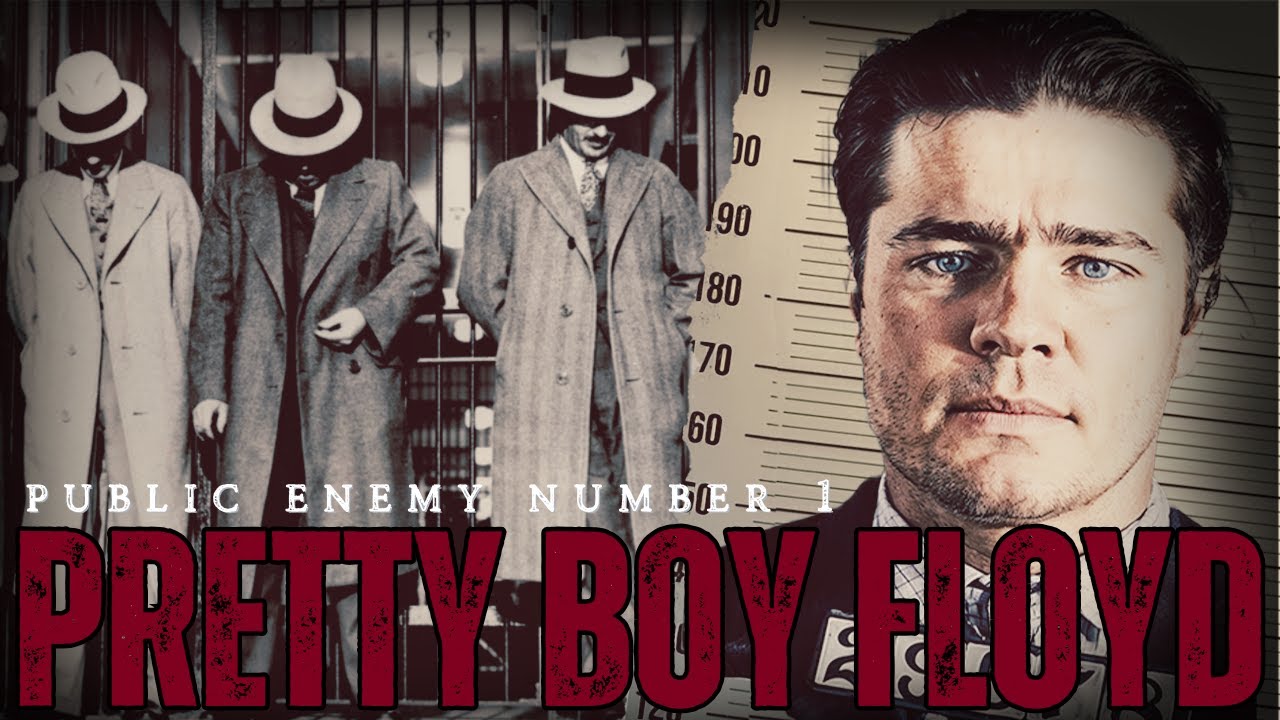 The man who knocked on the screen door of Mrs. Conkle’s modest gray farmhouse that afternoon was a shadow of the flamboyant outlaw whose exploits had made headlines across the nation. He was soaked to the bone from days of hiding in the woods, his body wracked with hunger and fatigue.
He asked the widow for something to eat, claiming he had been out squirrel hunting, a story she immediately suspected was a lie. She recognized him from the front pages of every newspaper in the country, but in those days, you didn’t turn a hungry man away from your door. She invited him in, offering him a meal of ribs, potatoes, rice, coffee, donuts, and pumpkin pie, a feast fit for a king in the midst of the Great Depression.
As Floyd ate ravenously, he complimented Mrs. Conkle’s cooking and insisted on paying her a dollar for the meal, a gesture of strange politeness from a man accused of so much bloodshed. He was desperate to get to Youngstown, a known haven for criminals, but he was lost, exhausted, and running out of time.
The FBI, led by the relentless Melvin Purvis, had thrown a net over the entire region, with roadblocks closing all exits and armed agents scouring the countryside. The noose was tightening, and Floyd knew it. He mentioned to Mrs.
Conkle that he needed a ride, and she told him her brother, Mr. Dye, owned a Model A Ford parked behind the corncrib. By 4 p.
m. , Floyd had convinced Dye to drive him to the next town, Clarkson, hoping to find a moment’s respite and a chance to plan his next move.
The pursuit of Pretty Boy Floyd had become an obsession for J. Edgar Hoover, the Director of the FBI, who had vowed that Floyd would be dead before Christmas. The Kansas City Massacre of June 1933, in which four law enforcement officers and a federal agent were gunned down in a brazen ambush, had provided Hoover with the perfect justification to expand his agency’s power and resources.
Although Floyd’s direct involvement in the massacre has been debated by historians for decades, with many believing it was actually the work of Mafia hitmen, Hoover seized upon the opportunity to brand Floyd as Public Enemy Number One, a symbol of the lawlessness that threatened the nation. The newly passed Fugitive Felon Act gave the FBI the authority to pursue criminals across state lines, and agents were now armed with the power to shoot to 𝓀𝒾𝓁𝓁. The hunt for Floyd was no longer just a manhunt; it was a crusade to legitimize the growing power of the federal government’s premier law enforcement agency.
Melvin Purvis, the man who had orchestrated the killing of John Dillinger just months earlier, was put in charge of bringing Floyd to justice. Purvis was a polished, polite former lawyer, a small man with a flare for the finer things in life, who had become a national hero for his relentless pursuit of criminals. He arrived in Wellsville, Ohio, on October 19th, after Floyd had narrowly escaped a gunfight with local police chief John Fultz, who had been wounded in the foot.
Floyd’s partner, Adam Richetti, had been captured, leaving Floyd alone, wounded, and on the run. Purvis set up his base of operations at the Travelers Hotel in East Liverpool and summoned agents from across the Midwest to assist in the hunt. Roadblocks were set up closing all exits from the area, while armed teams scoured Spencer Woods, the last known location where Floyd had vanished.
The rain fell relentless through Sunday night into Monday morning, but the search continued, fueled by Hoover’s determination and Purvis’s unwavering focus.
Floyd’s life of crime had begun decades earlier, in the cookson Hills of Oklahoma, where he was born in 1904 into a hardworking farming family. As a teenager, he had left home to work on harvest crews, where he fell in with the wrong kind of men who taught him how to fight, how to win without mercy, and how to play the game of life with little regard for the law. His first taste of crime came in 1922 when he broke into a post office, making off with a mere $33.
50 in dimes. He narrowly avoided punishment when key witnesses failed to show up in court, likely feeling sympathy for the young boy. He married Ruby Hargraves in 1924, but the pull of easy money was too strong.
In August 1925, he kissed his wife and infant son goodbye, promising to return soon, and headed for St. Louis with a small-time thief named John Hilderbrand. They embarked on a series of robberies, culminating in the armed heist of a Kroger grocery store payroll, netting $1,500.
The thrill of the crime was like nothing he had ever experienced, but his naivety soon caught up with him. He was arrested, tried, and sentenced to five years in the Missouri State Penitentiary, a grim, overcrowded facility known as the bloodiest 47 acres in America.
It was during his trial that he earned the nickname that would define his life. The payroll master described him to police as a mere boy, a pretty boy with apple cheeks, a description that journalists seized upon, forever linking him to the moniker “Pretty Boy” Floyd, a name he despised for its effeminate connotations but one that stuck, following him for the rest of his life. Prison failed to rehabilitate him; it only hardened his resolve.
He made a promise to himself that he would never serve time in prison again, and that he would never be taken alive, a promise he would keep until his dying day. Upon his release in March 1929, he did not head home to his wife and son. Instead, he made a direct path for Kansas City, a corrupt, lawless metropolis that was a haven for criminals of all stripes.
There, he learned the ropes of big-time crime, rubbing elbows with bank robbers, conmen, thieves, and smugglers, all either on the run or gearing up for their next big score. He was taken under the wing of a seasoned criminal named Red Lovett, who taught him how to stay in the shadows, listening for opportunity and speaking only when necessary, and to always be prepared to succeed.
Floyd’s transition from petty criminal to ruthless bank robber was swift and brutal. He joined the Jim Bradley gang in Ohio, participating in a series of bank heists that netted them thousands of dollars. But their luck ran out on March 8th, 1930, when two police officers spotted them in Akron.
A shootout ensued, resulting in the death of Officer Harland Mann, and Bradley’s eventual capture and execution. Floyd was captured and sentenced to 15 years in prison, but he managed to escape from a moving train en route to the Ohio State Penitentiary, a daring feat that only added to his growing legend. He returned to Kansas City, where he reconnected with his mistress, Wanita Ash, and a fellow gunman named William Miller.
Before they left town, they dealt with the Ash brothers, who had betrayed them to the police; the brothers were found dead in a ditch on the outskirts of the city. The partnership between Floyd and Miller was short-lived, however. In Bowling Green, Ohio, they were recognized by a salesperson while shopping, sparking a fierce shootout in the busy streets.
Miller was killed, Wanita was wounded, and Floyd managed to escape, but not before killing Officer Ralph Castner, who died a week later. Floyd swore he would never return to Ohio, a state that had only brought him bad luck.
By April 1931, Floyd was heading west towards the cookson Hills, hotter than ever, more determined than ever to make this his home base. The Great Depression had gripped the country, hitting rural America hard. Farmers lost their homes to merciless bankers, and small town economies crumbled, leaving entire communities bankrupt.
Floyd returned to Oklahoma with a new purpose. No longer did he rob banks out of restlessness or the thrill of it all; now he had a cause. He wasn’t just taking money for the sake of it; he was sending a message to the wealthy, the bankers, and the people who hoarded wealth while the poor suffered.
His message was clear: if the government wasn’t going to help the common man, then Pretty Boy Floyd would. It was in this new phase of life that Floyd’s legend truly began to grow, gaining traction in a way that felt inevitable. The sound of his Thompson submachine gun firing through the valleys of Oklahoma, Arkansas, and Missouri was more than just the sound of gunfire;it was the beat of a drum heralding his crusade.
By the end of 1931, he had pulled off enough bank robberies, disrupted enough crooked business deals, and handed out enough stolen cash to the poor to earn the adoration of the public.
During his many bank robberies of 1931, he often instructed the bank manager to show him not just where the cash was but also the mortgage papers, which he would also steal and destroy, freeing hundreds of Oklahoma residents from property debt. He earned the title of the Robin Hood of Oklahoma, with most seeing him as a hero for the downtrodden. Many Oklahomans thought the banks were on the wrong side of the law themselves, so of course they worshiped Floyd.
To the working-class farmer, Floyd couldn’t be more honest. To help carry out his mission, Floyd needed an assistant, someone who he could trust to help with the robberies and act as a lookout. He turned to George Birdwell, an old friend from his youth in the hills.
Between 1931 and 1932, Floyd and Birdwell would go on to rob more banks than any other criminals in Oklahoma’s history. Their targets read like a directory of local banks: Conowa Bank, the Bank of Shamrock, Morris State Bank, the State Bank of Castle, the Bank of Paden, DOA Bank in Oklahoma City, and many others in every direction. Nobody knows for sure quite how many banks Pretty Boy Floyd robbed in his lifetime;maybe 50, 60, perhaps even more.
They were all mostly country banks off the beaten track that didn’t have a lot of money in them, but that also meant that they didn’t have a lot of security, making them easy pickings.
Floyd’s methods were meticulous and efficient. Birdwell would first case the joint, sizing up the bank’s defenses, assessing the number of guards, determining the bank’s layout, figuring out where the safes were and how accessible they were. Once everything was in place, the two bandits would park the getaway car close, keeping the engine running.
Wearing their hats low over their eyes, they would enter the bank, guns drawn. Birdwell would direct his machine gun at the guards whilst Floyd would cover the employees, ensuring a smooth and efficient heist. Floyd had a distinctive way of carrying his Thompson submachine gun, preferring to carry it with the butt stock removed and a 20-round clip instead of the usual drum magazine.
This setup made the weapon more compact, allowing it to be concealed beneath an overcoat. In a shootout, Floyd could fire one-handed, leaving his other hand free to carry loot, seize hostages, or steer the getaway car. If an alarm had been triggered, Floyd and Birdwell would exit the bank calmly, still holding a hostage as a shield.
Once in the getaway car, they might even make the hostage climb in with them to deter pursuit before eventually dropping them off at the edge of town.
By early 1932, bank insurance premiums had doubled due to the escalating wave of Floyd’s robberies. The outraged bankers pressured Governor Bill Murray to deploy the National Guard in pursuit of the elusive criminal. His response was candid and resonated with a touch of humor:“National Guard?
As long as he stays down there where he’s at and is protected the way he is by those people, he will continue to rob banks, National Guard or not.” The governor’s words highlighted something crucial: Floyd’s reputation as a folk hero had spread far and wide, especially amongst the impoverished of Oklahoma. His actions, whether robbing from the banks or helping the less fortunate, painted him as a Robin Hood figure.
He brought money and groceries to families that weren’t going to have a Christmas, families who didn’t have anything at all. Floyd’s generosity knew no bounds;he was generous to kids and old people, and it was reported that at one point he was feeding over two dozen families. Stories of Floyd’s kindness were passed from person to person, growing into a legend that stretched across the country, making Pretty Boy Floyd a symbol of defiance against the wealthy and a hero to the common folk, stealing from the rich and giving to the poor.
Floyd’s popularity reached such heights that when he decided to rob the bank in his hometown of Sallisaw, he gave everyone the heads up. Family, friends, neighbors, and even casual passersby gathered around, some sitting on the sidewalk under the shade of the boardwalk, as if attending a public spectacle. The bank president thought Floyd was just playing a joke until Floyd’s car appeared outside, greeted by cheers from the crowd who were chanting,“Give him hell, Choc.”
With a smile, Floyd entered the bank and, addressing the surprised president, said,“Quit, no offense, but hell, I’m sure you wouldn’t mind making a little contribution to the community.” Despite his local fame and the public’s amusement, law enforcement wasn’t entertained by Floyd’s antics. In response to his increasingly bold robberies, the Oklahoma Bankers Association convened a meeting and a reward of $5,000 was offered for Floyd’s capture, dead or alive.
The Oklahoma Bureau of Criminal Investigation led the charge, sending county sheriffs after Floyd, but their efforts were in vain. They chased him from town to town, fully prepared for a shootout, but failed to catch him. The growing absurdity of the manhunt became a source of local amusement, with the authorities appearing more like bumbling fools than effective law enforcement.
In late 1931, Floyd decided it was time to reconnect with his family. He discovered that Ruby had remarried, but when he showed up on her doorstep, the spark between them reignited instantly. Ruby, still in love with him, left an apologetic note for a new husband and, without hesitation, took little Dempsey and left with Pretty Boy.
The reunited Floyds made their way to Fort Smith, Arkansas, where they rented a modest home under the alias of Mr. and Mrs. Jack Hamilton.
Birdwell, not far behind with his wife and four children, adopted his own pseudonym and settled in a nearby house. For the first time in years, Floyd felt a fleeting sense of normality. Between September 1931 and February 1932, Dempsey went to school, and Floyd and Birdwell occasionally robbed banks in more remote areas when their funds ran low.
To the neighbors, Floyd was simply a traveling salesman from Kansas City, which explained his frequent disappearances. It was a period of happiness for The Floyds, one that Dempsey would later reflect on fondly. In an episode of Biography aired in 1995, he shared,“It was the best six months of my life that I can remember being with him.
He did a lot of funny things. He teased my mother and he cooked for us. He made spaghetti and meatballs, and he enjoyed cooking and doing things with us.
Took me fishing and did everything that fathers usually do, wrestle around with me, and at night he’d always take me to bed. He put me on his shoulders and take me in and throw me in bed, you know, like having fun with me. My mother and father, when I saw them together, they were just great.
 They were in love, you could tell they were.”
The idyllic family life was shattered in February 1932, when the authorities received a tip from a neighbor and surrounded the Douglas residence in Tulsa. Floyd, Ruby, Birdwell, and little Dempsey escaped just moments earlier, with Ruby and Dempsey heading on foot for the bus station while Floyd and Birdwell took the motor and headed for the safety of the cookson Hills. Ruby and Dempsey were apprehended that afternoon, but with no concrete evidence, the police released her.
All efforts to capture the elusive fugitive had come to nothing, so Oklahoma officials turned to a recently retired sheriff with a formidable reputation: Irv Kelley, known for his relentless pursuit of criminals. Kelley had brought more bank robbers to justice than any other sheriff in Oklahoma’s history. He agreed to the challenge, setting up surveillance on the home where Ruby and Dempsey Floyd were living, confident that Pretty Boy would eventually return there.
On April 3rd, 1932, it seemed that Kelley’s hunch would finally pay off. Ruby and Dempsey left their home early that morning, and the lawmen followed them to Bixby, where they crossed the road to a brown two-story house that belonged to Ruby’s father. Kelley and his team watched as the elderly Hargraves greeted his daughter and grandson, inviting them into the house.
It seemed likely that Floyd would show up soon, so Kelley called for reinforcements. That night, the posse assembled in town before heading out in the dark towards the Hargraves Farm. The plan was carefully orchestrated, with four machine gunners placed at the side of the road leading to the gate and Kelley acting as a roadblock.
Around 2 a. m. , the team began to suspect that Floyd would not show up that night.
With the air growing chill, the team asked Kelley if they could head into town for some coffee, and Kelley, ever the patient hunter, told them,“You boys go ahead, never mind me. I’ll stay here just a bit more, just in case.”
As luck would have it, fate intervened. No sooner had the others left for town that Kelley heard the faint sound of an approaching car. He saw the outline of a dark vehicle creeping down the road, its hood shaped like a turtle shell.
The car slowed at the gate, its tires crunching on the gravel. Kelley crouched behind a fence post, his machine gun ready. Two men emerged, neither spoke a word.
From the way they moved, Kelley could tell that they were as cautious and as alert as he was. The time to act was now. “Throw up your hands, Floyd,” Kelley commanded, stepping from his cover into the tense night.
But he was not ready for the speed of Floyd’s reflexes. By the time Kelley had finished his sentence, Floyd had already begun firing. The crack of his automatic echoed into the night, and before Kelley could react, the outlaw had emptied his .
45 into the sheriff, hitting him seven times. The force of the gunfire sent Kelley to the ground, but Floyd, in his panic, didn’t immediately realize that he’d also been hit. He had taken shots in both legs, but his focus was on survival.
Birdwell, uninjured, scrambled back into the car, the engine roared to life, and Floyd, using the last of his strength, reached for the open passenger door. He collapsed inside, barely able to communicate his instructions. “Go,” he signaled to Birdwell.
The tires spun as the car shot forward, spraying dirt in all directions. By the time the rest of the team had arrived, Sheriff Kelley was already dead, and Floyd and Birdwell had disappeared into the darkness.
The killing of Sheriff Kelley marked a dark chapter in Floyd’s criminal career, one that would haunt him until the day he died. Although in his mind the encounter was a case of 𝓀𝒾𝓁𝓁 or be killed, the event weighed heavily on him. He talked about it when he gave a few interviews to newspaper reporters.
He was disgusted with himself because Kelley left behind three children. The murder of Sheriff Kelley marked the first, and in fact the only murder on Floyd’s record that he ever openly discussed, because it haunted him. After his recovery, Floyd retreated to the safety of the hills, briefly staying at his brother’s home.
Wanita Ash re-entered the picture, having recovered from the wounds she sustained in Bowling Green, and she became Floyd’s constant companion once again. Ruby, ever the devoted wife, was not pleased by the reappearance of Wanita, but when she heard that he had been injured, she put aside her anger and rushed to his side, staying with him for a few weeks. After Ruby left, it was Wanita’s turn to hide out.
The situation had started to wear on George Birdwell, who grew increasingly frustrated with Floyd. He remarked that Floyd might be better off focusing on business rather than chasing women, sparking an argument that ended their long-standing partnership. Birdwell had become disillusioned with the growing myth of Pretty Boy Floyd, as he had been cast as little more than a sidekick to the more charismatic and famous Floyd.
Floyd learned that George Birdwell was killed during a holdup, shot by a citizen while trying to rob the Farmers and Merchants Bank. Floyd expressed regret at the loss, acknowledging that despite their differences, he had hoped that they could have reconciled. Birdwell’s departure left a void, and Floyd soon set out to find a replacement.
He found a new partner in Adam Richetti, a 23-year-old machine gun expert and seasoned bandit. They immediately got to work hitting several banks in Oklahoma, employing the same method of operation as before. As their criminal careers continued, the duo expanded their operations, with Floyd taking to frequenting Missouri, a state he hadn’t hit as much in the past.
It was during this time that Floyd had a deeply introspective moment. On Mother’s Day in 1933, Floyd met with his mother, attended church with her, and afterwards the two stopped to pay a visit to his father at his grave. He told his mother that his time was running out, and he expected to be buried next to his parents.
This conversation marked a pivotal moment in Floyd’s life, as it was an admission that he felt cornered and signified a shift in his mindset, perhaps for the first time, a realization that his own criminal lifestyle was leading him towards an inevitable violent end. The mention of his own death was significant, as it reflected Floyd’s guilt over the death of Sheriff Kelley, an incident he could never fully shake off. After killing Kelley, the image of the Sheriff’s children left behind weighed heavily on Floyd.
He often wondered how his own son would cope with his eventual death, and this reflection seemed to deepen his sense of guilt.
Despite the weight of these thoughts, Floyd was far from giving up on his criminal lifestyle. He and Richetti continued their spree, robbing banks in multiple states. Their escape from Boonville, Missouri, on June 8th, 1933, represented one of the many close calls that the duo would endure, and this particular incident had a comical twist to it.
The two outlaws had decided to switch vehicles, a tactic they regularly employed to avoid detection. They came across a four-car garage owned by Excelsior High School in Cromwell, Oklahoma. Inside, they spotted a new Pontiac and figured it would make a good replacement for their current vehicle.
However, whilst they were preparing to steal the car, a teacher locked the garage door from the outside. The duo, realizing they had been trapped, feared the police might have been alerted. With no time to waste, they decided to break out of the garage by smashing the Pontiac through the heavy door, leaving a dent in the car’s fender.
With the law likely on their tail, Floyd and Richetti quickly headed for Bolivar, Missouri, to lay low for a bit and fix the car. Richetti’s brother Joe worked as a mechanic at a garage in the center of town, and Floyd figured this would be the perfect place to repair the Pontiac. However, trouble quickly brewed when Pope County Sheriff Jack Killingsworth and his deputy pulled into the gas station where the duo had stopped.
Richetti, who had been drinking, panicked at the sight of the officers and loudly muttered,“Damn, the law.” This alerted the two lawmen to the criminals’ presence. Floyd quickly drew his pistol before Killingsworth could react, taking the sheriff hostage.
The deputy managed to flee the scene, running off to summon help. They sped off through the back roads, avoiding major highways where they could be spotted. The police, now aware of the situation, launched a massive search party of over 300 police officers, including city and county policemen and the highway patrol, joining the chase for the duo.
As dusk settled, The Outlaws managed to flag down an unsuspecting innocent motorist on the outskirts of Deepwater. They eventually stole his car while keeping the sheriff captive, and they drove into Kansas City hoping to find a place to lay low. Once they were within the city, Floyd and Richetti stopped at the corner of Ninth Street and Hickory.
There, they released Sheriff Killingsworth, with Floyd warning him not to alert the authorities too quickly. “Now don’t go rushing into the phone, copper. Give us time to get away,” Floyd said as he and Richetti disappeared into the night.
When Killingsworth eventually returned to his post, he gave reporters an unusual description of Floyd. Whilst he acknowledged Floyd’s criminal career, he said Floyd seemed“as clean a fellow as I ever run into outside his record.” He further noted that Floyd had treated him with respect during the entire ordeal, which was something that surprised the sheriff.
In fact, Floyd had confided into Killingsworth during their brief captivity, expressing a rare moment of vulnerability. Floyd spoke about the constant pressure he felt living a life on the run, haunted day and night. He shared his fears, noting,“Sooner or later, I’ll go down full of lead.
That’s how it will end. How would you like to be hunted day and night? How would you like to sleep with this thing,” pointing to his Thompson submachine gun,“across your knees?”
Then Floyd fell silent. After a moment, he turned to the sheriff with a look that suggested a sense of regret, and he added,“I have a son, and I’d like to see him before I die.” This vulnerability was a stark contrast to the image he projected as a ruthless bandit, adding layers to his character and motivations.
The Kansas City Massacre of June 1933 marked a pivotal moment in Pretty Boy Floyd’s life and ultimately sealed his fate. This violent and tragic event would haunt him until his own death, although Floyd’s name would be forever linked to the massacre, it appears that he had no direct involvement in it. Nevertheless, the massacre intensified the nationwide manhunt for Floyd, setting the stage for his eventual downfall.
The events leading up to the massacre began on the morning of June the 17th, when Frank“Jelly” Nash, a notorious criminal, was being escorted by four police officers from the Union Railway Station in Kansas City to a car. Nash had escaped from the Kansas State Penitentiary in 1930, and after helping seven other inmates escape, he had been on the run for nearly 3 years. The day before, Nash was finally recaptured in Hot Springs, Arkansas, and authorities were determined to transport him safely to jail.
The group of officers, including FBI agents R. J. Caffrey and Reed Vetterli, as well as Kansas City police officers W.
J. Grooms, Frank Hermanson, and Chief of Police Otto Reed, were tasked with escorting Nash. As they hurried him outside their Chevrolet sedan, the doors of the car were unlocked,and Nash was placed in the front seat.
Just as the officers were taking their places in the vehicle, they were ambushed. Suddenly, three gunmen emerged from the parked car behind the sedan. A barrage of gunfire rang out, and Officers Grooms and Hermanson were killed instantly.
Agent Vetterli was wounded but managed to seek cover, Agent Caffrey was fatally shot in the head, and Police Chief Otto Reed was killed. Nash, seated in the front seat, was also riddled with bullets and pronounced dead at the scene. Remarkably, Agent Reed Vetterli survived despite taking three gunshot wounds.
The gunmen fled the scene, and the shooting spree left the city stunned. Remarkably, no innocent bystanders were slain, but the attack did leave four law enforcement officials and Frank Nash dead.
The country reacted with outrage. The killing of law enforcement officers and a federal agent, coupled with the brazen nature of the attack, shocked the nation. The memory of the 1929 St.
Valentine’s Day Massacre in Chicago resurfaced, as the public feared that gang violence and lawlessness were spreading unchecked across the country. Attorney General Homer Cummings spoke for the government, condemningThe killers and calling for a full investigation. He declared that the murder of a Department of Justice agent was a direct challenge to the government.
J. Edgar Hoover, the head of the FBI, quickly turned his attention to Floyd, Richetti, and a former World War I hero turned criminal named Verne Miller. Miller had ties to the Kansas City underworld and worked as a hitman for mob boss John Lazia, and Hoover believed he had been involved in the massacre.
 The next day, Hoover’s words rang out across the nation as he made a public statement over the radio:“No time, money, or labor will be spared towards bringing about the individuals responsible for this cowardly, despicable act. They must be eliminated, and to this end, we are dedicating ourselves.” Hoover’s dedication to bringing the killers to justice marked the beginning of a relentless pursuit of Floyd and his associates.
Though it’s thought that Floyd had no direct role in the massacre, the FBI’s swift targeting of him and his associates would become a defining feature of the government’s crackdown on gangsters during the Prohibition era. The massacre became a death warrant for Floyd, with law enforcement across the country determined to hunt him down at all costs. Floyd’s life was now under constant threat, as the nation’s most powerful law enforcement agencies vowed to end his reign of terror.
The question of Pretty Boy Floyd’s involvement in the Kansas City Massacre is one that has been clouded with doubt and suspicion from the outset. Most scholars and historians all agree that Pretty Boy Floyd was actually not involved in the massacre at all. The event simply does not line up with his criminal style, and most believe that actually the perpetrators were Mafia hired gunmen sent on a mission to free Frank Nash from custody.
There is also a prevailing theory that the Kansas City Massacre was not an attempt to free Frank Nash but an attempt to silence him, as he had helped orchestrate many high-profile criminals escape from Leavenworth State Penitentiary. It is believed those in the underworld feared his knowledge of their operations. The mission to extract Nash from police custody may have just gone horribly wrong, with either the FBI agents or the criminals involved being too quick to pull the trigger.
It’s believed that the FBI’s allegations against Floyd were not backed up by any evidence. The style of the attack simply did not match Floyd’s typical modus operandi, and it’s believed that the real culprits, those who had botched the job, were later killed by the mob for their failure. The car used by the shooters was found burned with an unidentified body inside, and Verne Miller was found dead in November of the same year.
Despite the lack of evidence linking Floyd to the massacre, the FBI under J. Edgar Hoover quickly turned to him as the prime suspect. Hoover’s interest in the case went beyond solving the crime;it was an opportunity for him to further consolidate his power, as Hoover sought greater influence within the federal government, particularly during a period of political change with the Roosevelt administration.
The Kansas City Massacre provided a perfect opportunity to bolster the reputation of the FBI. Hoover found it easier to blame Floyd, a public figure with a significant reputation, rather than go after the powerful political figures and gangsters who ran the Kansas City underworld. By branding Floyd as Public Enemy Number One, Hoover stood to gain substantial media attention and resources for the FBI, which ultimately helped to strengthen his control over the bureau.
Floyd’s notoriety provided Hoover with the perfect scapegoat, one that he could exploit to further his own career ambitions.
Three separate witnesses who were shown fugitive cards after the Kansas City Massacre each dismissed Pretty Boy Floyd’s photograph, instead identifying other notorious criminals involved in the event: Verne Miller, Wilbur Underhill, and Harvey Bailey were all recognized as the actual perpetrators. Floyd maintained his innocence to his dying day, insisting that he had no part in the massacre. He swore on his father’s grave that he was not involved in the killing of the officers.
To further cement his claim, he sent a postcard to the Kansas City Police directly denying any involvement. The postcard read:“Dear Sir, I, Charles Floyd, once it made known that I did not participate in the massacre of officers at Kansas City. Charles Floyd.”
This gesture, a straightforward declaration of his innocence, could have had a great impact on the situation had it been given the attention it deserved. However, the media were far more focused on The sensational headlines that Pretty Boy Floyd and the criminal persona that Floyd had built over the years, as that ultimately sold more newspapers. Floyd’s son, Dempsey, later spoke on his father’s behalf in an interview, reiterating that his father was not the type to take a paid contract to 𝓀𝒾𝓁𝓁 a lawman.
“My father wasn’t a hired killer. He robbed banks. He got all the money he needed from robbing banks.
Why would he take a fee for killing some policemen that were trying to transfer another criminal? You know, I don’t think he ever had anything to do with Nash. I never heard Nash’s name mentioned in my life, except with the Kansas City Massacre.”
This statement from Dempsey encapsulated the family’s belief in Floyd’s innocence with regard to the massacre. Despite the media’s portrayal of Floyd as a violent criminal, those who knew him, especially his family, stood firm in their belief that he was not responsible for the bloodshed in Kansas City.
In a desperate bid to escape the growing heat in the Midwest, Floyd, along with Richetti and the Bader sisters, made their way East. They were hoping to find a refuge, a place to hide from the law. It’s believed that they initially found a brief, albeit expensive, sanctuary in Cleveland, where they took shelter with the gang run by the Flaim and buoyant Jewish gangster Moe Davis.
However, their stay in Cleveland was short-lived, as plainclothes officers began frequenting Davis’s nightclubs, asking questions about Floyd’s whereabouts. The bandits realized that the law was closing in on them. Davis’s crew had been under surveillance, and soon enough, the heat in Ohio became too much.
Floyd had already faced trouble in the state twice before, and it was clear three strikes, and it was time to move on. In an attempt to avoid any further entanglements with the underworld, he chose to relocate to a city with little criminal activity:Buffalo, New York. There, he hoped he could blend in and live quietly under an alias.
On September the 16th, Floyd and His companion Wanita, along with Richetti and Juanita’s sister Rose, who had taken a liking to Adam, moved into the Amante Building at 450 Rhode Island Street in Buffalo, overlooking 18th Avenue. They rented the whole second floor, which was large and furnished with five rooms and a bathroom, all for a relatively cheap rent of $45 per month. The couples kept to themselves, remaining under the radar.
They rarely ventured out, keeping their activities minimal. Their time spent at home consisted mostly of playing cards quietly, with no heated arguments. They kept a low profile in every way, subscribing to local newspapers and a few popular magazines.
Floyd and Adam Richetti read True Detective while the women enjoyed Photo Play and Women’s Home Companion. Their mail was sparse, no bills, no letters, just the occasional magazine. They didn’t even own a telephone.
Most of their meals were ordered in, and their lifestyle was one of isolation, seeking anonymity in a city that seemed far removed from their past lives.
The quiet of Buffalo, New York, however, was not to last. Meanwhile, in the halls of Washington, the Bureau of Investigation was growing stronger and more powerful. J.
Edgar Hoover, emboldened by the national outrage following the Kansas City Massacre, was using the tragedy to push for sweeping changes that would enhance the FBI’s ability to track down the country’s most notorious criminals. Hoover had convinced Congress to Grant him the authority to pursue criminals across state lines and carry out arrests without the legal limitations that had previously bound his agents. The newly passed Fugitive Felon Act made escaping across state lines a federal crime, giving the FBI the power to act on any fugitive trying to flee the jurisdiction of local authorities.
The agents were armed and would shoot to 𝓀𝒾𝓁𝓁 if necessary. Federal agents now had full protection and authority, and the agency was backed by the promise of up to $225,000 in rewards for information leading to the capture of criminals. These changes were not just administrative;they were a clear signal that the FBI was now a force to be reckoned with, and its targets would find themselves under constant scrutiny.
For men like Floyd, the new laws posed a direct threat. The agency now had the power to pursue criminals wherever they went, and Hoover’s public denouncements of the nation’s most wanted criminals ensured that every criminal knew they were on the bureau’s radar. Among the names on Hoover’s infamous Public Enemies list were Floyd, along with notorious figures like John Dillinger, George“Machine Gun” Kelly, Baby Face Nelson, and Bonnie and Clyde.
These criminals were seen as Public Enemies, and Hoover had made it clear that they were to be hunted down at all costs.
After 8 months of isolation in May 1934, Floyd, restless and driven by a sense of impending doom, returned to Oklahoma with his partner Adam Richetti to visit their families. The trip, however, was overshadowed by the chilling news that Bonnie and Clyde had been ambushed and killed in a hail of bullets by Texas Rangers. The graphic photographs of the aftermath, dozens of bullet holes in their car, their bodies sprawled lifeless, filled the newspapers.
The article also made it clear that John Dillinger and Pretty Boy Floyd were the next targets for the federal authorities. While such threats had been made before, this time, the gravity of the situation fell all too real. On May the 13th, Floyd met with his mother on a secluded spot along a dirt road.
The FBI had placed the entire Floyd family under constant surveillance, so this secret meeting was likely the last time that Floyd would ever see her. As he kissed her goodbye, he warned her that he might never return. He didn’t know it at the time, but this would be Floyd’s last meeting with his mother.
A few weeks later, Floyd, joined by Richetti, met John Dillinger and his gang in South Bend, Indiana, for a robbery at the Merchants National Bank. It was likely the last bank job the two infamous outlaws would commit together. On June the 30th, 1934, they entered the bank with guns drawn.
Dillinger shouted,“This is a holdup,” while Floyd opened fire with his Thompson submachine gun, shooting into the ceiling to instill fear into the customers. As Dillinger and Floyd moved behind the teller counter to fill their bags with cash, Fatso Negri, another member of Dillinger’s gang, herded the bank guards into a back room. Outside, Police Officer Wagner heard the gunfire and started towards the bank.
Homer Van Meter, Dillinger’s right-hand man stationed outside, shot the officer dead before turning his attention back to the robbery. As the robbery progressed, the men knew they had to hurry. The sound of the shots outside alerted them to the presence of a crowd, and the police were closing in.
Floyd and Dillinger grabbed a couple of hostages to use as human shields as they made their escape. In the chaos, one of the hostages was wounded, and Vanita was grazed by a bullet in the scuffle to get into the getaway car. With hostages still clinging to the car, the gang made a hasty exit from South Bend, never to return.
The robbers released their hostages outside of town and vanished, taking only $4,800 from The heist, around $100,000 today. For Floyd, it was one of his final acts of defiance against the law. Less than three weeks later, John Dillinger would be dead, shot by FBI agents in Chicago.
Floyd’s days were numbered. The law was closing in, and it was only a matter of time before they caught up with him. His life of crime, once filled with bravado and excitement, was now nearing its tragic end.
Floyd returned back to Buffalo and laid low for a while. By October 1934, Floyd had become the prime target for the FBI. With the death of John Dillinger, Floyd was now number one Public Enemy, the torchbearer of lawlessness in America.
The pressure was mounting, and on October the 11th, a grand jury in Kansas City indicted both Floyd and Adam Richetti for the murders of the policemen at the Kansas City Massacre. J. Edgar Hoover, determined to take down the remaining outlaws, vowed that Floyd would be dead before Christmas.
To accomplish this, Hoover put the legendary FBI agent Melvin Purvis in charge of bringing him down. Purvis, already celebrated for his role in John Dillinger’s death, was a household name, a polished, polite former lawyer who had become a national hero admired for his relentless pursuit of criminals. To Floyd, the prospect of being hunted by Purvis was a grim reality, and he knew he had to act fast to avoid capture.
Floyd’s plan was drastic but perhaps the only option: flee to Mexico. But first, he wanted to gather his family and friends in Oklahoma and offer them the chance to escape with him. On October the 18th, Floyd and his companions Richetti, Wanita, and Rose left their Buffalo hideout under the cover of night, heading for the cookson Hills in Oklahoma.
As they drove through the night, they made their way south through New York, passing along the edge of Lake Erie and into Ohio. But disaster struck in the early hours of October the 19th. A thick fog descended upon the road south of Youngstown, and Floyd, struggling to see through the haze, crashed the car into a telephone pole at a junction near Interstate 7 and the Pennsylvania railroad tracks.
Although no one was injured, the crash left the car with a dented fender and a damaged radiator. As the car steamed and spluttered, Wanita and Rose searched for a mechanic while Floyd and Richetti hid in the nearby woods. They weren’t willing to take any chances after nearly being caught at the garage in Bolivar.
After a while, Wanita and Rose returned with a tow truck driver, and Floyd gave them some money, instructing them to wait with the car and return once it was fixed. With nothing to do but wait, Floyd and Richetti stayed hidden in the woods, watching out for any sign of danger. They passed the hours in intense silence, constantly alert to any passing cars.
Just after 10 a. m. , two local men drove by and noticed the two men in suits lying by the side of the road.
Their suspicious behavior led them to report them to the local police, and within moments, local police chief John Fultz, along with two officers, approached the ridge where Floyd and Richetti were hiding. When they saw the officers approaching, Richetti bolted into the woods, and Floyd instinctively drew his gun. A gunfight ensued, with Floyd firing at the police chief, narrowly missing him.
The exchange of fire grew intense, but one of Floyd’s bullets hit the officer in the foot, causing him to stumble. Seizing the opportunity, Floyd rolled down the steep incline of the ridge and escaped into the surrounding forest, narrowly avoiding capture. Despite the close call, Floyd had managed to evade the law once again, but he knew it was only a matter of time before the net would tighten around him.
 With Melvin Purvis and the full weight of the FBI hunting him down, his options were dwindling, and his days of freedom were numbered. Floyd’s thoughts raced through his mind as he splintered through the dense Ohio woods. All he could think about was how he never had any luck in Ohio, and now, as he fled from the law, it felt as though the state was once again trying to trap him.
During the gun battle, Richetti had been captured by the Wellsville police after giving a false name and remaining tight-lipped. He was taken to the station for identification. Chief Fultz soon realized that the man they had in custody was none other than Pretty Boy Floyd’s right-hand man, Adam Richetti.
An all-points alert was sent out, and word of his capture quickly reached Melvin Purvis, who had been in Cincinnati on another case. Hoover immediately relieved Purvis of that assignment and sent him to Ohio to take charge of the manhunt. Purvis brought along his right-hand man, Herman Hollis, and arranged for additional agents to join the search.
By 4 p. m. , Purvis had arrived in Wellsville, where he met with Sheriff Ray Long of the Ohio State Patrol.
They set up their base of operations at the local Travelers Hotel in East Liverpool, and soon agents from across the Midwest, Pittsburgh, Cleveland, Detroit, and Chicago, began to arrive to assist in the hunt. Roadblocks were set up closing all exits from the area, while armed teams scoured Spencer Woods, the last known location where Floyd had vanished. Despite the rain, which fell relentlessly through Sunday night into Monday morning, the search continued.
Purvis feared that Pretty Boy might have slipped through the net and found refuge in Youngstown, a known haven for criminals. But then a promising lead came in: a man reported having seen another man resembling Pretty Boy Floyd near the Bell Schoolhouse, about 10 miles east of East Liverpool. The farmer described the man as a disheveled figure wearing a ring, an expensive suit that had been scratched by thistles and pine needles.
He had a day’s worth of stubble on his chin, and though the farmer hadn’t recognized him, the description matched Floyd’s wanted poster.
On Monday afternoon, October the 22nd, 1934, Floyd was exhausted, soaked to the bone, and hungry. He had spent the entire day moving through the woods, and the only food he had received since the previous day was from the farmer near the Bell Schoolhouse. As he peaked out from the dense cover of the forest, he saw a farmhouse sitting at the edge of a cornfield, with more woods on the other side.
The house looked harmless enough, and Floyd, desperate for a meal, decided to make a break for it. His pocket watch read 3 p. m.
He hadn’t had a decent meal in over 24 hours, and the thought of food urged him to risk it. His situation had become desperate. For days, he’d been surviving on apples, pears, and berries.
His stomach goring with hunger, his mind muddled by dizziness from exhaustion. He knew he needed to get to Youngstown, but the journey had been so confusing, he couldn’t tell east from west anymore. His mind, one thin from the constant evasion, had lost its bearings.
The FBI, local police, and even a low-flying scout plane, had been hunting him relentlessly in their pursuit. All he could think about now was finding a chair, a bite of food, and a cigarette, though he had no matches. As he cautiously emerged from the trees, he surveyed the road.
It appeared deserted except for two people working far off in the fields of a nearby farm. The road sign read Spruce Road. Desperately seeking some help, Floyd knocked on the screen door of the small gray house.
The woman who answered, a middle-aged widow named Mrs. Conkle, listened to his request. “Ma’am, I’m hungry and lost,” he told her.
“Could you please spare something for my stomach? A little bread and a little meat would do me just fine.” Floyd told her that he had been out squirrel hunting, which she suspected was a lie, as he was in a full suit.
People didn’t turn people away from the door in those days, and despite her suspicions, thinking that the same man plastered on the front page of the newspapers was now the man at her front door, she invited him in and offered to fix him a meal while Floyd washed up. Mrs. Conkle prepared him a hearty meal: ribs, potatoes, rice, coffee, donuts, and pumpkin pie.
After eating, he complimented her cooking, calling it a meal fit for a king, and insisted on paying her a dollar for the meal. Mrs. Conkle mentioned that her brother, Mr.
Dye, owned a Model A Ford parked behind the corncrib, and if Floyd needed a ride, he might be able to help.
By 4 p. m. , Floyd noticed Mrs.
Conkle’s brother returning from the fields. He introduced himself to Floyd as Mr. Dye, and after a little persuading, agreed to take Floyd to Clarkson, the next town up the road.
Dye’s wife was wary of the situation, but Mr. Dye was eager to get going before nightfall. Floyd climbed into the car, relieved to put an end to all the endless walking.
The sound of the engine momentarily made him feel safe. In his mind, he was going to Clarkson to rest and plan his next move. But as they neared the end of the road, Floyd saw trouble: two cars appeared, their occupants eyeing him suspiciously.
Floyd’s instinct screamed that the men in those cars were no strangers. Purvis and his agents were in the first car, and East Liverpool policemen were in the second. They had been stopping at every house on Spruce Road looking for Pretty Boy Floyd when they saw Floyd climbing into Dye’s Model A.
They recognized him instantly. “That’s our boy,” Purvis shouted. Doors flew open, and more than half a dozen agents and officers, armed with machine guns, shotguns, and revolvers, poured out of the cars.
Floyd, his heart pounding, bolted from the car and ran towards the open field, instinctively reaching for his . 45 automatic. The agents followed, their footsteps pounding behind him.
Floyd cut across the slope, but no matter how fast he ran, the woods seemed to move further away. His only thought was to escape into the woods, to keep running until the danger passed behind him. Behind him, Purvis and the others shouted for him to surrender.
Then, the unmistakable crack of a rifle echoed across the field. The shot, fired by Chester K. Smith, the sharpshooter, struck Floyd in the right arm.
The pain was intense, and it threw him to the ground, but he didn’t stop. He got back on his feet and kept running. The agents were closing in.
Purvis gave the command to open fire, and Floyd could hear the bullets flying through the air. The pain from the gunfire was unbearable, but Floyd kept moving. He was not going back to prison.
The wind whistled in his ears, and all he could hear was the pounding of his own heart and the rhythm of his feet against the grass. His body screamed for him to stop, but he couldn’t. The sound of the gunfire rang out again, and the pain threw him like a thousand red-hot needles.
Floyd collapsed to the ground, hit by three bullets. As he lay there, he recognized the figure standing over him: Melvin Purvis, the man who had captured Dillinger. Purvis looked exactly as he had in the newspapers, shaven face, high cheekbones, intense eyes.
“Were you at Kansas City?” Purvis asked, his voice steady. “No,” was all Floyd managed to say, tasting the blood on his lips.
As his vision blurred, the taste of blood faded, replaced by the comforting scent of cotton. He could hear the faint sounds of bird song from the trees above, and for a moment, he imagined himself on horseback riding towards the horizon. The weight of his fate seemed distant, as though he were riding towards an unknown destiny, far from the pain and the chaos of the present.
But the moment was fleeting, and as the twilight deepened, Floyd’s fate was sealed. He was no longer The fugitive on the run, but a man at the mercy of the law. Charles Arthur Floyd died there in that field, aged just 30 years old.
Floyd’s body was moved from the field to the Sturgis Funeral Home in East Liverpool, where it was displayed in a crushed velvet blanket. Floyd proved to be just as popular in death as he was in life. Over 20,000 people flocked to the funeral home to catch a glimpse of Public Enemy Number One.
After Pretty Boy Floyd’s death, his body was returned to Sallisaw, Oklahoma, the cookson Hills where he had grown up and where people still remembered him as their own. The funeral, attended by more than 40,000 people, was the largest funeral ever in Oklahoma’s history, and still is today. Every flower shop in a 20-mile radius of Sallisaw sold out of stock as the crowd flocked to Akins Cemetery to watch Floyd be laid to rest.
He had achieved that folk hero status he had craved since his youth. While figures like bankers and lawmen may have felt relief for his passing, the majority mourned the loss of Floyd, seeing him as a local hero and protector. Wanita and Rose Bader, who had learned of Floyd’s capture in Wellsville, Ohio, quickly made their way to Sallisaw after the car repairs were done.
They arrived in time to attend Floyd’s funeral, their grief reflective of many who had lost someone they considered one of their own. As for Richetti, the man involved in Floyd’s criminal activities, he never tasted freedom again. He was returned to Kansas City, where he was convicted for his role in the infamous massacre, and despite requesting a second trial, he was found guilty and executed in the gas chamber on October the 17th, 1938.
Ruby Floyd, Floyd’s widow, and their son Dempsey continued on after his death. Ruby even being paid by a movie company to promote the film“Crime Doesn’t Pay.” She traveled and received press coverage for a while, but her subsequent marriages were less successful.
She died in 1970. Dempsey, on the other hand, led a successful life. He graduated high school, served in World War II, and later became a businessman and father.
He died in 1999, and kept his father’s memory alive during his life, which was helped particularly through John Steinbeck’s“The Grapes of Wrath” and the song“The Ballad of Pretty Boy Floyd” by Woody Guthrie. Despite his notorious life of a gangster, Pretty Boy Floyd was not only remembered for his crimes. He left behind a loyal and adoring public who saw past the violence and chaos.
He was known for his family and close friends also knew the warm side of Floyd that the world often overlooked. On the first anniversary of his death, Adam Richetti and the Bader sisters paid tribute to him with a heartfelt poem published in the Kansas City Star:“We never knew what pain he had, we did not see him die. We only knew he passed away and did not say goodbye.
We are thinking of you, Daddy dear, thinking of the past. You left behind some broken hearts that loved you to the last. That never did, nor never will, forget you, Daddy dear, and while you rest in peaceful sleep, your memory we shall always keep.”
The poem captured the depth of affection and loss that those who truly knew Pretty Boy Floyd felt when he was killed. Far from the media perspective of this famous gangster, for them, he was a man of warmth, a protector, and a father who left a legacy that would never be forgotten. But for many, he was a ruthless killer and bank robber.
His legacy is one that will forever dance on the line between hero and villain.