



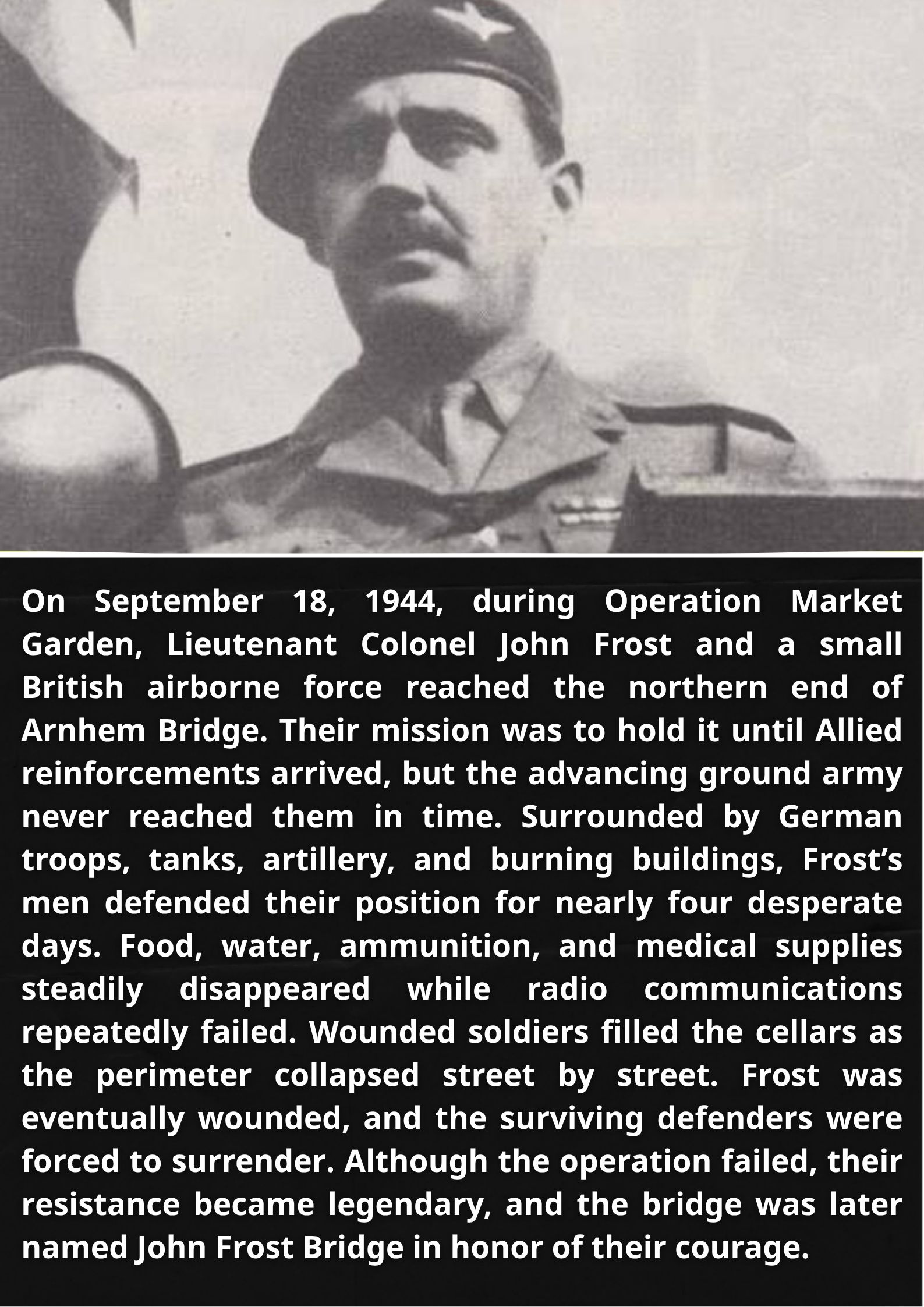
On September 18, 1944, British paratroopers moved through the streets of Arnhem carrying one of the most important missions of Operation Market Garden. Their goal was to seize the great road bridge across the Lower Rhine and hold it until Allied ground forces arrived from the south. If the plan succeeded, the Allies hoped to cross the major rivers of the Netherlands, bypass Germany’s strongest defensive positions, and open a direct route toward the industrial heart of the Third Reich.
Among the British officers leading the advance was Lieutenant Colonel John Dutton Frost, commander of the 2nd Battalion, Parachute Regiment. Frost was an experienced airborne officer who understood both the ambition and danger of the operation. His men had landed west of Arnhem as part of the British 1st Airborne Division. From there, they were expected to move rapidly into the city and capture the bridge before German forces could organize a defense.
The plan looked simple on paper. Airborne troops would seize a series of bridges, while the British XXX Corps advanced along a narrow highway to relieve them. But almost immediately, problems appeared. The landing zones were several miles from Arnhem Bridge, communications were unreliable, and German resistance was much stronger than Allied planners had expected.
Many British units were delayed or blocked before reaching the city. Frost’s battalion, however, managed to push through. By the evening of September 17, part of his force had reached the northern end of Arnhem Bridge. They occupied houses, offices, and buildings overlooking the roadway, creating a defensive perimeter around the bridge approach.
Frost had reached the objective, but only a fraction of the expected British force was with him.
The soldiers knew they could not hold the position indefinitely. Their task was to defend the bridge until XXX Corps arrived. According to the operational timetable, relief should have come quickly. Yet the ground advance from the south became trapped by traffic, destroyed bridges, narrow roads, and determined German counterattacks.
At Arnhem, Frost and his men waited.
The Germans soon understood that British paratroopers had captured the northern approach. Armored vehicles attempted to cross the bridge, but British defenders opened fire. In one dramatic encounter, a German reconnaissance column charged across the bridge and was struck by rifles, machine guns, anti-tank weapons, and explosives. Several vehicles were destroyed, and the attack was broken.
But the defenders had revealed their position, and much heavier forces began closing around them.
German troops surrounded the buildings occupied by the British. Tanks and self-propelled guns moved into the streets. Artillery shells smashed walls, shattered windows, and set entire houses on fire. Snipers targeted anyone who moved between buildings. German infantry attacked repeatedly, attempting to divide the perimeter and eliminate the isolated groups of paratroopers.
The British soldiers turned ordinary houses into fortresses. They fired from upper windows, staircases, basements, and holes blasted through walls. When one position became impossible to defend, they slipped through gardens or broken buildings to another. Every room and street corner became part of the battlefield.
The situation grew worse with each passing hour. Ammunition began running low. Food and clean water became scarce. Medical supplies were quickly consumed as wounded men crowded into makeshift aid stations. Doctors and medics worked in dark rooms while shells exploded nearby. Some buildings caught fire, forcing injured soldiers to be moved under enemy fire.
Radio communication, already unreliable from the beginning, became increasingly difficult. Frost’s men struggled to contact the rest of the division and could not clearly determine when help might arrive. They could hear fighting elsewhere in Arnhem, but the main British force was unable to break through to the bridge.
Still, Frost’s soldiers continued to resist.
For nearly four days, the small force held the northern end of Arnhem Bridge against a much larger German concentration. Their position gradually shrank as one building after another was destroyed or captured. German commanders demanded surrender, but the British defenders repeatedly refused while they still possessed the means to fight.
The battle became one of endurance rather than maneuver. The paratroopers no longer fought to expand their position. They fought simply to survive another hour and delay the enemy for as long as possible.
Frost himself remained among his men, directing the defense while conditions collapsed around them. Eventually, he was seriously wounded by shellfire. He was taken to a medical position, where the number of casualties had become overwhelming.
By then, many of the defenders had almost no ammunition left. Their anti-tank weapons had been exhausted or destroyed, leaving them nearly helpless against German armor. Fires were spreading through the buildings, and wounded soldiers could not be evacuated. The promised relief force was still far away.
The survivors faced a terrible decision. Continuing the battle would mean the deaths of wounded men and defenders who could no longer resist effectively. Small groups attempted to escape through German lines, but many were captured. Others remained with the wounded and surrendered when further resistance became impossible.
Operation Market Garden continued elsewhere, but the attempt to secure a permanent bridgehead across the Lower Rhine failed. Arnhem became known as “a bridge too far,” a phrase later made famous through books and film. The operation had aimed to end the war more quickly, yet its planning depended on speed, reliable communications, and lightly defended objectives. At Arnhem, all three assumptions collapsed.
Frost survived his wounds and became a prisoner of war. After the war, his leadership and the courage of his battalion were widely honored. The defenders had not achieved their strategic objective, but their resistance became one of the most remembered episodes in British airborne history.
In 1978, the rebuilt bridge at Arnhem was officially named the John Frost Bridge. It remains a physical memorial not only to Frost but also to the soldiers who fought beside him, including those who were killed, wounded, or captured during the battle.
Their story is often remembered because it reveals the human cost hidden beneath military plans. On maps, Operation Market Garden appeared as a sequence of arrows, bridges, and timetables. At Arnhem, those plans became burning houses, wounded men, empty ammunition pouches, and soldiers waiting for reinforcements that never arrived.
John Frost and his men held their position until exhaustion, casualties, and overwhelming enemy power made resistance impossible. They could not change the final outcome of the operation, but their discipline and determination ensured that the defense of Arnhem Bridge would never be forgotten.