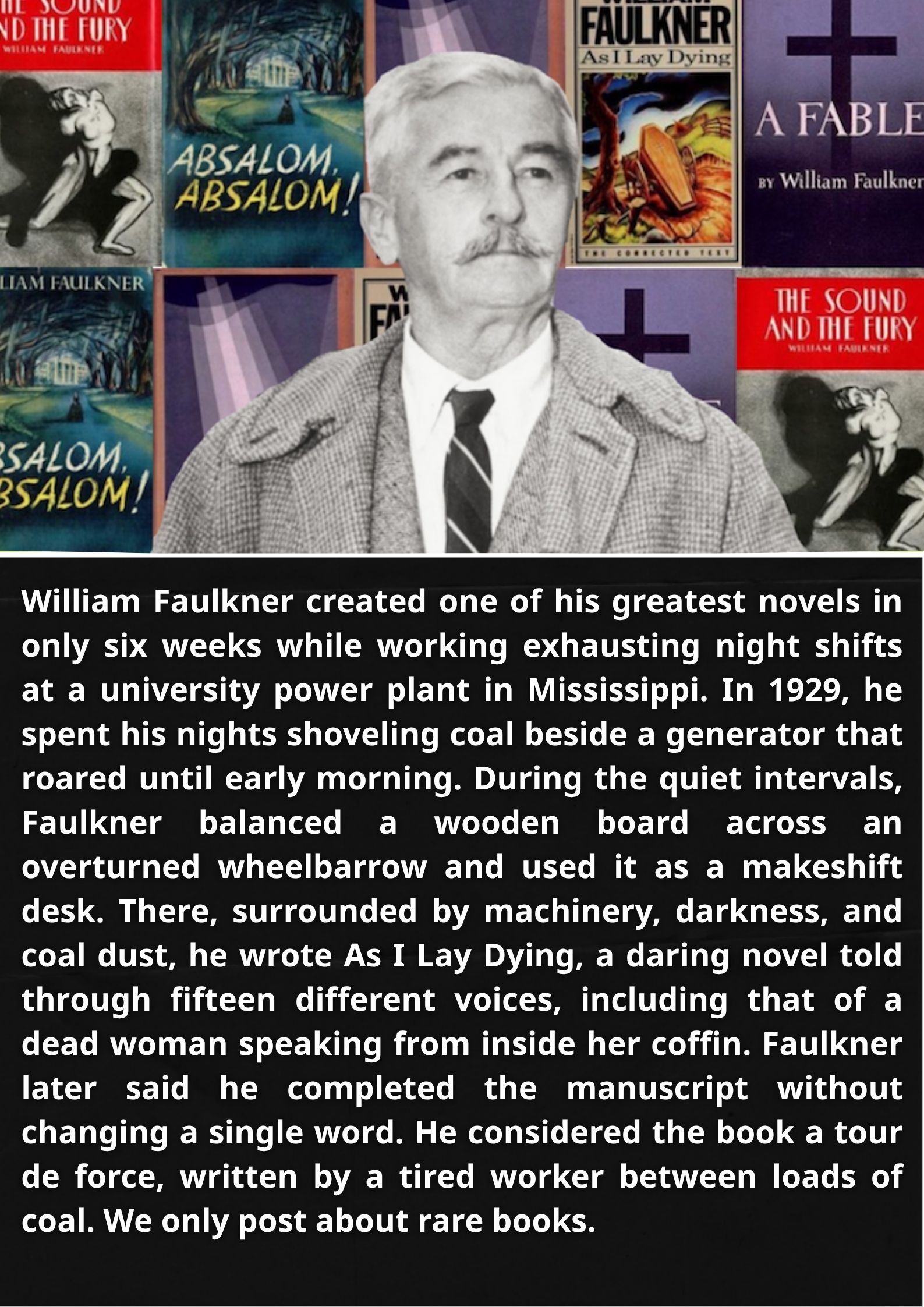
Some literary masterpieces are created in peaceful studies, surrounded by shelves of books, comfortable chairs, and long hours of uninterrupted thought. William Faulkner’s As I Lay Dying was born in a very different place. It emerged at night inside a university power plant, beneath the constant hum of machinery, while its author worked a demanding job shoveling coal.
In 1929, Faulkner was living in Oxford, Mississippi, and working the night shift at the University of Mississippi power plant. The job was not glamorous. His duties involved feeding coal into the machinery and watching over a generator that supplied electricity to the campus. The work required physical effort, patience, and long hours in an environment filled with heat, dust, and mechanical noise.
Faulkner’s shift stretched deep into the night, often lasting until four in the morning. At the beginning of each shift, the plant could be busy and noisy. Coal had to be moved, machinery had to be monitored, and the generator demanded constant attention. But there were also quiet intervals when the equipment was running steadily and little needed to be done.
Most workers might have used those pauses to rest. Faulkner used them to write.
There was no proper desk waiting for him inside the power plant. Instead, he improvised. He reportedly found an overturned wheelbarrow, placed a wooden board across it, and transformed it into a crude writing surface. With the generator humming nearby and coal dust settling around him, he began creating what would become one of the most important American novels of the twentieth century.
The book was As I Lay Dying.
Its story follows the Bundren family as they attempt to honor the dying wish of Addie Bundren, a wife and mother who asks to be buried in her hometown of Jefferson. After her death, her husband and children place her body in a homemade coffin and begin a difficult journey across rural Mississippi.
What appears at first to be a simple funeral journey quickly becomes a story of hardship, selfishness, loyalty, grief, resentment, and hidden motives. The family faces floods, injuries, fire, poverty, and emotional conflict. As the journey continues, each character reveals a different understanding of Addie’s death and of the family itself.
The structure of the novel was highly unusual. Faulkner told the story through fifteen different narrators. Each voice offers a separate version of events, and no single narrator provides the complete truth. The reader must piece the story together from conflicting thoughts, memories, fears, and private desires.
Some voices are practical and direct. Others are confused, poetic, bitter, or deeply emotional. One narrator is a young child who struggles to understand death. Another is a son slowly losing his grip on reality. Most famously, Addie Bundren speaks in one section even though she is already dead, allowing the woman inside the coffin to describe her own life, marriage, and feelings toward her children.
This choice gave the novel an unforgettable psychological power. The dead woman at the center of the journey is not merely a silent body being transported by her family. She becomes one of the story’s most revealing voices, challenging the assumptions of those around her and exposing the complicated truth behind her final request.
Writing such a novel would have been difficult under ideal circumstances. Faulkner attempted it while physically tired and working through the night. Yet he later described the process as unusually controlled and intense. According to his own recollections, he completed the manuscript in approximately six weeks.
He also claimed that he knew the story so clearly that he did not need to revise it significantly. He sometimes said that he wrote the entire novel without changing a word. Whether taken literally or as part of Faulkner’s own legend, the statement reflects the confidence he felt about the book. He believed the story had come together exactly as he intended.
Faulkner called As I Lay Dying a “tour de force.” The phrase suggests an achievement produced through exceptional skill, control, and creative energy. He seemed proud not only of the final novel but also of the extraordinary circumstances under which it had been written.
The image of Faulkner composing the book on a wheelbarrow has become one of the most memorable stories in literary history. It represents the contrast between the physical world around him and the imaginative world growing in his mind. Outside the manuscript, there was coal, machinery, exhaustion, and darkness. Inside it, there was a grieving family, a dead mother, a dangerous journey, and fifteen voices competing to tell the truth.
The power plant also seems strangely appropriate for the novel. As I Lay Dying is filled with labor, discomfort, heat, dirt, suffering, and ordinary people trying to endure impossible circumstances. Faulkner was writing about exhausted rural families while he himself worked through exhausting nights. The rough conditions may have helped shape the book’s urgency and directness.
When the novel was published in 1930, it did not immediately bring Faulkner widespread popular success. His writing was often considered difficult because of its shifting viewpoints, experimental structure, and intense psychological detail. Over time, however, As I Lay Dying came to be recognized as one of his major achievements.
The novel remains widely studied because it transformed a simple journey into a complex examination of human nature. Each family member believes that he or she understands what is happening, yet every perspective is incomplete. The result is a story in which truth changes depending on who is speaking.
Faulkner’s unusual working conditions have become part of the book’s legacy. Readers are often astonished that such a formally ambitious novel could have been written so quickly, in such an uncomfortable place, by a man balancing creative work with physical labor.
The story also challenges the romantic idea that writers need perfect circumstances before they can begin. Faulkner did not wait for silence, comfort, or financial security. He used the time and materials available to him. An overturned wheelbarrow became his desk. The pauses between coal deliveries became his writing hours. The noise of a generator became the background to one of literature’s most haunting journeys.
Years later, the power plant job would be remembered mainly because of what Faulkner created during those long night shifts. The coal was burned, the machinery was replaced, and the ordinary working nights disappeared into history. But the words written on that makeshift desk survived.
What began as a manuscript created by a tired worker in the darkness became a masterpiece read around the world.