Deep in the dry and unforgiving landscape of China’s Xinjiang region lies one of the most fascinating archaeological mysteries ever uncovered. Beneath the sands of the Tarim Basin, archaeologists discovered hundreds of remarkably preserved human remains that appeared to have been frozen in time for thousands of years.
Known as the Tarim mummies, these ancient bodies have challenged traditional ideas about early human movement, cultural exchange, and the development of civilizations across Asia. Their unusual appearance, advanced preservation, and mysterious origins have made them one of the most debated discoveries in modern archaeology.
The Tarim Basin is a vast desert region surrounded by some of the highest mountains in the world. Today, much of the area is extremely dry, with the famous Taklamakan Desert covering large portions of the landscape. However, thousands of years ago, this region was not simply an empty desert. It was crossed by rivers, supported communities, and later became an important area along ancient trade routes connected to the Silk Road.
The first Tarim mummies were discovered in the late 20th century during archaeological excavations in Xinjiang. Researchers were surprised by how well preserved the bodies were. Some had intact hair, skin, clothing, and facial features despite being buried for more than 4,000 years.
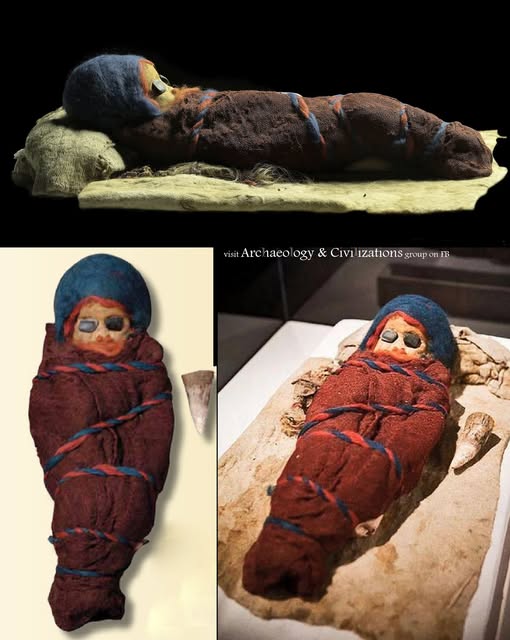
Among the most striking discoveries was the mummy of an infant, preserved with remarkable detail. Like many other Tarim remains, the child was found wearing clothing made from materials such as wool and woven fibers, revealing unexpected skills in textile production. The condition of the remains allowed scientists to study not only the physical appearance of these ancient people but also aspects of their daily lives.
One of the features that immediately attracted attention was that many Tarim mummies displayed characteristics often associated with populations from western Eurasia, including lighter hair colors, different facial structures, and clothing styles unlike those traditionally expected in ancient East Asia.
This discovery created a major historical question: Who were these people?
For decades, researchers debated their origins. Some suggested that the Tarim population may have migrated from regions far to the west, possibly connected to ancient Indo-European-speaking groups. Others argued that they developed locally through complex interactions between different populations living across Central Asia.
The mystery became even deeper because the mummies were extremely ancient. Some of the remains date from approximately 1800 BC, while newer research has identified groups dating as early as around 2100–1700 BC. This means these people lived thousands of years before many famous historical civilizations reached their peak.
The preservation of the Tarim mummies is another remarkable aspect of the discovery. Unlike Egyptian mummies, which were intentionally preserved through elaborate religious rituals, the Tarim bodies appear to have been naturally preserved by the harsh desert environment.
The extremely dry climate, salty soil, and limited moisture prevented rapid decomposition. In some cases, the bodies retained astonishing details: eyelashes, facial hair, woven clothing, and even the shape of their original hairstyles.
Their clothing provides some of the most valuable clues. Researchers discovered garments made with advanced weaving techniques, including wool fabrics and other materials. Some clothing styles showed similarities with ancient traditions from distant regions, suggesting that these communities were connected to wider networks of exchange.
The discovery of felt hats, woven textiles, and leather items also revealed that these people possessed sophisticated craftsmanship. They were not isolated desert inhabitants but part of a complex society adapted to life in a challenging environment.
Another important clue came from scientific analysis. DNA studies have attempted to determine the ancestry of the Tarim population. Some research suggests that they were genetically distinct, while other studies indicate that they had connections with ancient populations from both eastern and western Eurasia.
Rather than proving a simple story of migration from one place to another, the evidence suggests a much more complicated history. Ancient Central Asia was a crossroads where different groups interacted, exchanged ideas, and influenced each other long before the official Silk Road existed.
The Tarim mummies challenge the idea that ancient civilizations developed separatel y without contact. Thousands of years ago, people were already traveling across enormous distances, carrying technologies, traditions, and genetic connections with them.
The presence of European-like features in ancient Chinese territory also created public fascination and speculation. Some exaggerated claims suggested the discovery completely rewrote human history or proved impossible theories about ancient civilizations. However, archaeologists emphasize that the evidence points toward normal human movement and cultural exchange rather than mysterious explanations.
The real story is already extraordinary.
The Tarim people lived in one of the harshest environments on Earth. They created clothing, built communities, raised families, and developed traditions that allowed them to survive. Their remains provide a rare opportunity to see ordinary human lives from thousands of years ago.
The infant mummy is especially powerful because it reminds researchers that these discoveries are not only about ancient populations or scientific debates. Behind every mummy was a real person—a child, parent, worker, or traveler who once lived, experienced the world, and belonged to a community.
The desert preserved their physical remains, but archaeology continues the process of preserving their memory.
Today, the Tarim mummies remain among the most important archaeological discoveries in Asia. They continue to inspire new research using advanced DNA analysis, chemical testing, and modern imaging technology. Each new study adds another piece to the puzzle of who these people were and how they fit into the larger story of human history.
More than 4,000 years after they were buried, the silent figures of the Tarim Basin still raise questions that scientists are working to answer.
Who were they? Where did they come from? How did they survive in the ancient desert?
The sands of Xinjiang have preserved their bodies—but their story is still being uncovered.