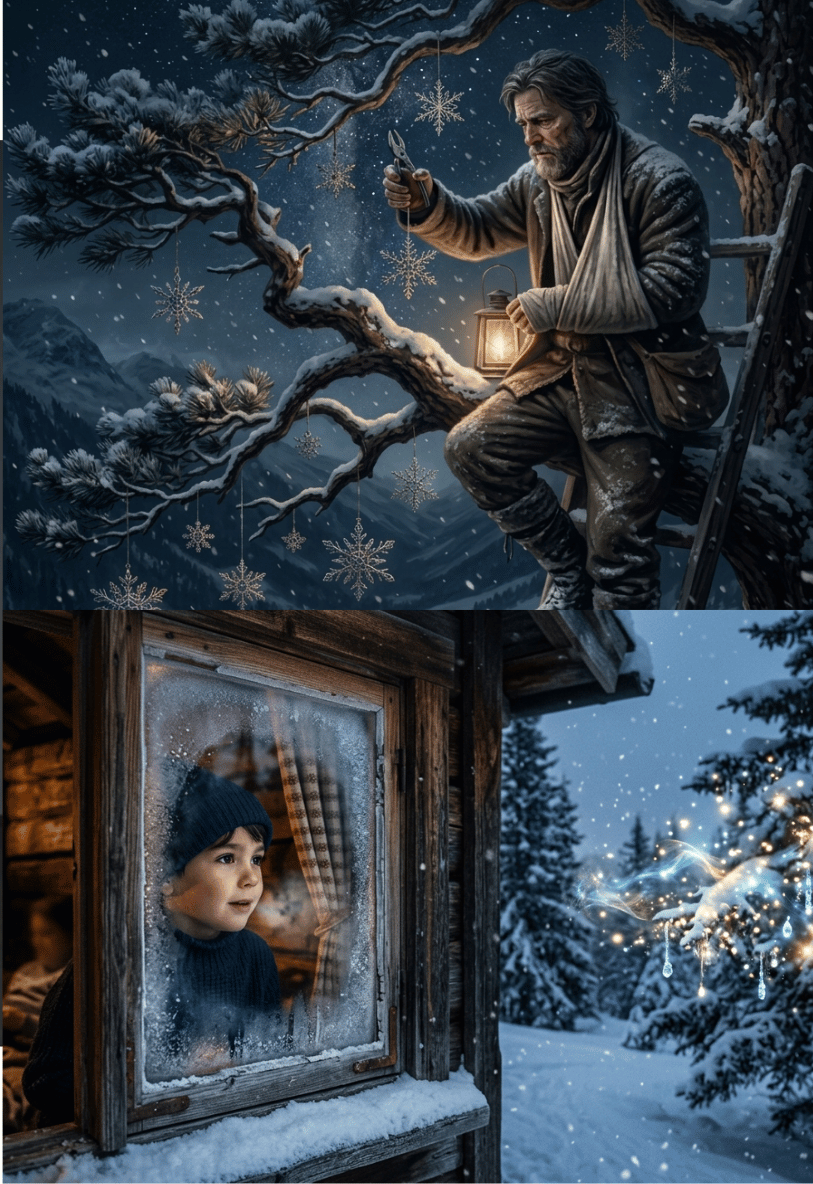
High in the unforgiving highlands of Switzerland, where winter reigned for nine months a year and the wind screamed like vengeful spirits, stood a solitary forge hidden deep within the ancient pines. Its master was Klaus, a giant of a man with a body as broken as his soul. His left arm hung useless at his side, paralyzed from an old injury, and one of his ears was completely deaf. The villagers in the valley called him “The Cursed Blacksmith” and “The Devil of the Mountain.” They said he carried darkness in his heart and blood on his hands. No one dared approach his crumbling wooden hut.
In the village below lived Leo, a fragile eight-year-old boy whose eyes held the emptiness of someone far older. Four years earlier, a catastrophic avalanche — triggered by a mysterious explosion — had buried his parents alive. Since that day, Leo had not spoken a single word. The trauma had stolen his voice. He lived in a painful, self-imposed silence, finding his only solace in collecting smooth stones from the frozen stream and arranging them into intricate, lonely patterns that no one else understood.
One bitter afternoon, while wandering too far from the village, Leo stumbled upon Klaus’s forge. What he saw captivated him completely.
Instead of forging swords or axes, the old blacksmith was hammering thin sheets of steel with astonishing delicacy, creating snowflakes so fine they looked like frozen lace. The rhythmic clang… clang… clang of the hammer on the anvil echoed through the forest like a heartbeat. Leo stood transfixed in the snow, his small hands clenched at his sides.
From that day forward, the silent boy returned every evening. He never spoke, and Klaus never asked questions. The two damaged souls sat together in the glow of the forge — one old and tormented, one young and mute — connected only by the ancient song of metal and fire.
Then came the Storm of the Century.
For nine days and nights, the blizzard raged with apocalyptic fury. Trees snapped like matchsticks. The entire village was buried under mountains of snow. Roads vanished. Food supplies ran out. Children cried from hunger, and adults began to lose hope. In the midst of this nightmare, Leo fell deathly ill. His small body burned with fever while his spirit withered from grief and starvation. He lay motionless in his bed, eyes glassy, no longer reaching for his beloved stones.
The village doctor whispered the words everyone feared: “He may not survive the night.”
From his lonely forge on the mountain, Klaus watched the village dying below. With his one good arm trembling, he made the most painful decision of his life.
That night, as the storm reached its peak, Klaus burned every last piece of coal he had saved for winter. He melted down the only silver he had accumulated over decades — the last remnant of his former life. Working with nothing but his right arm and sheer willpower, he forged thousands upon thousands of silver snowflakes. Each one was more intricate than the last.
Exhausted, bleeding from cracked hands, and half-frozen, Klaus dragged his crippled body through the howling blizzard. One by one, he hung the silver snowflakes on the bare branches surrounding Leo’s house and along the main path of the village.
At dawn, the storm finally quieted.
When the villagers opened their doors, they were struck speechless.
The entire world around them had transformed into a shimmering, magical wonderland. Hundreds of thousands of silver snowflakes hung from every tree and rooftop, sparkling like diamonds. When the wind blew gently, they spun and chimed together, creating the most hauntingly beautiful melody the village had ever heard — a song of healing, redemption, and hope.
Leo, wrapped in thin blankets, crawled weakly to his frost-covered window. His hollow eyes suddenly widened. A single tear rolled down his pale cheek.
“Beautiful…” he whispered, his voice hoarse and cracking from years of silence. “So… beautiful.”
His voice had returned.
The villagers, weeping with joy and disbelief, rushed up the treacherous mountain path to thank the man they had once feared and shunned. But when they burst into the forge, their hearts shattered.
Klaus sat peacefully in his old wooden chair beside the cold, dead forge. His hammer was still loosely gripped in his only working hand. A faint, serene smile rested on his weathered face. He had passed away during the night, alone, just as he had lived for so many years.
Beside him lay an old, leather-bound journal.
The final entry, written in shaky handwriting, revealed the devastating truth:
“My dear Leo, Fifteen years ago, I was a proud military engineer. In my arrogance, I tested a new explosive device in these mountains. The explosion triggered the avalanche that killed your parents. I have carried their deaths in my heart every single day since. I exiled myself here to atone in silence. Tonight, I return what I stole from you — not their lives, but your voice. May these silver snowflakes sing for you when I can no longer. Forgive me… if you can.”
The man the village had mocked and feared had spent fifteen years in self-imposed hell, waiting for one final chance to redeem himself. With a crippled arm and a deaf ear, he had created a miracle of silver and sound — all for the boy whose life he had unknowingly destroyed.
As the silver snowflakes continued to sing softly in the morning wind, the villagers stood in stunned silence, tears freezing on their faces.
In the end, the “Cursed Blacksmith” had not been a monster.
He had been a father, a penitent soul, and a guardian angel who gave everything — even his last breath — so that a broken little boy could find his voice again.