The Marks on the Wooden Door
Chapter 1: The Echo of the Anvil
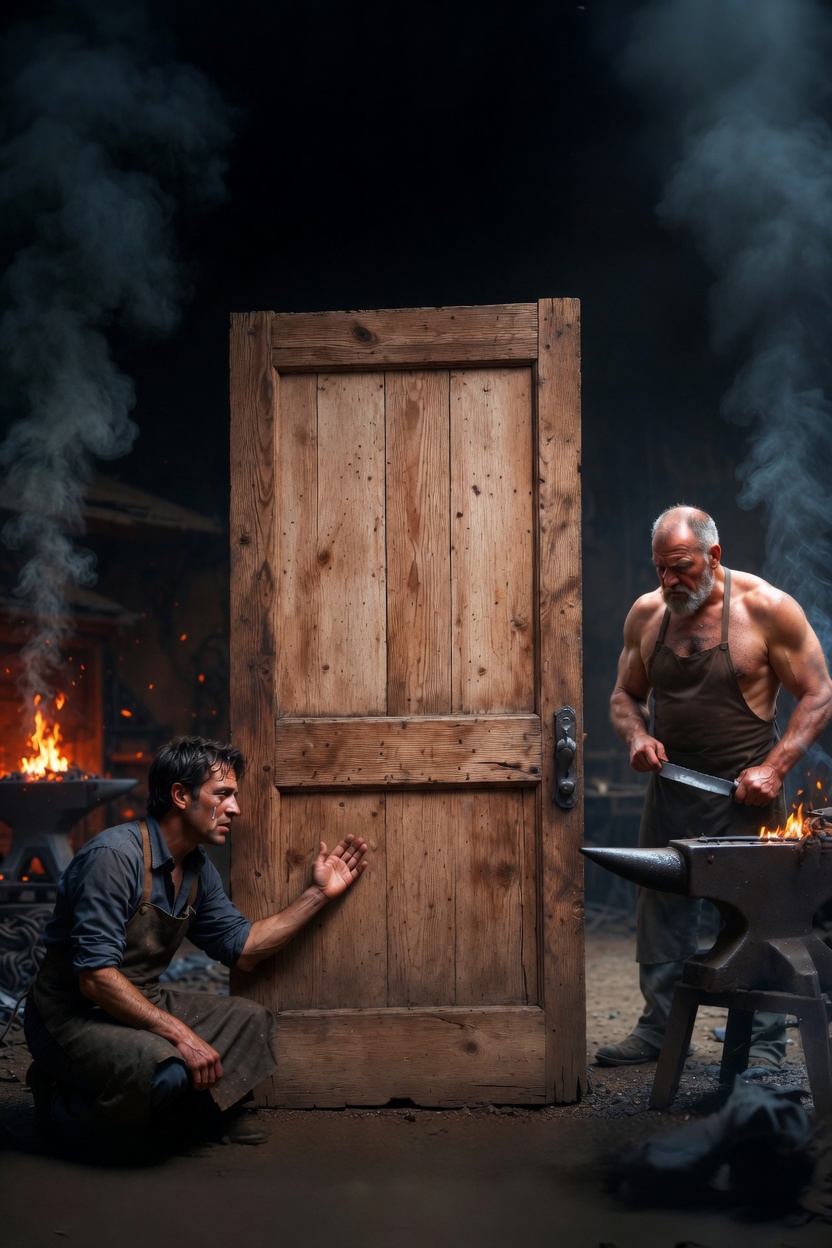
I grew up in a poor farming town in Iowa. Throughout my youth, I harbored a deep, burning resentment toward my father, who was a blacksmith. He was a man of few words, practicing a harsh brand of emotional neglect, always forcing me to inherit the family business. Every day after school, he made me stand for hours in the suffocating heat of the forge, hammering glowing red iron under blinding clouds of coal smoke. On the weathered wooden door leading into the workshop, my father used a dagger to score a deep line to measure my height each year. Every time he finished, he would just say coldly, “Still too weak. You aren’t big enough to carry this workshop yet.”
At eighteen, I managed to win a full scholarship to study Finance in Chicago. The day I dragged my suitcase to the bus station, he remained standing by the forge with his back turned to me. The sharp, rhythmic clack-clack of his hammer hitting the anvil was his brutal version of a goodbye. I promised myself I would never return to that godforsaken town. After fifteen years of grinding, I became a wealthy investment fund manager in Chicago, married into high society, and cut all ties with that harsh man from my past.
Chapter 2: The Hidden Truth
Last month, I received a handwritten letter from the town’s attorney. My father had passed away in a tragic forge accident. There was no secret box, no hidden fortune, and no formal will left behind. He only left the wooden house and the rusted blacksmith shop. I brought my wife, Clara, who knew nothing of my past, back to Iowa to quickly liquidate the entire estate.
That evening, while walking around the empty house, Clara stopped dead in her tracks in front of the old wooden door leading to the forge. She stared intensely at the old height markings, and suddenly burst into tears. She turned to me, her voice trembling, “Eric… have you ever actually looked closely at these marks?”
I walked over and turned on my phone’s flashlight. In the dark, as I looked closely at the dagger lines carved deep into the wood grain over the years, my heart stopped beating.
The distance between the height marks from the time I was fourteen to eighteen had not increased at all. They sat perfectly on a single, straight line. At fourteen, a severe illness had permanently stunted my physical growth. But to shield me from feeling insecure around my peers, and to ignite a fierce spirit of defiance inside me—to make me want to prove him wrong and find a way out of that poor town—my father had secretly carved each annual mark higher than the last. Next to the final marking from my eighteenth year, he had used the tip of his dagger to scratch a tiny message that I had completely missed all this time: “You are tall enough now to fly on your own wings.”
I collapsed in front of the wooden door, realizing that my father’s coldness was actually a brutal yet deeply protective launchpad, designed entirely to push me out of his impoverished life.
Chapter 3: The Unfinished Blade
The revelation shattered the carefully constructed armor I had worn for fifteen years. I couldn’t sleep. The cold, calculating corporate executive was gone, replaced by a grieving son who had completely misjudged the man who built him.
The next morning, instead of signing the papers to sell the property, I walked back into the cold, silent forge. Dust covered the heavy iron tools. Cobwebs clung to the bellows. But on the main anvil, right in the center of the room, sat a single, unfinished piece of steel. It was a hunting knife, perfectly forged but missing its final polish and wooden handle.
Next to the blade lay a dated logbook. I opened it, my hands shaking. My father’s rough handwriting filled the last page, dated just two days before his death:
“Eric’s birthday is coming up. Fifteen years. He won’t answer my calls, and I don’t blame him. I had to be the monster so he would chase the light. My hands are too stiff from the heat and arthritis to strike the metal accurately anymore, but I will finish this final blade for him. It’s the last thing I can give my boy.”
“Eric’s birthday is coming up. Fifteen years. He won’t answer my calls, and I don’t blame him. I had to be the monster so he would chase the light. My hands are too stiff from the heat and arthritis to strike the metal accurately anymore, but I will finish this final blade for him. It’s the last thing I can give my boy.”
The local attorney later revealed the true nature of my father’s “accident.” He hadn’t been careless. A massive fire had broken out in the neighboring barn, threatening the entire block. Despite his failing health and weak joints, my father had rushed into the flames to pull out the neighbor’s trapped horses. He saved them all, but his lungs couldn’t handle the thick, toxic smoke. He died three days later in the hospital, refusing to let the doctors call me because he didn’t want to disrupt my “important corporate meetings.”
He lived as a heavy iron wall, and he died like a hero, silent until the very end.
Chapter 4: The Final Spark
I cancelled the liquidation sale immediately. Clara supported me without a single question as I made the most irrational decision of my life: I took a permanent leave of absence from the investment firm in Chicago.
I didn’t know how to run a corporate fund anymore, but I remembered how to swing a hammer.
For the next three months, I lived in that hot, smoky forge. I fired up the old furnace. I let the black coal dust cover my expensive clothes. My hands, once soft from typing on keyboards, blistered and bled as I picked up my father’s heavy hammer. I struck the red iron over and over, letting my tears hit the hot metal, evaporating into steam. I was no longer running away. I was finishing his final lesson.
Yesterday, on my 33rd birthday, I finally completed the hunting knife my father left on the anvil. I carved the handle out of the very oak wood from that old door—the piece containing his hidden message.
We didn’t sell the forge. Instead, Clara and I converted the property into “The Arthur Forge Academy”—a free trade school for troubled, underprivileged teenagers in Iowa who felt trapped by their circumstances. We teach them discipline, resilience, and how to shape their own destiny out of raw, heavy iron.
During our opening ceremony yesterday, a rebellious, angry fifteen-year-old boy stood by the furnace, refusing to work, his eyes full of the same bitter resentment I once carried.
I walked over to him, handed him my father’s old hammer, and pointed to the glowing red steel on the anvil.
“The fire is hot, and the iron is heavy,” I told the boy, placing a firm hand on his shoulder. “Your father might not know how to tell you he loves you with words, but the steel never lies. Hit it. Prove to the world how strong you really are.”
The boy looked at the hammer, then at me. Slowly, he raised his arm and struck the metal. As the bright sparks flew into the dark room, I looked up at the ceiling, smiling through my tears. The anvil was echoing once again. My father’s voice was gone, but his fire would never go out.