The courtroom was stifling. Nazar sat beside her. Denys sat across the aisle in a dark green jacket—new. Lesya had never seen it on him before.
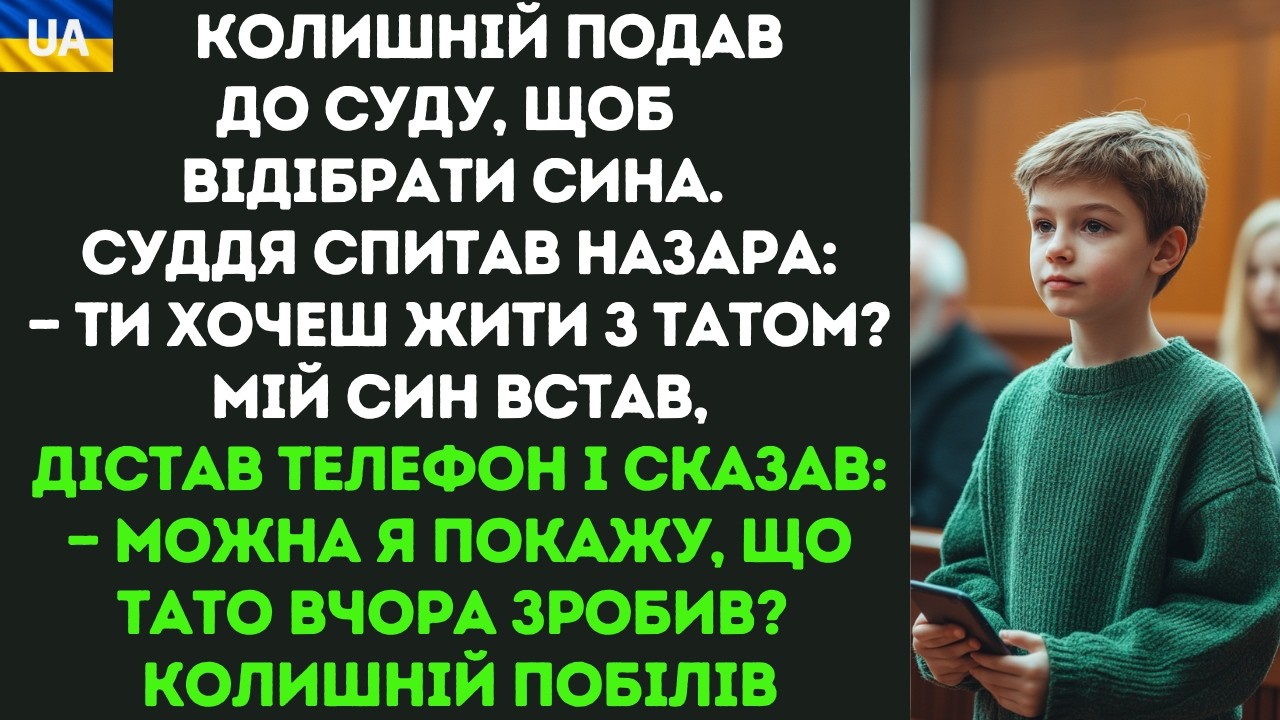
“Nazar,” the judge said, “you are thirteen. The court has the right to hear your opinion. Is there anything you want to say? ”
Lesya stopped breathing.
They had talked about this—that the judge might not give him the floor, that fourteen was different from thirteen, that it all depended on the person sitting behind the bench. Lesya didn’t know what to expect. Nazar reached into his jeans pocket and pulled out an old phone with a cracked screen. “Can I play a recording?
It has dad’s voice. I want you to hear it. ”
Denys snapped his head around. His lawyer set down his pen.
Lesya looked at her son, and she had no idea what was on that recording. Nazar had only said, “It’s safer this way, Mom. ”
The judge leaned forward slightly. “Give the phone to the secretary.
”
Eight months earlier, Denys had come to pick up Nazar for the weekend. Lesya was holding her phone, checking a transfer confirmation. Every month she sent money to a drone fund. Not much—what she could—but regularly.
Denys saw the screen and snorted. “From a bakery salary, Lesya? That’s laughable. ”
“I want to speed up Ukraine’s victory,” she said.
He looked at her with contempt. “You work with buns and you look like a bun. Hard to look at. And you think your pennies matter?
”
He laughed at his own joke. Nazar was standing in the hallway. He picked up his backpack and walked past his father, eyes on his phone. He had started an Instagram page.
No fake content. Lesya had looked once—screenshots of Russian news side by side with sources debunking them. Short captions, precise. “This is fake.
Here’s why. ” Not many followers, but active ones. “Why do you do this? ” she’d asked.
Someone has to, he’d said. That evening, after he went to bed, she saw his notebook open on the desk. In big letters: “Want to join the Armed Forces when I grow up. ” Below, smaller: “Don’t tell dad.
”
She closed the notebook and left it where it was. —
Lesya learned about the neighbor from Oksana. They were leaving the factory together. Oksana had worked in packaging for twelve years and knew everyone in the neighborhood.
“Listen,” Oksana said, grabbing Lesya’s elbow. “You know Valentyna Hryhorivna from the second floor? The one you helped carry groceries for? She’s been watching you.
”
Lesya stopped. “What do you mean? ”
“She’s been noting when you come and go. Says Denys asked her to.
Paid her something, I don’t know how much. She told Tamara from the fourth floor, and Tamara told me. ”
Lesya stood in the middle of the sidewalk. “How long?
”
“Tamara says since spring. Four months, maybe more. ”
Four months. Lesya leaving for her shift at four in the morning.
Her mother Halyna coming at three to sit with Nazar while he did homework, ate dinner, went to sleep. And Valentyna Hryhorivna—the woman Lesya carried groceries for, left pies for, the woman who said, “Thank you, Lesyunya, what a fine boy you have”—watching the door and noting the hours. At home, she dialed Denys. He picked up after three rings.
“Did you pay my neighbor to watch me? ”
“Lesya, it’s late. ”
“Did you pay her for four months while my mother sat with Nazar and he did his homework, so you could claim in court that my child is neglected? ”
“Lesya, listen—”
She moved to the window, hand on the sill.
“I wake up at four in the morning. I went a month without buying anything for myself to get Nazar new sneakers. My mother comes every single day to sit with my son while I’m at the factory. And you paid someone to count the hours?
”
He hung up. She called back. He didn’t answer. She sat in the kitchen until four in the morning.
At five, she went to her shift. That day, she oversalted the dough. The first time in six years. The shift supervisor looked at her and said nothing, just nodded toward the bucket.
—
A week later, the summons came. Lesya stood in the hallway holding the envelope. Nazar was still at school. She opened it, read it, put it on the table, went to the bathroom.
Stood there five minutes. Came back out, read it again. Denys had filed a lawsuit to determine Nazar’s place of residence. With his father.
She called the factory and took unpaid leave. Then she called her mother. Halyna arrived within the hour, saw the envelope on the table, read it. “What do we have?
” she asked. “Nothing,” Lesya said. “Not yet. ”
Her mother nodded and sat down.
The first hearing was scheduled for Tuesday. Lesya took leave, sat in the courthouse hallway for an hour, and learned from the secretary that the hearing had been postponed. Air raid. “Come next time.
” Next time was two weeks away. The second hearing happened. Denys came with a lawyer. Lesya came alone.
The judge read the claim. Both parties confirmed attendance. Next date set. Forty minutes.
Lesya spent another leave day and went home, counting each one against her paycheck. No money for a lawyer. Denys was in no hurry. One morning, the alarm went off during her early shift.
9:17. She was pulling a baking tray; she stopped and set it back. Everyone filed to the shelter under the factory building—iron doors, concrete walls, forty people packed in. The air smelled of old metal and cement.
A bare bulb flickered overhead. Lesya tried to check the court website, but there was no signal. The first strike came ten minutes later. Distant.
Then silence. The second hit closer; dust fell from the ceiling like flour. Someone cried out. Someone grabbed a stranger’s hand.
The third strike. Lesya pressed her hand to her chest for one second, then lowered it. She thought of Nazar. He was at school.
Probably in a shelter too. They had practiced. The alarm lasted forty minutes. When the all-clear sounded, they came out to smoke rising beyond the fence.
Two fire trucks and an ambulance were already moving. “Something hit the factory grounds,” someone said, “but not the building. ” The shift supervisor let everyone go home. Lesya walked.
No marshrutkas ran after an alarm. She walked and thought not about the smoke or the strike. She thought about calling her mother and telling her everything. Halyna picked up after the first ring.
“Mom,” Lesya said. “I need to tell you about the apartment. ”
—
Halyna came the next morning and listened. Lesya told her about the deal Denys had offered before the lawsuit.
He would drop the custody claim if she signed over her share of the apartment. She refused. Three weeks later, the summons arrived. “He said I don’t understand how courts work,” Lesya said.
“That it costs money and nerves. That I’ll give up before he spends half of what my share is worth. ”
Her mother was silent for a long moment. Then: “He thinks you’re alone.
You’re not. ”
“He doesn’t want Nazar,” Halyna said. “You know that, don’t you? ”
“I know.
”
“Nazar is leverage. A lever to make you give up your half of the apartment. ” Her mother set down her cup. “But he made one mistake.
He didn’t count on me. ”
She pulled out her phone and started dialing. —
Spring turned into summer. Three more hearings—short, formal.
Each one cost Lesya a day’s wages. Denys wore a new jacket each time, looking like a man with all the time in the world. His lawyer filed motions for additional materials. The judge granted extensions.
Then another air raid. Another postponement. Lesya sat in the courthouse hallway counting her remaining leave days. Once she ran into Denys in the corridor.
He stopped and looked at her. “You look well,” he said, like a mockery. She didn’t answer. “Lesya.
” His voice dropped. “It’s not too late. Sign the papers and it all ends. Nazar stays with you.
I’ll withdraw the claim. Why put yourself through this? ”
“What do you want from Nazar? ”
He blinked, then smiled.
“Because I’m his father. ”
“You remembered that when you realized I wouldn’t sign. Three years before this: two calls a month and late child support. ”
He walked away without a word.
Nazar didn’t ask about the court. He went to school, ran his page, sometimes showed her screenshots. “Look,” he’d say, sliding his phone toward her. “They wrote that Kharkiv fell.
Here are three sources saying they didn’t. ”
“Good. ”
“You’re not reading, Mom. ”
“I am.
”
“No, you have that face. Like you’re not reading. ”
One evening he asked, “Mom, does dad know I run the page? ”
“I don’t know.
Maybe he saw it. ”
“He said it was brainwashing. Said someone was telling me what to post. ”
“What did you say?
”
“Nothing. ”
—
Halyna came on a Wednesday evening. She was carrying a thick folder. Nazar was in his room.
Halyna put the folder on the kitchen table and sat down. Inside were printouts, handwritten notes, photocopies. “I’ve been going to the court,” she said. “Two months.
Reading the case files. Talking to people. An old colleague of mine gives consultations. I told her everything.
”
Lesya stared at the folder. “You’ve been going for two months and you didn’t tell me? ”
“You’d have worried. What would that help?
”
She laid out the first page. “Denys’s claim rests on three things. First: his stable income versus yours. He wins on numbers, but not on substance.
You provide for the child consistently. No debts. That’s verifiable. “Second: the neighbor’s testimony that you come home late and the child is unsupervised.
But I was always there. ” Halyna set down another page. “I’m a witness. She saw the door.
She didn’t see what was behind it. And the school attendance records are clean. No complaints against you. ”
She paused.
“Third is harder. His lawyer is preparing something. They’re going to present it at the hearing so you don’t have time to respond. ”
“What is it?
”
“I don’t know. ” Her mother folded her hands. “But you need to be ready for something unexpected. Something that looks convincing and you can’t refute on the spot.
”
“How do I prepare for something I don’t know about? ”
“Keep everything,” Halyna said. “Every scrap of paper, every message. Everything written between you and him.
Do you still have your old correspondence with Denys? ”
“It’s in my old phone. The one I gave Nazar. ”
“Don’t delete anything.
”
That night, after her mother left, Lesya went to Nazar’s room. He was in bed with his phone. He saw her in the doorway and set the phone face down. “What is it, Mom?
”
“Nothing. How was school? ”
“Fine. ”
“Math?
”
“Mom. ” He looked at her. “What happened? ”
“Nothing happened.
”
He was quiet. She was quiet. “I know about the court,” he said finally. Lesya didn’t move.
“How? ”
“I heard you talking to grandma a week ago. You thought I was asleep. ”
She sat on the edge of his bed.
“I didn’t want to drag you into this. ”
“I’m already in it. It’s all about me. ”
“Yes.
It’s all about you. ”
“Dad wants the apartment. ”
“How do you know that, Mom? I hear more than you think.
”
She had no answer. He picked up his phone and started scrolling—not to escape the conversation, just to have something in his hands. “It’s going to be fine,” she said. “I know.
” He put the phone down. “You won’t lose. ”
—
Denys picked Nazar up Sunday morning. He was supposed to return him by five.
He didn’t. At six, Lesya called. “Where is Nazar? ”
“We’re still playing.
I’ll bring him later. ”
“When? ”
“There’s school tomorrow—”
“Lesya, don’t start. An hour or two.
”
She hung up. At nine she called again. “Denys, he needs to be up at seven. His homework isn’t done.
”
“Lesya, curfew is at eleven. If I drive him back now, I won’t make it home. He’ll stay here. We didn’t agree on this.
”
“It’s not force majeure, Denys. You knew what time to pick him up. You just didn’t think. ”
“I’ll bring him in the morning.
”
He hung up. She sat in the kitchen. Whether he’d done it on purpose or just hadn’t thought about it didn’t matter. The result was the same.
—
It was a confrontation about the apartment—and about Nazar, forced to walk a tightrope between two parents who wanted different things, one of them perhaps only nominally. The next morning, Denys brought Nazar at seven twenty. Nazar got out of the car looking tired and flat. “Good morning,” he said, and went to the bathroom.
Denys stood by his car. “It’s fine,” he said. “We had a good time. ”
“Next time we agree on a specific time,” Lesya said.
“And you stick to it. Or I document every violation and take it to court. ”
He shrugged and got in the car. She went inside.
Nazar was brushing his teeth. She started making breakfast. He came out, sat down, took bread. “There was Alina,” he said.
“Who’s Alina? ”
“Dad’s fiancée. She talked to him all evening like I wasn’t there. I showed her my page.
She said it wasn’t for kids. Asked dad to take my phone. ”
“Did he? ”
“He did.
” Nazar chewed, staring at the table. “I sat there all evening with nothing. They argued about me in the other room. She said I was a difficult child and the page was brainwashing from my mother.
” He looked up. “Dad said I was fine. Just needed more time. ”
Lesya sat down across from him.
“He gave the phone back in the morning. Apologized. Said Alina overdid it. ”
“What about you?
How are you? ”
“I’m fine. ” He finished his tea and stood. “Mom, can I go to Artem’s after school?
We want to finish a video for the page. ”
“Yes. ”
He took his backpack and left. —
The next day he came to her himself.
She was at the kitchen counter peeling potatoes. He sat on the stool and was quiet. She didn’t push. “Mom,” he said finally.
“Dad told me what to say in court. ”
She set down the potato and turned. “When? Saturday morning, before we left.
He said the judge would ask where I want to live and I had to answer. He told me exactly what to say. ”
“So I recorded it. ”
She put the knife down.
“Recorded what? ”
“The phone was in my pocket. He’d given it back to me that morning. Remember when he came over and started talking?
I pressed record. He didn’t see. ”
Lesya sat down. Her legs had gone weak.
“I wanted someone to believe me. If I just told you, you might not believe me. This way there’s proof. ”
She looked at him.
Between them on the table sat half-peeled potatoes and everything she hadn’t known. “Show me,” she said. “No, Mom. If you hear it, you’ll get upset.
And it’ll show in court. ”
He took his phone from the table, put it in his pocket. “It’s safer this way,” he said, and went to his room. —
Halyna arrived the next morning.
She hung up her coat and said, “Here’s what’s important. The recording exists, but the judge may not give him the floor. Thirteen isn’t fourteen, and it’s her call. If she refuses, we submit the recording through the lawyer as evidence.
I called Olena yesterday. She agreed to take the case. Pro bono. ”
Lesya stared.
“Why? ”
“Because I asked. And because she doesn’t like cases like this. ”
Lesya thought about it.
Her mother had spent two months going to court. Her thirteen-year-old son had recorded his father because he decided it was safer that way. They had both been right. “When’s the hearing?
” she asked. “Thursday. ”
—
Thursday morning, Lesya woke at five without an alarm. She lay in bed, staring at the ceiling, trying to guess what Denys’s lawyer would spring on them.
What Halyna had warned about: something unexpected. Something convincing. She still didn’t know what it was. At eight she got Nazar up.
He washed, ate, put his phone in his pocket. “Ready? ”
“Ready. ”
The courtroom was suffocating.
Denys’s lawyer, a man in his forties with a thick file, stood and spoke about Denys’s stable income, his living conditions, about Lesya’s shift work and the child left without supervision. Olena—a short woman with gray hair—answered briefly and precisely: school records, witness testimony from Halyna as the regular caretaker. Then Denys’s lawyer said, “Your Honor, we have additional materials. Correspondence between the parties indicating the mother’s intent to restrict the father’s contact with the child, up to and including leaving the country.
”
He placed printouts on the table. The judge took them. Olena took a copy. Lesya looked over her shoulder.
Screenshots. Her correspondence with Denys. The words were familiar, but something was wrong. Cut off.
No opening. No context. “This is the correspondence from March,” the lawyer said. “Here Mrs.
Koval clearly writes that she plans to leave with the child and not inform the father. ”
“That’s not true,” Lesya said. The judge raised her eyes. “Mrs.
Koval, the lawyer is speaking. ”
“It’s taken out of context. He said—”
Olena put a hand on her wrist. Lesya fell silent, staring at the printouts.
The full correspondence was in the old phone. She looked sharply at Nazar. He was sitting upright, looking straight ahead. Halyna, sitting behind them, leaned forward and whispered one word to Olena.
Olena nodded and stood. “Your Honor, the defense has the complete version of this correspondence, unlike what the petitioner submitted. Without the cut fragments. ”
Denys’s lawyer looked up.
“From where? ”
“Mrs. Koval gave her old phone to her son a year ago. The account was never logged out.
The full correspondence synced automatically and is still on that device. ”
Olena placed several sheets on the table. “This is the complete March correspondence. The same messages, but with the beginning and context, showing that Mrs.
Koval was responding to a threat from Mr. Koval. His words precede her response. ”
The judge took both versions and laid them side by side.
The courtroom went quiet. Denys looked at the printouts, then at Halyna. She sat looking straight at the judge. Denys’s lawyer whispered something to him.
Denys didn’t answer. The judge read for a long time, turning pages, then removed her glasses and looked at the room. “Nazar,” she said. “You wanted to say something to the court?
”
Nazar stood. “Yes. Can I play a recording? ”
He took the phone from his pocket.
The judge looked at him, then at the phone, then at Denys. Denys looked at his son and said nothing. “Give it to the secretary. ”
Nazar walked to the table, set down the phone, returned to his seat.
Lesya sat beside him, staring straight ahead. The secretary pressed play. First static. Then Denys’s voice, clear.
“The judge will ask where you want to live. You’ll say with me. Understand? ”
Nazar’s voice, calm.
“And if I want to live with Mom? ”
“Nazar, I’m telling you what to say. Say anything else, and I’ll find a way to make your mother lose her job. And no one will hire her in this town again.
I’m not nobody here. Understand? ”
Silence on the recording. Then: “Yes.
”
“Good boy. Now go. ”
The recording ended. No one moved.
Denys’s lawyer stared at the table. Denys stared at the phone lying in front of the secretary. “Mr. Koval,” the judge said.
“Is that your voice? ”
Denys was silent. “It could be interpreted differently,” he said finally. “How?
”
He didn’t answer. The judge looked at Nazar. “You decided to make this recording on your own? ”
“Yes.
Alone. I thought if I just told people, they might not believe me. ”
The judge nodded, folded her hands. “Fifteen-minute recess.
” She stood. —
Lesya sat on the bench by the window. Nazar sat beside her, legs stretched out, looking at his phone. Halyna stood at a distance talking to Olena.
Denys sat at the other end of the corridor. His lawyer was speaking to him in a low voice. Denys listened but stared at the floor. Lesya looked out the window.
An old maple tree, wide crown, leaves yellowing at the edges. She thought about how many times she had walked past trees like that without noticing. “Mom,” Nazar said quietly. “Yes?
”
“How are you? ”
“Fine. ”
“You’re lying. ”
“Maybe a little.
”
He nodded and looked back at his phone. She looked at his hands—already big, almost a man’s. She remembered when they were the size of her finger. —
Fifteen minutes later they were called back.
The judge entered, sat down, arranged the papers, and looked at the room. “I have carefully reviewed all materials in this case, including the evidence submitted today by both parties. Mr. Koval’s claim to determine the child’s place of residence with the father is denied.
Nazar Koval remains living with his mother, Lesya Andriivna. ”
Lesya didn’t move. “As for the audio recording submitted to the court, the materials are forwarded to the relevant authorities for separate review. This concerns threats made to a minor child and attempts to influence a witness.
”
Denys’s lawyer wrote something on a piece of paper and slid it toward him. Denys didn’t look at it. “Father-child meetings to be arranged on a separate schedule, by mutual agreement. If agreement is not reached, through the court.
” The judge removed her glasses. “The hearing is closed. ”
Olena squeezed Lesya’s hand. Halyna nodded once, like putting a period at the end of a sentence.
Nazar said nothing. He stood and zipped his jacket. —
In the hallway, Denys approached. He stopped in front of Nazar—not looking at Lesya, not at Halyna.
At Nazar. Then he extended his hand. Nazar didn’t take it. He turned and walked toward the exit.
Lesya followed. Denys stood in the middle of the corridor with his hand out. She didn’t look back. Outside, the autumn sun was shining without warmth.
Nazar stopped on the steps and lifted his face to the sky, eyes closed for a second. Lesya stopped beside him. They stood that way for a moment. Maybe two.
“Are you hungry? ” she said. “Starving. ”
“Let’s go.
”
They walked down the stairs. Halyna followed; Lesya could hear her footsteps. There was a small café around the corner. Lesya had never been inside, only walked past.
“Here,” she said. They went in. Nazar ordered a sandwich and hot cocoa and started eating immediately. Halyna ordered coffee and sat quietly.
Lesya held a glass of water and looked at the checkered tablecloth. She thought not about the ruling, not about Denys in the corridor with his hand out, not about what came next. She thought about her mother walking to the courthouse for two months, saying nothing. Just preparing.
The only thing she’d told Lesya: “Keep everything. Don’t delete anything. ” Two sentences Lesya hadn’t understood at the time, hadn’t questioned. And Nazar, sitting at his father’s house all evening without his phone, listening to his father and his girlfriend argue about him in the next room.
Getting his phone back in the morning. Deciding, on his own, without being told, to record the conversation. She had tried to protect him from all of it, kept him at a distance, told herself he didn’t know. He knew.
And he hadn’t told her because he knew she’d worry. They were both protecting her, her mother and her son. Each in their own way. Nazar finished his sandwich and pushed the plate away.
“Mom. Do you think dad understood anything? ”
She set down her glass. “What do you mean?
”
“That you can’t treat people like that. ”
She looked at him—his serious face, his hands on the table, the old phone sticking out of his jacket pocket. “Honestly, I don’t know. ”
Nazar nodded and looked out the window.
“I don’t know either. ”
He picked up his phone and started scrolling. Probably his page. Probably a new fake story he needed to debunk.
Lesya watched him and thought about the hand Denys had offered in the hallway, and the hand Nazar hadn’t taken. Whether that was dignity or revenge, and whether a thirteen-year-old should have to know the difference. She didn’t have an answer.
She sat in the small café with the checkered tablecloth, listening to her son scroll through his phone, her mother sipping coffee across the table, and the autumn sun falling through the window onto all three of them, warm without heat, the way it falls after a long year when you finally get to sit still.