The phone rang at 6:12 in the morning. Sofia found it on the nightstand, next to the ring box she and Oleh had placed there the night before, laughing at something small. “Sofia Mykhailivna. Bus accident on the highway.
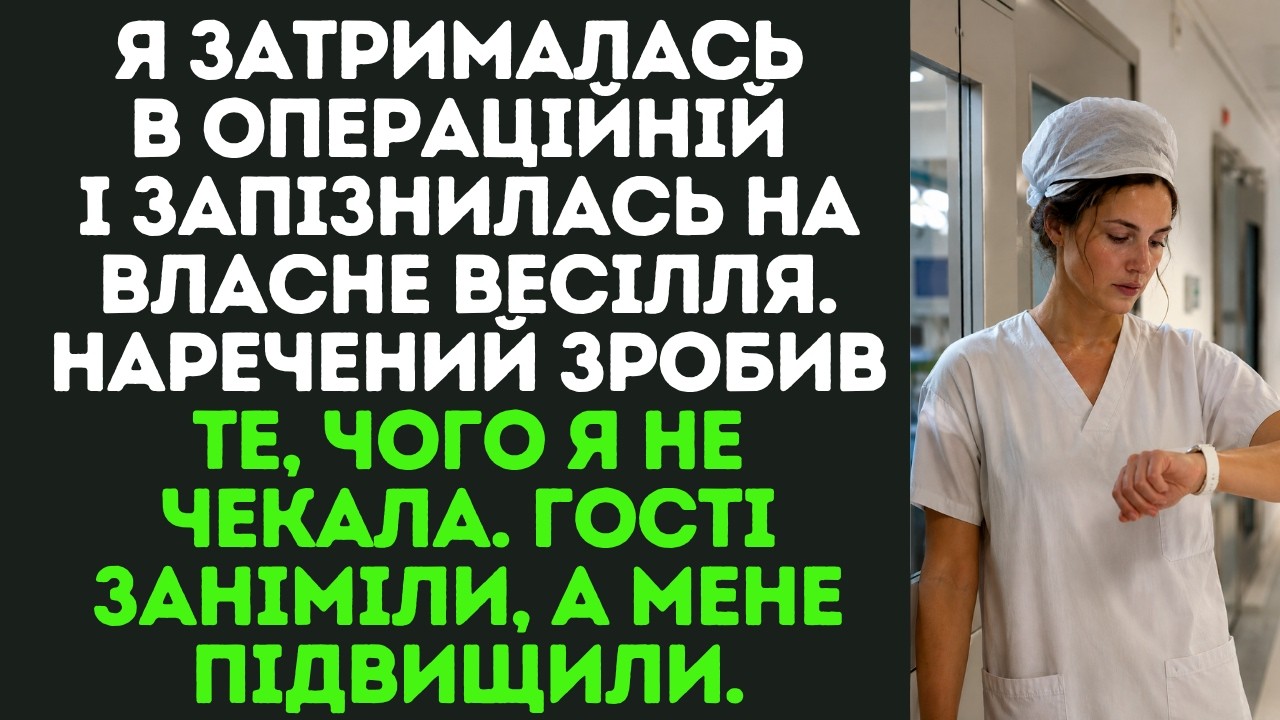
Many injured. One critical. A child. We can’t do this without you.
”
The head of surgery sounded exhausted. She sat on the edge of the bed before he finished speaking. Her eyes moved to the chair by the door. Her wedding dress hung there.
“How much time do I have? ”
“Better if you were already here. ”
She ended the call. Oleh sat up, woken by the ringing.
He looked from her to the dress, then back. “I’ll make it,” she said. “I’ll make it, I promise. ”
He took a loud breath.
“You said the same thing when you went to meet my parents. ”
She was already reaching for her coat. “Oleh, I’m going,” she said. “Of course.
I understand. You save lives. ”
He turned toward the window. —
He’d known from the beginning.
But he decided he was strong enough to handle it. They met three years ago at a corporate event. She arrived an hour late, apologized lightly, took a glass of wine, and said something funny about traffic. He thought she was interesting, alive.
Later he learned the traffic had nothing to do with it. The surgery had run long. The first months were easy. She was always rushing off, working weekends, sometimes called out at night.
He made her favorite pasta with meat, learned to fall asleep to her quiet stories about other people’s diagnoses, and stopped asking when she’d be home, because she didn’t know herself. There were good evenings. When she came home on time and they had dinner together, she laughed for real. When he waited up after a hard case with hot tea and asked nothing.
When she fell asleep on his shoulder at the movies and he let her sleep until the credits ended. He loved her. Completely. But there were other evenings.
Meeting his parents. She warned she might be late. Then she called to say she wouldn’t come at all. Emergency surgery.
His mother silently removed her plate. His father changed the subject and never asked about her again. Dinner with his friends. He booked the table, told everyone.
She arrived two hours after dessert. They were already putting on their coats. They said, “It’s fine, we understand. ” But he never invited them again.
His birthday. She came at one in the morning with a cake and pink tulips. He’d once said he liked tulips. He was sitting in the kitchen with cold coffee, staring out the window.
They didn’t argue. They cut the cake and ate it in silence in the dark. He didn’t count then. He started later.
Seventeen. He reached seventeen in three years. Not all the times were big. Some were small.
An hour late. A canceled Sunday walk. New Year’s Eve she spent at the hospital, coming home at four in the morning smelling of antiseptic with the eyes of someone who’d just pulled a person back from death. He said nothing.
Made tea. Went to bed. He never told her he was counting. He was ashamed of it—it felt petty, unworthy.
But the number grew on its own. Steadily. Seventeen. And today would have been eighteen.
—
At the hospital, orderlies were running. Stretchers weren’t enough. Someone was crying in the corner of the corridor. “Where’s the most critical?
” Sofia asked, pulling on her gown. A nurse led her to a boy, about eleven. He lay still, skin almost transparent, lips dry. On his abdomen, a hematoma swelling fast.
“Suspected splenic rupture,” the resident said. “Pressure is dropping. ”
Somewhere down the hall a woman screamed—his mother, probably. They weren’t letting her in.
Sofia leaned over him. He was barely breathing. For one second—only one—the white dress on the chair flashed through her mind. The ring box.
Oleh by the window. She pushed it away. “Operating room. Now.
”
—
In the operating room, everything was clear. White lights. The anesthesiologist’s calm report. “Pressure 80 over 40 and falling.
”
“Let’s begin. ”
Minutes stretched. The damage was worse than expected. Heavy bleeding.
The boy was too small for that much blood loss. “Pressure dropping,” the anesthesiologist said again. “More adrenaline. Quickly.
”
At some point the anesthesiologist asked quietly, “Sofia, how much time do you have before the ceremony? ”
She didn’t answer. The clock above the operating room read 13:47. The ceremony was at 14:00.
And then she understood something that made her chest go cold. Not that she’d be late. Not that Oleh was waiting. Something else.
She felt no panic. Her hands moved steadily. Her head was clear. She had known at 6:12 that morning that she wouldn’t make it.
She loved Oleh. And she went anyway. “Clamp,” she said. —
She ran in at 16:03.
Out of breath, hair loose, she stopped in front of the guests sitting in tense rows. Someone held a phone. Someone stared at the floor. Her mother looked older than she was.
Lyudmyla Vasylivna sat with her hands folded in her lap, eyes fixed somewhere to the side. Oleh stood by the window. Not pacing. Not calling.
Just standing, watching the door. Not with hope. With confirmation. “I made it.
” Her voice broke. He looked at her and didn’t move. His hands stayed in his pockets. He watched her the way you watch something already decided.
The registrar came out. “If you’re ready, we can go into the hall. ”
The guests stood. Inside the registration hall it was quiet.
Flowers in vases. A tidy table with a folder. Oleh stood beside her and said nothing. The registrar opened the folder and spoke warmly about family, about responsibility.
The words passed through Sofia like air. “Oleh, do you consent to take Sofia as your wife? ”
He turned to her. He looked carefully, calmly, as if memorizing every line of her face, every breath.
She felt something begin to sting in her chest. She knew before he spoke. She could read it in his eyes. He was saying goodbye.
“No,” he said quietly. The folder closed. The sound was sharp, like a period at the end of a sentence that could not be continued. No one moved.
No one breathed. —
In the corridor, he explained. “I’m not angry at you. I just counted.
” He paused. “Seventeen times in three years you chose work over me. I didn’t complain. I waited for something to change.
” He looked away. “Nothing changed. And today, nothing changed either. ”
“Oleh, there was a child.
He could have died. ”
“I know. ” He nodded. “That’s exactly why you went.
And why you’ll go next time. And the time after that. ”
He looked at her without anger. “I don’t want to live like this anymore.
I can’t. ”
She opened her mouth, but nothing came. Because he was right. She’d known it at 6:12 in the morning.
His mother passed by. She stopped next to Sofia for a second and looked at her, slightly from above. “I knew this would happen the first time I saw you,” she said quietly. “When someone needs you, you’re just an empty space next to them.
”
She walked off after her son. —
That evening Sofia sat on the floor of the empty apartment in her wedding dress. She couldn’t take it off. Her hands wouldn’t move.
Outside, it was getting dark. Somewhere below, people were laughing. She sat for an hour. Maybe two.
She didn’t look at the clock. On the table was his blue mug with the chipped handle, the one he refused to throw away. She looked at it and thought about small things. How he always left it by the sink.
How it annoyed her in the first year, and then she got used to it. How the mug was still here, going nowhere, while he was already gone. At one in the morning she stood up. She tried to unbutton the dress, but the buttons wouldn’t give.
She pulled. A button flew off and rolled under the bed. She didn’t look for it. She hung the dress on the chair—the same chair where it had hung that morning—and lay down in her clothes.
Then she picked up her phone and called him. Long rings. She wrote: “Oleh, I know you’re right. I still want to talk.
Please. ”
Two check marks. He’d read it. He didn’t answer.
She called the next morning. Long rings. She wrote in the evening. Read.
No reply. A day later, she called again. More long rings. She didn’t know that he sat holding the phone, staring at her name on the screen.
That his fingers hovered over the answer button. That he wanted to pick up, but was afraid. Afraid of hearing her voice and giving in. And he couldn’t give in anymore.
If he gave in now, he’d give in forever. He loved her. That was why he didn’t answer. She kept calling from the hospital parking lot.
Typed messages, deleted them, typed again, sent. Two check marks. Silence. —
One morning she came to work early.
The boy was stable. She checked his stitches, watched the monitor. Her hands knew what to do, but when a nurse asked her something, she had to ask twice. “Good afternoon.
My name is Viktor Andriyovych. I’m Artem’s father. ”
She turned. A man around fifty stood in the doorway, composed, in an expensive suit.
She recognized him from the news. A deputy. He thanked her. Then he said he knew about the hospital’s equipment requests.
Two years stuck in the ministry without response. For a second, she stopped thinking about Oleh. For years she had written justifications, submitted requests, begged. The answer was always the same: insufficient funding.
And now the person who could change that was standing in front of her. “If you write an official request with medical justification, I’ll support it as a deputy,” he said. “Together it will move faster. ”
“It will still take months,” she said.
“I know. But someone has to start. ”
She looked at the boy through the glass. Then at the deputy.
“Fine. I’ll write it. ”
That evening she sat at the kitchen table, drafting the request. Numbers.
Specific cases. She worked alone. Oleh’s forgotten book was still on the hallway shelf. He’d never come back for it.
Before bed, she dialed his number. Long rings. She put the phone down and kept writing. —
A month passed.
Sofia spent three hours on her feet in a complex surgery. When she came out, she stopped against the corridor wall and pulled off her gloves. Her head throbbed. She checked her phone.
One missed call from Oleh. One minute ago. For the first time in two months, he had called her. Her chest tightened so sharply she pressed a hand to it.
She called back. Rings. Two. Three.
He didn’t answer. Maybe he’d stepped away. Maybe the phone was in his pocket. Fourth ring.
A young colleague came out of the operating room. “Sofia Mykhailivna, the next patient is ready. A child. Complex anatomy.
They’re asking for you personally. ”
Fifth ring. She looked at the screen. At his name.
At the rings disappearing into nothing. Then at her colleague. She put the phone in her pocket and walked in. —
That evening she called again.
He didn’t answer. She wrote: “I saw your call. I’m sorry, I was in surgery. I’m here if you want to talk.
”
He read it. He didn’t reply. —
A week later, the ministry responded. The request had been accepted for review.
The head doctor called her in and placed promotion papers on the desk. “You made the right choice,” he said. She looked at the papers and thought: *Which choice, exactly? *
—
She saw him on the street once.
She was leaving the pharmacy. He was walking along the sidewalk about twenty meters away. A woman in a light coat walked beside him—not tall, dark-haired, speaking and gesturing as she went. He listened, nodded.
Sofia stopped. The woman finished what she was saying and laughed. Genuinely. He smiled too, in his restrained way, the way he used to smile at her.
They stopped at a shop window. The woman pointed at something. He looked, said something back. She nudged him with her shoulder—easily, as if it were the most natural thing in the world—and they walked on.
They didn’t see Sofia. She watched until they turned the corner. Then she watched the empty sidewalk for another minute. She walked to her car, sat with her hands on the wheel, and didn’t start the engine for ten minutes.
She didn’t cry. She just sat. Then she started the car and drove away. —
Three months later, the operating rooms had new equipment.
The younger doctors said things felt different now. Brighter lights. More precise tools. She nodded.
One evening she stayed late. She walked down the corridor between the new ORs and stopped at the window. Outside, people walked past with bags, with children, with phones pressed to their ears. Ordinary people who hadn’t had to choose today between their own life and someone else’s.
She thought about the day she missed Oleh’s call. Two phones that never connected in the same moment. Maybe if she’d called an hour later, he would have picked up. Maybe if he’d called an hour earlier, she would have answered.
Maybe it all comes down to one hour that never aligns between them. Or maybe it was never about the hour. Maybe the person next to someone like her simply had to be different. Someone who could wait without counting.
She didn’t know. Oleh’s book was still on the shelf. She’d never moved it. Her phone vibrated in her pocket.
An unknown number. “Sofia Mykhailivna, sorry to call so late. Emergency situation. Are you still at the hospital?
”
She looked out the window. Streetlights were coming on, one after another, all the way down the street. “Yes, I’m still at the hospital. I’ll come right now.
“