I heard my name through the half-open door. Then my wife’s voice, flat and clear:
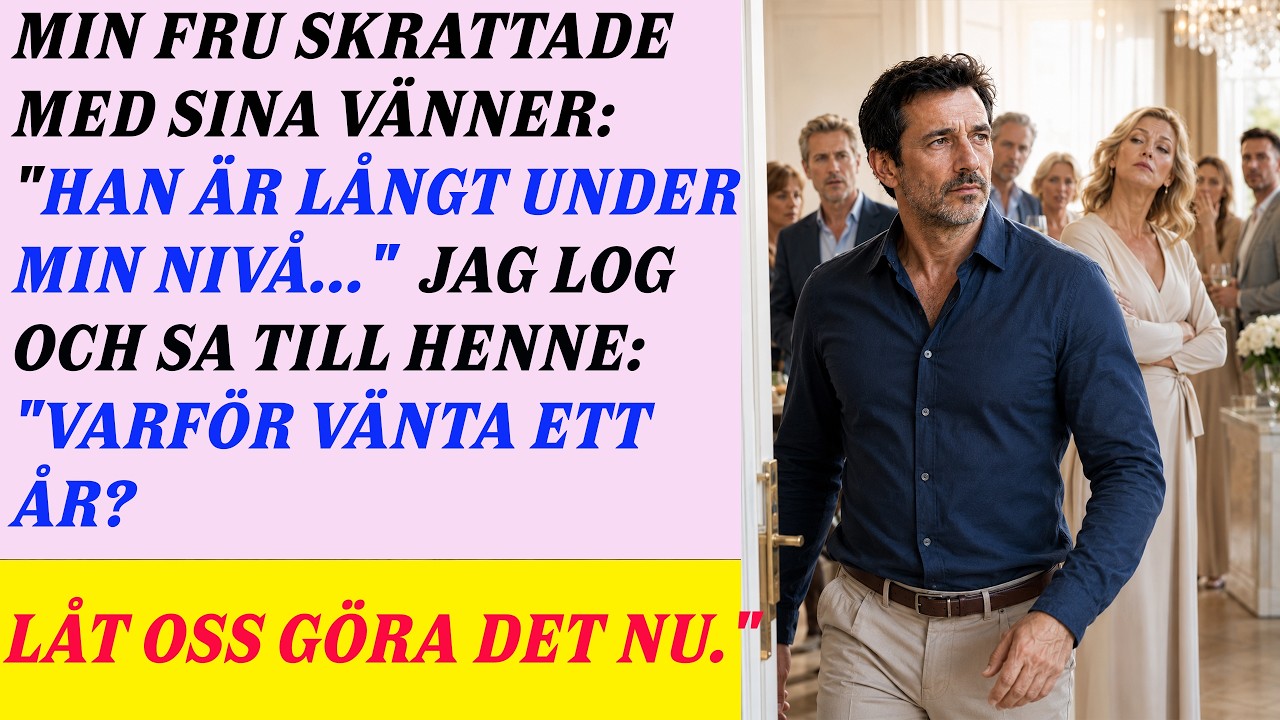
“I don’t think this marriage will last another year. He has sunk far below my level. ”
Malin’s low, trusting voice followed.
“Johan is excellent at arranging other people’s evenings. He can serve. He can make guests comfortable. He knows when to disappear.
He’s exactly the sort of man you want in the dining room at an event. Not the man you want sitting next to you as an equal. ”
Ebba laughed. “Annika, you have to admit he’s good at his craft.
It’s just that his craft is making other people look good. Not himself. ”
My wife didn’t defend me. She waited until the laughter died.
“That’s not the point. The point is there’s a limit to how long a woman like me can ignore certain differences. He stayed where he was. I moved on.
”
“Maybe less than a year,” Ebba said. “Maybe less. ”
I stood there with the wine bottle in my hand. The first thing I felt wasn’t anger.
It was slower and heavier. That conversation hadn’t been born in our living room that night. Annika had been carrying it inside her for a long time. I was just the last person to hear it.
I walked in, set the bottle on the table, and looked at her. Not at her friends. At her. “Why wait a year?
Let’s end it now. ”
Her mouth opened. Then she tried a small smile, a little wave, as if I were exaggerating, as if it were just talk between girlfriends. I didn’t wait for the sentence.
I took my keys from the hall table and walked out. No speech. No slammed door. Just cold Stockholm air hitting my face as I stepped onto the street.
I drove for almost an hour with no destination. Bridges, dark office windows, neighborhoods I knew because I had carried boxes through them, built tables, run kitchens, created perfect evenings for families that weren’t mine. Annika’s voice kept looping: He stayed where he was. I moved on.
Then the phone vibrated on the passenger seat. It was Sofia. One of Annika’s old university friends. The one who usually stayed quiet.
“The part you heard was the kindest part. Annika has been preparing a story about you for weeks. If I have something you need to see before she uses it, pull over. ”
I stopped by Nybroviken and read it again.
Then I wrote: “Where are you? ”
She gave me an address near Gullmarsplan. The kind of place none of Annika’s Östermalm contacts would ever set foot in. I understood the choice wasn’t random.
She was sitting in the back of the bar, a glass of water in front of her, purse held tight in her lap. She didn’t look relieved. She looked like someone who had been carrying something too long and finally found a reason to put it down. “Thank you for coming,” she said.
I sat down. “There’s been a group chat for years. Me, Annika, Malin, Ebba. Three weeks ago Malin left her phone unlocked at my place.
I saw there was another chat. Just the three of them. Without me. ”
She showed me photos taken from Malin’s screen.
Crooked, but readable. Messages from Annika, built over months, with that calm precision she used when she wanted to sound reasonable. She wasn’t shouting. She was building.
“He can’t accept that things have changed. He has problems with other people’s success, especially mine. He seems tense lately. He says everything is fine, but you can see he can’t handle it.
I’m afraid that when I tell him I want to leave, he won’t take it well. You know me. I always try to avoid conflict. But with him, I don’t know how it will end.
”
Then a message from four days earlier about his most important event: Lagerkrants. “Ebba has a contact there. I’ll be there too. If he wants to prove I’m the problem, he’ll get his chance.
”
Sofia said softly, “Annika has already talked to someone in the family. She told them you’re going through a difficult period. That you’re pressured. That you sometimes react badly.
She used the word unstable. ”
I stayed quiet. That word was carefully chosen. Repeated in the right room, before the right people, it would stick to my name for years.
“Why are you telling me this? ”
Sofia hesitated. “Because Annika does this to me too. Not like this.
But I know how she works. At some point I stopped wanting to cover for her. ”
I didn’t thank her. It wasn’t the right moment, and it wouldn’t have been honest.
That event wasn’t just a job. It was the kind of dinner that opens doors in Stockholm. If the night went well, the following month could bring three new inquiries. I had told Annika that myself, months ago.
She had chosen that exact night. Annika wasn’t waiting for me to lose the marriage. She was waiting for me to lose the name I had built over twenty years. I came home near midnight.
She wasn’t awake, or pretended she wasn’t. I slept in the study. The next morning she came down at eight with that rehearsed lightness. “You slept here?
” she asked. “Yes. ”
She poured coffee. “Last night you were overtired.
Maybe you misunderstood the context of a conversation that wasn’t really about you. ”
“I didn’t misunderstand anything. ”
“I worry about you. You take everything home.
Kitchen stress, clients, staff. You can’t separate things anymore. Maybe you should talk to someone. I’m not saying this to hurt you.
”
I didn’t answer. I finished my coffee, took my jacket, and left. I had forty-eight hours before the Lagerkrants event. I spent the morning at the office going over every detail with Märta Lind, my coordinator for seven years.
Menu, serving rhythm, wine list, transport, extra staff. The family wasn’t new, but this was their first formal dinner in years. Fourteen guests, every name that mattered in Stockholm. Märta looked at me.
“Are you okay? ”
“Yes. ”
She put the papers on the desk. “We’ll handle this night properly.
Don’t worry about it. ”
She had never needed to say that before. Annika called Wednesday afternoon. “I just wanted to know how things look for tomorrow.
I heard the Lagerkrants are very demanding. I hope you can handle the pressure. ”
“I’ve handled pressure for twenty years. ”
A small pause.
“It’s just that you seem heavier lately. I say it because I care. ”
The words weren’t for me. They already had a destination.
I arrived at the villa on Djurgården at four in the afternoon. At seven the dining room was ready. Right light, perfect place settings, linen pressed, cutlery straight. The kitchen moved quietly.
Guests began arriving at ten past seven. I saw her come in at ten past eight. Annika wore a dark blue dress I had never seen. She wasn’t a guest.
Ebba was at her side, introducing her directly to Charlotte Lagerkrantz with a familiarity built over weeks. Annika laughed, touched the hostess’s arm, said something that made two other women smile. She sat at the table, third chair from the left. The exact center of the room I had built.
She looked at me across the room and smiled slowly. The kind of smile you give someone who has carried plates and already knows his place. First course went out at twenty past eight, on time. I moved between kitchen and dining room with the concentration I use on nights that matter.
Annika sat at the main table, laughing with Charlotte. She didn’t look at me when I passed. That was a choice, not distraction. At half past eight, she turned to me.
“Johan, excuse me a moment. This wine is what we selected together, isn’t it? I thought it was another label. Maybe you changed it at the last minute.
Charlotte, sometimes when he’s pressured he changes details without telling anyone. No criticism. I know him well. ”
“The label is the one we agreed on,” I said.
“I can show you the confirmation if you’d like to check. ”
“No, no, of course not. I was just remembering. You’ve been so busy lately.
It’s normal to drop a detail. ”
I went back to the kitchen. Märta was at the counter. She followed me with her eyes but said nothing.
Then she said, “We’re ready. ”
That was enough. Around nine, Annika raised her hand in front of four guests. “Johan, excuse me.
This sauce is what we discussed, right? I remember it lighter. ”
“It’s the sauce approved three weeks ago. Dill, brown butter, lemon.
It’s on the menu Charlotte approved. ”
Annika tilted her head toward the guests. “Do you see? This is exactly what I mean.
He remembers everything technical. It’s impressive. But sometimes that intensity makes everything feel heavier than it needs to be. ”
Four people looked at me.
I explained the dish calmly and walked away. Annika had already gotten what she wanted. She had made a simple answer look like a defense, in front of people who now wondered why a defense was needed. The rest of the night went without mistakes.
Each course arrived on time. Around ten, Märta passed me and said quietly, “You’re doing very well. ” From her, on a night like that, it was worth more than any formal compliment. Then I approached the main table for a final check.
Annika was talking to Charlotte in a low voice. “He’s an excellent professional, really. It’s just that he hasn’t been well lately. He carries everything inside.
He never releases tension. I try to stand by his side, but it’s a difficult period for him. You can see it even if he’d never admit it. ”
Charlotte nodded slowly, and then looked up at me.
What I saw in her eyes wasn’t hostility. It was doubt. The kind of doubt Annika had planted with care, over weeks. I smiled, asked if they needed anything, and went back to the kitchen.
As I walked, I understood something cold and clear. Annika wasn’t attacking my work. She was attacking how other people read me. A lie spoken calmly, with concern in your eyes, in a room like that, is worth more than ten correct answers.
At twenty past ten, I approached with dessert. Annika waited until I was close. “Johan,” she said to the table, “I was just telling Charlotte how you started this business from nothing. Literally from nothing.
It’s a beautiful story. Even if you might need to slow down right now. Some people work more than they think, right? ”
Three people looked at me.
“This work has given me a lot,” I answered. “I have no intention of slowing down. ”
I thanked the guests and moved to the other side of the table to adjust a glass that didn’t need adjusting. Just to close the sequence without giving her more room.
Later, Charlotte Lagercrantz came up to me while I checked the dessert table. “I wanted to say the evening was handled beautifully. Every detail. ”
“Thank you.
That’s what we wanted. ”
A short silence. “Are you well? ”
“I’m fine.
It’s a demanding night. Like all nights that matter. ”
She watched me for a moment. “Your wife seems very worried about you.
”
I chose my words carefully. “Annika worries. It’s in her nature. Tonight all that mattered was that your guests were well taken care of.
”
Charlotte inclined her head. She stayed a second longer than necessary. Then she said, “A man who isn’t well doesn’t handle a night like this. ”
She didn’t add anything.
She returned to her guests. As the guests were leaving, Henrik Lagerkrantz shook my hand with a firmness he rarely used. “We’ll be in touch. ”
Charlotte came back as I was gathering the last details near the entrance.
Her voice was low. “I want to tell you something because it feels right. Annika contacted me three days before the event. She said she was worried about your emotional state, that you were going through a difficult period, that she feared the pressure was becoming too much for you.
”
I stood still. “Why are you telling me this? ”
“Because I spent the whole evening watching you work. What I saw didn’t match what was described to me.
”
I thanked her. She went back inside. Annika hadn’t left with the guests. She was standing near the glass doors, phone in hand, while my staff worked around her as if she were part of the furniture.
“It went well,” she said, as if commenting on a night she had helped create. “Yes. The Lagerkrants were pleased. ”
“I said I could help with the guest side.
I already know some people in their circle. It would be easier for everyone. ”
“I handle the guest side. It’s part of the job.
”
Annika smiled with that patience she used when she wanted to seem reasonable. “Johan, clients like the Lagerkrants don’t just want good service. They want a relationship. Someone to talk to before and after dinner.
Someone who understands their world. You’re very good with the kitchen, the team, the logistics. No one questions that. But the social side—the relationships, the conversations that matter—that requires a different kind of presence.
Many clients would feel more comfortable if someone like me functioned as a bridge. You’d be freer to focus on the kitchen, where you’re really strong. ”
It sounded like a suggestion. It was a verdict.
Annika was dividing the work into two parts: one with social value, and one without. She said “strong in the kitchen” the way you say it to someone who has a practical skill but isn’t made to stand in the room with the adults. I let her finish. I didn’t answer.
Later, Märta found me at the car during loading. “I need to tell you something. That woman Ebba asked questions to three people on the team tonight. ”
“What kind of questions?
”
“Whether you’re often nervous during events. Whether you argue with suppliers. Whether you drink before work. ”
She looked at me with a clarity that needed no comment.
“I told them not to answer anything that didn’t concern the service. ”
Ebba wasn’t curious. She was collecting confirmations that would look independent. Separate voices pointing in the same direction.
“Thank you,” I said. Märta nodded and went back to loading. I drove home with one thought. Annika didn’t just want to leave with her part.
She wanted a public version of herself that held. The refined woman who had kept together the side that mattered, while her husband played with pots and suppliers. The one who understood the real clients. The one who knew how to move through the right rooms.
She was rewriting fourteen years. Not out of grief. Out of position. The phone vibrated on the seat.
Sofia. “Tomorrow at ten, Annika has a meeting with a Lagerkrantz contact. She’s presenting it as an evaluation to relaunch Bergström Events in a new direction. She hasn’t mentioned that you know nothing about it.
If it goes forward, she’ll present herself as the new face of what you built. ”
She wasn’t trying to leave me. She was trying to keep my name without me. I got to the office at half past seven, two hours before the team.
I sat with the files and calendar and the smell of fabric, metal, and wood that accumulates over years. Twenty years of work, visible only if you knew where to look. Märta came at quarter past eight. “You’ve been here since seven.
”
“Yes. ”
She watched me. “What do you want to do? ”
“Show up.
”
Charlotte Lagercrantz had sent a message late the night before. “A mutual acquaintance has asked me for a contact in our circle regarding a project connected to your company. She said it was an agreed transition. I thought it was correct to inform you.
”
An agreed transition. Annika had used the word agreed as if I were already out. The meeting was at a private club near Stureplan. I arrived at ten past ten.
Annika was already there with Gustav Fors, a consultant in corporate events, someone who had worked with wealthy families and foundations for years. She wore her usual presentation smile. She saw me enter. The smile stayed, but her eyes changed.
I walked over and shook Gustav’s hand before she could speak. “Johan Bergström. I heard about the meeting this morning. I’m glad to be here.
”
Gustav looked at me, then at Annika, then back. He was recalculating. Annika opened her mouth. “Johan, that wasn’t necessary.
I was just exploring preliminary ideas. Nothing definitive. ”
“Bergström Events is my company. Every conversation about this brand, its clients, or its direction begins with me.
Not because I want to complicate things. Because it’s correct. ”
Gustav nodded slowly. “I understand.
”
Annika smiled again, with less control. “You’re reacting as if something wrong happened. I wanted to help the brand reach another audience. You’ve said yourself that the relationship side isn’t your strength.
”
“I’ve never said that. ”
Gustav cleared his throat and turned his tablet toward me. “Actually, Mrs. Bergström sent a short presentation last night.
An introduction document. ”
I read the first page: “Bergström Social. Relationship direction and client development, by Annika Bergström. ” My name appeared nowhere except in the title of the company I had created.
She had already built something inside what was mine, with my name on the door and her name at the center. I thanked Gustav for his time, said we would speak through official channels, and stood up. Nothing more was needed that morning. But as I left, I understood that protecting my reputation wasn’t enough.
Annika was turning the name Bergström into something she could carry away. I had to make sure that name remained unmistakably mine before she finished rewriting where it came from. Back at the office, Märta waited. “She’s created a document.
She calls it Bergström Social. She introduces herself as relationship director for the brand. My name appears only in the title of the company I founded. ”
“How long has she been working on this?
”
“I don’t know yet. We need to find out. ”
I started with the oldest clients. Lars Holmqvist answered on the second ring.
A former restaurant owner on Södermalm, retired, still connected to everyone who mattered. I had organized his daughter’s wedding six years earlier. “Actually,” Lars said, “your wife called me in March. She wanted to know if I had contacts in corporate events in Uppsala and Västerås.
She said she was taking over certain relationships because you were in a transition period. ”
“Transition? ”
“Her words. She said you were tired, that you were considering reducing your direct involvement, and that she was covering the side you no longer managed.
”
I was quiet long enough for Lars to understand this wasn’t a routine check. “That doesn’t match,” I said. “I figured. It didn’t sound like something you’d do without telling me yourself.
”
Cecilia Hammar, a client for nine years, told me Annika had contacted her in February with a different tone. “She said she was working on a new direction for Bergström Events, more focused on the luxury segment, and asked if I was open to a meeting. ” The meeting never happened. Annika was collecting openings before she moved more visibly.
Sara, our administrative coordinator, had given Annika the updated supplier list, photos from recent events, and the template for quotes. Three times. “Annika said she was preparing marketing material to help you,” Sara said. The third time she hesitated because something felt wrong.
Annika had used my own team’s trust to pull out operational material. She wasn’t positioning herself in the market. She was building a working copy of the brand with my tools, my clients, my name. From inside.
Then Charlotte’s message arrived: “Gustav Fors contacted me this morning. He has received conflicting information about who actually leads Bergström Events and wants formal confirmation before proceeding with any conversation. ”
The story had moved. It was no longer a private matter between me and my wife.
It was a matter in the city where I had worked for twenty years. I went home early. Annika wasn’t there. I sat in the kitchen and waited.
Gustav sent a message later that afternoon: “I won’t proceed with any conversation connected to Bergström Social or any proposal linked to your company unless it comes directly from you. ”
Lars sent another: “Annika called me this morning. She said you had reacted excessively to a work initiative, that you were cold to her in front of important people, and that you’re going through a period where you have trouble accepting change. ”
The story was moving.
Annika couldn’t present herself as the misunderstood employee anymore. Now she was the patient wife of a rigid, ungrateful man. Annika came home around six. She walked in without greeting, dropped her bag a little harder than normal, and found me in the kitchen.
“Are you happy? You made me look like a liar in front of Charlotte Lagercrantz and Gustav Fors. People I could have built something with. ”
“Did I make you look like something?
Or did you do that yourself? ”
“You brought Märta into it. You took out that list as if you were collecting evidence against me. ”
“Märta found a document describing real requests you made to Sara.
No one invented anything. ”
Annika opened her mouth, closed it. “I was trying to help you. Take the brand where you’d never get alone.
”
“You didn’t help me. You used my name, my clients, and my team to build something that was yours, without telling me, without asking me. And when I discovered it, you tried to make the discovery look like my problem. My emotional fragility.
”
She looked at me with something colder than anger. Fear. Not fear of losing me. Fear of losing the position she had tried to take.
The circle, the dinners, the hands shaken in the right rooms. She didn’t answer. She took her bag and went upstairs. At half past nine, Sofia sent a voice clip.
Annika, to Malin, in a less controlled voice:
“Sofia betrayed me. She couldn’t have done it alone. Someone told him where to go. But it doesn’t matter.
Now I’ll show everyone who Johan really is. What kind of man he becomes when he feels threatened. What kind of husband he’s been. I’ll say enough so he never recovers.
”
The elegant Annika, the one with calibrated smiles and chosen words, was gone. What remained was someone who had lost control of the story and was about to do what people do when they lose control. Stop building. Start burning.
Three days later, Charlotte Lagercrantz hosted a small informal aperitif at her terrace. Twenty people. The kind of evening Stockholm used to gather certain circles after something had disturbed them. She invited me with a direct message: “I’d be glad if you came.
It’s important that the right people see who Johan Bergström is. ”
Annika was already there when I arrived, standing near the terrace edge with Ebba and two women I didn’t know. She was working the room, laughing, still trusting her cards. When she saw me, no smile came.
For the first twenty minutes I talked with Lars Holmqvist and Henrik Lagercrantz about the coming event season. Real, concrete conversation. The kind built through years of honest work. At quarter past eight, Annika approached.
“Johan,” she said, with the voice she had used many times to appear reasonable. “I’m glad you came. Maybe we can clear up some things. I think there have been misunderstandings about what I was trying to do with Bergström Social.
”
Lars answered before I could. “There were no misunderstandings. You called me in March and said Johan was in a transition. That he was reducing his involvement.
A thing like that should have come from him, not from you. ”
Annika opened her mouth. “I was trying to protect the brand during a sensitive period. Johan was going through a difficult time—”
“I read the document you sent me.
” Gustav Fors had come up without anyone noticing. “You use the name Bergström Events as the basis for a commercial proposal that Johan never approved. You contacted clients and introduced yourself as relationship director for a company that isn’t yours. That’s not protecting a brand.
That’s something else. ”
The silence wasn’t empty. It was full of people listening and understanding. Annika looked at Ebba.
Ebba lowered her eyes to her glass and said nothing. This wasn’t loyalty. It was a guest who didn’t want to be found on the wrong side. Charlotte Lagercrantz came forward.
“I invited Johan tonight because I value relationships based on clarity. Bergström Events is his company. He built it. For me, that’s not open for discussion.
”
The words closed a door. Annika stood in the middle of a terrace full of people she had spent months trying to impress. And they looked at her not as a sophisticated woman with a vision, but as someone who had tried to enter a door that didn’t belong to her. She stayed still for a few seconds, then excused herself and went inside.
I found her near the exit twenty minutes later, already holding her coat. “What are you going to do now? ” she asked. “The same thing.
I move on with the company, with the clients, with the work I built. I protect the name Bergström because it’s mine. And I live my life without building a false story on top of it. ”
I walked past her.
Outside, the cold air from the water hit my face, the same night that doesn’t change for anyone. The weeks that followed weren’t a victory. There was no single moment where everything turned. The good things that matter seldom come all at once.
They accumulate the same way damage does. Charlotte called ten days later to plan an autumn dinner. No reference to Annika. Just “I prefer to start now so we have time to do things properly.
”
Lars told me Annika tried to contact Charlotte twice that week. The first time she got a three-word answer. The second, silence. The circle Annika had tried to enter didn’t close with a loud door.
It pulled back quietly, slowly, until she stood outside and no one needed to explain why. Invitations stopped. Messages that used to get answers in minutes now got short, polite, definitive replies. People who had greeted her warmly now kept the polite distance that is never announced, only understood.
That silence wasn’t hostile. It was the indifference of people who had understood and no longer had anything to check. Gustav Fors contacted me two weeks later. A new client, a family with a historic estate near Sigtuna.
Ninety people for a year-end event. “I thought of you,” he wrote. “I think the timing is right. ”
I brought the inquiry to Märta.
She read it twice, then looked up. “This is another level. ”
“I know. We’re ready.
”
That was enough. One morning, as I checked the last details at the office, I stopped and looked around. Twenty years of work lived in that room. Not visible, not something you could hold, but there, in every person who had chosen to stay, in every client who had chosen to return, in every evening built without failure when it mattered.
Annika had believed that using my name was enough to inherit what stood behind it. She was wrong. Clients didn’t trust Bergström Events as an abstract brand. They trusted Johan Bergström.
Twenty years of promises kept in silence. That trust doesn’t transfer through a document and a smile in the right room. It doesn’t work that way. It never has.
Late in the first month, Annika sent one message: “You got what you wanted. You destroyed me in front of everyone who mattered to me. I hope it was worth it. ”
I read it once.
Then I wrote: “I didn’t destroy you. You built something false with another person’s name and work, and when it came into the light, it broke. Calling that destruction means you still don’t understand the difference between a consequence and an injustice. I did nothing to you.
You did it all. ”
She didn’t answer. Maybe she understood. Maybe not.
That question no longer belonged to me. I put down the phone and went back to work.