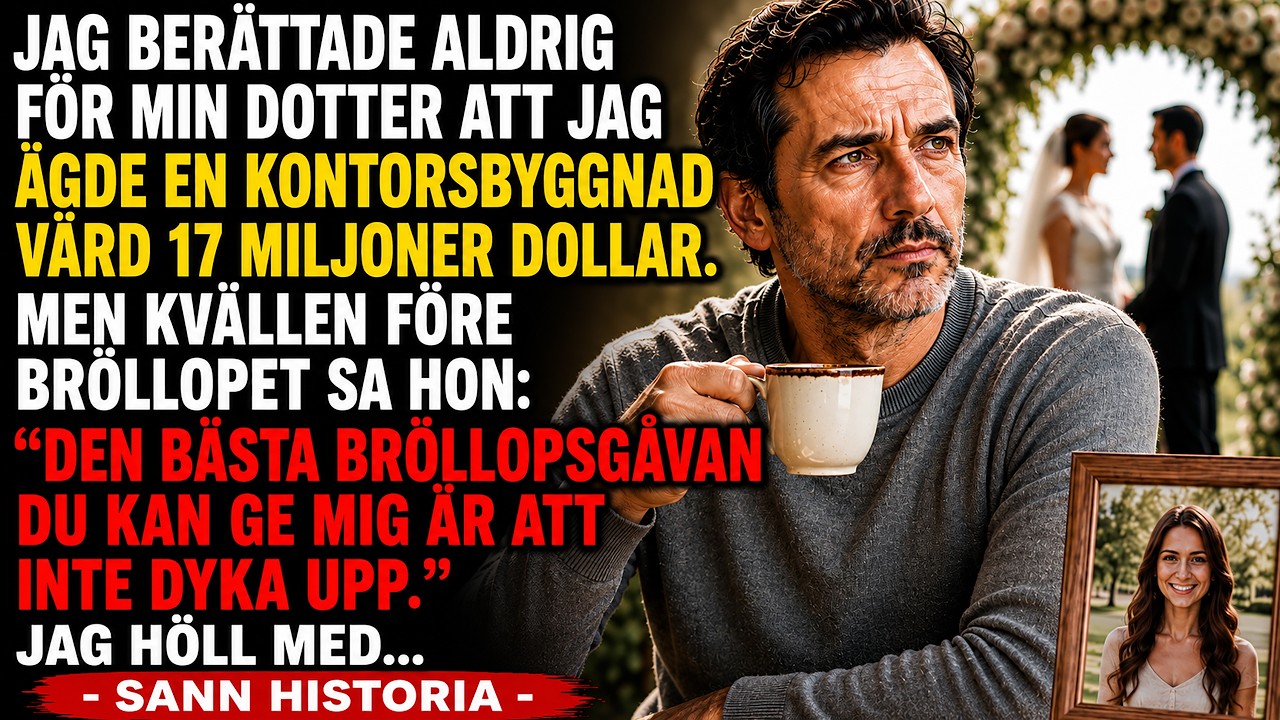
The night before my daughter’s wedding, my phone rang. “Papa,” she said softly. “The best wedding gift you can give us is not to show up tomorrow. ”
For a second, I honestly thought I’d misheard.
My gaze slid to the manila folder on the kitchen table. Inside lay the deed transfer for a six-story office building on Sveavägen in central Stockholm, valued at 180 million kronor. My lawyer had already prepared everything. All that remained was my signature after the ceremony.
My daughter’s name sat neatly at the top of the first page. I stared at it while she waited. “Okay,” I said quietly. “Thank you, Papa.
”
The call ended. If you’ve ever reached an age where silence hurts more than shouting, you understand how that kitchen felt. —
It was almost nine on a warm Friday evening in early June. My small terraced house in Täby smelled of coffee I’d forgotten to drink.
The ceiling fan clicked every few seconds, just as it had for fifteen years — a sound I’d always meant to fix but had come to find comforting. Everything looked exactly the same. Only my life had changed. Across the table stood a photo of Ingrid, my wife, in that faded AIK jersey she refused to throw away.
“I didn’t see that coming,” I told her. No answer. Just the same familiar smile. You spend thirty years raising one child.
You imagine a thousand conversations. None of them sound like that. —
People assume a man who owns a building worth 180 million lives in a mansion with gates and fountains. Not me.
I still drove a twelve-year-old Volvo with a faded hood. My watch was an old Certina Ingrid bought me on our twenty-fifth anniversary. It ran two minutes slow every month. I never bothered to replace it.
Neither did she. That was Ingrid. She had a way of making ordinary things feel precious. When she got sick, nothing felt precious anymore — not cars, not property, not money.
Time was the only thing we both wanted more of. We didn’t get it. Before she died, she made me promise something: “Don’t let money become Elin’s measure of worth. Help her when she needs it.
But don’t raise her to expect it. And if we’re lucky enough to leave her something one day, let kindness surprise her, not greed. ”
I carried those words for fifteen years. That’s why almost no one knew what I actually owned.
Especially not Elin. She knew I’d done well in commercial real estate and retired comfortably. She just didn’t know how comfortably. The Sveavägen building took thirty-eight years to build.
I bought neglected properties when the banks wouldn’t touch them. I fixed roofs, negotiated leases, mopped empty offices myself when I couldn’t afford a cleaning crew. Ingrid and I skipped vacations so every extra krona went into another investment. She never complained.
When the valuation came back that spring, even I stared at the number: 180 million kronor. It was never about the money. It was forty years of ordinary Tuesdays — roofs, pipes, contracts, late nights, early mornings, two people who believed in something before anyone else did. —
A week before the wedding, I met my lawyer, Karin Lindholm.
“Are you sure? ” she asked, sliding the transfer documents across the table. “I’ve never been more sure. ”
“You understand that once it’s transferred, it’s hers.
”
“I know. I didn’t work for the building. I worked for my family. ”
The plan was simple.
Quiet. Monday morning breakfast with Elin. I’d hand her the folder. She’d think it was insurance papers.
Then she’d read the first page. Now the folder sat unopened on my kitchen table. My phone buzzed. A text from Elin: “Thank you for understanding, Papa.
This makes everything easier for everyone. ”
Easier. I read the word three times. Easier for whom?
I didn’t answer. Instead I opened the folder and slowly pulled out the first page. Tomorrow my daughter would marry the man she loved, and for the first time in thirty-one years, I found myself hoping she would never know what I’d almost placed in her hands. —
I didn’t sleep much that night.
Around midnight I gave up. On the dresser stood an old photo of Elin at seven, missing a front tooth, her pink softball helmet too big for her head, smiling hard enough to break your heart. “You used to run toward me,” I whispered. I couldn’t stop thinking about that.
Not the property. Not the money. Just that little girl sprinting across a dusty field in Solna, yelling, “Papa, did you see me hit it? ”
I always saw her.
After Ingrid died, it became my job to see Elin. Not watch her — see her. There’s a difference. When she was sixteen, and some boy broke her heart, I found her crying on the driveway at ten at night.
I didn’t ask questions. I just sat down beside her. “I feel stupid,” she said. “That means you’re human.
”
She gave a wet little laugh and leaned her head on my shoulder. “Don’t ever remarry, Papa. ”
“Why not? ”
“Because I don’t want to share you.
”
For years I believed we’d kept that contract. Maybe that was my mistake. Children grow up. Parents sometimes don’t notice until the door is already closing.
—
Viktor came into her life three years before the wedding. The first time I met him was at Sturehof. Elin had insisted on somewhere nice. That should have told me something — we’d always been happy with burgers at Max.
Viktor stood when I reached the table. Good posture. Polished shoes. A smile so perfect it looked rehearsed.
“Nils,” he said, offering his hand. “I’ve heard a lot about you. ”
His handshake was a little too firm. Men like that think every handshake is a test.
He worked as a business consultant. He asked about my work, my holdings, my investments. He didn’t ask what kind of work I enjoyed. He didn’t ask what Elin was like as a child.
He didn’t ask about Ingrid. The first little stone in my shoe. Small enough to ignore. Sharp enough to remember.
Over the next year, the stones multiplied. At Midsummer, he walked through my house like he was appraising it for insurance. “Nice area,” he said. “Have you ever considered upgrading?
”
“The house? ”
Elin jumped in too fast. “Papa’s happy here. ”
Viktor smiled.
“Of course. It’s comfortable. ”
The way he said it made my home sound like an old armchair no one wanted to sit in anymore. One Sunday, Elin stood outside a restaurant and looked at my old Volvo.
“Papa, maybe you could park around the corner next time. ”
“Viktor’s colleagues come here,” she whispered. “It’s a car, sweetheart. ”
“I know, but it looks—”
She didn’t finish.
The unfinished sentence hurt more than any finished one. The wedding planning made it worse. First, Elin wanted me to walk her down the aisle. Then came the adjustments.
“Papa, about the father-daughter dance. Viktor thinks we should keep the reception moving. ”
“Maybe skip it,” she said. A week later: “Papa, don’t take this the wrong way.
About the speech — Viktor’s father is a very strong speaker, and the schedule is tight. Maybe we let him handle the toast. ”
“That’s fine,” I said. Parents lie all the time.
Not big lies. Small ones that keep children from feeling guilt. —
The night before the wedding, she called and asked me not to come. And when I sat in my kitchen with her name printed on paper worth 180 million kronor, I realized something I’d avoided for too long.
My daughter hadn’t forgotten who I was. She had decided who I was. —
The next morning, I woke before my alarm. My suit hung on the wardrobe door.
Dark blue, pressed, ready. Elin had called it old. But Ingrid had helped me choose it. I touched the sleeve.
Then I hung it back in the closet. No ceremony. No walk to the altar. No father-daughter dance.
At 9:12, another text from Elin: “Thank you again for understanding. We just want the day to be calm. ”
Calm. I put the phone face down.
“Calm it will be,” I told the empty kitchen. —
At half past ten, I drove into the city. I parked behind my building on Sveavägen, by the garbage bins and service entrance. The nice front doors were for tenants.
The back door was for me. Mats, the security guard, looked up from his crossword. “Herr Bergström. Big day, right?
”
I’d told him about the wedding. “Congratulations,” he said. I nodded. “Thanks, Mats.
”
He looked closer. “You going there later? ”
“No. ”
Mats didn’t ask more.
People who know when not to dig — you appreciate that more as you get older. On the fourth floor, Mrs. Andersson’s accounting door stood ajar. Tax people never really go home.
“Nils,” she said. “I thought it was your daughter’s wedding today. ”
“It is. ”
She waited for more.
I gave her nothing. Then she closed her folder and asked, “Do you want some tea? ”
That almost undid me. Not because I wanted tea, but because sometimes a near-stranger offers more tenderness than your own blood.
“My father missed my wedding,” she said quietly. “He had a stroke two weeks before. I still looked for him when the music started. ”
I looked at the floor.
“I hope Elin doesn’t look too hard. ”
“She will, one day. ”
—
Around lunch I stood in the empty space on the sixth floor, the best view in the building. I’d planned to bring Elin here Monday after signing.
I’d imagined saying, “Look out there, sweetheart. Part of this is yours now. ”
Instead I stood alone at the window. My phone buzzed.
A Facebook notification. A tagged photo from one of Ingrid’s old church friends. Elin stood in a white dress under an arch of pale flowers. Viktor stood beside her in black tie, smiling like a man who’d just closed a deal.
I zoomed in before I could stop myself. Elin was beautiful. Of course she was. She was my daughter.
I turned the phone off and pressed both hands against the glass. “You’ve survived recessions, cancer, funerals, and three roof replacements,” I told myself. “You can survive a wedding. ”
But those things had happened to me.
This had been chosen. That’s the difference. —
At 2:17, Karin called. “Nils, just confirming Monday morning.
Ten o’clock still works for the transfer signing. ”
“No,” I said. A pause. “No, as in we need to reschedule?
”
“No, as in we’re canceling. ”
Another pause, longer. “Nils. This is the transfer of the Sveavägen property.
Valued at 180 million kronor. ”
“I know what it’s worth. ”
“Has something happened? ”
I closed my eyes.
“Yes. Something happened. ”
“Want me to hold the documents until you’ve thought it over? ”
“No.
Cancel it. And Karin — I want a different plan for the property. One that protects it. From my daughter, from her husband, and from the part of me that almost ignored what was in front of me.
”
Karin exhaled. “I’ll start working on alternatives. ”
—
Three weeks after the wedding, Viktor found out. Not because I told him.
He found out the way men like Viktor usually find things out: while trying to make money. His consulting firm was looking for office space in the city center. A broker showed them my building. “Great visibility on Sveavägen.
Stable tenant mix. ”
“Who owns it? ” Viktor asked. “Nils Bergström.
”
That was all it took. People at the meeting said Viktor’s face changed before he could stop it. He dug. Land records, tax assessments, corporate registrations.
There I was — not flashy, not hidden, just sitting in public records like a fact, waiting to embarrass him. —
Elin called at 4:42 that afternoon. I let it ring. Then came a text: “Papa, can you call me?
It’s important. ”
I turned the phone over. Viktor called next. I let it ring, then listened to his voice message:
“Nils.
Hi. Listen, I think there may have been a misunderstanding around the wedding. Elin and I would really like to sit down with you. We had no idea.
”
We had no idea. Not “we hurt you. ” Not “we were ashamed of you. ” No — we had no idea.
Which meant they’d had no idea I was useful. I deleted it. —
That evening, Elin showed up. No warning.
She stood beside Viktor’s black BMW in a cream sweater and jeans, face pale. Viktor carried a folder. My folder. Evidence that I’d been worth knowing after all.
“Papa,” she called through the door. “Please. ”
That word hit harder than I expected. I opened the door.
“Hi, Papa. ”
Viktor stepped forward. “Nils, we really need to talk. ”
I looked at him.
“Funny. I was family three weeks ago too. ”
“Papa, I didn’t know about the property. ”
“I know.
That’s the problem. ”
Viktor jumped in. “We made a mistake. The wedding was stressful.
Elin was under pressure. ”
I raised my hand. Viktor stopped. I looked at my daughter.
“Did you miss me that day? ”
Her eyes filled. “Papa, that’s not fair. ”
“It’s not an answer.
”
She wiped under her eye with her sleeve. “I thought it would be easier. ”
There was that word again. Easier.
“For you,” I said. Viktor opened his folder. “Maybe we should sit somewhere neutral. ”
“Good idea.
But not tonight. And not just the three of us. Your parents should be there. ”
“Why would my parents—”
“Because they were at the wedding.
And they deserve to hear what really happened before everyone starts rewriting the story. ”
Viktor closed the folder. “When? ”
“Friday.
Seven. Guldahuset. ”
—
Friday evening, I arrived twenty minutes early. Karin was already there, sitting at a round table in the back.
She rose when she saw me. “Are you sure you want to do this? ”
“I don’t want a scene. I want witnesses.
”
Elin came in first. Viktor followed. Behind him, his parents. Sten, Viktor’s father, had the kind of face men get after forty years in banking.
Eva, his mother, smaller and quieter, with eyes that moved quickly through the room. Elin saw me and stopped. For half a second, she looked like my little girl again. Then Viktor touched the small of her back and steered her forward.
Sten cleared his throat. “Viktor says there was a misunderstanding around the wedding. ”
“There was no misunderstanding. ”
Viktor leaned forward.
“Emotions ran high. We were managing a lot of expectations. ”
I looked at Elin. “Is that what happened?
”
She stared at her lap. Viktor answered for her. “I didn’t ask you. ”
The table went still.
Elin’s fingers twisted around her napkin. “I was overwhelmed,” she said quietly. I nodded. “That’s closer.
”
Sten frowned. “May I ask what exactly was said? ”
Elin looked away, so I said it: “The night before the wedding, my daughter called and said, ‘The best wedding gift you can give me is to not show up tomorrow. ‘”
Eva’s hand flew to her mouth.
Karin opened her leather bag. “No,” she said calmly, “it really isn’t taken out of context. ”
She placed a folder on the table and turned the first page toward Elin. Her name sat in the middle: Elin Bergström-Holm.
“What is this? ” Elin whispered. “Transfer documents for the office property on Sveavägen. Prepared before the wedding.
Scheduled for signing the Monday after. ”
Eva whispered, “Oh my God. ”
Viktor’s eyes moved across the page — too fast for sorrow, fast as calculation. Sten noticed.
His son read the numbers before he looked at his wife. “Did you know about this? ” Sten asked. Viktor’s mouth opened, closed.
“I found out later. ”
“That’s not what I asked. ”
“No. I didn’t know.
”
Elin looked at me. “You were going to give this to me. ”
“Yes. ”
Her voice broke.
“Monday morning. ”
She put her hand over her mouth. For a second I saw the girl with the pink helmet again. Then I saw the woman who had asked me to disappear.
Both were real. That was what made it hurt. Viktor recovered first. “Nils, we can work through this as a family.
”
I turned to Elin. “If I had shown up at your wedding in my old suit with my old car parked outside and no property behind my name — would I still have been family? ”
She started crying. “Papa, please don’t do this.
”
“No, Elin. Humiliation is when your only child asks you not to stand beside her because you don’t look valuable enough. ”
“I’m not punishing you forever. I’m refusing to reward what happened.
”
Karin turned another page. The property records. The value. 180 million kronor has a way of making silence heavier.
Elin looked ashamed. Viktor looked hungry. That difference mattered. Sten saw it too.
He turned to his son. “What did you say to her about her father before the wedding? ”
Elin wiped her cheeks. “He said people would ask questions.
Why my father looked like he didn’t belong there. ”
Viktor pushed his chair back. “I was trying to protect the event’s image. ”
There it was.
Not love. Image. Elin looked like the word had struck her. I pulled the folder toward me.
“These papers were a gift. Respect was the condition. No one wrote that down. ”
Elin shook her head.
“Papa, please. I’m sorry. I’m so sorry. ”
“I believe you’re sorry.
But I still don’t know what you’re sorry for. ”
Viktor leaned forward. “So what do you want from us? ”
“Nothing.
”
That confused him more than anger would have. I turned to Elin. “From you, I want time. ”
“How much?
”
“I don’t know yet. ”
I closed the folder. Karin placed her hand over it. Final.
Clean. Sten stood. “I owe you an apology, Nils. I raised a son who mistook appearance for character.
”
“Pappa—”
“Be quiet. ”
That one sentence did more damage than anything I could have said. I stood slowly, my knee cracking loud enough for Karin to glance at me. Age keeps you humble even in victory.
Elin stood too. “Papa. ”
I stopped. “I still love you,” I said.
“But love isn’t permission to keep hurting me. ”
I took the folder. Viktor’s eyes followed it all the way into Karin’s bag. When I walked out into the warm Stockholm evening, I knew the building was safe.
What I didn’t know yet was whether my daughter was. —
The divorce papers came before the apology. Sten told me. He called one rainy Tuesday in October while I stood in the aisle of ICA Maxi trying to remember whether I’d come for eggs or blood pressure medicine.
“Nils. Elin has left him. ”
“Is she all right? ”
“As well as a woman can be who realizes she married a man looking for a lifestyle.
”
Elin had found messages, old emails, searches — names of families in Stockholm, Gothenburg, even Malmö. Women with inherited money. Fathers with companies. She found herself on the list, next to my name, next to a note Viktor had written months before the wedding: “Father seems modest.
Verify assets before committing. ”
When she read that line aloud to me, her voice broke halfway. I didn’t say “I told you so. ” At my age, you learn some truths don’t need help to hurt.
—
For three months after the dinner, Elin and I barely spoke. Two texts. “I’m sorry, Papa. I know that’s not enough.
” Then: “I miss Mamma today. ”
I answered that one. “Me too. ”
That was all.
In January, she came by the house. No Viktor. No folder. No makeup.
Just a winter coat and a paper bag from Vetekatten. “Hi, Papa. I brought cinnamon buns. ”
“You hate cinnamon buns.
”
“I know. They’re your favorites. ”
That almost got through. Almost.
She walked into the living room as if she wasn’t sure she still belonged there. Then she said, “I don’t want the money. ”
I turned from the coffee maker. “I need you to know that before anything else.
I don’t want the property. I don’t want a check. I just—” Her chin trembled. “I want to be your daughter again.
If you’ll let me earn that. ”
I took down two mugs. “Coffee first,” I said. Then she cried.
Not loud. Just silently, one hand over her mouth, as if ashamed of the sound. I let her. Then I poured the coffee.
Sometimes that’s all a father can do without lying that he’s healed. —
Our first breakfast was stiff. A diner near Norrtäljevägen. She ordered pancakes and barely touched them.
I ordered eggs and forgot to salt them. We talked about the weather, gas prices, her divorce lawyer. Everything except the wedding. When the bill came, she reached for it.
“No,” I said. “I can pay. ”
“I know you can. I’m your father.
Let me buy you breakfast. ”
Her eyes filled again. “Elin, if you cry every time I buy you eggs, we’ll get banned from every restaurant in Täby. ”
That got a real laugh.
Small, but real. The first board on the porch that held. —
By spring, she came over on Sundays. She helped me clean the gutters, though I wouldn’t let her on the ladder.
“You’re worse than a foreman,” she said. “I own buildings. Bossing people around is half the job. ”
“You never bossed me around.
”
“You wouldn’t have listened. ”
She smiled. Then her face changed. “I should have listened.
”
We both should have said more, earlier. Approgress doesn’t always look like an apology. Sometimes it looks like your daughter handing you a water bottle before you ask for it. In May, we visited Ingrid’s grave.
Elin brought white daisies. She knelt and brushed grass clippings from the stone. “Mamma would be so angry at me. ”
“I think your mother had a way of being angry and loving you at the same time.
”
Elin laughed through tears. “That sounds like her. ”
Before we left, she touched the top of the stone. “I’m trying, Mamma.
”
I looked away. Some things are too private, even for a father. —
That summer, Karin finalized the new trust structure. The building was placed in a Swedish foundation with professional management.
Elin would receive distributions gradually over many years, but no future husband or partner could force a sale or use it as collateral. “Not future spouse can force a sale,” Karin explained. “No future spouse controls distributions. The building stays protected.
”
Elin looked at me. “You didn’t have to include me at all. ”
“No. I didn’t.
”
“Then why did you? ”
I looked at my hands — older now, more spots, more stiffness. Still mine. “Because I’m not trying to erase you from my life.
I’m trying to keep us both from making the same mistake twice. ”
She nodded, and cried again. But softer this time. Not desperate.
Grateful. That’s a difference. —
I still drive the old Volvo. I still wear the old Certina.
The ceiling fan still clicks every few seconds. Elin still comes for breakfast most Saturdays. Sometimes we talk easily. Sometimes we don’t.
But she shows up. Showing up, I’ve learned, is where respect begins. The property was never the real gift. It was brick and windows and numbers on paper.
The lesson cost more than that. Money can protect a future. But boundaries protect a person.