The name hit me like a physical blow: Harrison Mitchell. I had spent forty years burying that name, along with the girl I used to be. But there he was, climbing onto the small stage in the hospital ballroom, silver-haired and distinguished, thanking the crowd for their generosity before dedicating the new pediatric wing to someone who had taught him that healing was about more than medicine. His eyes scanned the room.
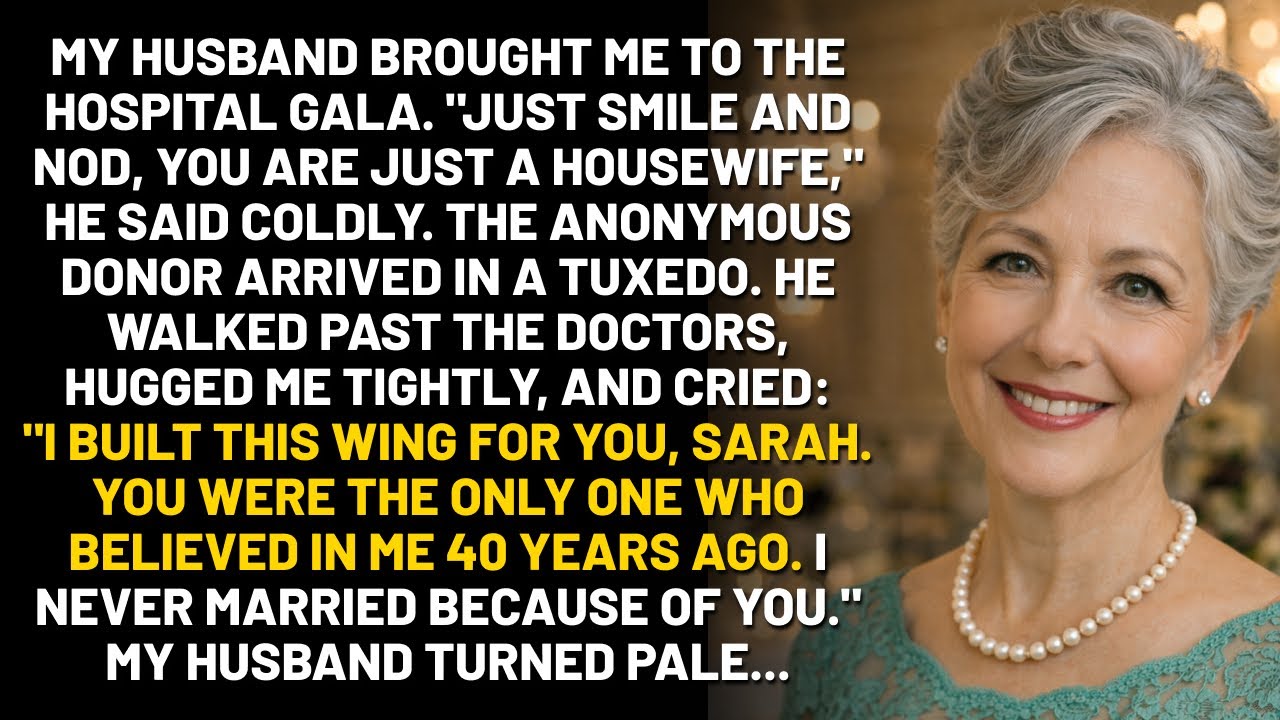
Then they found mine. People stepped aside as he moved through the crowd with purpose. My husband, Wesley, pressed his hand against my back in warning, but I couldn’t feel it. I couldn’t feel anything except the impossible fact that Harrison was standing in front of me.
He ignored Wesley completely. He opened his arms, and without thinking, I stepped into them. “Sarah,” he whispered against my ear, his voice thick. The name cracked something open inside me.
He pulled back, hands still on my shoulders, tears in his eyes. “I built this wing for you. You were the only one who believed in me forty years ago. I never married because of you.
”
The ballroom went silent. Wesley’s face had turned white. “I think there’s been a mistake,” Wesley said tightly. “My wife’s name is Clarissa.
”
Harrison never looked away from me. “Her name was Sarah when I knew her. Dr. Sarah Thompson.
One of the most brilliant medical students I ever studied alongside. ”
Dr. Sarah Thompson. The woman I had been before I became Mrs.
Wesley Hartwell. “Sarah doesn’t exist anymore,” I whispered. “She does. She’s standing right in front of me.
”
Wesley’s laugh was sharp. “My wife isn’t qualified for anything you’re offering. She’s been out of medicine for decades. ”
I felt something burn in my chest.
“I completed two years of medical school with a 4. 0 average. I was accepted into a pediatric residency. You know that.
”
Wesley’s hand tightened on my arm, but Harrison spoke before he could answer. “I’d like to offer you a position. Administrative director of pediatric services. You’d oversee family support programs, coordinate care across departments, advocate for patients.
It’s exactly the kind of holistic medicine you used to talk about. ”
“Clarissa,” Wesley’s voice was ice, “we’re leaving. ”
But I didn’t move. A card appeared in Harrison’s hand.
When I took it, our fingers touched, and I felt something I hadn’t felt in four decades. “My personal number,” he said. “The door is always open. ”
Wesley drove home in silence.
The house on Magnolia Heights looked exactly as it always did—perfect, impressive, cold. Only when the door was locked did he finally turn on me. “What the hell was that? ”
“Harrison Mitchell is someone I knew in medical school.
”
“Someone you knew. ” Wesley stepped closer, his voice dropping to that controlled, dangerous tone. “He called you Sarah. He built you a wing.
He offered you a job, and you stood there like you were actually considering it. ”
“For one second, I was. ”
He poured himself a scotch. “Forty years I’ve given you everything.
A beautiful home, financial security, social standing. I never asked for more than loyalty. ”
“And I’ve been loyal. But you lied to me.
”
“About what? ”
“About why I never became a doctor. ”
Wesley’s jaw tightened. “You made choices, Clarissa.
We made them together. ”
But I had been doing research of my own. That morning, I met Harrison at a quiet cafe called Rosemary’s. He showed me the blueprints for the pediatric wing—warm spaces, natural light, family centers woven into the clinical areas.
He told me the administrative director position was real, with a trial period, a salary, a chance. Then he handed me a manila folder. “I still have contacts at Johns Hopkins. I asked about your academic record.
”
Inside was a letter I had never seen. My acceptance into the pediatric residency program at Children’s Hospital. Full funding. Top of the list.
“I never got this,” I said. “The letters were sent to your home address. The house you were living in with Wesley. ”
Forty years of lies crashed over me.
Wesley had intercepted my acceptance letters. He had told me my grades weren’t strong enough, that I couldn’t handle the pressure, that my dreams were selfish. He had stolen my future and made me thank him for it. When I got home, Wesley was waiting in his study.
“I’ve been making some calls about your friend Mr. Mitchell,” he began. “Concerned about his motives. ”
“What about what really happened with my medical school applications?
”
For a moment, Wesley’s composure slipped. “Your applications were decades ago. Why bring that up now? ”
“Because I found the acceptance letter.
My letter. The one you hid from me. ”
He went still. “I chose you,” I said, my voice shaking.
“I chose based on false information. You deliberately destroyed my chances. ”
Even then, he tried to spin it. “I was protecting you.
The competition, the pressure—medical school would have destroyed you. ”
“That wasn’t your choice to make. ”
“It was for our marriage. For us.
”
“You made sure I never had the chance to find out what I could do. You spent forty years making me feel grateful for the sacrifice you forced on me. ”
He stood by the window, staring at the perfect lawn. “What do you want now?
”
“I’m going to take the job. ”
“You’re sixty-two years old. You haven’t worked in decades. You’ll fail.
”
“Maybe. But maybe I won’t. And I deserve the chance to find out. ”
I left him standing in his study.
That night, I texted Harrison: “I accept the position. When can we start? ”
His reply came within minutes. “I’ll meet you at the hospital tomorrow at 9.
”
Six months later, I stood in my office overlooking the pediatric wing, my name on the door: Dr. Sarah Mitchell, Director of Family Advocacy Services. The first weeks had been brutal. I learned hospital systems and insurance protocols.
I navigated colleagues who saw me as a novelty, a doctor’s wife playing at a career. I proved them wrong. We reduced average length of stay by eighteen percent, improved patient satisfaction scores across every pediatric department, and built a family support program with a waiting list. Elena had become my closest confidant.
“My grandmother used to say a bird in a cage might feel safe, but it never learns to fly,” she told me. The divorce was finalized last week. Wesley fought at first, but the evidence of economic control was clear. I walked away with enough to be independent, and with something more valuable: the knowledge that I was never the failure he convinced me I was.
The morning after the settlement, Wesley called. “I heard about your proposal. Patricia Lennox mentioned it. I’m proud of you, Clarissa.
”
“Thank you, Wesley. ”
“I understand now why you had to leave. I spent forty years trying to keep you safe from failing, and I never gave you the chance to succeed. ”
“I don’t regret our marriage.
But I don’t regret leaving it either. ”
“Are you happy? ”
“Yes. For the first time in a long time, I am.
”
Three weeks later, Harrison asked me to meet him at an address in the arts district. It was a restored Victorian house with a small brass plaque beside the front door. I read it aloud. “The Sarah Thompson Foundation for Medical Education.
Providing scholarships for students pursuing careers in pediatric medicine. ”
“Twelve full scholarships so far,” Harrison said. “Four of those students have finished their residencies and are practicing in rural communities that desperately need them. ”
I walked through the rooms in wonder, reading the stories of young doctors who had gotten chances they never could have afforded.
Kids like I had been. Smart, passionate, determined, without the money to make it real. “Why my name? ” I asked.
“Why not your own? ”
He was quiet for a moment. “Because you taught me something I never forgot. Even during the forty years when I thought I had lost you.
That the best way to honor the gifts we’ve been given is to make sure other people get the same chances. ”
His voice caught. “And because I wanted to create something that would last long after we’re both gone. ”
I turned to face him, tears flowing freely.
“This is the most beautiful thing anyone has ever done for me. ”
“Sarah. ” He stepped closer. “I love you.
Not the twenty-two-year-old student I fell for in medical school. Not an idealized memory. I love the woman you are now. Strong, compassionate, brilliant, brave enough to rebuild her entire life at sixty-two.
”
The words hung between us, beautiful and terrifying and exactly what I had been hoping to hear for months. “I love you, too,” I said. “I think I started falling for you again the moment you called me Sarah at that gala. You were the first person in forty years who saw me as I really am.
”
He kissed me, soft and sweet and full of possibility. A kiss that tasted like second chances and dreams deferred but not destroyed. When we finally broke apart, I looked around the foundation office at the photos of young doctors, at the mission statement, at the physical proof of Harrison’s faith in who I had always been meant to be. “There’s something I want to add to the foundation,” I said.
“Tell me. ”
“A mentorship program. Pairing scholarship recipients with established doctors who can guide them through medical school and residency. People who can help them navigate the challenges and stay focused on why they wanted to become doctors in the first place.
”
Harrison’s face lit up. “Do you have someone in mind to run it? ”
I smiled, feeling the last pieces of my new life clicking into place. “Actually, I think I might know just the person.
“


