The moment my son told me I wasn’t welcome at his house on Christmas Eve, I went cold. Mikael and I had been talking about my famous Christmas turkey—the one with the sage stuffing his mother always loved—and something in his posture shifted. His shoulders pulled together like he was bracing for a blow. “Dad, unfortunately you’re not welcome here on Christmas Eve.
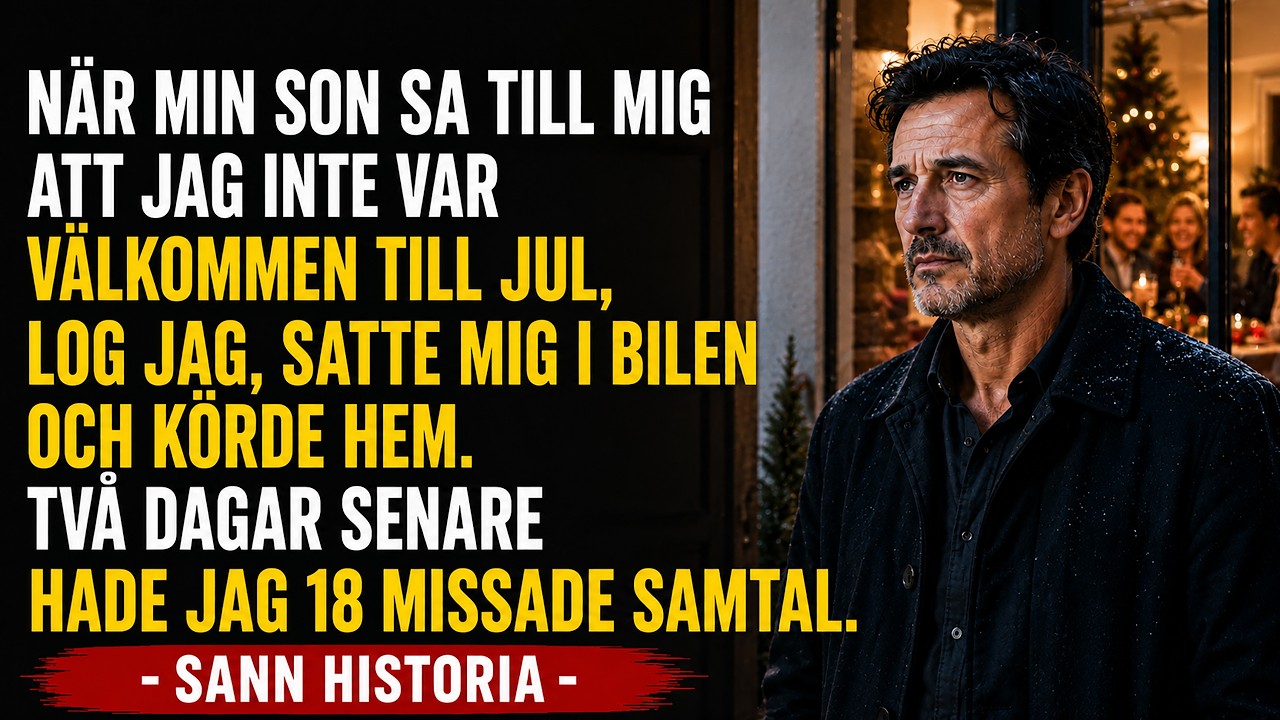
”
The words hit me like a punch to the chest. “What do you mean? Why wouldn’t I be welcome? ”
He couldn’t meet my eyes.
He stared at the marble table I’d helped him choose last spring, when Isabella decided their old furniture wasn’t sophisticated enough. “Isabella’s parents are coming. They’d prefer you not be here. ”
“They’d prefer it,” I repeated slowly.
“And which way is that, Mikael? ”
“Dad, please. Don’t make this harder than it has to be. ”
I looked around the living room.
The silk curtains I’d paid for when Isabella complained about the street view. The hardwood floors financed through my second loan. The crown molding that had pushed my credit card to its limit. Every inch of that house carried my fingerprints, my sacrifices, my love for my son.
None of it was enough to earn me a seat at their table. “What am I supposed to do for Christmas? ”
His face collapsed. “Maybe you could visit Aunt Rosa.
Or we could do something the weekend after. ”
The weekend after. As if Christmas Eve were a meeting that could be rescheduled for convenience. I stood, my knees protesting after eight years of carrying this burden alone.
I walked past the family photographs, my face growing smaller and more distant in every frame. Past the closet full of Isabella’s thousand jackets. The door handle was cold under my palm. “Say hello to Isabella’s parents for me.
”
December air hit my face as I walked toward my old pickup. Behind me, Mikael called my name once. Then the click of the door closing. Final.
Absolute. I sat in the driver’s seat with the engine off, watching Christmas lights glitter in windows where I’d never be welcome. My phone buzzed—probably Mikael wanting to smooth things over with empty promises. I didn’t answer.
Instead, I turned the key and drove into the dark. The numbers had been spinning through my head for months. Twenty-nine thousand kronor, every month, for five years. When I’d finally added everything last spring, my calculator had nearly given up.
More than one and a half million kronor. Maria’s life insurance money. Our pension savings. The fund we’d started for grandchildren I’d apparently never meet.
Gone. All of it, gone into their perfect villa. I pulled into my own driveway, the cracked concrete I couldn’t afford to fix because every spare krona disappeared into their lifestyle. The porch light flickered.
Another repair postponed. The phone rang as I fumbled with my keys. Isabella. She probably wanted to explain why I wasn’t good enough for her parents’ delicate sensibilities.
I’d been waiting five years for this conversation. “Anders,” she said, her voice dripping with false sweetness. “I heard about the little misunderstanding with Mikael. ”
“Misunderstanding?
You made your position very clear. ”
“Look, I know this seems harsh, but you have to understand my parents’ perspective. They’re very traditional people. They expect a certain atmosphere during Christmas.
”
“A certain atmosphere,” I repeated. “What atmosphere would that be? ”
“Well, they’re not used to your type of food. All that spicy food from your old neighborhood.
The loud music. That working-class feeling. And honestly, Anders, they’re educated people. They expect conversations about culture, literature, art.
”
Eight years of swallowing insults for Mikael’s sake. Eight years of pretending I didn’t notice how she looked at me like a hired hand she could order around. My voice stayed flat. “You mean the food you ate every Sunday for three years when times were tough?
The stuffed pirogi you said reminded you of your grandmother? ”
“That was different. We were grateful then. But now, with my parents, we can’t have a builder from the outskirts embarrassing us at a fine dinner table.
”
The sweetness was gone. “Don’t be dramatic, Anders. This isn’t about background. It’s about class.
My father graduated top of his class. My mother speaks four languages. They summer on the Riviera and in Båstad. What would you contribute to the conversation?
Stories about tile and construction dust? ”
Heat flooded my chest, but my voice stayed steady. “I built a company from nothing after your husband’s grandfather died. I’ve employed over fifty people.
I’ve paid more in taxes than your father earned in his best year. ”
“Money isn’t everything. Upbringing matters. Education matters.
And honestly, Maria knew her place better than you know yours. ”
The line went dead silent. She’d crossed a line I didn’t know existed. “What did you say about my wife?
”
“I’m just saying she was better at fitting in. She didn’t make waves. ”
“Maria had more class in her little finger than your entire bloodline will ever have. ”
“Oh, please.
She was a cleaning woman who got lucky. At least she had the decency to keep quiet about it. ”
My voice dropped to something I barely recognized. “Isabella.
Listen very carefully. This conversation is over. ”
She tried to speak. I hung up.
The kitchen felt different. Lighter. As if something toxic had been drained from the air. I walked to my desk and pulled out the brown folder I’d been avoiding for months.
Bank statements. Mortgage papers. Five years of automatic transfers that had drained me while they lived like royalty. Time to stop the bleeding.
I spread the documents across the kitchen table. Twenty-nine thousand kronor on the fifteenth of every month, vanishing from my account into theirs. And beyond that, the down payment. The renovations.
The appliances. The roof repair. The garden work. The furniture necessary for their lifestyle.
“Customer service, this is Jenny. How can I help you? ”
“I need to stop an automatic transfer. ”
“Certainly, Mr.
Lindgren. I see it here—29,000 kronor monthly to Swedbank. How long have you been making this transfer? ”
“Five years.
”
“And you want to stop it with immediate effect? ”
“With immediate effect. ”
“Done. Is there anything else I can help you with?
”
“No. ” The word tasted better than anything in years. “That was everything. ”
I sat in the silence.
For the first time in five years, next month’s budget would balance. For the first time since Maria died, I could fix the porch light, buy proper food, maybe even take a vacation. I took the folder to the fireplace. One match.
Five years of foolishness turned to ash. The warmth on my face felt better than anything I’d felt in years. I poured a glass of the good whiskey, the bottle I’d saved for a special occasion that never seemed to come. Tonight felt special enough.
I raised the glass to Maria’s photo on the mantel. “Merry Christmas to me. ”
—
The next morning, the phone rang at exactly 10:47. Isabella.
“Anders, I need you to pick up my parents at Landvetter. Their flight from Stockholm lands at two. ”
“After yesterday’s conversation, you’re calling me for a favor? ”
“We need to focus on practical matters.
My parents need transport, and you’re the only one free during the day. ”
“And you’re asking me because…? ”
“Because that’s what family does, Anders. They help each other.
” Her voice sharpened. “And honestly, you’re not exactly busy. You’re too insignificant to be my rival, so just get in the car and pick them up. ”
The final insult, delivered like a command.
“Which airline? ”
“SAS flight 447. Baggage carousel three. And dress decently.
They notice things like that. ”
She hung up without saying thank you. At 2:15, I was still in my armchair with a fresh cup of tea and the weekend paper. The phone buzzed.
I let it ring. At 2:47, a message appeared: “Dad? Where are you? My parents are—” I turned the phone face down and went back to the sports pages.
By 3:30, it had buzzed six more times. I switched it off entirely. At five, someone began pounding on my door. Not knocking—pounding, with the rhythm of pure rage.
I opened it to find Carl Johansson’s red face inches from mine. “What the hell is wrong with you? We waited at that airport for over three hours! ”
Katarina pushed past him, her usually perfect hair slightly disheveled, her lips pressed thin.
“This is completely unacceptable behavior from a man your age. ”
Isabella came last, designer coat rumpled, makeup smeared. “You humiliated us. ”
“Get out of my house.
”
Carl’s face deepened from red to purple. “You can’t make demands here, not after what you did. ”
“This is my house. And I want you to leave.
”
Katarina stepped forward. “Anders, you don’t understand the scope of your mistake. My husband has contacts all over this city. Business and social contacts.
You can’t treat people like us this way—”
“This is a lesson about your arrogance and how you treat people you consider beneath you. ”
Isabella’s mouth dropped open. “A lesson? Who do you think you are?
You’re nobody—”
“I’m someone who finally stopped being your personal bank and taxi service. ” I opened the door wider. “The lesson is over. Leave.
”
Carl jabbed a finger at my chest but didn’t quite touch me. “You have no idea who you’re dealing with, old man. I know people. People who can make your life very difficult.
”
“Is that a threat? ”
“It’s a promise. ”
Katarina nodded. “Exactly.
Actions have consequences, Anders. And yours will be very public. ”
They marched out like a defeated army. Carl turned at the threshold.
“You’ll regret this. ”
I locked the door behind them and watched them drive off into the December night. —
Three days later, I saw my own face staring back at me from page three of the Göteborgs-Posten. “LOCAL BUSINESSMAN ABANDONS ELDERLY COUPLE AT AIRPORT DURING HOLIDAY WEEKEND.
”
Carl had painted himself and Katarina as helpless victims, stranded in dangerous cold. The article hinted at my unstable mental state. No mention of being uninvited from Christmas dinner. No context about five years of financial support.
Just me, the villain who’d abandoned poor elderly people in conditions that never existed—it had been five degrees and clear. They’d declared war. Fine. I’d show them what war actually looked like.
I spent the next three days in the same focused state that had once built my company from nothing. Carl Johansson, retired bank director, member of the Gothenburg business club. A man with a career built on trust. A man with a lot to lose.
Katarina’s Instagram showed charity lunches and Riviera vacations. Isabella’s Facebook showed the kitchen I’d paid for, check-ins at expensive restaurants during months I was covering their electricity bills. Mikael’s LinkedIn revealed a new connection: Patrik Mörk, the lifestyle editor who’d written the hit piece. They’d made three mistakes.
They’d underestimated me. They’d gone public, which meant I could go public too. And they’d documented their entire parasitic lifestyle online. I opened a document and began to write.
A timeline. Five years of payments. The down payment of 470,000 kronor from my second mortgage. Kitchen renovations on my credit card.
Sixty monthly mortgage payments of 29,000 kronor. Over two million kronor total. More than I’d spent on myself in a decade. On Christmas Eve morning, I put on my best suit and drove to their villa in Askim.
Cars lined the driveway. Through the windows, I could see people gathering around the table. Twelve guests. 6:45.
Perfect timing. Late enough for everyone to be seated. Early enough that the main course was still being served. The front door was unlocked.
Of course it was. Isabella loved boasting about how safe their neighborhood was, unlike the rougher areas people like me came from. I walked into the dining room, briefcase in hand. Twelve faces turned toward me.
Isabella froze with her wine glass halfway to her lips. Mikael went pale. Carl and Katarina looked like they’d seen a ghost. “Good evening, everyone,” I said calmly.
“I hope you don’t mind me joining your celebration. ”
“Anders, this is completely inappropriate—”
“Actually, I think your guests deserve to know who paid for this dinner. ” I opened the briefcase and began placing a packet in front of each person. “Bank statements.
Five years of financial support. Over two million kronor in mortgage payments, down payment, renovations, furniture, appliances. Everything you see around you. ”
The room fell silent except for the rustle of paper as twelve people began reading.
Isabella’s composure cracked. “It’s more complicated than it looks—”
“I also brought the newspaper article,” I said, placing copies on the table. “The one where Carl and Katarina told all of Gothenburg I’m mentally unstable. Notice they left out the part where they’d forbidden me from attending this dinner because I wasn’t refined enough for their company.
”
An older man looked up from the article. “Carl, what is this about? ”
“The weather was five degrees and clear,” I said. “They weren’t stranded tourists.
They were Isabella’s parents, on their way to the dinner I’d been excluded from because a builder from the wrong part of town would embarrass them. ”
Katarina found her voice. “He’s twisting everything—”
“Mrs. Johansson, I’ve supported your daughter and son-in-law with nearly thirty thousand kronor a month for five years while you looked down on me.
And when I stopped, you tried to destroy me. ”
An elderly woman in a pearl necklace set down the papers. “How could you let your daughter treat this man this way and then attack him publicly when he stopped? ”
“You don’t understand—”
“I understand perfectly.
This man supported your family while you treated him like a servant. ”
I closed my briefcase and straightened my tie. “Enjoy the rest of your dinner. It’s the last one I’ll be paying for.
”
Behind me, the arguing began. Voices raised in accusation. The sound of a carefully built social facade collapsing. It was the most beautiful Christmas music I’d ever heard.
—
The letter came on a Tuesday in March. Certified mail. Notice of payment default. Three months of missed mortgage payments had caught up with them.
Eighty-seven thousand kronor in arrears. Fourteen days to settle the account or face foreclosure. I set the letter aside and went back to my coffee. My phone had been ringing for weeks.
Isabella’s number I blocked after the first hysterical voicemail. Even Mikael called—I ignored him, curious how long it would take him to swallow his pride. The answer was 97 days. He knocked on my door on a Thursday evening.
Not the confident man who’d uninvited me from Christmas, but someone who looked a decade older. Dark circles under his eyes. An expensive suit wrinkled. Desperation clinging to him like cheap perfume.
“Dad. We need to talk. ”
I let him in. He looked around my house like he was seeing it for the first time.
The new furniture. The fresh paint. The repairs I’d finally been able to afford. “Nice here,” he said quietly.
“That’s what happens when you spend money on yourself instead of people who don’t appreciate it. ”
He flinched, then sat on the edge of the couch. “Dad, I’m so sorry. For everything.
The Christmas dinner. The article. The way Isabella—” He ran his hands through his hair. “I didn’t know Carl planted that story.
I swear. The things they said about you, about Mom… ”
My jaw tightened at the mention of Maria. “What did they say?
”
“That she knew her place better than you knew yours. ” He couldn’t look at me. “I should have defended you. Years ago.
”
“Yes,” I said simply. “You should have. ”
We sat in silence for a long time. Five years of mistakes filled the space between us.
“The house is going into foreclosure,” he finally said. “We can’t make the payments without—” He stopped. “Without my money. ”
He nodded miserably.
“Maybe we can start over? I know it looks bad, but—”
“You can’t start over by going back to the same arrangement that got us here. I funded your lifestyle for five years while you let her family treat me like something to be hidden away. ”
He started to cry, quietly.
“I lost you. I chose them, and now I’ve lost you for good. ”
“You didn’t lose me. You gave me away.
That’s different. ”
The words hung between us. “Is there any way you could forgive me? ”
“I forgave you months ago.
But forgiveness doesn’t mean pretending this never happened. ” I stood and walked to the mantel, where Maria’s photo sat beside a new one—me with Rosa and her family at Easter dinner, the first holiday I’d spent with people who actually wanted me there. “It means if you want a relationship with me, you build it from the ground up. You show me respect instead of demanding I earn it.
And the next time someone tries to shut me out of a family gathering, you remember who actually behaves like family. ”
He nodded slowly, understanding something he’d never understood before. “The house isn’t your problem anymore,” I said. “You’re a grown man.
Sell the house. Buy what you can afford. Stop living beyond your means and expecting others to cover the difference. ”
He stood slowly, his shoulders straighter than when he’d arrived.
At the door, he paused. “Dad, for what it’s worth—when I saw you stand up for yourself on Christmas Eve, I was proud of you. Angry too. But proud.
”
“Then maybe there’s hope for you yet. ”
He left. I poured a glass of good whiskey and stepped onto the back porch. Spring was coming to Gothenburg.
The trees were starting to bud. Maria had been gone eight years. I’d wasted five of them being a doormat for people who saw me as a wallet with a pulse. I wasn’t going to waste any more.
My phone buzzed. A message from Rosa: “Dinner Sunday. The kids want to show you their school project. ”
I smiled and wrote back.
“Wouldn’t miss it. ”
Real family, it turned out, was something you found with people who actually wanted you there. Everything else was expensive theater. I was done buying tickets to shows where I wasn’t welcome on stage.
The whiskey tasted like freedom.