The old woman put down her fork in the restaurant car. For twenty minutes she had talked about weather, prices, grandchildren, and her vegetable garden. Then her voice stopped as if the thread had been cut. “When did you last see your mother-in-law?
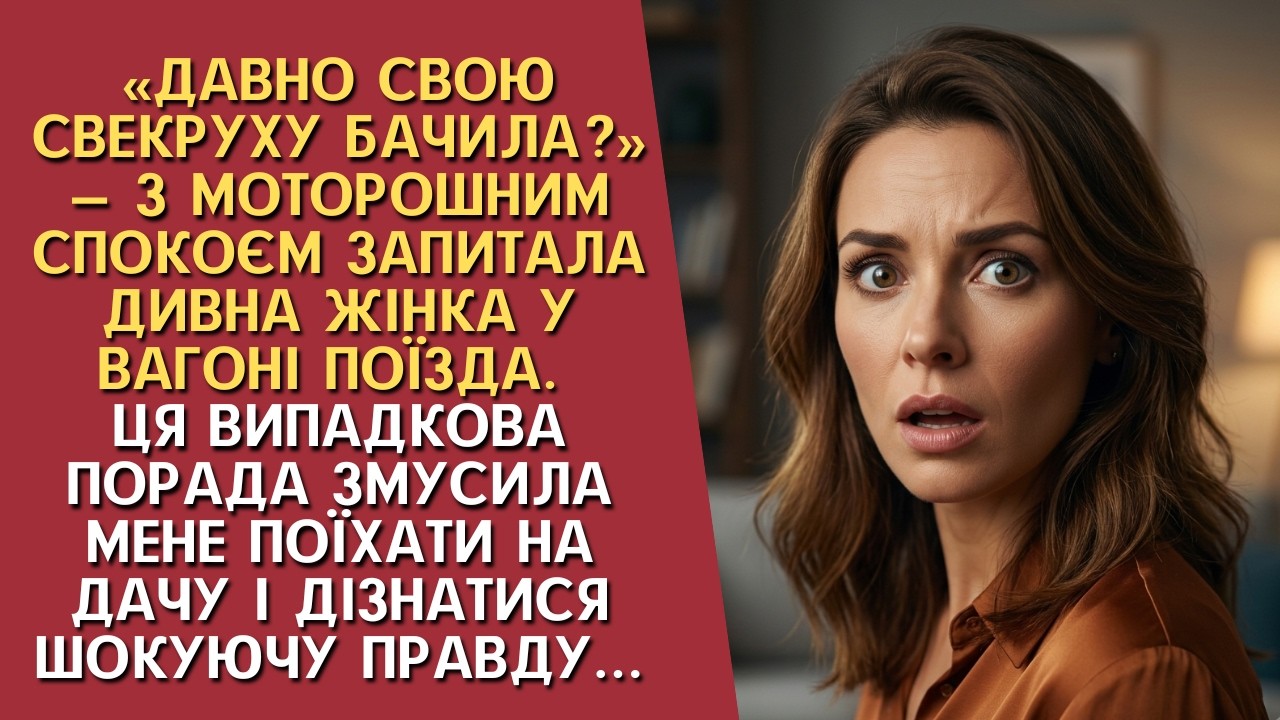
”
Solomia choked on her double espresso. The hot coffee burned her throat, and tears stung her eyes. “Excuse me? ”
“Your husband’s mother.
When did you last see her face to face? ” The woman’s tone had changed completely. No more cheerful chatter, no more village warmth. Her eyes were sharp and insistent.
“A long time ago. Two years, maybe. ”
“Ah, daughter. ” The old woman shook her head slowly.
“That is not good. That is not good at all. ”
Solomia forced a polite smile and said nothing. She paid, walked back to her seat, and opened her laptop.
But the financial reports blurred in front of her. The stranger’s words stayed with her, heavy and cold. Her mother-in-law was Halyna Petrivna, the mother of her husband Maksym. For seven years the two women had circled each other like strangers sharing a border.
Every visit ended with the same bitter questions: When will you have children? Why do you spend your life in offices? Do you know what a home looks like? Solomia stopped going.
She told herself it was self-protection. But the question had opened a door. As the train cut through the dark autumn landscape, she thought about Nazar, the man she had left at the station. He had held her leather suitcase like it was his only anchor.
She had kissed his unshaven cheek and pretended not to feel his stare. She knew he loved her, had known since high school, since they shared the same desk and stayed late together in the after-school group. He had always been ready to drop everything for her. She had given him nothing except a faint wash of guilt when the train carried her away.
Her calendar was full. Her life belonged to Maksym and to the granite business, to export contracts and meetings that ended after midnight. Maksym had not called in three days. She had not called him either.
At first his silence had hurt. Now it was just the rhythm of their marriage. In the beginning he had burned with jealousy. He hated her late nights, her trips, her love for winning.
She promised it was temporary—one more contract, one more tender, and then they would have everything. He had stopped fighting faster than she expected. The phone calls stopped. The accusations stopped.
They learned to live under one roof without living together. When the train arrived, Solomia did not give the taxi driver her home address. She gave him Halyna Petrivna’s house on the dark edge of the city. She told herself it was a surprise for Maksym.
He often spent long days at his mother’s house, fixing the roof, tending the garden. She would walk in and tell him she was ready to slow down. Ready for a child. The thought was terrifying, but it felt like the first honest thing she had allowed herself in years.
The house was dark and unwelcoming. She knocked on the gate, then on the door. She heard footsteps, but no one opened for a long time. At last the lock clicked and Halyna Petrivna appeared in her robe, surprised and uneasy.
“Solomia? At this hour? ”
“I came from my trip. I thought Maksym would be here.
He didn’t answer my calls. ”
“He was here. He left about an hour ago. ” The older woman’s eyes slid away too quickly.
“You should have warned us. We would have prepared. ”
It was too late to turn back. Halyna made tea, clattered cups, and asked sharp questions about Solomia’s career.
“You still live in hotels? ” “Somebody has to secure our future,” Solomia answered. “At least my Maksym is not like that. He values his family.
” Solomia pressed her lips together. She went to bed early and fell into a dreamless sleep, but the house woke her with its silence. It was nine in the morning. Her mother-in-law had gone out, leaving a note on the kitchen table.
To occupy herself, Solomia began dusting the living room. Dust had settled thickly over everything. On the old dresser, a drawer was stuck half open. She pulled it free.
Inside lay framed photographs. A small curly-haired boy. The same boy a little older, laughing. Then a photograph that made her hands go cold: Maksym held that boy in his arms.
His face was soft with a tenderness she had never seen directed at her. She reached for the next frame. Maksym was kissing a young woman with long dark hair. Her hand rested on her round belly, and his hand covered hers.
“Found them. ”
Solomia spun around. Halyna Petrivna stood in the doorway, a bag of milk in her hand, her face completely calm. “Your own fault,” she said, walking into the kitchen.
“You never paid attention to your husband. He needed a real family, not a cold partner who lives in airports. ”
“Her name is Olena. The daughter of my old friend.
She loves him sincerely, not for his money or his connections. Their son Kostyk is already two. ” She placed the milk on the table and showed no guilt at all. “I introduced them.
I saw my son suffering beside you, so I brought him to a woman who values family. He stays with you only because of your company and your money. You built it all yourself. Now you pay for it.
”
Solomia did not scream. She did not break anything. The same cold mechanism that had won her corporate battles switched on. She placed the photograph back, pushed the drawer closed, took her coat and suitcase, and walked out without a word.
The divorce was fast and ruthless. Her lawyers acted immediately. Because the company was registered in her name, because the apartment and the car belonged to her parents, Maksym left with nothing. He called, texted, waited outside her door, swore it was all a mistake.
Solomia listened through the locked door and remained silent. A week later Nazar appeared on her doorstep, pale and exhausted. “Forgive me,” he said. “I should have told you everything.
Two months ago I saw Maksym in Bukovel with his mother, a young woman, and a child. They looked like a real family. I was afraid you would not believe me, so I paid the woman on the train to point you toward your mother-in-law. ”
Solomia stared at him.
The old woman’s strange question suddenly made sense. She should have felt betrayed. Instead she wrapped her arms around him and finally cried. He stayed.
He stayed through the long, dark evenings and the sleepless nights. He made her breakfast, set a warm cup of coffee in front of her, and stayed quiet when she needed silence. He asked for nothing and waited for nothing. Six months later she sold the granite business.
Her old partners called it madness. But Solomia no longer needed to win. She returned to Zhytomyr, to the city where she and Nazar had grown up. With the money from the sale, she opened a small bakery and coffee shop in the old town.
No more boardrooms, no more midnight negotiations. The air smelled of cinnamon, hot bread, and strawberry jam. A year after that their daughter was born. She had dark curls and a snub nose like Nazar’s.
He became a different man around her, waking at the first sound, singing old songs, carrying her through the apartment as if she were the most precious thing in the world. Solomia watched them and understood how many years she had spent building a life that gave her status but left her empty. One morning Nazar came back from the park with their daughter on his shoulders and a handful of crimson and golden autumn leaves in his hand. Solomia hugged them both and breathed the cold autumn smell from their clothes.
She did not check her watch. There was nowhere else she needed to be.