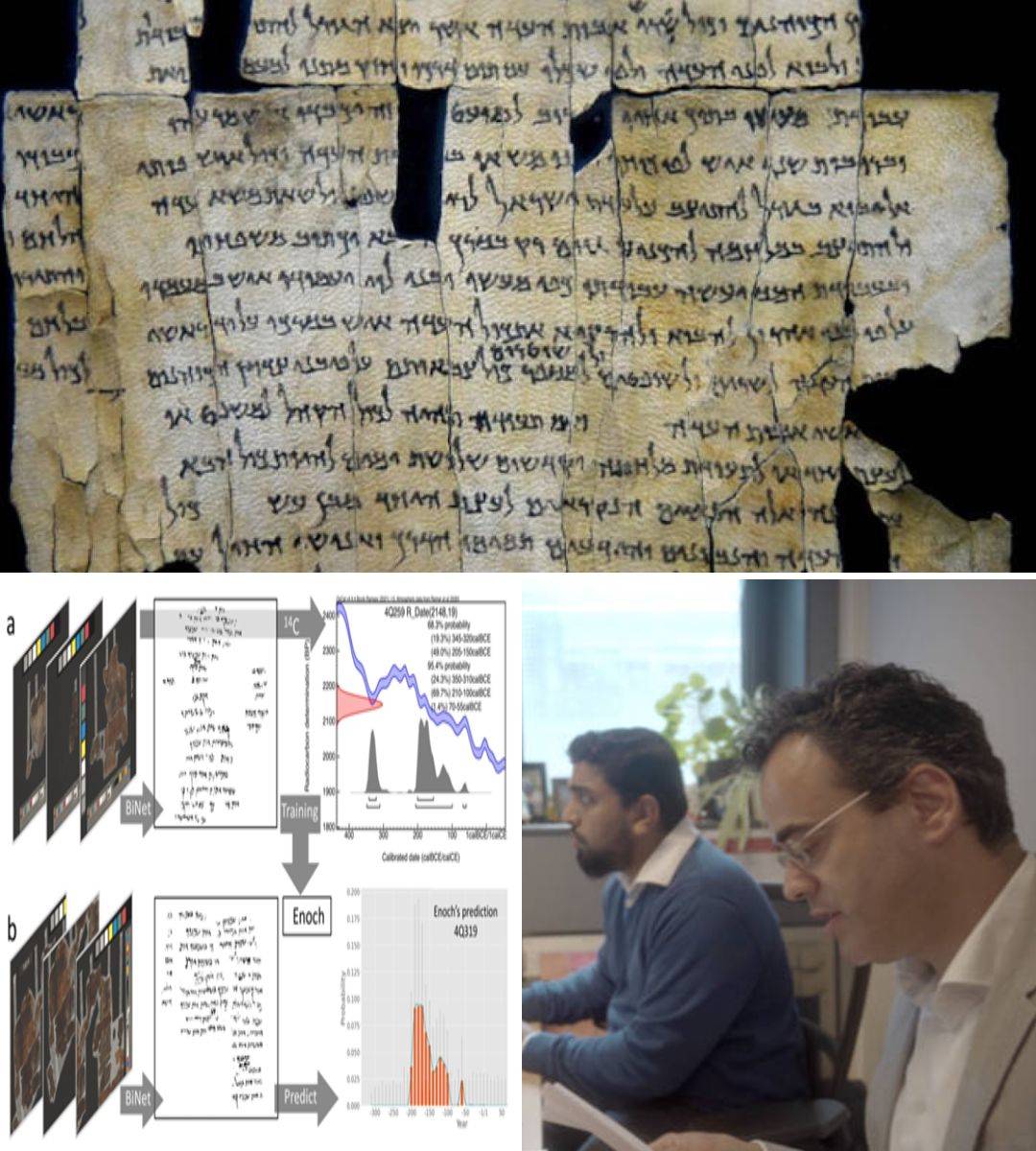
In a stunning revelation that could reshape our understanding of ancient texts, a team of international scholars has harnessed the power of artificial intelligence and radiocarbon dating to provide new insights into the Dead Sea Scrolls. For over 70 years, these ancient manuscripts have captivated scholars and enthusiasts alike, but their dating has long remained a murky mystery.

Led by the University of Groningen, researchers have introduced an innovative AI model named Enoch, which has allowed them to re-evaluate the ages of these scrolls. Remarkably, many of these ancient texts now appear to be significantly older than previously believed. This breakthrough not only strengthens the timeline of hundreds of manuscripts but also for the first time, links two biblical fragments to the time periods of their supposed authors.
Since their discovery in the Qumran caves between 1947 and 1956, the Dead Sea Scrolls have transformed our understanding of early Judaism and Christianity. They contain some of the oldest known biblical texts, as well as writings that shed light on ancient legal codes and sectarian beliefs. Accurately dating these scrolls is crucial for grasping their historical context, authorship, and impact.

Historically, scholars have relied on paleography, the study of handwriting styles, to date these manuscripts. However, this method has its limitations, often being subjective and lacking solid empirical support. The absence of securely dated reference manuscripts from the critical period between the fifth century BC and the first century AD has left many scrolls without precise dates.
Enter Enoch, a groundbreaking tool developed through the ERC project The Hands that Wrote the Bible. By combining carbon-14 dating from 24 samples of the Dead Sea Scrolls with advanced AI handwriting analysis, Enoch bridges the gaps in our chronological understanding. The model utilizes a deep neural network called BiNet, which identifies micro-level ink patterns in digitized manuscripts.
Through Bayesian ridge regression, Enoch correlates specific handwriting traits with known radiocarbon dates, effectively learning how script styles evolved over time. This allows the AI to predict manuscript dates with an impressive accuracy of ±30 years, often surpassing the precision of carbon dating alone in the 300-50 BC range.
In testing Enoch on 135 scroll fragments, paleographers were able to glean new insights into the timeline of manuscript production. For example, several scrolls once thought to originate from the late Hasmonaean period (circa 150-50 BC) are now believed to be even older. Additionally, the Herodian script, previously thought to have emerged in the mid-first century BC, may have been in use as early as the late second century BC.
This new understanding of script evolution paints a more intricate picture of literacy and scribal practices during a time of political upheaval, including the Hasmonaean uprising and the rise of Roman power.
Among the most exciting findings is the precise dating of two biblical manuscripts to the eras traditionally associated with their authors. Fragment 4QDanielc (4Q114) aligns with the early 160s BC, coinciding with the final editing of the Book of Daniel. Similarly, 4QQoheleta (4Q109) has been dated to the third century BC, aligning with the scholarly consensus regarding the composition of Ecclesiastes.

While Ecclesiastes has often been attributed to King Solomon and dated to the tenth century BC, most scholars now agree on a later Hellenistic origin. The Enoch model provides the first empirical evidence supporting these academic theories, paving the way for deeper exploration into the development of biblical literature.
Professor Mladen Popović, director of the Qumran Institute, and Dr. Maruf Dhali, an AI expert at the University of Groningen, spearheaded this interdisciplinary research, merging physical sciences with digital analysis to achieve a level of objectivity previously unattainable in manuscript studies.
Dr. Dhali describes Enoch as the first comprehensive machine-learning model that utilizes raw image inputs to generate probabilistic dating predictions for ancient texts. Its transparency and explainability make it a valuable resource for studying other manuscript traditions beyond the Dead Sea Scrolls.
With the potential to refine and challenge existing paleographic assessments, Enoch is set to become a pivotal tool in ancient textual scholarship. By anchoring these texts more accurately in time, researchers can gain a better understanding of the sociopolitical and religious contexts that shaped them.
As we delve deeper into the mysteries of the past, one question lingers: what other secrets might the Dead Sea Scrolls still hold?