
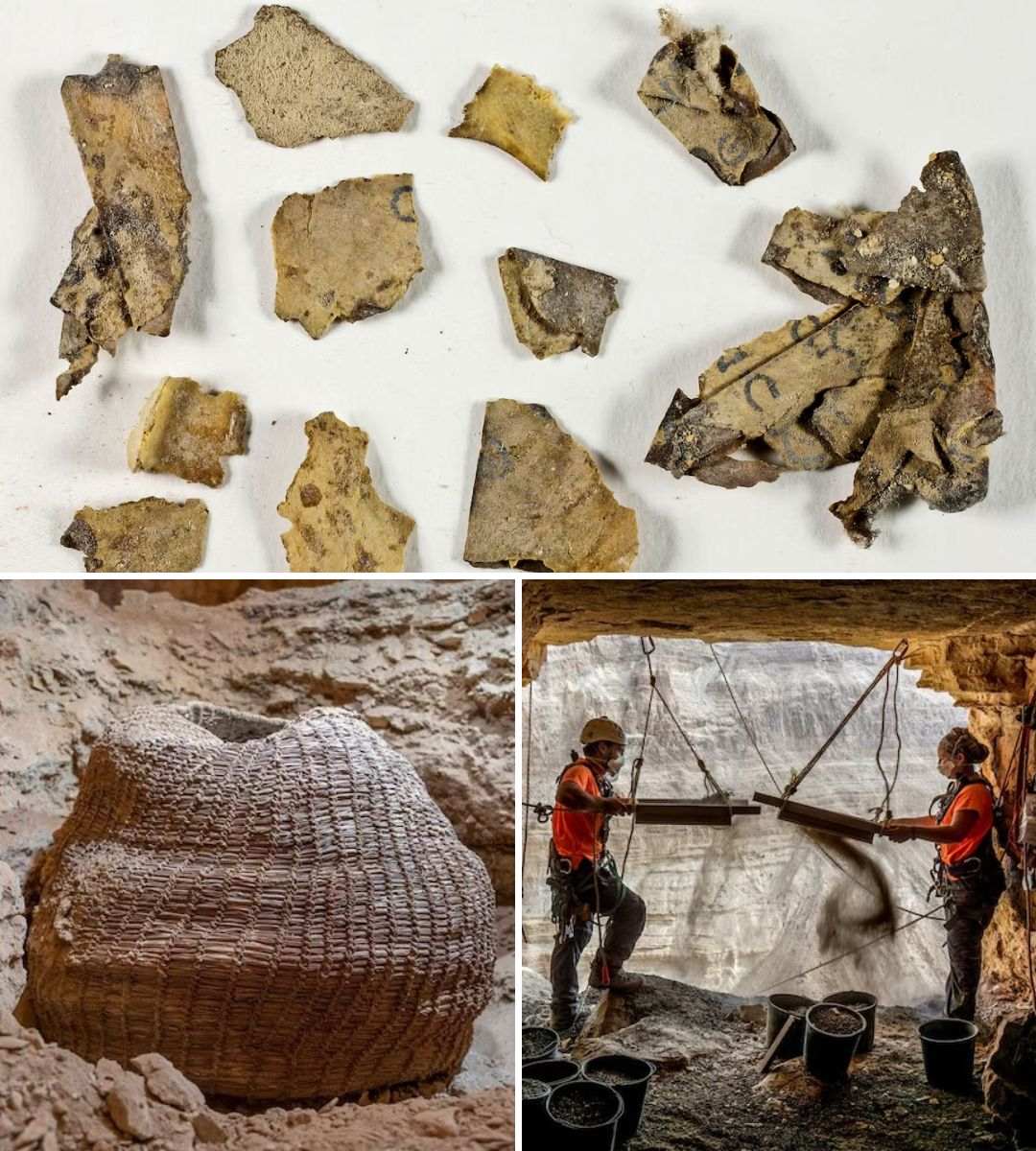

In a groundbreaking archaeological endeavor, the Israeli Antiquities Authority (IAA) has unveiled the first Dead Sea Scroll fragments discovered in over 50 years, alongside what might be the world’s oldest intact basket. This thrilling revelation comes from a multi-year mission aimed at preventing looting in the Judean Desert’s remote caves.
Amir Ganor, head of the IAA’s theft-prevention unit, shared insights into the challenging efforts to protect these invaluable artifacts. “For years, we chased after antiquities looters. We finally decided to preempt the thieves before artifacts are removed from the ground and the caves,” he stated in a recently released video.

Launched in October 2017, this ongoing project has led archaeologists to survey around 600 caves across a 45-mile stretch of desert cliffs, encompassing both Israel and parts of the occupied West Bank. While international law typically restricts archaeological work in these territories, the Israeli government argues that emergency salvage operations are justified when cultural heritage is at risk.
The project aims to catalog the caves and document their archaeological significance, ultimately assisting the IAA in identifying sites vulnerable to looting. Eitan Klein, deputy director of the theft-prevention unit, noted, “We know exactly where there is a chance to find artifacts, and where the looters can dig but will not find anything.”

The remarkable scroll fragments were unearthed in Cave 8, known as the “Cave of Horror,” during excavations in late 2019 and early 2020. This cave has a haunting history, having been the resting place of 40 individuals, believed to be Jewish victims fleeing Roman forces during the Bar-Kokhba Revolt of A.D. 132-135. Accessing the cave required specially trained archaeologists to rappel down a sheer cliff face, a feat reminiscent of ancient methods.
The newly discovered fragments belong to the Minor Prophets Scroll, which was first identified in Nahal Hever by local Bedouins in the 1950s. Oren Ableman, a researcher in the IAA’s Dead Sea Scrolls unit, explained that these fragments, written in Greek by two different scribes, share similarities with previous finds. The scroll includes prophetic texts found in both the Jewish Bible and the Christian Old Testament, with deciphered lines revealing messages from the prophets Nahum and Zechariah.
Christopher Rollston, a professor at George Washington University, emphasized the significance of these fragments, stating, “Nearly every time a new fragment of a biblical text is found, it sheds crucial new light on ancient scribes and textual traditions.” Notably, references to God’s name are inscribed in an archaic Paleo-Hebrew script, a practice that highlights the historical reverence for the divine name.

In addition to the scroll fragments, archaeologists made a chilling discovery in the Cave of Horror: the remains of a child buried approximately 6,000 years ago. Other artifacts, including coins from the Bar-Kokhba Revolt, sandals, and arrowheads, were also found, revealing a rich tapestry of history.
Meanwhile, another astonishing find emerged from Cave 4 at Wadi Muraba’at, where an intact basket estimated to be around 10,500 years old was uncovered. This remarkable basket, woven from plant materials and featuring an intact lid, stands as a testament to early human craftsmanship. Bill Finlayson, project director at the Endangered Archaeology in the Middle East & North Africa program, remarked on the rarity of such well-preserved organic remains.
Archaeologists are intrigued by the basket’s purpose and why it was left in a cave near the Dead Sea, far from the fertile regions where early agricultural communities thrived. Edward Banning, an archaeologist at the University of Toronto, speculated on the possibility of Neolithic peoples harvesting salt for trade.
As researchers continue to study these extraordinary finds, one can only wonder what other secrets the ancient caves of the Judean Desert might still hold.


