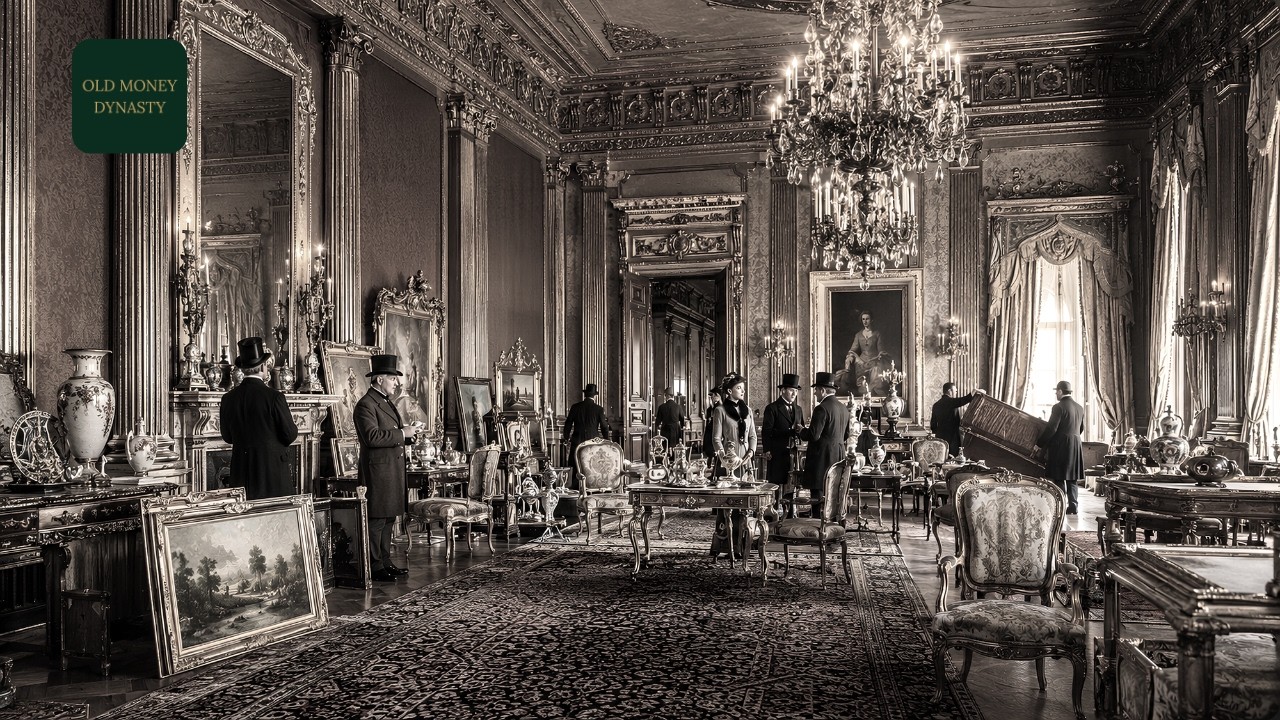
The arithmetic of a vanished world is laid out with brutal clarity in the ledgers of the American Art Association and its successor, Parke-Bernet. For seventy-five years, this single corporate lineage presided over the serial dismantling of America’s grandest private homes, from the 1880s Gilded Age palaces of Fifth Avenue to the final, fully staffed cottage in Newport that fell in 1962. What the catalogues and sales statements reveal is not a story of moral punishment for excess, but a colder, more precise measurement of the gap between what a life costs to assemble and what it brings when broken into numbered lots and offered to strangers.
The origin of this vast documentary record lies in a concert hall on Fifth Avenue. On the evening of March 23, 1887, a crowd gathered at Shering Hall for the sale of the estate’s contents from the marble palace of Alexander Turney Stewart, the Irish-born merchant prince who had built a dry goods empire and left an estimated fortune of up to sixty million dollars. The catalogue for the event was a symbol of the world being sold: a two-hundred-fifty-page volume, bound in red cloth with gilt edges, its awkward size and production cost a deliberate marker of social standing.
 The star lot was a battlefield scene by the French painter Jean-Louis-Ernest Meissonier, acquired eleven years earlier. The art world had waited months for its sale. The hammer fell at sixty-six thousand dollars, and the buyer was Henry Hilton, the judge and family attorney who had been appointed to settle the widow Cornelia Stewart’s estate—an executive buying back the goods he was duty-bound to disperse.
The sale moved uptown to the American Art Gallery and promptly stopped working. The audience went silent. Bids failed to reach figures deemed acceptable.
The catalogue had famously announced a sale without reserve, yet reporting from the final session described reserve prices that could not be met. A marble sculpture by Hiram Powers, one of the most celebrated American artists of the era, went unsold. Henry Hilton bought the statues himself.
The marble that had been destined for strangers’ hands went back into its old corner of the house on Thirty-fourth Street, where it would sit for another three years before the building was demolished.
The scene was a portrait in miniature of a structural flaw in the entire machinery. An auction room can process a painting, a chair, a set of plate. It is defeated by what must be dismantled for delivery or by what is worth less than the cost of moving it.
For those things, a different marketplace operates—one that does not print catalogues. Clarence McKay’s mansion at Roslyn on Long Island, a Stanford White design built on a silver fortune from the Comstock Lode, was blasted in 1947. Before the dynamite detonated, the wreckers stripped out one hundred tons of cast iron and sold it by weight, at scrap prices.
No record of that transaction survives.
 The same cold logic consumed the architectural golden age. *Caroline Astor’s life, which had defined the social and social standards of New York, had a mansion built in 1894-1896 by Richard Morris Hunt, modeling his design on a sixteenth-century French chateau. After the death of John Jacob Astor IV on the Titanic in 1912, his son Vincent, who had no interest in supporting the place, sold it to the land that same year.
In April 1926, the American Art Association sponsored a two-day public viewing of the interiors before the contents were auctioned, with a number on every surface. The sale list is a brutal inventory of the entire building, including the marble statues and the bronzes, the furniture and the silver, the carpets and the “painted insets,” and the “carved wood wall paneling,” which could be unscrewed and lifted out.
This was the central event that set the stage for the genealogy that the Archives of American Art, containing nearly 28 linear feet of ledgers, sales statements and surveys, and a thousand photographs at the Frick, reveal in exacting detail from the same firm that ran the business, a change of ownership in 1929 with Anderson Galleries, then a 1938 merger. The curtains closed three years later when the combined firm renamed the two executive voices hired by the new owner, Courtland Field Bishop. It was known as Park-Bernet Galleries.
By that time, the Harvey Stewart selling had long since demonstrated that the bidding room held no memory of what any object had cost. The same held true for the stuff of the White Marsh Hall, a 147-room, six-story, 100,000-square-foot wedding gift built by Eva Stotesbury outside Philadelphia. It cost roughly ten million dollars to build, and a million a year to run, and, after the death of her husband, the banker Edward Stotesbury, in 1938, the fortune had dwindled to as little as four million dollars.
When the Widow Stotesbury was 79 in November 1944, the Park-Bernett sale lot came up for sale on the “late Edward T. Stotesbury.” The sale moved quickly, with a Raeburn portrait as the first lot.
She had already sold the jewelry, even the pearl necklace worth 1912, her wedding had cost close to half a million.
 Barre can also be a symbol of the industrial limits of the auction room. The theme of what happens when desire is trapped in a broken mechanism is best seen in the The Elms. A thirty-thousand-square-foot home in Newport, Rhode Island, it was the last remaining house on Bellevue Avenue with a working household and 40 servants into the 1960s.
Its owner, Julia Berwin, had been the hostess for her coal-baron brother, Edward, who died in 1936, on the condition that she maintain his estate in perfect order. She continued, until death at 91 in 1961. After her passing, the house was sold to out-of-town developers who had cleared the site.
In June 1962, Park-Bernet arrived at Bellevue Avenue for the sale of 684 lots. Two days of sales realized just over $70,000. It was enough.
A market downturn that hit the developer’s finances and the preservation instincts of the Newport Historical Society raised $116,000 to buy the house, garden and guest cottage. The contents of the building had still brought in nearly double the price of the structure that contained it. The Elms, which came to be a museum, became a symbol of a structural truth that it had taken the highest-Gilded Age to learn.
The object inside was worth more than the shell.
The market’s indifference to sentiment was unionized in the greatest single disposal of all—the liquidation of William Randolph Hearst. By 1937, the newspapers and the body had stopped buying. The largest private collector in the world, displaced by insurmountable debt, took his largest private collection in America, estimated to have been bought over thirty years for tens of millions of dollars, not into an auction room, but onto the fifth floor of Gimbels department store on 34th Street, the largest in the world.
 It was sold by weight and measure. That collection. Instead of a sale room, a crowd is at a clearance counter, items marked with price tags beside a cash register.
When the page of a big city newspaper finally goes to the archival library, it is not a catalog of dirges but of survival, of which the greatest collections of the era survive better than the houses themselves. A Rose from. Single piece of Ashton painting that went for more than expected, $66,000 at Sherring Hall, is now at the Metropolitan Museum and hangs a few miles from the corner where it sold.
The ornate rooms of the Astor mansion did not go to the the but to the gate of the Ring Brothers on a whim a decade later, and await the visitors in Sarasota, Florida. The extensive Hearst collection, including the European architectural portions, is now in universities and public museums across the country.
The Hearst’s Spanish monastery, dismantled and stored in 14,000 crates in the Bronx, never reached California. It was bought by developers and reassembled as a tourist attraction in North Miami Beach. The library’s archive remains open to any researcher who wants to request an appointment.
The shifted weight of the story is the movement from the private to the public sphere, a shift which auction houses orchestrated meticulously. The auctions did not punish the families. They simply reported the market’s terms on a particular Tuesday.
At the heart of this mechanism is the dagger, a copper-bladed knife with two ridges and an ebony and alabaster handle, bought for $40 in 1913 by Hearst, sold for $19 in 1941. The family had c cntr intersection. What the catalogue survives, the ledgers and printed in a record, the final disposition of the dagger, the details, down to 88 cents, precisely what was paid for a life that was, at the end of the day, assessed piece by piece by strangers in a room, or over a department store counter.
The only conclusion is that the market has no memory of a sacrifice. It only reports back, in detail, the price of not needing a thing at a specific time.