
The woman kneeling in the wet grass outside Dexter, Iowa, on the morning of July 24th, 1933, could not see the men closing in around her. She could not see the guns raised in her direction, nor the trees that framed the ambush. Five days earlier, a spray of shattered glass from a bullet-riddled car window had ended the sight in her left eye for good, leaving her world a blur of shapes and shadows.
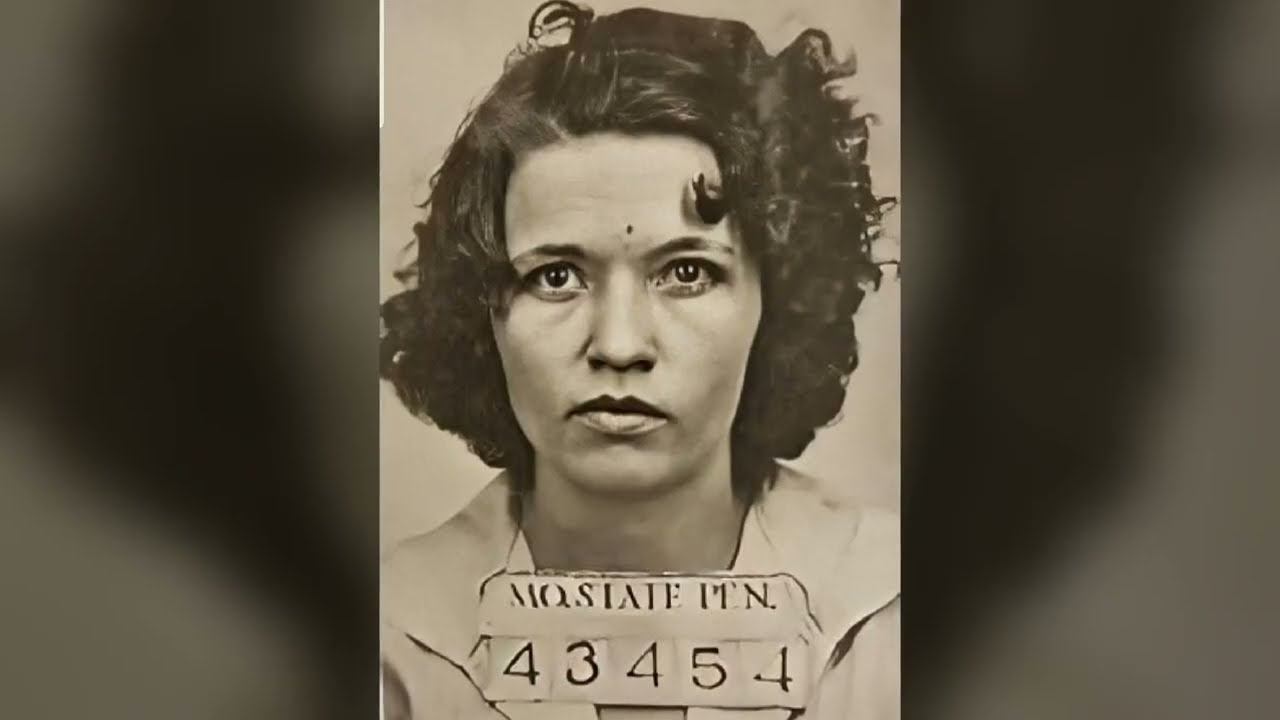
Her name was Blanche Barrow, and she was 22 years old, holding the head of her mortally wounded husband, Buck, in her lap as the world she had fought to build collapsed into the mud.
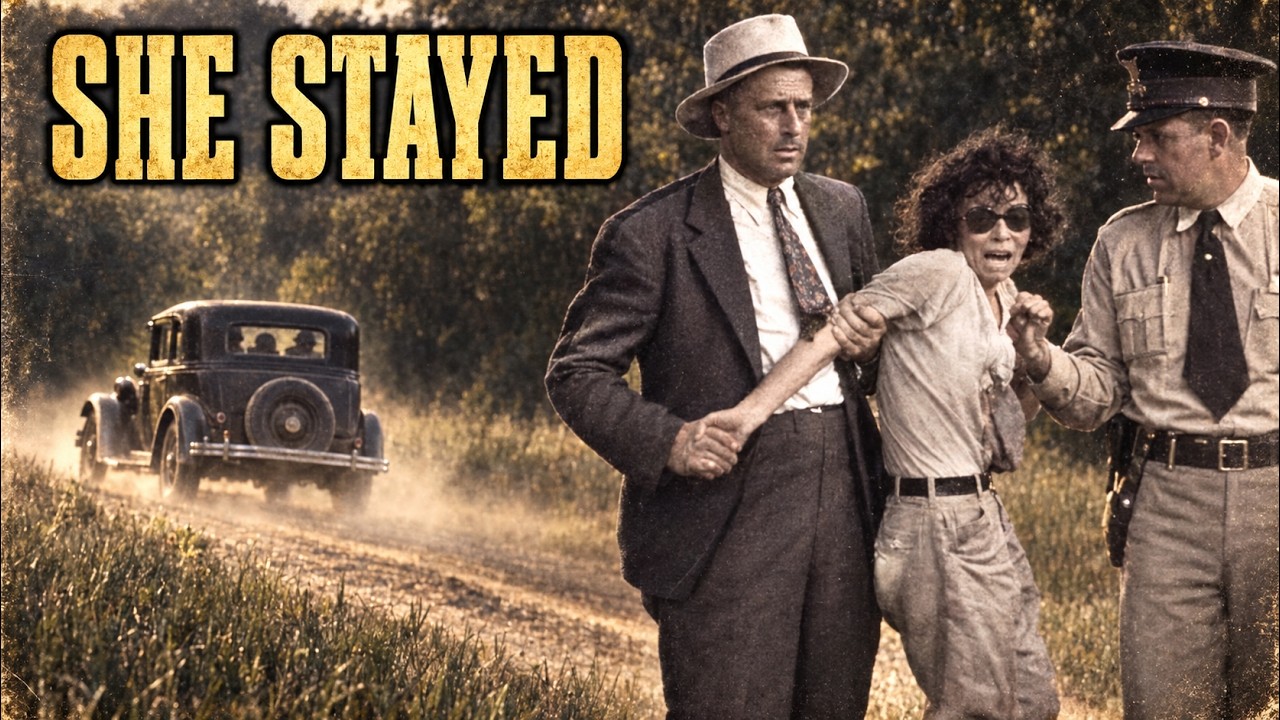 For more than ninety years, the public narrative has been a simple, damning one: Bonnie Parker and Clyde Barrow, the infamous outlaw duo, fled that Iowa field and left the nearly blind Blanche behind to face the consequences alone. It is a story that has been repeated in films, books, and historical markers, cementing Blanche’s role as a helpless casualty of a criminal life she supposedly knew nothing about. But Blanche told a different story.
She wrote it down in pencil, from a prison cell, in a manuscript that sat unread for 71 years, a document that complicates every assumption made about her life, her choices, and the loyalty that kept her on her knees in that field while others ran for the river.
The woman who would become known to the world as Blanche Barrow was born Benny Iva Caldwell in the first days of January 1911, in Garvin, Oklahoma. Her childhood was fractured early when her parents separated, leaving her to be raised by her father, a man of varied trades who cut timber, farmed the land, and, by some accounts, preached on Sundays. It was a hardscrabble existence, but one with a moral center.
That foundation was shattered at the age of 17 when her mother arranged a marriage for her to a much older man of means. There was a financial arrangement in the match for her mother, but for the teenage bride, it was a descent into violence. The 𝓪𝓫𝓾𝓼𝓮 she suffered was so severe that it left her with permanent injuries, robbing her of the ability to ever bear children.
She escaped the marriage, and the divorce was finalized in 1931, but the scars, both physical and emotional, would define her.
Before that divorce was even official, on November 11th, 1929, a terrified Blanche Caldwell was hiding out in Dallas County, fleeing the husband who had brutalized her. It was there she met Marvin Barrow, a man eight years her senior, twice divorced, and a father of three. Everybody called him Buck.
Their connection was immediate, but their life together was born under a shadow. Just a few weeks after they met, Buck was shot and captured by police following a burglary in Denton, Texas, landing him in the Texas prison system. On March 8th, 1930, he walked away from the Ferguson Prison Farm near Midway, simply strolling out the gate, stealing a guard’s car, and driving straight to West Dallas where Blanche was living.
It is at this juncture that the historical record splits into two irreconcilable versions of Blanche Barrow. For most of her life, the story she told authorities, the one that ran in newspapers and was accepted by the public, was that she had no idea who Buck Barrow truly was or what he had done. She claimed she discovered his criminal past only after he had escaped.
This was the version she gave to the men in Missouri who held the power to shorten her prison sentence, and it is the version that has largely persisted in the public consciousness. But late in her life, she sat down with historian John Neal Phillips, the man who would eventually edit her memoir, and she told him a different truth. She told him she knew exactly who he was.
She admitted to hiding with Buck while the state hunted for him and confessed to going out on robberies with him. Two accounts, decades apart, from the same woman. One was given to men who could take years off a sentence; the other was given to a historian at a point in her life when there was nothing left to lose.
The couple married on July 3rd, 1931, in Oklahoma. Then, in an act that defies easy categorization in either version of her story, Blanche did something remarkable just two days after Christmas that year. She put her husband in a car and drove him to the front gate of the penitentiary at Huntsville, Texas.
Buck walked up to the officials and told them he had escaped almost two years earlier and wished to return to finish his sentence. They were stunned, but they took him back. A little over a year later, in March of 1933, he walked out again, this time with a pardon signed under Governor Ma Ferguson’s plan to thin out the state’s overcrowded prisons.
His conviction was wiped clean. Whichever version of those years one accepts, they all end at the same place: she married him, she drove him back to prison herself, and she waited out his sentence. In March of 1933, at 22 years old, Blanche finally had a husband with nothing outstanding against him.
Three weeks later, she was sitting in a garage apartment in Joplin, Missouri, when two carloads of officers pulled into the driveway. The trouble began with a visit from Clyde Barrow, Buck’s younger brother. There was drinking and a private conversation in a parked car that Blanche was not part of.
When Buck came back inside, he had made his brother a promise to join him. Blanche said no. She said it more than once, but she got in the car only after Buck told her he was going without her.
In late March 1933, they settled into a garage apartment on a quiet street in Joplin, two floors over a double garage. The neighbors noticed things: the shades that stayed down during the day, the cars coming and going at odd hours, and the sheer volume of beer bottles in the trash for two couples who never seemed to leave the house. Someone made a phone call.
On April 13th, local officers, believing they were dealing with bootleggers, rolled up the driveway. It was a catastrophic miscalculation. Two of those officers did not go home that night.
 Blanche was out in the street when the shooting started, having gone after her dog. Someone caught her by the arm and pulled her into a car that was already rolling. By the time she got the door shut, everything she had built since Huntsville was left behind on that street.
She would later write about watching her whole life come apart as the car pulled away. She did not fire a weapon that day, nor at any point in the entire saga, but that fact became irrelevant because of what the gang left behind in that apartment: a marriage license with her name on it and a roll of undeveloped film. When the police developed the film, the images that emerged changed everything.
They showed a young woman with a cigar clenched in her teeth, leaning against the bumper of a Ford, and a young man in a suit holding a shotgun, both clowning for the camera. Up to that point, most Americans had no idea what these outlaws looked like. After Joplin, everybody knew.
The photos went out over the wire services and were printed in papers from Texas to New York. The Barrow Gang stopped being a regional police problem and became a national obsession, a serialized 𝒹𝓇𝒶𝓂𝒶 for the Sunday edition, and Blanche Barrow’s name and picture were in every one of those papers.
Three months later, in a motor court in Missouri, it was not bullets that would change Blanche’s life forever, but glass. In June of 1933, outside Wellington, Texas, Clyde Barrow drove into a road-closed sign in the dark, sending the car off the end of a bridge and into a ravine where it caught fire. Bonnie Parker was pinned beneath the vehicle and suffered a severe leg burn that left her unable to stand without help.
For weeks, she had to be carried in and out of buildings, forcing the entire five-person gang to stop moving. On July 18th, 1933, they pulled into the Red Crown Tourist Court just south of Platte City, Missouri, two brick cabins joined by single-car garages at a highway junction. They stayed for two nights.
Bonnie could not walk, and Clyde spent his days working on the Ford. On the second night, Buck and Blanche talked of going north to Canada to live as trappers, leaving Blanche as the only one who could walk outside and act normal in front of strangers. The people at the Red Crown noticed things: five dinners going out to the cabins every evening, a woman paying in silver coins, a trip into town for bandages and rubbing alcohol, and a woman in riding britches who never came inside or stood where the light could reach her face.
Someone made another phone call.
In the early hours of July 19th, a posse came up the highway with an armored car and pulled it broadside across the garage doors. What followed lasted only minutes but was ferocious. Automatic weapons fire tore through the cabin walls.
Buck was hit in the forehead, the bullet passing straight through the front of his skull. The gang managed to get the Ford out, with Clyde putting it through a gap and onto the highway. As they fled, a burst of gunfire raked across the rear window.
The glass did not break into pieces; it disintegrated into a cloud of powder and slivers that shot forward into the car. Blanche was in the back seat. The glass embedded itself in both of her eyes, and a fragment cut her scalp at the hairline.
She lost the sight in her left eye that night, and she never got it back.
This next part matters because almost every version of this story gets it wrong. Most retellings place Blanche’s injury in Iowa. Historical markers say it, articles say it, and books have repeated it for decades.
It did not happen in Iowa. It happened in Missouri, five days earlier, at a motor court off a highway junction. By the time Blanche Barrow reached that field in Iowa, she had already been effectively blind for five days.
The gang drove north through the dark in a car with shot-out windows. At some point, they stopped, and someone held a flashlight while another person went into her eye with tweezers, trying to grasp a piece of glass. The tweezers kept slipping off.
They gave up, and she rode the rest of the night with both hands over her face. Buck was in worse shape. Three or four times a day, they poured drugstore hydrogen peroxide into the wound in his forehead, letting it foam.
 No one in that car had any medical training.
They ran north through the night and most of the next day, stopping outside a town called Dexter, Iowa. The place they chose was an abandoned amusement park called Dexfield Park, which had been a going concern before the Great Depression. By 1933, the swimming pool was empty, the dance pavilion was shut, and the whole area was just woods with a river running along the bottom of the slope.
They set up a camp with blankets on the ground and a fire ring. Five people, every one of them hurt, living outdoors in the middle of an Iowa July. They washed bandages in the river and hung them on branches to dry.
Buck could not sit up on his own, so Blanche fed him and changed the dressing on his head, working mostly by feel because she could not see well enough to do it any other way. They stayed for four or five days. One morning, a troop of Girl Scouts camping in the same park hiked past their camp and waved.
According to local historical records, the girls only found out later who they had waved at. Then someone found bloody bandages in a ditch, and word spread through Dexter quickly. The townspeople figured out who was camped in the old park and started making telephone calls.
On the morning of July 24th, around 5:00 AM, roughly 50 men closed in on the park. They blocked the bridge and the road out. A twig snapped, Clyde heard it and shouted, and the entire posse opened fire on the stand of trees at once.
The first car hit a stump before it made twenty feet. The second car would not start, its engine already riddled with bullets. Buck went down, hit six times in the back on top of the head wound he had been carrying for five days.
Clyde, Bonnie, and W. D. Jones went down the slope toward the water, each of them hit.
Blanche was the only person in that clearing who was not wounded that morning. She could barely see, and she was the only one of the five who could have made it to the river. She did not go.
The version that ran in the papers that week, and the version most people still carry, is that Bonnie and Clyde abandoned her. The account Blanche gave first to the men who arrested her, and later in her own handwriting, is that she was not left behind. She stayed.
She would not leave Buck lying on the ground. Both versions are on the record, and neither has ever been definitively settled. What is not in dispute is where she was standing when the shooting stopped.
They took her with her hands over her face, still on her knees in the grass.
A mile away, Clyde Barrow came up on a farmhouse belonging to a family named Feller, out of ammunition, and demanded a car. The son, Marvel Feller, told the story for the rest of his life: Clyde got behind the wheel of the family car and could not work the gears. A farm boy from Dallas County, Iowa, had to lean in through the window and show Clyde Barrow how to shift.
It was the last thing Iowa kept of him. They brought Buck to King’s Daughters Hospital in Perry, Iowa, under guard, because there was real fear that Clyde would return for his brother. Blanche was brought in with him.
Reporters filled the hallway within hours, and photographers had already gotten their picture that morning at the park: a 22-year-old woman with her hair in her face, being walked out of the trees. The doctors examining Buck’s head wound were astonished. A bullet had gone through the front of his skull five days earlier and had been treated in the back of a moving car by people with no training and a bottle from a drugstore counter.
It was clean. They put it in the report because they did not believe it. The peroxide was the one thing anyone had done right, and it kept him alive for ten days.
 Buck was awake. He talked, he ate, and he told the doctors the aspirin was handling the pain in his head just fine. The pain bothering him was in his back.
He talked to the officers guarding the door, admitting to things no one had charged him with, and they wrote it all down. They went in after the bullet, which had entered his back, glanced off a rib, and lodged against his chest wall. The surgery was performed despite the high risk of pneumonia.
Then his temperature rose to 105 degrees and would not come down. His limbs stopped working, and pneumonia set in. On July 29th, 1933, Marvin “Buck” Barrow died in that hospital in Perry, Iowa.
He was 30 years old, and he had been out of Huntsville, pardoned and legally clean, for only four months and one week. Blanche was in the room.
Missouri wanted her. She was extradited and charged with assault with intent to 𝓀𝒾𝓁𝓁, the victim named on the charge being Sheriff Holt Coffey of Platte County. She had not fired a weapon at Platte City or anywhere else, but in 1933, that was not a defense the courts had much use for.
In September, Sheriff Coffey drove her to the penitentiary himself. Federal agents came to see her, as she was the only member of the gang in custody, and Bonnie and Clyde were still at large. She gave them nothing.
In May of 1934, she read about a road outside Gibsland, Louisiana, just like everyone else, learning of the ambush that killed Bonnie and Clyde. Somewhere in those six years, in a cell in Jefferson City, Blanche Barrow picked up a pencil and began writing down what had happened in those four months. It grew into a full manuscript, but she never showed it to anyone.
On March 22nd, 1939, the governor of Missouri signed a conditional commutation, reducing her ten-year sentence to six. Three days later, she walked out, sent to her father in Oklahoma with two more years of probation and an order to leave Cole County for good.
In 1940, she applied for permission to marry a carpenter named Eddie Frasier. The state granted it, hoping it would help her settle. She stayed married to him until his death in 1969.
In the mid-1960s, Warren Beatty came knocking, wanting the rights to her name for a film about Bonnie and Clyde. Unlike many others, she did not sell blind. She read the script, approved it, and signed.
Then the script changed. When the film opened in 1967, Blanche went to a theater to watch it. What she saw on the screen was a shrieking hysteric whose entire role was to panic and wail, making Bonnie Parker look capable by comparison.
Blanche later said the performance made her look like a screaming horse’s ass. The film won two Oscars, including Best Supporting Actress for Estelle Parsons, who played Blanche. The only member of the Barrow Gang who lived long enough to correct the record was the one whose record got rewritten in front of her, with her signature on the paperwork that allowed it.
She died of cancer in Dallas on December 24th, 1988, at the age of 77. She is buried under the name Blanche B. Frasier, not Barrow, in a different cemetery from the man she refused to leave lying in the grass.
Sixteen years after her death, the University of Oklahoma Press published her pencil manuscript, edited by John Neal Phillips, under the title she gave it. Every serious account of the Barrow Gang written since leans on that book. It is the fullest account anyone left from inside that car.
The most reliable witness to the most famous crime spree in American history spent 55 years being contradicted by people who were never there, and by a version of herself she gave a parole board in 1933. The myth got into theaters in 1967. The witness got into print in 2004.
That gap is the whole story.


