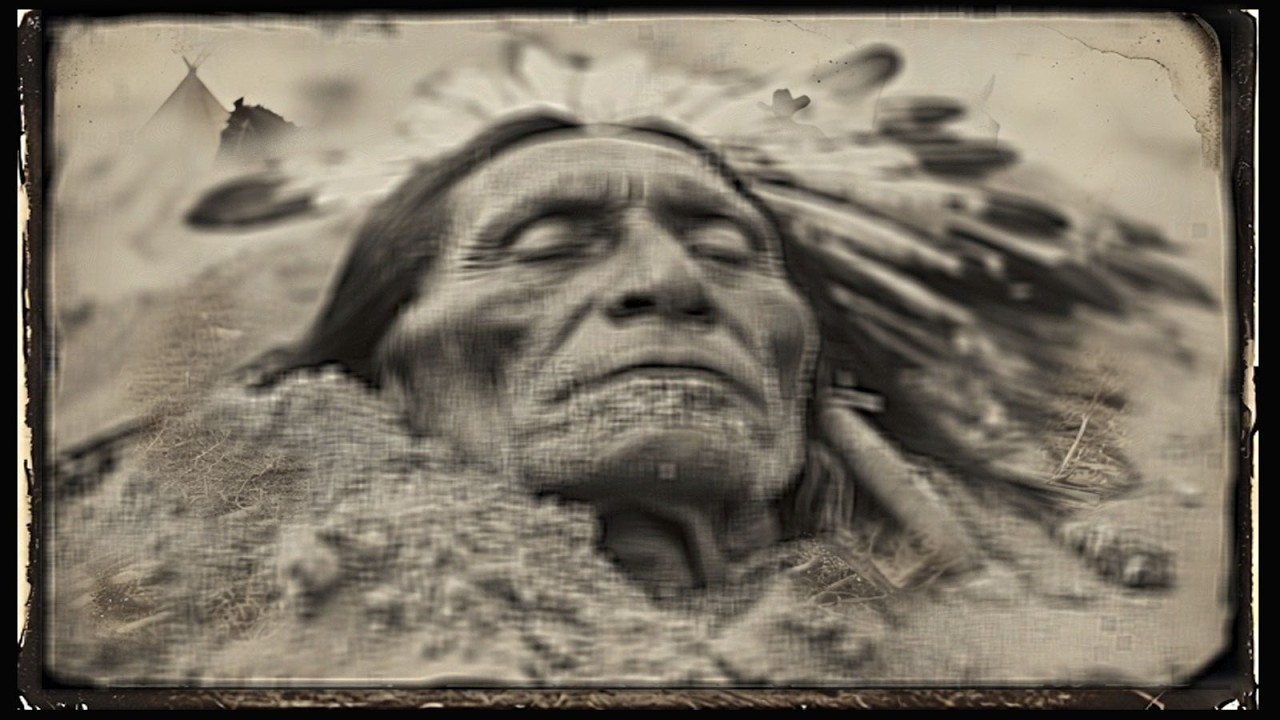
Five of the most renowned American Indian warriors of the 19th century met their ends in strikingly different ways. One was killed by a single gunshot during a morning battle, another died in chains inside a prison fortress, one fell to a bayonet thrust while under guard, and another was silenced by a bullet fired during an arrest. Their final moments, long debated and often obscured by legend, reveal the harsh realities that followed their decades of resistance against American expansion. Tecumseh, the Shawnee leader, was born in March 1768 along the Sciota River in the village of Chillicothe.
His name, meaning “shooting star,” reflected a clan tradition and foreshadowed his role as a unifier. After his father was killed at Point Pleasant in 1774, Tecumseh was raised by his brother, who trained him in hunting, tracking, and oratory. Early conflicts with settler bands shaped his resolve to defend the Ohio country. By the late 1790s, Tecumseh had rejected the 1795 Treaty of Greenville, which ceded two million acres, and later condemned the 1809 Treaty of Fort Wayne, which conceded an additional three million acres.
Between 1798 and 1810, he rode over 5,000 miles forging alliances among the Shawnee, Miami, Potawatomi, Wyandot, Kickapoo, Creek, and Choctaw. At every council fire, he argued that land belonged to all tribes and that no chief could surrender it without unanimous consent. In 1794, Tecumseh led Shawnee warriors at the Battle of Fallen Timbers under Blue Jacket, a defeat that forced wary chiefs to sign the Treaty of Greenville. Tecumseh deemed the treaty void, arguing it was a sale made without full tribal agreement.
In 1805, his brother Tenskwatawa ignited a spiritual revival at Prophet’s Town on the Wabash and Tippecanoe rivers, where Tecumseh denounced whiskey and rallied diverse nations to his confederacy. When the War of 1812 began, Tecumseh allied with the British, commanding around 500 warriors. On August 16th, he joined forces to encircle General Hull’s garrison at Detroit, which surrendered without a shot, securing British control of the Old Northwest. In May 1813, he led roughly 700 warriors at the siege of Fort Meigs, where he famously intervened to halt the scalping of prisoners, insisting on humane treatment even as British allies objected.
Commodore Perry’s naval victory on Lake Erie on September 10th, 1813, severed British supply lines. Isolated, General Proctor retreated toward Moravian Town in Upper Canada, shielded by Tecumseh’s 800 confederate warriors. On the morning of October 5th, 1813, a heavy mist hung over the Thames River as Tecumseh’s rear guard took position. Mounted on a gray stallion and wearing a British silver breastplate, red sash, and eagle feather headdress, he rode along the front ranks urging his men to hold firm.
When Colonel Richard Johnson’s dragoons charged forward, a musket ball pierced Tecumseh’s right breast. He dismounted to rally his men, then collapsed to his knees. Comrades tried to carry him to cover, but fresh volleys made it impossible. He died upright, still gripping the reins, his eyes fixed on the enemy line.
Warriors draped a fallen officer’s cloak over his body to conceal it before withdrawing. American troopers stripped his corpse of feathers and ornaments and claimed his scalp for a Detroit bounty. His breastplate and war shirt became prized trophies. Accounts diverge on his final disposal, with one eyewitness describing a hasty cremation on a Canadian shore and another speaking of settlers burying charred remains in an unmarked mound.
No official record marks his grave, and his exact resting place remains unknown. Osceola was born around 1804 in the cane brakes and cypress groves of the Alachua region in Spanish Florida. Recorded by settlers as Billy Powell, he bore the Seminole name meaning “black drink cry,” after the ritual holly infusion used at dawn ceremonies. His mother was Upper Creek, and his father was a mixed-race trader, reflecting the blend of Creek, Mikasuki, Black Seminole, and runaway slave communities in the region.
By the early 1830s, US policy had shifted to forcible removal. The 1832 Treaty of Payne’s Landing promised relocation west of the Mississippi, though only a handful of chiefs signed it. Osceola refused to attend exploratory delegations, rejected the treaty outright, and began rallying young warriors. He argued that Seminole land was a communal trust, not a commodity to be sold by a minority of leaders.
Tensions exploded on December 28th, 1835, when Major Francis L. Dade’s column of 110 soldiers marched into Seminole territory. At dawn, Osceola led roughly 70 warriors hidden among sabal palms and sawgrass. He timed his assault so the first volley shattered the formation before they could form ranks.
Within minutes, Dade was dead and most of his men were down. The ambush marked Osceola as both a strategist and a symbol of Seminole resistance. Over the next 18 months, Osceola directed a campaign of guerrilla warfare, striking forts and supply lines before vanishing into hammocks and hidden bays. He forbade attacks on women and children and even ordered his men to rescue drowning US soldiers after a skirmish.
His mastery of canoe routes and tidal creeks allowed Seminole bands to evade large detachments for months. In September 1837, under a provisional truce arranged by Colonel William S. Harney, Osceola agreed to meet under a white flag at Fort Peyton in St. Augustine.
Unarmed and wearing ceremonial grass skirts, he arrived at dawn on October 21st, trusting the promise of safety. Instead, Lieutenant Peyton’s soldiers seized him and 25 companions. Within days, Osceola was loaded onto the USS Malabar and sent to Fort Moultrie on Sullivan’s Island, South Carolina. At Fort Moultrie, Osceola endured dank, mosquito-infested barracks and meager rations.
Guards shackled his wrists each night, and barred windows overlooked a tidal marsh. He kept a pocket Bible and scribbled notes, but the dampness and constant bites wore on his health. By mid-January, he suffered bone-deep chills, feverish sweats, and a hacking cough. In the pre-dawn hours of January 30th, 1838, Dr.
Thomas Boyd recorded that Osceola’s pulse was irregular and fluttering. He had bronchial inflammation complicated by dysentery. Around 4:15 a. m.
, he died. Three days later, Marines carried his oak coffin across Charleston Harbor to St. Philip’s Churchyard. No Seminole attended his burial beneath live oaks, and no stone marks the grave.
His death in captivity became notorious as a betrayal of truce terms. Black Hawk was born around 1767 in Saukenuk, the great Sauk village on the west bank of the Mississippi near today’s Rock Island, Illinois. From boyhood, he learned from his father, the warrior White Breast, how to track deer and read the river’s currents. The Sauk and Meskwaki peoples lived in semi-permanent villages linked by canoe routes across the region.
In 1804, US commissioners secured a treaty at St. Louis ceding Sauk lands east of the Mississippi, signed by just a handful of chiefs. Black Hawk, still a minor, ignored its terms, refusing to recognize any sale made without full tribal consent. He later earned fame fighting alongside Tecumseh’s confederacy in the Northwest Indian War, witnessing battles like Tippecanoe and Fort Dearborn.
By the 1820s, settlers pressed the Mississippi’s west bank, and the Sauk were restricted to small bison hunts on the Iowa prairies. In April 1832, convinced by visions that the Great Spirit favored a return east, Black Hawk and about 900 followers slipped across the ice from Iowa into Illinois, intent on reclaiming ancestral fields. The ensuing Black Hawk War was brief but savage. On May 14th at Stillman’s Run, militia panic turned a small Sauk force into fleeing lines.
Weeks later, at Wisconsin’s Bad Axe River, US gunboats bombarded Black Hawk’s people as they waited upstream trying to escape. Hundreds died. Only a few survivors reached Iowa’s western marshes. Black Hawk himself surrendered at Prairie du Chien on August 27th, 1832.
He was held briefly in St. Louis and then taken on a publicity tour, where he shook hands with President Jackson. The long journey drained him, and he suffered from rheumatism and untreated wounds. He was released in the spring of 1833 on condition he never again set foot in Illinois.
Over the next five years, his body weakened under the strain of displacement and recurring fevers. On October 3rd, 1838, while staying at the home of a friendly trader in Davis County, Iowa, Black Hawk awoke gasping for breath. Dr. William Williams noted labored respiration and extensive bronchial congestion but lacked quinine or opiates.
Around midafternoon, the warrior uttered a single word in Sauk meaning “father,” then exhaled gently and died. That evening, his sons dug a shallow grave on a high bank overlooking the Des Moines River’s fork, wrapped in buffalo robes and marked only by a cedar stake carved with four arrowheads. Crazy Horse was born around 1840 in a tepee camp on the Grand River in what is now western South Dakota. His Lakota name meant “his horse is crazy,” referring to a youthful feat in which he raced a beloved colt to exhaustion.
His band, the Oglala Lakota, roamed between the Black Hills, pine ridges, and the wide Missouri bottoms, where buffalo herds numbered in the tens of thousands. By his teenage years, Crazy Horse had distinguished himself as a warrior. In 1866, he joined a vast Lakota and Cheyenne force that ambushed and wiped out Captain William Fetterman’s cavalry detachment at Lodge Trail Ridge near Fort Phil Kearny. News of that victory spread, and within a year his reputation drew other warriors to his side.
Though he never accepted a formal title of chief, his counsel carried weight at council fires. In the summer of 1876, Crazy Horse rode out with Sitting Bull’s camp, exchanging blows at the Rosebud before reinforcing orders at the Little Bighorn Valley. He arrived too late to join in Custer’s final engagement but led a pursuit that captured government packs and horses. By spring 1877, after the Lakota were starved and surrounded, the US Army offered amnesty to those who would surrender.
On May 6th, Crazy Horse brought his band in to live under army escort. Rather than receiving freedom, his people were confined to a fenced corral. In August, rumors circulated that he planned to slip away to winter camps. On September 4th, authorities decided to remove him to Fort Robinson, Nebraska, for safekeeping.
He was housed in a small guardhouse cabin, and though officers assured him he was free to go, a written order declared him under arrest. The next morning, September 5th, 1877, soldiers entered the cabin to search for hidden weapons. Accounts differ, with some saying they found a knife beneath his blanket and others claiming they planted the weapon. When the guards demanded he surrender the blade, Crazy Horse rose and stepped toward the door.
Suddenly, Private William Gentles lunged forward and plunged his bayonet into Crazy Horse’s right side. He staggered past the threshold and collapsed against the door frame. Witnesses recall his final words as “my friend” before he lay still. Dr.
Valentine McGillicuddy found the bayonet had pierced a lung and lacerated the diaphragm. Without the benefit of an operating theater, he administered a weak dose of morphine, but the internal injury proved fatal. At 2:55 p. m.
, barely an hour after the stabbing, Crazy Horse died. His body was carried to Fort Robinson’s Post Cemetery and buried in an unmarked grave beneath a cottonwood sapling. The army ordered no ceremony, and Lakota mourners were kept at a distance. The precise location of the cabin faded with time, and in 1878 the post was abandoned.
Today, no marker notes the spot where his life was cut short. Sitting Bull was born around 1831 to 1837 into the Hunkpapa band of the Lakota on the Grand River. His earliest name, “Slow Whistling Wind,” gave way to “Buffalo Bull Who Sits Down” after a vision during a sun dance in his teens, when a great buffalo spirit promised him power to protect his people. In the 1850s and 60s, as white hunters and settlers poured onto the plains, his reputation grew.
He refused annuity rations and treaty councils that ceded hunting grounds at Fort Laramie in 1868 and again in 1876. Instead, he led his band from camp to camp, joining Sioux and Cheyenne warriors in raids on supply trains and army posts. His calm, deliberate counsel carried weight even though he held no formal title of chief. By spring 1876, Sitting Bull had gathered a large encampment on the Little Bighorn River.
Although he missed the battle itself, having injured his thumb and sent his warriors under Crazy Horse, hundreds of lodges under his aegis celebrated the defeat of Custer’s Seventh Cavalry. In the brutal winter that followed, his people scattered to seek buffalo, suffering hunger and cold under relentless army pursuit. In July 1877, starving bands surrendered at Fort Yates. Sitting Bull led his followers into two years of imprisonment at Fort Randall, South Dakota, then Fort Yates, forced to depend on military rations.
Released in 1881, he moved with his family to the Standing Rock Reservation on the North Dakota-South Dakota border. He refused to farm allotments, preferring a wanderer’s life, and his camp remained a magnet for Sioux resisting assimilation. In late 1889, rumors of the Ghost Dance swept the reservation. When Indian service agents reported that prophetic dances would spark an uprising, the US commissioner decided to remove Sitting Bull for his safety.
On the morning of December 15th, 1890, Agent James McLaughlin dispatched Indian police to arrest him at his cabin near Fort Yates. After they entered, witnesses heard a struggle. Sitting Bull stood clutching a pistol given him by Buffalo Bill, declaring, “I will die here. ” In the scuffle, police Corporal Red Tomahawk leveled his rifle and fired a single shot into Sitting Bull’s chest.
He collapsed backward against the door frame, his medicine bundle stained with blood falling to the floor. Two policemen were killed in the melee. Dr. Valentine McGillicuddy found the bullet had pierced a lung and damaged the liver.
With no chance for surgery, he administered morphine, but Sitting Bull lay silent. That afternoon, Indian police dragged his body from the cabin and carried it to a low hill by the Missouri’s west bank, where a few Lakota clansmen buried him at dusk beneath a simple cover of earth. No marker, no ceremony beyond whispered prayers.