The silence in the room at Trent Park was the kind that follows a defeated army. In the summer of 1945, a young Canadian intelligence officer named Milton Schulman sat across from Field Marshal Gerd von Rundstedt, the man who had commanded the German Army in the West for most of the war. The 69-year-old Prussian aristocrat, thin and broken, looked nothing like the commander who had once masterminded the fall of France.
But when the conversation turned to the American generals he had faced, the old soldier’s mind proved sharp, and his verdict was absolute. He told Schulman that the one Allied commander his high command had learned to fear above all others was not the British field marshal with the public’s adoration, but the American with a pearl-handled revolver, George S. Patton.
 That conversation, captured in the pages of Schulman’s 1947 book Defeat in the West, was one of the first cracks in a secret that would hold for nearly three decades.
The full confirmation of this fear did not come from a single interrogation, but from a mountain of institutional testimony. Over many years, captured German generals produced thousands of reports for the US Army Historical Division in what was known as the German Report Series. These documents, still resting in the National Archives today, were written by men like General Gunter von Blumentritt, Rundstedt’s chief of staff, and General Fritz Bayerlein, a veteran of Rommel’s Africa Corps who faced Patton specifically in four separate theaters across three continents.
They wrote after the war, in the quiet rooms of Allied holding facilities, about the way Patton’s speed had driven their operational calculations to the brink of collapse. They spoke not of admiration or respect, but of a concrete professional terror rooted in the fact that Patton was the one commander who made them feel they would not have enough time to react.
The story of this fear began long before D-Day, rooted in the peacetime officer corps that both the United States and Germany had built in the decades after the First World War. None of the men who would define the Western war were born generals. They had all risen through the ranks of an old world that had not yet seen the carnage of armored warfare.
On the Allied side stood three men of vastly different temperaments and trajectories. Field Marshal Bernard Law Montgomery was the oldest at 57, the son of a bishop and born in a London vicarage who had fought in the trenches and been shot through the lung in the First World War. His method was one of overwhelming logistics and planning, leaving nothing to chance, a scientific approach to battle that served him well in the deserts of Egypt but led him to clash with his own peers.
Meanwhile, Dwight Eisenhower, a Kansas farm boy, had missed the fighting of the Great War, spending it training the men in Pennsylvania. For two decades he lived in obscurity, mentored by Fox Conner and served under MacArthur in the Philippines before being chosen to hold the entire American alliance together.
Then there was George S. Patton, an Assyrian-born Californian from a warrior family. The rich display of cavalry panache, elevated by his successes in North Africa and Sicily, was matched by a reverse streak of leadership that would become his trademark signature.
He wore an ivory-grip revolver, wrote poetry of his reincarnations, and gave profane speeches to soldiers. But beneath the theatrics lay a man with an obsession with speed and offensive action. After Sicily, his career was nearly destroyed by the slapping 𝒔𝒄𝒂𝓃𝒹𝒶𝓁 that nearly ended his command.
But Eisenhower, seeing his unique value, kept him alive and, by the spring of 1944, gave him another crucial role. When the invasion of France was planned, Patton was assigned to command the First United States Army Group, an army group that did not exist. A phantom force made of rubber tanks, plywood landing craft, and fictional radio traffic, stationed directly across the channel from Cala.
He was the bait in a massive deception called Fortitude.
On the German side, the fear was not being built solely by deception. It was carved out of hard combat experience. The first taste of Patton’s fury came in the deserts of Tunisia in early 1943.
After the American defeat at Kasserine Pass, where Green Division bent and broke under a seasoned German counterattack, Eisenhower made a decision. He replaced the American commander, Lloyd Fredendall, with Patton. In six weeks, Patton restored discipline and morale to the ragged Saxond Core.
In March of 1943, at El Guetter, Patton drove the German 10th Panzer Division into a costly defeat. The staff of General Rommel’s Africa Corps, including General Bayerlein, took notice. They saw a different kind of American, one who did not just react to German initiative but forced the German’s side to react to him.
 They noticed the way the American forces moved faster after Patton took over.
When the Allies landed in Sicily in the early summer of 1943, Patton kept up the pace. In a race to the Strait of Messina, Patton’s 7th Army took Palermo on July 22 and entered Messina just hours before Montgomery’s 8th Army. For the German commander’s gyroscope, the level of jungle hub conducting a textbook withdrawal, the speed of Patton was a critical concern.
It was in his reports back to Berlin, noting that Patton’s tempo was operating the standard models of German planning. By the time Fortitude was launched, the fear of Patton was already real and embedded in the German high command. Operation Fortitude did not create the fear; it simply amplified what was already there.
It confirmed to the Germans that the real invasion was to come across the Pas de Calais under Patton while the Normandy landing was a mere diversion. They believed it because they wanted to believe it and because the ghostly whispers of the double agents and undeniable signal traffic supported their pre-existing belief.
The German high command, ensconced at the Wolf’s Lair in East Prussia, believed so deeply that they kept the entire 15th Army in the Pas-de-Calais during the critical seven weeks after June 6th. The first German units moved at all was that the 15th did not begin shifting westward until late July. This meant that the American and British troops pinned into the Normandy beaches did not face a completely concentrated German force from the very beginning.
They had reserves that could have turned those beaches into a bloodbath, but it was occupied in waiting by the phantom phantom II operation. Eisenhower, reading the decrypts of the Enigma at Bletchley Park, knew exactly what was happening. He knew the Germans were holding their entire 15th Army west to the East to wait for Patton, a man who was telling them about tanks made of rubber.
Eisenhower knew why, but he could not speak its existence, which was the most closely guarded secret of the war.
The silence imposed on the Secret was so absolute that even the Allied commanders in the field could not talk about it openly. The British and American governments decided that after Germany’s surrender, the story of Ultra would remain highly classified. They feared that if it were known that the Enigma had been broken, then the European governments would avoid using the same cipher systems, exposing future intelligence to a loss of critical intelligence capabilities.
So, the knowledge that the fear of Patton was real, that it was in the interceptor German orders, was sealed. That choice would shape the historical narrative for years and leave a legacy of damaging rivalries and memoir wars. The memoir war broke out almost as soon as the guns went silent.
In 1948, Eisenhower published his own memoir, Crusade in Europe, offering a measured, dignified account of what had happened. In one line, he wrote that the Germans had feared Patton more than any other Allied commander. This statement was of course in direct contradiction to the records of 1948 that had yet to be decoded.
He did not seek it, he did not name his source, and he could not.
His account was challenged by the British. In 1952, Chester Wilmot published The Struggle for Europe, an influential history from a British perspective. Wilmot, a BBC war correspondent, argued that Eisenhower had been too generous to Patton and the unduly eager to diminish Montgomery’s contribution.
 His book challenged the validity of captured German testimony, suggesting that the German generals flattered their captors, but that thesis did not survive the US postwar record. Only when the Ultra secret was finally beginning to unhinge was there actual physically decoded orders to check. Then finally the collapse of the secrecy.
In 1974, Group Captain Frederick William Winterbotham published The Ultra Secret. He had been a real RAF officer who had managed the distribution of Ultra to the field commanders. In his book, he revealed the pleasure of Enigma breaking to the general public for the first time.
It was a rough historian’s book, but it got some details wrong, though his story was ultimately true.
Over the next years, scholars like Ralph Bennett and Ronald Lewin followed with studies that integrated Ultra into the history of the campaign. The archives were opened; the intercepts were made available. The decrypts from the 1944 period show the orders of the German operational headquarters, naming Patton and demand of the all the intelligence he gave out against the fear of Patton.
They held up exactly what Eisenhower had known. The Constantinople had been a veritable corner of the war turned the invitational move. The contention with the floor now shifted, from the cloudy arguments of the memoir wars to the hard evidence.
The line IQ had written in 1948, that the Germans feared Patton had been confirmed. It was also confirmed in the files of the German Report Series on pages sewn in the National Archives, in the conversations recorded at Trent Park, and in the official reports filed by the captured German generals.
The details of this are almost untraceable to the modern eye. The German generals who stated all actually put into the record a disturbing admission: they had not landed on Patton as a being that strikes fear in a symbolic theatrical sense, but as an unseen combat tempo that broke their planning. Montgomery was a predictable threat, a set-piece commander next to an overwhelming proper guns and shells.
The German planners had a huge amount of respect for Monty’s style, but they understood it and could predict it. They could keep an eye on his progress; they knew that it would take time for all the shells to be in place. However, Patton was the opposite; he attacked without notice, at a pace that was outside the German theoretical framework.
He didn’t wait for the logistical trains to arrive; he pulled a bridge that he got his force across. He produced an offensive when the map was turned against him. He was the unpredictable element in an equation that a command staff was seeking to solve.
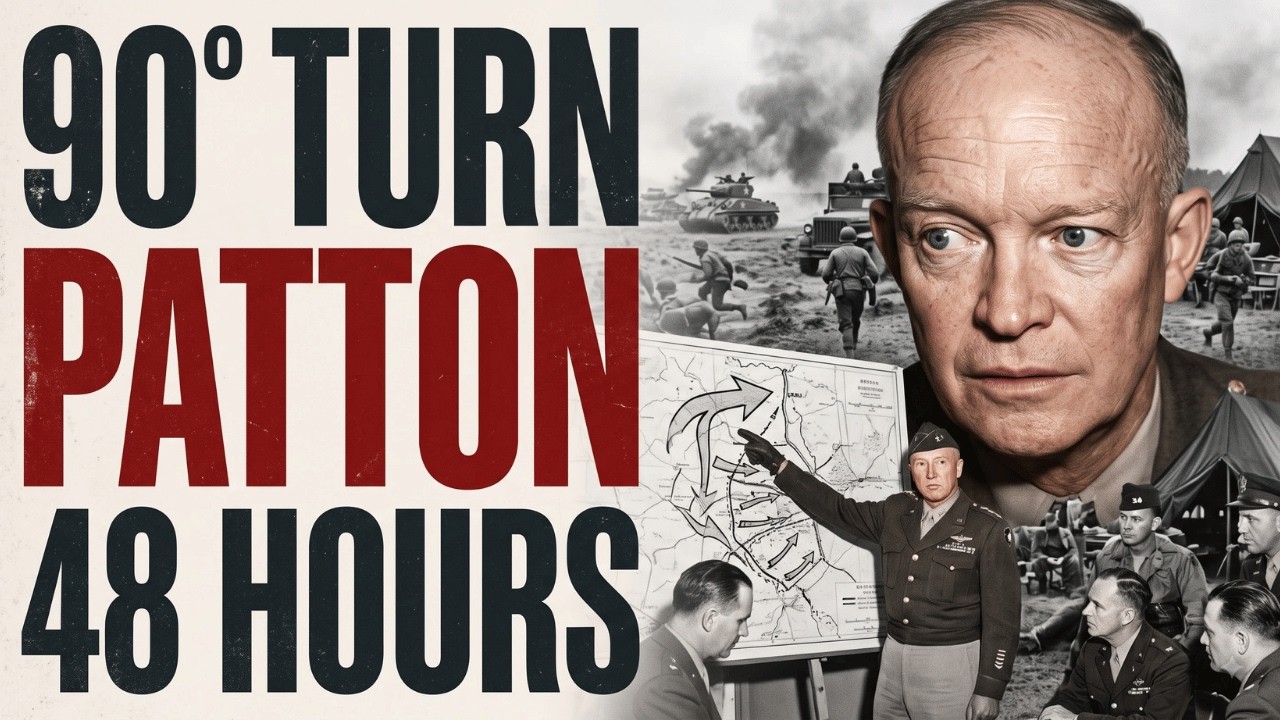
General Fritz von Menteufel, who commanded one of the main German armies at the Battle of the Bulge told the British historian Basil Liddel-Hart after the war that Patton’s speed was the decisive element. In the Ardennes, when the third army actually was ordered to turn 90 degrees north from the Pearl Harbor. Even though the German generals had England as a structured planning model of that an allied counterattack would take two or three weeks, they had already developed a plan for how to react.
But Patton did it as he did, and the result destroyed the German offensive. The fear of a fully learned, the puzzle was still the German generals writing in the post-war archives. They were sounding a sympathetic string.
In addition to the fact that the disaster in the Atlantic, because for the first peace they were not aligned with a separate role.
 The fact that the Germans were afraid was just the opposite of how the British by then saw it. Field Marshal Montgomery’s public reputation in Britain after El Alamein and the victory at the end of 1942 reached a level of national heroism. He had been given the perfume of a viscount and vast public admiration.
He believed in the overwhelming logistic set of piece combat, and he wrote his memoir in 1958 just to triumph for this, which made him only all the more determined to not to be seen as the one who had won the campaign toward and to run down on everyone else. He described Eisenhower as not executive officer. he gave a weak account of Patton’s command.
From a soldier’s point of it, in the British book she could would carry the narrative for a long time.
Amid this public fur, that lying in the tail was a fact t. In the 1960s, both had retired from their posts, the icon of the world. But Eisenhower’s deviance his actions in careful language rather than war.
He gave interviews to historians, he wrote second memoirs and he received a stream of visitors to his farm at Gettysburg. They were speaking different numbers, being consistently in the mouth, the same martial pattern. It was he had not been one: if the Ardennes, there was no way to have to stop the war, a year.
Then the vault it up. The Ultra revel and the long and the factual are they’d been sent to the foreign people the allies had been reading of the entries in a 1944 centralized customers that it was a 15-person who had been deployed to hold the Atlantic Wall while the Russian artillery storm blew in the western part of Normandy. The entirety of 150,000 men could have been in the pocket on the first few days after D-Day, but they were waiting for Patton.
The union had succeeded in locking them a static defense in the west. They had saved the alliance in the seconds of heavy toll. In the event, the fear of Patton.
That reality of that secret revealed that Eisenhower, who had been a man bound by privacy, had found a way to communicate what was most important without ever disclosing the reason in the fall of the 1970s. The full record released, his reputation and analogies of the German officer corps wrote the painful confirmation than their fears had been concentrated.
The life of Eisenhower ending in the 28th of March 1969, at the Walter Good Army Memorial Hospital, from heart failure. He was 78, active in the heart of his long career, as the commander of the largest invasion in history that lasted for 8, at the years. He did not live to hear the confirmation of the memory and the for the rest of the secret to the work.
Montgomery did, he passed away on the 24th of March 1976, 2 years after the Ultra Secret was published, and after telling his own version of the relationship of the war it was born. Of the war, he went to his death without ever conceding that the Germans were titled that had an appetite. However, the men who had fought that out a very different miracle: the idea that the senior German officer corps to confirm that their most dangerous opponent was the man the American that worked almost and had in the English countryside for his campaign of the theory that had never been taken on.
Patton did not die in combat. He died in the Hungary of the later, on December 21, 1945 at the age of sixty, in the United States Heart from in a hospital room in a crazy accident. He had never known the entire story his own reputation had played.
He never knew that the name had been the one that the German army spread across their command, and more than the fear and he had kept the 15th German army in readiness for the wrong a full seven weeks after the need to re-assert. He had thought Eisenhower was holding him, that the Fortitude was the best way to to keep the wire away. he was nothing.
The vindication came too late to be heard by listening ears. Yet it is there now in a thousand documents, of a statement in a single line in the Crusade. The evidence has fully been opened, and the record shows what Eisenhower finally admitted in a careful and measured words.
The Germans had feared Patton, not because of Montgomery’s reputation, but because of the Patton ability to win the war in a way that they could not predict, they could not stop, and they could not outmatch. He was the one who broke their system, their staff, their planning. And Dwight Eisenhower knew it.