Belle Gunness was not the typical image of an Old West outlaw. She did not rob trains or take part in shootouts, but the Norwegian-born widow is believed to have been one of the most prolific female killers in American history. Operating between 1884 and 1908, she is suspected of orchestrating the deaths of more than 40 people across Chicago, Illinois, and La Porte, Indiana, often motivated by life insurance payouts, property, and fraudulent schemes. Born Brynhild Paulsdatter Størseth on November 11, 1859, in Selbu, Norway, she was the youngest of eight children in a working-class family.
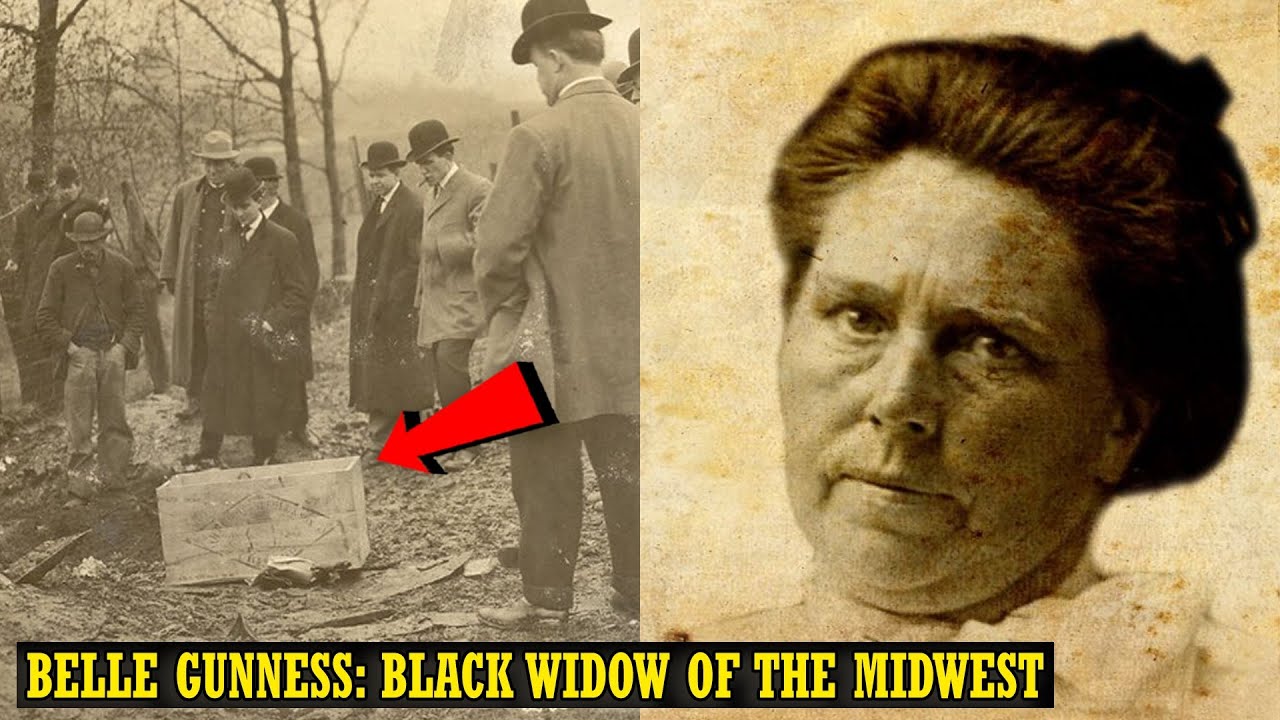
Known for her unusually strong build, she stood around 5 feet 9 inches tall and weighed over 200 pounds. A story passed down through the years, though never fully confirmed, claims that as a teenager she was physically assaulted by a man from a well-connected family, and that the alleged attacker later died of stomach cancer. There is no concrete evidence tying her to his death. She immigrated to the United States in 1881, adopting the name Belle to fit into American society.
She settled in Chicago, where she worked in domestic service. In 1884, she married Mads Albert Sorenson, a fellow Norwegian immigrant. The couple opened a candy store, but it struggled, and both their shop and home were destroyed by fires under uncertain circumstances. The insurance payments allowed them to purchase a new home.
The couple had four children: Caroline, Axel, Myrtle, and Lucy. Caroline and Axel died in infancy, with the cause listed as acute colitis, a condition that could also mask other ailments common to the 19th century. The couple received life insurance payments after these deaths. In July 1900, Mads Sorenson died unexpectedly on the single day his two life insurance policies were both active.
One physician suspected poisoning, but the family doctor attributed the death to heart failure, and no autopsy was performed. Despite concerns raised by Sorenson’s family, no legal action was taken. Belle received $8,500 in insurance benefits, roughly equivalent to $250,000 today. She used the money to buy a farm on the outskirts of La Porte, Indiana.
Soon after, reports surfaced that both the boathouse and carriage house on the property had been destroyed by fire. Before relocating, Belle reconnected with Peter Gunness, a Norwegian widower and butcher. They married in April 1902. One week into the marriage, Peter’s infant daughter from his previous marriage died unexpectedly while alone in the house with Belle.
In December of the same year, Peter himself died under unusual circumstances. Belle told authorities that a sausage grinder had fallen from a high shelf and struck him fatally. The local coroner reportedly expressed doubts about the explanation, and an investigation was launched, but Belle was never charged. Peter’s death brought another insurance payout of about $3,000, equivalent to roughly $85,000 today.
Locals were skeptical that a skilled butcher could have been so careless with heavy equipment. The district coroner publicly stated his belief that the death was not accidental, but Belle persuaded authorities to close the case. She gave birth to a son, Phillip, in May 1903. Toward the end of 1906, Belle told neighbors that her foster daughter, Jenny Olsen, had left to attend a Lutheran college in Los Angeles.
Years later, Jenny’s remains would be discovered buried on Belle’s property. In 1907, Belle hired a farmhand named Ray Lamphere. While he began as an employee, rumors circulated that their relationship was more personal. When under the influence of alcohol, Lamphere occasionally spoke openly about his closeness with Belle, surprising locals who knew her as a rugged, no-nonsense farm woman who often wore men’s work clothes and handled butchering duties herself.
Despite her bond with Lamphere, Belle began placing personal advertisements in newspapers throughout the Midwest. One ad read: “Personal comely widow who owns a large farm in one of the finest districts in La Porte County, Indiana, desires to make the acquaintance of a gentleman equally well provided with a view of joining fortunes. No replies by letter considered unless sender is willing to follow answer with a personal visit. Triflers need not apply.
”
The ad attracted several middle-aged men of financial means. Over the following months, Belle was seen in the company of unfamiliar gentlemen, often on Sunday afternoons, dressed elegantly and displaying a charm quite different from her usual farm image. Among those who responded was John Mo from Elbow Lake, Minnesota, who reportedly brought over $1,000 to help pay off her mortgage. She introduced him as her cousin.
Within a week, he vanished. Another suitor, George Anderson of Tarko, Missouri, was startled awake one night to see Belle silently standing over him holding a lit candle. He left the house that same night and caught the earliest train back to Missouri, never returning for his belongings. In April 1907, a widower named Ole Budsburg from Iola, Wisconsin, was last seen at a La Porte savings bank, where he finalized a mortgage and withdrew a significant amount of cash.
When his sons later contacted Belle, she wrote back claiming she had never met their father. In December 1907, Belle began corresponding with Andrew Helgelien, a bachelor farmer from Aberdeen, South Dakota. Her letter, dated January 13, 1908, was romantic and persuasive: “To the dearest friend in the world. No woman could feel happier than I do right now.
I know you are coming to be with me and I am certain you are the right man for me… Please come ready to stay with me forever. ”
Helgelien arrived in January 1908, bringing a check for $2,900, his life savings. A few days later, Belle and Andrew deposited the funds at the local bank. Around this time, Belle dismissed Ray Lamphere on February 3, 1908, following an argument.
Shortly afterward, Helgelien was no longer seen in the community. Not long after his disappearance, Belle returned to the bank and deposited an additional $1,200. Belle then went to the La Porte County Courthouse, reporting that Lamphere was mentally unstable and dangerous. After an examination, he was declared mentally competent and released.
She later had him arrested for trespassing. At one point, Lamphere confided in a nearby farmer, reportedly saying, “Helgelien won’t bother me anymore. We fixed him for keeps. ”
When Andrew Helgelien’s brother, Asle, wrote asking for information, Belle claimed Andrew had left for Norway.
Asle did not believe her and continued to press for answers. In February 1908, Belle hired a new farmhand named Joe Maxon. In the early morning hours of April 28, 1908, Maxon woke to the smell of smoke. He called out for Belle and the children, but received no answer.
He climbed out a second-story window and narrowly escaped. By the time help arrived, the Gunness house had burned to the ground. In the ruins, authorities found the remains of four people: an adult woman, notably missing her head, and three children. Sheriff Albert Smutzer quickly determined the fire was not an accident.
Ray Lamphere was arrested and charged based on a local boy’s report that he had been seen running from the farm just before the blaze. The physical characteristics of the body did not match the descriptions of Belle, who was taller and more robust. Several people who knew her said the woman was not Belle. A local dentist then identified a partial set of dental bridgework found in the ruins as his own work for Belle, and coroner Charles Mack officially declared the body to be hers.
During the investigation, Asle Helgelien arrived in La Porte and directed men to dig in a specific area near Belle’s hog pen. They uncovered four bodies, all dismembered and wrapped in oilcloth. One was identified as Andrew Helgelien. Joe Maxon told the sheriff that Belle had instructed him to fill in depressions in the ground with dirt near the hog pen.
Several farmers also recalled seeing Belle digging there at night. By May 3, 1908, the search uncovered the body of Jenny Olsen, along with two unidentified children’s bodies. More bodies followed, all found in the hog pen. Identified victims included Ole Budsburg, Thomas Lindbo, Henry Gerhalt from Scandinavia, Wisconsin, Olaf Svenude from Chicago, John Mo, Olaf Lindblom, and Benjamin Carling, a Chicago man who had traveled to La Porte with $1,000 in insurance money.
News of the grisly discoveries spread throughout the Midwest, and relatives of missing men arrived in La Porte hoping to identify their loved ones. Many other men were believed to be potential victims, including Christy Hilken from Dove, Wisconsin, Charles Nieberg from Philadelphia, John H. McJunkin from near Pittsburgh, Olaf Jensen from Indiana, Bert Chase from Mishawaka, and several others. Their relatives recounted stories of men lured by matrimonial ads who traveled to La Porte with their savings and were never heard from again.
On May 22, 1908, Ray Lamphere stood trial for murder and arson. He pleaded not guilty. His defense argued that the body found in the ruins was not Belle Gunness. He was convicted of arson but acquitted of murder.
On November 26, 1908, he was sentenced to 2 to 21 years in prison, where he died from tuberculosis on December 30, 1909. After his death, a reverend came forward with a statement about a confession Lamphere had made before passing away. According to the reverend, Lamphere claimed that Belle was still alive and that he had helped her bury the bodies of her victims. He described how she would charm victims with a large meal, drug their coffee, and kill them with a meat chopper, or chloroform them in their rooms at night.
He claimed she disposed of remains by boiling them in a vat, covering them with quicklime, or feeding them to the hogs. Lamphere also said Belle had lured a woman from Chicago under the pretense of hiring her as a housekeeper days before her escape. After drugging and killing her, she dressed the body in her own clothes, removed her teeth, and placed them near the headless corpse to deceive investigators. She is also said to have killed her own children before setting the house on fire and fleeing across open fields.
Lamphere claimed Belle had murdered at least 42 men, stealing sums ranging from $1,000 to $32,000 from each, for a total of over $250,000, equivalent to about $6. 7 million today. Investigators found that most of her funds had been withdrawn from her accounts shortly before the fire, suggesting a carefully orchestrated escape. Over the following decades, numerous reports claimed to have spotted Belle across the United States.
As late as 1931, one report suggested she was living in a Mississippi town. Another theory proposed she was a woman named Esther Carlson, arrested in Los Angeles in 1931 for poisoning a Norwegian American man. The connection was never conclusively proven, and Carlson died while awaiting trial. The headless female corpse found in the ruins was never definitively identified.
It was presumed to be Belle Gunness and was buried next to her first husband, Mads Sorenson, at Forest Home Cemetery in Forest Park, Illinois. In 2007, with permission from Belle’s sister’s descendants, forensic anthropologists exhumed the remains to try to determine the true identity. They hoped to extract DNA from a sealed envelope flap found at the crime scene, but the sample was insufficient for a match.
The mystery of the identity of the headless corpse remains unsolved, and the exact number of victims is still uncertain.