On a February morning in 1952, in a garden high in the Kenyan hills, a young man walked his wife slowly across the wet grass and told her that her father was dead and that she was now queen. A few steps away stood a woman of 22 who had known that young man since they were children, and in the next moment she did something no one had ever done to Elizabeth before. She gave her a hug. Then she sank into a deep curtsy.
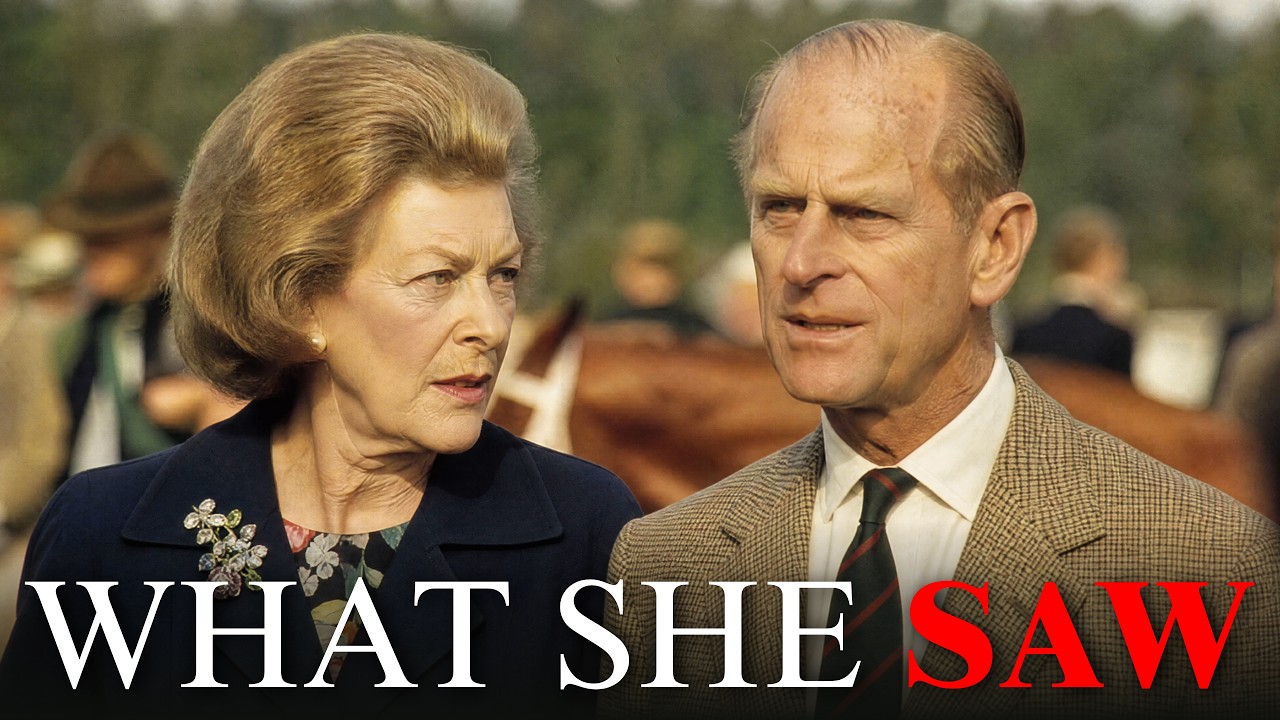
Lady Pamela Mountbatten had grown up beside Prince Philip in the same scattered, stateless royal family, and for 70 years she would watch him more closely than almost anyone alive. She knew the man the world laughed at, and she also knew the boy underneath. What she saw, she kept. She was born in Barcelona in the spring of 1929 into a family of fallen thrones and exiled princes.
Her father was Lord Louis Mountbatten, a naval officer with a bloodline running back through the royal houses of Germany, Russia, and Greece. Her mother was Edwina Ashley, one of the greatest heiresses in England, whose grandfather had left her a fortune counted among the largest in the country. Pamela was a great-great-granddaughter of Queen Victoria, a third cousin of the shy girl in London who would one day be Queen Elizabeth, and a first cousin of a boy called Philip, a prince of Greece and Denmark with even less of a country than she had. The family had given up its German name and titles during the First World War, taking the plain English name Mountbatten and setting about becoming more British than the British themselves.
By the time Pamela was a small child, at least four of the thrones her family was tied to by blood had already fallen or were about to. She was, in the plainest terms, born at the funeral of a whole class of people. What saved the Mountbattens was that they had done two things the fallen cousins had not: they had gone to sea and they had married money. Her father built a career in the Royal Navy that would carry him to its very summit, and her mother’s fortune gave the family solid ground beneath its feet.
So Pamela grew up on the safe side of a cliff edge, never once forgetting that the drop was there. Into that fortunate household again and again through her childhood came the boy from the poorest branch of all. Her cousin Philip had the grand name and the royal blood but none of the safety. His family had been expelled from Greece, and it was to the Mountbattens that he was sent for the things a child needs.
Pamela watched him arrive and leave all through the 1930s, not knowing she was watching the boy who would one day marry the future of England. The two Mountbatten daughters were raised by nannies and staff while their mother crossed the world in search of something she could not name. Edwina was a phenomenon of the age, beautiful, restless, and almost frightening in her modernity, traveling the globe and sometimes vanishing from her daughters’ lives for weeks on end. Pamela’s father belonged to the Navy, and the Navy took him where it pleased.
In place of parents came a world that would sound like pure invention if it were not so carefully recorded. There was the great country house, Broadlands in Hampshire, and the house in London. There were the animals, which mattered more to a lonely, clever girl than any grandeur could. Pamela’s great love was a dachshund named Lotty, whom she called the very center of her life.
There was also the day her mother came home from southern Africa bearing not affection but spectacle: a lion cub named Si. Pamela’s parents’ marriage had long since settled into an arrangement both understood completely. It was an open marriage in all but name, with each partner taking companions and allowing the other the same freedom. These were not hidden lovers skulking at the edges of the household; they became friends of the family, present at the dinner table.
When the war began in 1939, the two girls were sent to the United States for safety. Pamela spent part of those years among the American rich, staying with the Vanderbilt family on Fifth Avenue. But by the winter of 1941 she had come home to England, back into the war, because being frightened at home felt better than being safe among strangers. Home meant boarding school in Dorset, where the water froze in the glasses on the bedside tables overnight.
The heiress’s daughter was learning early that comfort could be taken away, that a family could be sent across an ocean at a day’s notice. A child who is often left to watch becomes very good at watching. Pamela grew up fluent in the manners and silences of a vanishing Europe, permanently valuable at the edge of the frame. She was always in the room and never in the picture.
Her cousin Philip began as the most rootless child in a family of rootless children. He was born a prince of Greece and Denmark in June 1921 on the island of Corfu, the fifth child and only son. He was little more than a year old when Greece lost a disastrous war and his father was arrested, tried, and banished for life. The family fled, and the infant Philip was carried down to a British warship in a cot fashioned from a fruit box.
He never had a country of his own again. What followed was an exile dressed up as childhood. His four elder sisters married German princes and vanished into Germany. His father drifted away to Monte Carlo for a life of cards and warm weather.
His mother, Princess Alice, suffered a severe breakdown and was taken to a sanatorium in Switzerland, removed from her children for years. By the age when most children are learning their multiplication tables, Philip had lost a throne, a country, a father, a mother, and four sisters. He was a prince with no kingdom, no parents in any daily sense, no home, and almost no money. It did not produce a broken man, Pamela always insisted; it produced a hard one and a proud one, a man who had decided very young that he would never let another living soul see that he needed anything at all.
At 14 he was sent to Gordonstoun, an austere school in the north of Scotland built on a creed of cold, discipline, and hardship. He took to it and excelled at it, becoming precisely the tough, capable, self-reliant young man the school existed to produce. He carried that toughness for the rest of his days like a suit of armor he had learned never to take off. The family that took him in more consistently than any other was the Mountbattens.
Lord Louis effectively took on the boy’s future as a personal project, steering him toward the Royal Navy. Philip took to the Navy as though made for it, winning a genuinely fine war record and being mentioned in dispatches. In the holidays, again and again, he came to Broadlands, into the very rooms where Pamela was growing up watching. She knew him not as a duke or a legend, but simply as the cousin who turned up, charming and quick and guarded, funny in a sharp and testing way, physically fearless, and armored against sympathy.
At 18, Pamela walked the corridors of the Viceroy’s House in New Delhi. It was 1947, and Britain was giving up India. The man sent out to lower the flag and hand over power was her own father, and she went with him. The palace was so vast it could take ten minutes to walk from her bedroom to the dining room, and the household kept some 25 gardeners employed for nothing but the flowers.
But she did not merely decorate the vice-regal round. She worked as an informal aide and co-secretary to her father inside the very offices where the maps were being drawn. She gave her hands as well to the human cost, helping in an overstretched clinic and dispensary. The division of India unleashed one of the largest and most terrible movements of human beings in recorded history.
Perhaps 15 million people were uprooted, and perhaps a million or more died in the violence. Pamela’s father stood at the center of it, praised by some for holding the ceremony of transfer together and blamed by others for the reckless haste of the timetable. Pamela was there at 18, inside the residence at the eye of the storm. She learned the hardest lesson closeness to power ever teaches: that the people who make history and the people who are crushed beneath it are sometimes only a single corridor apart, and that a person can love one and grieve for the others at the very same moment.
She also, in those months, learned to guard her mother’s greatest secret. Edwina Mountbatten and Jawaharlal Nehru, the brilliant nationalist who was about to become the first leader of a free India, formed a bond of extraordinary depth. Nehru himself described the pull between them as “the uncontrollable force. ” It was, on every serious account, one of the great loves of both their lives.
Pamela drew a single line with the care of a surgeon. Her mother and Nehru, she wrote, were deeply in love. But the relationship, she insisted, remained platonic. Two remarkable minds had met at the summit of enormous events and given each other something rarer than an affair.
In November 1947, Pamela watched her cousin marry the heir to the throne. She was there in the abbey, one of the young women chosen to attend the bride. The stateless prince of Greece had already renounced his titles, become a British subject, and taken the family name Mountbatten to make himself acceptable to the palace and the nation. The country saw a fairy tale.
Pamela, who knew the groom to his bones, saw a far more complicated thing: a proud, driven man of 26 walking with open eyes into a gilded cage he had chosen for himself. He would have every privilege and no purpose that was truly his own. A man who had commanded a fighting ship would find himself with no ship to command and nothing to do but stand a single deliberate pace behind. The sharpest wound did not fully reveal itself for years.
His children would not carry his surname. “I am nothing but a bloody amoeba,” he is recorded as saying, “the only man in the country not allowed to give his name to his own children. ”
And yet he had also gained something enormous. The boy carried out of Greece in a fruit box had married into the most secure family in Europe.
He had a country at last, homes that could never be taken away, and above all a wife who loved him steadily. The bargain took his freedom and gave him belonging. Pamela and Elizabeth had known each other since early childhood, third cousins separated by only about three years. Their friendship was the real article, the kind that begins before either party has anything to gain, and it would endure for more than 80 years.
When Elizabeth’s own household began to form around her, Pamela was drawn into it as a lady in waiting. A lady in waiting is not a servant; she is a companion of equal birth who attends a royal woman through the ordinary and extraordinary hours of her days. She sees the tiredness behind the wave, the grief before it has been composed into something the cameras may see, and she says nothing about any of it for the whole of her life. For Pamela, it was the natural culmination of everything her life had trained her to be.
When a great tour was planned to Kenya, Australia, and New Zealand, it was entirely natural that Pamela should go. She knew Elizabeth as a friend of a lifetime and Philip as a cousin of a lifetime. There was hardly another single person in the world who stood in that exact double relation to them both. The young couple left England on January 31, 1952.
The king himself came to the airport to see his daughter off, gravely ill and watching his heir fly to the far side of the world. It would be the last time he saw her. On the night the king died, his daughter was sitting in a treehouse in an African forest watching elephants at a water hole, and no one in the party knew. They had come up into the highlands of Kenya in the first week of February, and from a lodge called Treetops, built into the branches of an enormous fig tree above a forest clearing, they spent the night watching the great animals of Africa.
Elizabeth, 25 years old, sat up through part of that night with her camera, entirely herself, entirely private. She was in those hours the very last thing she would ever be allowed to be again: a daughter with a living father. Far away at Sandringham, in the small hours of February 6, the king’s heart stopped quietly in his sleep. He was 56 years old.
He died alone in the night, and for some hours not even his own household knew. While his daughter, who had become queen in the very same instant, sat in a tree in Kenya, photographing elephants at dawn, knowing nothing. The hunter guides at Treetops would say ever afterward that a princess had climbed up into the tree and a queen had climbed back down. Pamela herself gave that line its most memorable form: “She went up that ladder, a princess,” she said, “and came down a queen.
”
The most important message in the empire reached the forest and could not be read because no one had brought the right key. Secret telegrams encrypted in the careful manner of such things arrived in Kenya and simply stopped, because the cipher key that would have unlocked them had been left behind. The truth reached the party sideways, through ordinary human channels. Princess Elizabeth’s private secretary, Martin Charteris, learned from a journalist at a nearby hotel that the king had died, the word arriving before his own government’s secret cables could be read.
The world’s press already knew; only the new queen herself was held for a few more hours inside the very last quiet of her old life. The task of telling her fell to her husband. Philip went to her himself, took her up from her rest, and led her out of the lodge into the garden. There, walking slowly with her up and down the length of the lawn, alone, he told her.
No one heard the words, and no account records them. Pamela watched her two oldest connections in the whole world walk together out of the end of one life and into the beginning of another. When the walk ended, when Elizabeth at last turned back toward the house as queen, Pamela’s first instinct was warmth. She went straight to her friend and put her arms around her, giving her a hug.
Then, in almost the same motion, she caught herself, stepped back, and sank down into a deep curtsy. In that single sequence of two heartbeats, Pamela became one of the very first people on the face of the earth to kneel before Elizabeth II as her sovereign. Love coming first and duty following a hair behind it. Of the new queen in those first raw hours, Pamela’s verdict was plain: Elizabeth showed great control.
There were no scenes, no collapse. When an official asked the name by which she wished to reign, her reply echoed down the years: “My own name, of course. Elizabeth. ”
For Philip, the garden had held an entirely different revelation.
His wife had gained a throne; he had lost a life. From that single afternoon, he would walk two careful steps behind her for the whole of the rest of his days. Pamela watched him do the whole of it, and she never once forgot it. A year later, she followed the young couple around the world as they set out on a journey without precedent: a tour that carried them around the globe for close to six months, across something like 13 countries and territories.
It was the first time in history that a reigning monarch had circled the entire earth. The monarchy was reinventing itself before the world’s eyes, holding its scattered family of nations together no longer by power but by the simple sight of a young queen moving among them. It worked because Elizabeth was exactly suited to it, and because Philip, whatever it privately cost him, played his part flawlessly. The human cost was something Pamela was positioned to see.
The couple had two small children and left them behind for the better part of half a year. Pamela, who had grown up as precisely that kind of child, understood the exact shape of that deprivation better than anyone in the party. The frustration of Philip’s whole position became fully visible on that stage. Here was a decorated naval officer reduced to a role whose entire content was attendance.
Pamela saw the temper plainly enough, but she also saw exactly what sat beneath it. She saw a man who loved his wife steadily and completely, who had made a hard bargain with open eyes and fully meant to keep it. The world’s Philip, by the time he had reached old age, had hardened into a caricature: the gaffe machine, the tactless joke. Pamela spent the last decades of her own long life quietly insisting on the second portrait.
The rudeness the country found so offensive was not arrogance; it was armor forged in a childhood that had stripped a small boy of everything and taught him that the one unforgivable weakness was ever to be seen to need. The public saw coldness; Pamela saw deep and undemonstrative loyalty. The public saw a bully; Pamela saw the funniest man in the family, sharp and mischievous, genuinely warm to the people he actually trusted. She did not pretend he was an easy man, but she insisted the difficult surface was the smallest and least true part of him.
There was a coda to Philip’s story that Pamela witnessed from close range. In his mother’s final years, the tragic Princess Alice came to live under her son’s own roof, spending the final two years of her life quietly inside Buckingham Palace. Pamela observed that the queen was always marvelous with Princess Alice, and that Philip was “very busy down below carrying on the endless daily duties of his impossible role. ” A son abandoned by circumstance as a small boy had as a grown man brought his broken mother home to die in a palace.
At 30, Pamela married a man who cared nothing for thrones. In January 1960, at Romsey Abbey, she married David Nightingale Hicks, an interior designer who would become one of the most talked-about decorators of his generation. Princess Anne, aged nine, was among the bridesmaids. In marrying him, Pamela turned deliberately toward a life that was hers, a life of taste and family rather than duty and endless attendance.
Only a few short weeks after the wedding, her mother Edwina died suddenly while on official duty far away in North Borneo, worn out by the very humanitarian work she had thrown herself into. Pamela entered her new life already draped in mourning. The marriage lasted 38 years, until David Hicks died of lung cancer in the spring of 1998. It gave Pamela the one thing her own childhood had conspicuously lacked: a home that was steady and a family that was actually present in it.
On the morning of August 27, 1979, the axis of her entire life was blown out of the water off the coast of Ireland. Her father, Lord Mountbatten, now 79, had for many years kept a holiday home, Classiebawn Castle, on the coast of County Sligo. On that morning, a party from the family set out in a small wooden fishing boat, the Shadow V. The IRA had hidden a bomb aboard, and they detonated it in the calm water close by the little harbor of Mullaghmore.
Lord Mountbatten was killed outright. So too was one of his young grandsons, a boy of just 14. So was a local Irish boy of 15 who had been helping with the boat. And so, from her injuries, was the elderly mother of Pamela’s brother-in-law, a woman in her 84th year.
Pamela’s sister Patricia and her brother-in-law John were pulled from the water gravely hurt. Pamela’s own account of that day is one of the most harrowing things she ever set down. She was at the castle that morning. “I did not hear the explosion,” she said.
“My children heard it. ” Then came the last, simplest clause: “Nicky, the 14-year-old, and her father were dead. ”
The man who died in that water had been the fixed center of Pamela’s whole existence, the uncle who had gathered up the abandoned boy Philip and given him a home and a future, and the father who had taken her to India. He had been murdered on a family holiday as a cold and deliberate act in a long and bitter war.
One by one, the people who had stood in that Kenyan garden went on ahead of her until she was the only one left alive who still remembered it. Prince Philip died in the spring of 2021 at the age of 99. When Pamela wrote to her old friend after his death, Elizabeth wrote back. The single line she chose was one of the most quietly moving things in the entire record of that friendship: “Of course, you have known him longer than I.
”
The following year, the friend went as well. Queen Elizabeth II died in September 2022 after the longest reign in the history of the nation. Pamela, by then in her 93rd year, attended the state funeral alongside her daughter India. There in the great church, old and frail, she did once more the very thing she had first done on a lawn in Kenya in 1952: she curtsied.
She had become the oldest living descendant of Queen Victoria, the last one who remembered the accession from the inside, the last who had known Philip as a boy. She had outlived her entire generation of the story. She died on Friday, June 5, 2026, at the age of 97, peacefully. Her daughter India announced it, saying that although there was no tragedy in the death of a woman of 97 who had lived so full and long a life, her mother had kept right up to the last the impeccable style, sharp mind, and effortless charm that had made her the last of her kind.
With Pamela gone, the very last firsthand memory of that morning in the Kenyan hills died with her. There is no one now alive who saw it. There is only what she chose to write and what she chose to tell, the careful record she made in the full knowledge that a witness who does not speak leaves behind nothing at all but a locked and empty room. The hug and the curtsy in the garden are known to history at all only because she chose to record them.
The private Philip, the loyal and wounded man behind the public gruffness, was defended by the one person who had both the standing and the knowledge to defend him properly. None of it was inevitable. All of it might simply have vanished. It did not vanish because Pamela chose to speak.
The watcher at the very edge of the frame turned out to be nearly the most important person in the room, because she is the one who decides what the future will be allowed to know. She was always in the room and never in the picture. That was her chosen place, and she filled it faithfully for 70 years, until she alone was left of them all.